Executive Summary
The contemporary crisis of the United States is often described in insulting and simplistic language. Critics ask how one of the richest, most technologically advanced, and institutionally powerful nations in history could produce such widespread confusion, polarization, distrust, misinformation, and civic dysfunction.
The wrong answer is that Americans are inherently unintelligent.
The more serious answer is that modern American institutions have gradually created an environment in which obedience, consumption, specialization, credentialing, emotional reaction, and tribal loyalty are often rewarded more reliably than reflection, discernment, wisdom, or independent judgment.
This is not the product of a single conspiracy. No centralized authority designed every school, media company, political movement, corporation, religious institution, and digital platform according to one master plan. Rather, over two centuries, overlapping systems of industrial production, public education, political mobilization, commercial persuasion, ideological conflict, consumer debt, mass media, and digital technology evolved in ways that frequently weakened the intellectual and moral capacities required for democratic self-government.
The result is a profound contradiction.
The American constitutional tradition imagines the citizen as a rational, morally responsible, self-governing human being. Yet much of the contemporary political economy treats the same citizen as a consumer to be influenced, a worker to be managed, a voter to be activated, a data profile to be analyzed, and an attention stream to be monetized.
The crisis, therefore, is not simply one of education. It is a crisis in the relationship among power, purpose, future, and human identity.
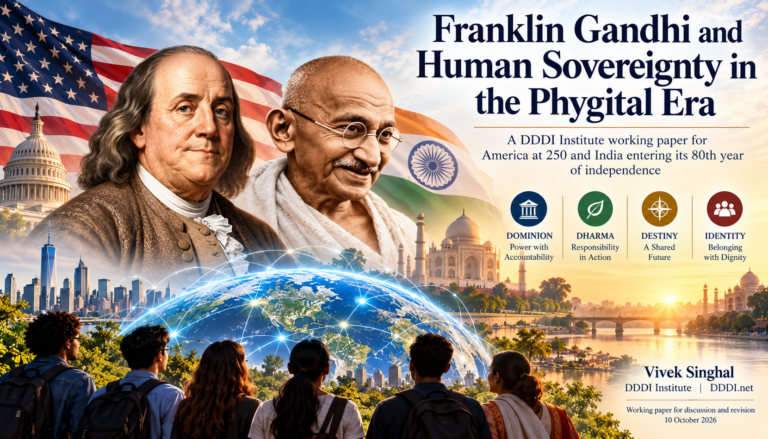
Using the Dominion–Dharma–Destiny–Identity framework developed by the Dominion, Dharma & Destiny Institute, this white paper argues that the United States has entered a civilizational transition in which traditional forms of political and economic control are being replaced by subtler forms of cognitive, emotional, financial, and algorithmic Dominion.
America’s future will depend on whether it can bring this expanding Dominion under the guidance of Dharma, consciously design its Destiny, and cultivate an Identity capable of sustaining freedom in the Phygital Era.
The central proposition of this paper is:
The American crisis is not fundamentally a shortage of intelligence. It is a misalignment between Dominion, Dharma, Destiny, and Identity.
The answer is not merely more information or more schooling. It is the renewal of critical consciousness, moral responsibility, civilizational memory, and self-governing agency.
I. The Deeper American Paradox
The United States was founded upon one of the most radical propositions in political history: ordinary human beings possess sufficient dignity, reason, and moral agency to govern themselves.
The Declaration of Independence did more than reject British rule. It articulated a new understanding of the human person. Human beings were not merely subjects of kings, dependents of aristocracies, or instruments of empire. They possessed rights that did not originate in government and could not legitimately be extinguished by government.
The American Experiment therefore rested upon a demanding assumption.
A republic of free citizens could endure only if those citizens possessed the judgment necessary to distinguish liberty from license, persuasion from manipulation, leadership from domination, and truth from convenient falsehood.
The challenge of self-government was always greater than the challenge of independence.
A people might overthrow an external ruler and still remain governed by fear, prejudice, appetite, propaganda, debt, dogma, faction, or ambition. Political sovereignty did not automatically produce psychological sovereignty.
This tension has followed the United States throughout its history.
America has produced world-leading universities, scientific breakthroughs, constitutional innovations, technological revolutions, entrepreneurial creativity, investigative journalism, and movements for abolition, civil rights, women’s rights, labor reform, religious freedom, and democratic inclusion.
At the same time, it has produced slavery, segregation, exclusion, economic exploitation, political hysteria, media manipulation, ideological conformity, consumer addiction, and recurring hostility toward intellectual complexity.
America is therefore neither simply a nation of enlightenment nor a nation of ignorance.
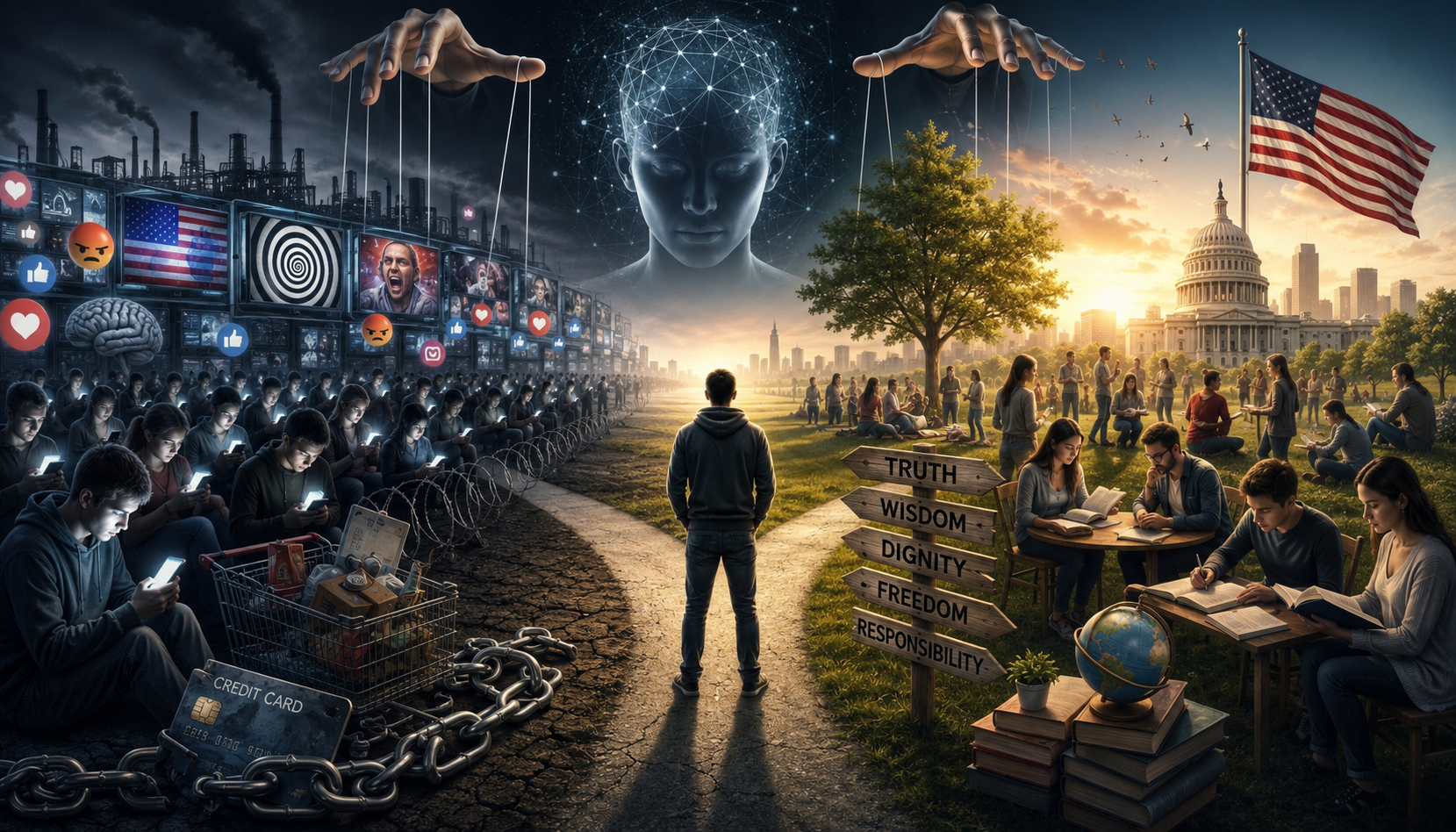
It is a civilization continually divided between two competing possibilities:
- the cultivation of the self-governing citizen; and
- the manufacture of the manageable population.
That struggle has entered a new phase.
In the Industrial Era, institutions sought to discipline bodies, synchronize labor, standardize behavior, and organize mass society.
In the Phygital Era, institutions increasingly seek to shape attention, emotion, perception, identity, and choice.
The locus of Dominion is moving inward.
II. What Is Engineered Ignorance?
The term “engineered ignorance” should not be understood as proof of a single intentional plot. It is better understood as an institutional condition.
Engineered ignorance emerges when the incentives of a society systematically make it easier to remain reactive, distracted, dependent, polarized, and poorly informed than to become reflective, discerning, and intellectually independent.
Such ignorance may be produced through:
- educational systems that reward memorization without understanding;
- workplaces that punish questioning while praising compliance;
- media systems that monetize outrage rather than accuracy;
- political organizations that reward loyalty rather than truth;
- religious movements that substitute certainty for inquiry;
- consumer systems that define freedom through purchasing power;
- debt structures that reduce time and psychological autonomy;
- digital platforms that amplify emotional extremity;
- cultural narratives that confuse confidence with competence;
- credentialing systems that mistake certification for wisdom.
The individual living within such a society may be highly capable in one narrow domain and deeply vulnerable in others.
An engineer may understand complex systems but possess little media literacy.
A physician may interpret medical evidence but remain trapped in ideological certainty.
A lawyer may reason with precision in court while consuming partisan misinformation at home.
A university graduate may accumulate credentials without learning how to examine assumptions.
A successful entrepreneur may confuse financial achievement with moral authority.
The problem is not low intelligence. It is fragmented intelligence.
Modern societies often produce specialists without citizens, consumers without philosophers, performers without self-knowledge, and voters without historical consciousness.
Engineered ignorance is therefore not the absence of knowledge. It is the inability to integrate knowledge into judgment.
III. Critical Thinking as a Democratic Capability
Critical thinking is frequently treated as a classroom skill, but its significance is civilizational.
It is the ability to examine claims, identify assumptions, assess evidence, recognize manipulation, compare explanations, tolerate ambiguity, and revise conclusions.
A critical thinker asks:
- What is being claimed?
- What evidence supports it?
- What evidence might contradict it?
- Who benefits if I believe it?
- What assumptions are hidden within it?
- What emotional reaction is being triggered?
- What alternative explanation is possible?
- What would cause me to change my mind?
These questions are essential not only for science or education but for democratic life.
A citizen unable to evaluate evidence is vulnerable to propaganda.
A citizen unable to recognize emotional manipulation is vulnerable to demagoguery.
A citizen unable to tolerate uncertainty is vulnerable to absolutism.
A citizen unable to admit error is vulnerable to tribal capture.
A citizen unable to distinguish disagreement from betrayal is vulnerable to authoritarian politics.
Critical thinking, however, is not sufficient by itself.
Intelligence without ethical orientation can become manipulation. Strategic reasoning without responsibility can become exploitation. Skepticism without humility can become cynicism. Deconstruction without purpose can dissolve trust without rebuilding anything in its place.
This is why DDDI places critical thinking within the larger framework of Dharma.
The essential question is not only whether human beings can think more effectively, but whether their thinking is aligned with truth, dignity, reciprocity, responsibility, and the well-being of the whole.
IV. Industrial-Era Education and the Manufacture of Conformity
Modern public education expanded literacy, widened opportunity, integrated immigrant populations, created civic identity, and prepared millions for participation in a modern economy.
These achievements should not be dismissed.
Yet the organizational structure of mass schooling also reflected the logic of the Industrial Era.
Students were separated by age, placed into standardized classrooms, moved according to bells and schedules, evaluated through uniform measurements, and trained to respond to centralized authority.
The system often rewarded:
- punctuality;
- compliance;
- repetition;
- standardized performance;
- deference to authority;
- competition for grades;
- adaptation to institutional expectations.
These qualities were useful in factories, armies, bureaucracies, and large corporations.
The central weakness was not that schools taught discipline. Discipline is necessary for achievement. The weakness was that discipline was often separated from inquiry, purpose, self-knowledge, moral reflection, and civic responsibility.
The implicit question of industrial education was:
Can the student perform the required task correctly?
The deeper question of human development is:
Can the student understand why the task matters, who designed it, whom it serves, what its consequences are, and whether it ought to be done?
When education becomes primarily a process of sorting, credentialing, and labor-market preparation, the student learns to pursue external validation.
Grades replace curiosity.
Credentials replace competence.
Testing replaces understanding.
Career advancement replaces vocation.
Institutional approval replaces independent judgment.
The student becomes skilled at navigating systems without learning how to evaluate the systems themselves.
This is one of the roots of engineered ignorance.
V. From Prussian Discipline to American Mass Society
Critiques of American schooling often invoke the influence of nineteenth-century Prussian education. This claim should be handled carefully.
American education was not simply imported wholesale from Prussia, nor was it created solely to produce obedient workers. Public schooling developed from many motives, including literacy, republican citizenship, religious instruction, social integration, economic development, and social reform.
Nevertheless, European models of centralized, graded, age-based, and standardized education influenced the development of American mass schooling.
The larger issue is not whether one country copied another. It is that industrial civilization required systems capable of organizing large populations.
Factories needed punctual workers.
Armies needed disciplined soldiers.
Bureaucracies needed rule-following clerks.
Corporations needed reliable employees.
Nation-states needed citizens with shared narratives.
Mass education became one of the central institutions through which modernity produced social order.
It expanded opportunity while also normalizing hierarchy.
It democratized literacy while standardizing thought.
It enabled social mobility while teaching conformity.
It created national identity while marginalizing alternative histories.
This dual character must be acknowledged.
The DDDI framework avoids the simplistic conclusion that education is either liberating or oppressive. Institutions can perform both functions simultaneously.
The proper question is:
Under what conditions does education cultivate capable citizens, and under what conditions does it merely produce efficient participants in systems they do not understand?
VI. Anti-Intellectualism and the American Character
American anti-intellectualism has deep roots, but it exists alongside an equally deep tradition of inquiry and invention.
The American experience elevated practicality, action, entrepreneurship, religious conviction, self-reliance, and suspicion of inherited authority. These qualities helped create a dynamic society.
Yet they could also produce impatience with complexity, contempt for expertise, and the belief that strong conviction is equivalent to knowledge.
The frontier celebrated action.
Commerce celebrated results.
Revivalist religion celebrated certainty.
Populism celebrated authenticity.
Mass politics celebrated emotional identification.
None of these tendencies is inherently destructive. Practicality can correct sterile theory. Entrepreneurship can liberate human creativity. Faith can generate moral courage. Populism can challenge unaccountable elites.
The problem begins when each becomes detached from self-criticism.
Practicality without reflection becomes short-termism.
Entrepreneurship without Dharma becomes extraction.
Faith without humility becomes dogmatism.
Populism without constitutional restraint becomes majoritarian domination.
Expertise without accountability becomes technocracy.
America has repeatedly oscillated between distrust of intellectual authority and overreliance on credentialed authority.
The challenge is not to choose between experts and ordinary citizens. It is to create a democratic culture in which expertise is respected but questioned, and popular judgment is honored but educated.
VII. The Red Scare and the Politics of Compelled Loyalty
Periods of national fear frequently narrow the boundaries of acceptable thought.
During the Cold War, anti-communism was not merely a foreign-policy doctrine. It became a cultural and political test of loyalty.
This did not eliminate critical thinking across American society. The period also produced major intellectual, scientific, artistic, and political achievements. Nevertheless, dissenting views could be treated as evidence of ideological disloyalty.
The deeper legacy was the normalization of a destructive sequence:
- classify the speaker before evaluating the argument;
- determine whether the speaker belongs to “us” or “them”;
- accept or reject the claim according to group identity;
- treat disagreement as evidence of moral or political corruption.
This structure did not disappear with the Cold War.
It reappears whenever criticism of a leader, party, nation, religion, corporation, movement, or social identity is treated as betrayal.
The result is compelled loyalty.
Compelled loyalty is one of the most powerful enemies of truth because it makes belonging conditional upon intellectual submission.
A free society cannot survive when citizens are required to choose between honesty and membership.
VIII. The Media Machine and the Commercialization of Attention
The rise of mass media transformed politics by making public attention a strategic resource.
Newspapers, radio, television, cable news, talk radio, digital platforms, podcasts, and social media each expanded access to information. They also created new opportunities for emotional manipulation.
The central transformation occurred when attention became measurable, purchasable, and monetizable.
In an attention economy, the most profitable content is not necessarily the most accurate or important. It is the content most likely to retain the audience.
Fear retains attention.
Outrage retains attention.
Humiliation retains attention.
Conflict retains attention.
Certainty retains attention.
Nuance is slower.
Context is less dramatic.
Ambiguity is harder to market.
Reconciliation generates less engagement than conflict.
Thus, media systems gradually learned to convert human emotion into revenue.
The citizen became a consumer of narratives.
The audience became a market segment.
The voter became a psychological profile.
The political opponent became a source of recurring content.
News became less a shared civic resource and more a personalized identity environment.
This transformation was intensified by digital platforms.
Traditional media institutions broadcast one message to many people. Digital systems can deliver different messages to different people, learn from their responses, and refine the emotional stimulus in real time.
Algorithmic systems do not need to convince everyone of the same proposition.
They need only identify which fear, grievance, aspiration, or identity is most likely to capture each individual.
This is a historically significant expansion of Dominion.
IX. Algorithmic Dominion in the Phygital Era
The Phygital Era merges physical existence with digital systems.
Human beings work, learn, shop, date, organize politically, receive medical advice, maintain relationships, consume entertainment, and form identities through digital interfaces.
These systems do not merely transmit information. They structure experience.
They determine:
- what appears first;
- what remains visible;
- what disappears;
- what is recommended;
- what is repeated;
- what is amplified;
- what is rewarded;
- what becomes socially real.
This is Algorithmic Dominion.
Algorithmic Dominion differs from earlier forms of control because it is often invisible, personalized, adaptive, and commercially embedded.
The user experiences the system as freedom.
The platform experiences the user as data.
The user believes he is choosing content.
The system is learning which version of the user is easiest to activate.
One person may be activated through fear.
Another through envy.
Another through anger.
Another through sexual desire.
Another through status anxiety.
Another through moral self-righteousness.
Another through political grievance.
The system does not require ideological consistency. It requires engagement.
This is Dominion without a visible sovereign.
No king issues a command.
No censor needs to ban a book.
No ministry must announce official truth.
The architecture of attention silently shapes the range of perception.
The individual is free to choose among options that have already been selected, ordered, and emotionally optimized.
The crisis of the Phygital Era is therefore not merely misinformation.
It is the gradual transfer of cognitive sovereignty from the human person to systems designed primarily for engagement, influence, and profit.
X. Debt, Healthcare, and the Material Conditions of Thought
Critical thinking requires more than education. It requires time, security, health, and psychological space.
A population burdened by debt, medical insecurity, unstable employment, rising housing costs, and constant economic pressure has less capacity for sustained civic reflection.
This does not mean poor or stressed people are incapable of thought. History contains countless examples of wisdom under hardship.
The point is structural.
When daily life is dominated by survival, attention becomes scarce.
When employment is insecure, dissent becomes costly.
When healthcare depends on work, independence is constrained.
When families are heavily indebted, risk tolerance declines.
When time is fragmented, long-form reflection disappears.
When citizens move from one emergency to another, politics becomes emotional triage.
Material insecurity therefore affects epistemic freedom.
A formally free person may still lack the conditions necessary to exercise meaningful agency.
The person may possess voting rights while having little time to study candidates.
The person may possess free speech while fearing professional retaliation.
The person may possess access to information while being too exhausted to evaluate it.
The person may possess consumer choice while lacking genuine control over the structures shaping life.
This is why the DDDI framework connects political liberty to economic, psychological, and cognitive conditions.
Freedom is not only the absence of external prohibition.
It is the presence of sufficient capacity to choose consciously.
XI. Epistemic Tribalism
One of the most dangerous outcomes of engineered ignorance is epistemic tribalism.
In epistemic tribalism, beliefs become inseparable from identity.
The individual no longer asks whether a claim is true.
The individual asks whether the claim belongs to the tribe.
Political affiliation becomes a complete moral worldview.
Media sources become markers of loyalty.
Facts become weapons.
Opponents become enemies.
Correction becomes humiliation.
Changing one’s mind becomes betrayal.
The result is a closed epistemic loop:
- the tribe identifies trustworthy sources;
- trusted sources affirm the tribe;
- contrary evidence is classified as hostile;
- hostility confirms the tribe’s narrative;
- rejection of outside evidence deepens belonging.
This system is self-sealing.
Attempts at persuasion may strengthen resistance because the individual experiences contrary evidence as an attack on identity.
Epistemic tribalism is not confined to one political party, social class, religion, race, or nation.
It can operate among conservatives and progressives, nationalists and globalists, religious believers and secular intellectuals, working-class populists and credentialed elites.
Every group is vulnerable when belonging becomes more important than truth.
The crisis becomes especially severe when citizens no longer share institutions capable of establishing common facts.
A democracy can survive disagreement over values.
It cannot survive indefinitely without some shared process for determining reality.
XII. The Export of American Dysfunction
The United States has enormous cultural reach.
Its films, universities, digital platforms, business models, political language, management theories, religious movements, lifestyle aspirations, and technological systems circulate across the world.
This influence has produced extraordinary benefits.
American culture has helped spread ideas of individual freedom, entrepreneurship, scientific inquiry, civil rights, freedom of expression, and democratic participation.
Yet America also exports its unresolved pathologies.
These include:
- hyper-individualism;
- consumer identity;
- self-branding;
- culture-war politics;
- algorithmic outrage;
- celebrity worship;
- prosperity theology;
- therapeutic narcissism;
- political polarization;
- attention addiction;
- simplified moral binaries.
Other societies may absorb American-style individualism without the constitutional traditions that once disciplined it.
They may absorb consumer freedom without civic responsibility.
They may absorb identity politics without pluralist institutions.
They may absorb digital platforms without regulatory capacity.
They may absorb prosperity theology without social solidarity.
They may absorb culture-war language that intensifies existing religious, ethnic, or national divisions.
America’s influence therefore creates a global paradox.
The country exports both liberation and fragmentation.
It exports tools of empowerment and mechanisms of manipulation.
It exports democratic aspiration and commercialized tribalism.
It exports technological abundance and psychological scarcity.
The world’s concern is not merely what America does within its borders. It is what American systems teach the rest of humanity to become.
XIII. The DDDI Framework
The Dominion–Dharma–Destiny–Identity framework offers a way to understand this crisis as a civilizational system rather than a collection of isolated failures.
Dominion
Dominion is the capacity to shape reality.
It includes political power but extends far beyond government.
Dominion determines:
- who controls resources;
- who sets institutional rules;
- who defines legitimate knowledge;
- who receives visibility;
- who designs technological systems;
- who benefits from economic arrangements;
- who controls narratives;
- who shapes public attention.
In the Industrial Era, Dominion was exercised through governments, corporations, factories, schools, armies, and mass media.
In the Phygital Era, Dominion increasingly operates through data, algorithms, platforms, networks, behavioral prediction, surveillance, and artificial intelligence.
The central DDDI question is:
Who possesses the power to shape human perception, and to what end is that power being used?
Dharma
Dharma is the ethical, relational, and civilizational principle that asks what power ought to serve.
Dharma is not merely religion.
It is the responsibility that arises from interdependence.
It asks whether institutions are aligned with:
- truth;
- dignity;
- justice;
- reciprocity;
- balance;
- responsibility;
- stewardship;
- long-term flourishing.
Dharma places limits on Dominion.
It converts power from domination into stewardship.
It asks not only whether something can be done, but whether it should be done.
In the context of education, Dharma asks whether learning produces responsible human beings.
In the context of media, Dharma asks whether freedom is being used to inform or manipulate.
In the context of technology, Dharma asks what kind of consciousness a system cultivates.
In the context of business, Dharma asks whether profit creates value for the whole or extracts value from the vulnerable.
Destiny
Destiny is the future generated by present choices.
It is not passive fate.
It is the accumulated result of institutional design, technological development, cultural habits, moral priorities, and human agency.
Destiny asks:
- What future is this system producing?
- What happens if this incentive structure continues?
- What kind of society emerges if this technology scales?
- What will the next generation inherit?
- Which possibilities are being opened or closed?
A civilization that refuses to design its Destiny will receive the future produced by its most powerful systems.
Identity
Identity concerns the kind of human being produced by institutions.
Every system creates habits of mind and character.
Schools create identities.
Markets create identities.
Religions create identities.
Political parties create identities.
Platforms create identities.
Families create identities.
The central question is:
What kind of person must exist for this system to continue functioning?
A consumer economy requires the consumer-self.
A polarized political system requires the partisan-self.
An attention economy requires the reactive-self.
A bureaucratic system requires the compliant-self.
A surveillance economy requires the datafied-self.
A democratic civilization requires something different: the conscious citizen-steward.
XIV. Dominion: The Evolution of Control
The history of modern America may be understood as a sequence of expanding forms of Dominion.
Industrial Dominion
Industrial Dominion organized bodies.
It synchronized labor, regulated time, standardized production, and concentrated authority.
The factory, school, army, and bureaucracy shared similar operating principles.
Ideological Dominion
Ideological Dominion organized loyalty.
It defined acceptable beliefs, identified enemies, and created moral boundaries between insiders and outsiders.
Commercial Dominion
Commercial Dominion organized desire.
Advertising, branding, consumer credit, and mass media connected identity to consumption.
Freedom became increasingly associated with purchasing power.
Financial Dominion
Financial Dominion organized dependence.
Debt, interest, credit scoring, housing costs, healthcare obligations, and retirement insecurity shaped personal choices.
Algorithmic Dominion
Algorithmic Dominion organizes attention, perception, emotion, and behavior.
It is more intimate than earlier forms of control because it learns continuously from the individual.
It becomes more effective as the user participates.
Narrative Dominion
Narrative Dominion determines how events are interpreted.
Political parties, media organizations, corporations, universities, movements, and influencers compete to define the meaning of reality.
The central danger is not that one institution possesses absolute control.
The danger is that the citizen is surrounded by systems competing for influence while lacking the tools to understand how those systems operate.
XV. Dharma: Reorienting Institutions Toward Human Flourishing
The critique of American ignorance is incomplete unless it offers a constructive alternative.
DDDI proposes that institutions must be redesigned around Dharma.
Dharmic Education
Dharmic education would integrate knowledge, inquiry, character, self-awareness, creativity, and civic responsibility.
Its purpose would not be merely to produce workers or credentialed professionals.
It would cultivate human beings capable of:
- thinking independently;
- acting responsibly;
- understanding systems;
- recognizing interdependence;
- evaluating evidence;
- engaging disagreement;
- resisting manipulation;
- serving the common good.
Dharmic education would teach students not only how to answer questions but how to question answers.
It would combine science with ethics, history with civilizational memory, technology with responsibility, and individual achievement with social obligation.
Dharmic Media
Dharmic media would not require state control or ideological uniformity.
It would require recognition that communication systems shape the moral and cognitive ecology of society.
Dharmic media would distinguish:
- information from provocation;
- persuasion from manipulation;
- disagreement from dehumanization;
- engagement from addiction;
- accountability from humiliation;
- freedom of speech from freedom from responsibility.
Dharmic Technology
Dharmic technology would evaluate success through more than growth, engagement, scale, or market value.
It would ask:
- Does this technology expand human agency?
- Does it strengthen or weaken attention?
- Does it promote truth or confusion?
- Does it encourage wisdom or compulsion?
- Does it distribute power or concentrate it?
- Does it serve humanity or merely monetize behavior?
Dharmic Capitalism
Dharmic capitalism would preserve innovation, enterprise, investment, competition, and wealth creation while rejecting the belief that shareholder gain is the only legitimate purpose of business.
It would recognize employees, customers, communities, ecosystems, future generations, and democratic institutions as stakeholders in value creation.
The central shift would be:
From extracting value from human vulnerability to creating value through human flourishing.
XVI. Identity: From the Managed Self to the Conscious Citizen
The institutions of modern America produce several incomplete identities.
The Obedient Performer
This person learns to satisfy institutional expectations but rarely questions their purpose.
Success is measured through approval, promotion, grades, and status.
The Consumer-Self
This person experiences identity through products, brands, lifestyles, and purchased experiences.
Desire becomes the organizing principle of life.
The Partisan-Self
This person derives belonging, morality, and meaning from political identification.
Opponents become existential threats.
The Credentialed-Self
This person equates formal education with wisdom and institutional status with authority.
The Therapeutic-Self
This person interprets all reality through personal emotion and may confuse discomfort with injustice or affirmation with truth.
The Influencer-Self
This person experiences existence as performance before an audience.
Visibility becomes a substitute for value.
The Datafied-Self
This person is continuously measured, predicted, scored, categorized, and monetized by digital systems.
The alternative is the conscious citizen-steward.
The citizen-steward is:
- free but responsible;
- individual yet relational;
- skeptical but not cynical;
- patriotic but not supremacist;
- spiritually grounded but not dogmatic;
- technologically capable but not algorithmically possessed;
- aware of rights and obligations;
- willing to dissent and willing to serve;
- capable of reflection, action, humility, and courage.
This Identity is essential for the future of democracy.
A republic cannot be sustained by consumers alone.
A civilization cannot be renewed by tribes alone.
A technological society cannot remain humane without self-aware stewards.
XVII. Destiny: Four Possible American Futures
The United States now faces several possible futures.
1. The Algorithmic Tribal Republic
Formal democratic institutions survive, but citizens increasingly inhabit incompatible realities.
Political participation becomes identity warfare.
Artificial intelligence generates personalized persuasion at unprecedented scale.
Elections continue, but public deliberation collapses.
2. Credentialed Technocracy
As public trust declines, decision-making shifts toward experts, courts, corporations, security institutions, and automated systems.
This may improve technical competence in some areas while deepening alienation and democratic resentment.
3. Populist Authoritarianism
A population exhausted by complexity seeks certainty, order, and national restoration through a powerful leader.
Dissent is portrayed as betrayal.
Institutions are subordinated to loyalty.
4. Dharmic Democratic Renewal
America rediscovers the deeper meaning of self-government.
Education cultivates judgment.
Technology strengthens human agency.
Media accepts responsibility for the ecology of consciousness.
Capitalism serves multiple stakeholders.
Citizens recover a shared constitutional Identity without erasing legitimate differences.
This fourth Destiny is possible, but it will not emerge automatically.
It must be consciously designed.
XVIII. The Declaration of Independence in the Phygital Era
The Declaration of Independence rests upon a particular image of the human being.
The human person possesses dignity, reason, moral agency, and rights.
Government derives legitimacy from consent.
Citizens are capable of judgment.
Power must be accountable.
These principles were never fully realized in 1776. Women, enslaved people, Native peoples, and many others were excluded from the promise.
Yet the universal language of the Declaration created a standard by which America could be challenged and expanded.
The contradiction of the Phygital Era is different but equally significant.
The constitutional order describes human beings as sovereign citizens.
The digital economy treats them as predictable behavioral assets.
The Declaration imagines consent.
Platforms manufacture preference.
The Declaration imagines reason.
Media systems monetize reaction.
The Declaration imagines self-government.
Algorithms increasingly shape the self that governs.
The next phase of the American Experiment must therefore extend the meaning of liberty.
In 1776, liberty meant freedom from external political Dominion.
In the Phygital Era, liberty must also mean freedom from invisible cognitive Dominion.
This does not require freedom from influence. No human being exists outside influence.
It requires transparency, agency, education, accountability, and the capacity to understand the systems shaping one’s choices.
The new frontier of freedom is cognitive sovereignty.
XIX. A DDDI Agenda for Democratic Renewal
A foundational renewal of the American Experiment requires action across institutions.
1. Redesign Education Around Judgment
Schools should teach logic, media literacy, systems thinking, statistics, philosophy, history, ethics, civilizational dialogue, and contemplative self-awareness.
Students should learn how institutions work, how incentives shape behavior, and how narratives influence identity.
2. Create an Ethics of Attention
Attention should be treated as a human and civic resource.
Technology companies, educators, families, and policymakers should recognize that continuous distraction weakens autonomy.
3. Establish Algorithmic Accountability
Citizens should have meaningful knowledge of how recommendation, ranking, targeting, and behavioral prediction systems affect their information environment.
4. Rebuild Shared Civic Spaces
Democracy requires institutions where citizens encounter disagreement without dehumanization.
Libraries, schools, local associations, civic groups, faith communities, and public forums can help rebuild trust.
5. Restore Time for Citizenship
Economic policies should recognize that exhausted and precarious populations cannot easily sustain democratic participation.
6. Reframe Business Purpose
Corporations should move from narrow shareholder primacy toward stakeholder value creation and social responsibility.
7. Cultivate Civilizational Memory
Citizens should understand both the achievements and failures of the American Experiment.
Patriotism should not require historical amnesia.
Criticism should not require national contempt.
8. Connect Rights with Responsibilities
A mature democratic culture must unite liberty with duty, individuality with relationship, and sovereignty with stewardship.
9. Develop Human-Centered Artificial Intelligence
AI should expand judgment rather than replace it, strengthen agency rather than manipulate it, and democratize knowledge rather than concentrate control.
10. Build a Conscious Citizen Identity
The ultimate goal is not simply institutional reform but human transformation.
No democratic system can remain healthy if citizens are governed primarily by fear, vanity, resentment, addiction, and tribal loyalty.
XX. The Next Great Awakening
American history has repeatedly been transformed by awakenings.
Religious awakenings challenged established authority.
The abolitionist movement challenged slavery.
The Progressive Era challenged industrial abuse.
The civil-rights movement challenged racial hierarchy.
The environmental movement challenged the assumption that economic growth had no ecological limits.
The next Great Awakening must be an awakening of consciousness.
It must help citizens recognize the systems shaping their perception.
It must restore the connection between freedom and self-mastery.
It must teach that rights without responsibility become entitlement.
It must teach that technology without Dharma becomes domination.
It must teach that intelligence without wisdom becomes dangerous.
It must teach that identity without relationship becomes narcissism.
It must teach that democracy without truth becomes theater.
This awakening cannot belong exclusively to the political left or right.
The left must confront the danger of ideological conformity, identity absolutism, credentialed arrogance, and institutional overreach.
The right must confront the danger of anti-intellectualism, conspiratorial politics, authoritarian temptation, and the commercialization of grievance.
Elites must confront their failures of accountability.
Populists must confront the dangers of resentment without responsibility.
Corporations must confront the human consequences of their business models.
Citizens must confront their own participation in systems they criticize.
The renewal must therefore be civilizational rather than partisan.
XXI. From Dominion Without Dharma to Dominion Guided by Dharma
Dominion is unavoidable.
Every society organizes power.
Every institution shapes behavior.
Every technology alters possibility.
Every culture defines norms.
The question is not whether Dominion will exist.
The question is whether Dominion will be conscious, accountable, transparent, and guided by Dharma.
Dominion without Dharma produces conquest, extraction, manipulation, and fragmentation.
Dharma without Dominion may possess moral aspiration but lack the capacity to act.
The future requires their integration.
Power must be capable.
Purpose must be ethical.
Destiny must be designed.
Identity must be conscious.
This is the central work of DDDI.
The challenge is not to eliminate power but to transform its purpose.
The challenge is not to reject technology but to align it with human flourishing.
The challenge is not to destroy markets but to expand the meaning of value.
The challenge is not to erase identity but to deepen it beyond tribe.
The challenge is not to abandon America but to help the American Experiment fulfill its own highest promise.
Conclusion
The question “How did Americans become so dumb?” is emotionally satisfying but intellectually inadequate.
It insults citizens while leaving institutions unexamined.
It turns a civilizational problem into a national stereotype.
It overlooks the achievements, resistance movements, intellectual traditions, and democratic capacities that continue to exist within the United States.
The deeper problem is not stupidity.
It is the systematic weakening of the conditions required for judgment.
It is the replacement of education by credentialing, citizenship by consumption, dialogue by performance, truth by tribal loyalty, and attention by algorithmic capture.
The American Experiment now confronts a contradiction between its constitutional ideals and its institutional operating systems.
It continues to proclaim the sovereignty of the citizen while permitting increasingly sophisticated systems to shape the citizen’s desires, fears, perceptions, and identity.
The future of America will depend on whether it can resolve this contradiction.
The task is not merely to make Americans better informed.
It is to cultivate human beings who are less governable by fear, resentment, vanity, addiction, manipulation, and tribal identity—and more capable of governing themselves.
This requires a movement:
From engineered obedience to conscious agency.
From fragmented knowledge to integrated wisdom.
From attention extraction to attention stewardship.
From algorithmic Dominion to digital Dharma.
From inherited conditioning to consciously chosen Identity.
From accidental futures to consciously designed Destiny.
America is not inherently engineered to fail.
It is being tested.
The question is whether the civilization that helped institutionalize modern freedom can now develop the consciousness required to preserve freedom in the Phygital Era.
That is the next frontier of the American Experiment.
That is the work of the Dominion, Dharma & Destiny Institute.
And that is the civilizational journey from Dominion without Dharma toward Dominion guided by Dharma in service of humanity and the whole.