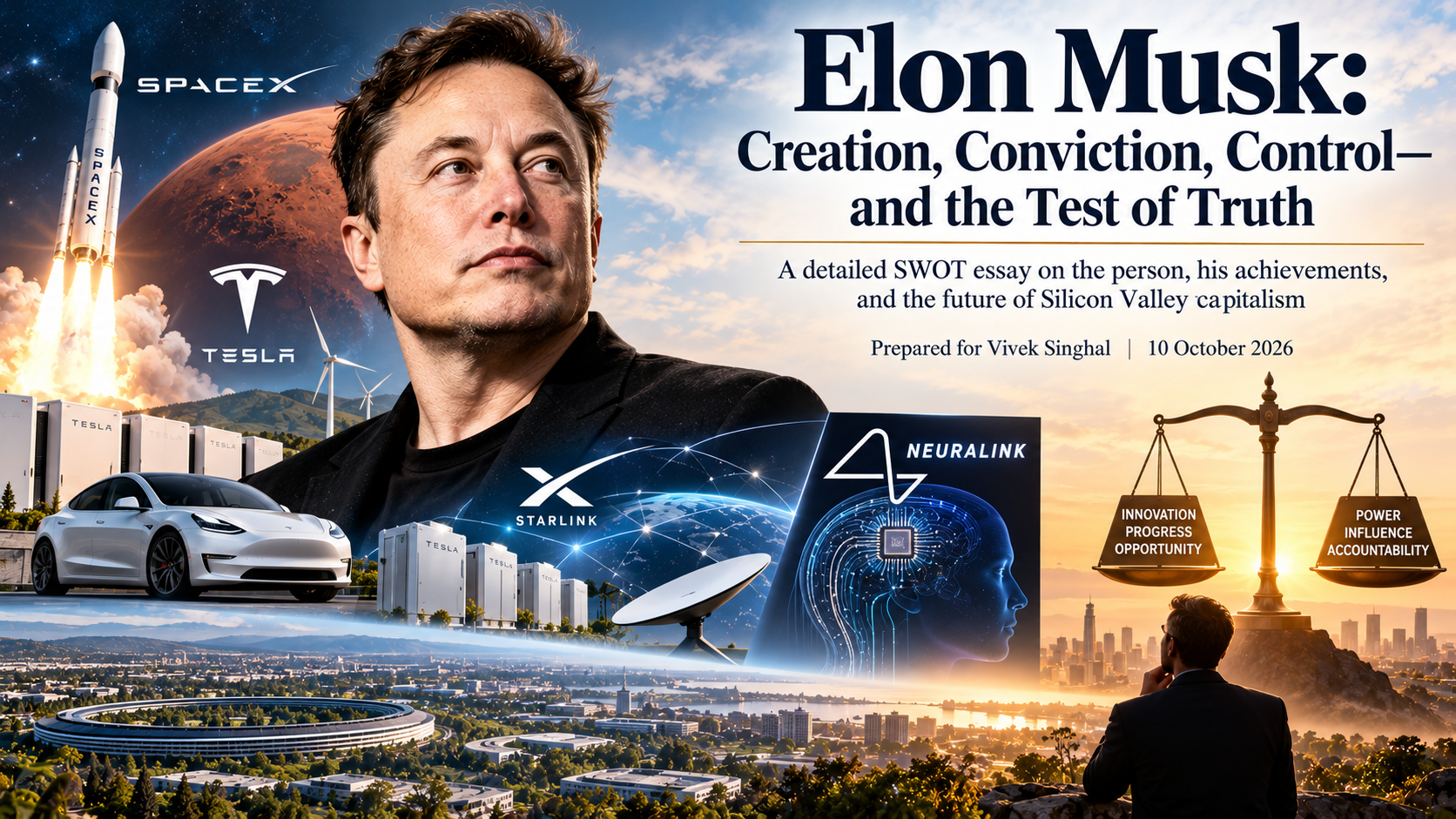
A detailed SWOT essay on the person, his achievements, and the future of Silicon Valley capitalism
Prepared for Vivek Singhal | 10 October 2026
Elon Musk presents a difficult test of judgment because the evidence resists a single verdict. He has helped build enterprises that perform genuinely difficult tasks. He has also accumulated a degree of economic and infrastructural influence that demands scrutiny independent of admiration for those achievements. The relevant question is not whether he deserves an uncomplicated label—genius, fraud, savior, or villain. It is how to distinguish what he has demonstrably created, what he promises, what markets reward, and what society should permit any individual to control.
The central argument of this essay is that Musk is an exceptional mobilizer of engineering, people, capital, and public imagination. His greatest accomplishments emerge from combining those resources into functioning systems. His greatest danger is the possibility that success in building such systems becomes a claim to authority over people and institutions without adequate accountability. This is an interpretation of his public record, not a diagnosis or an assertion that an outsider can know his private motives.
Forbes’s real-time profile displayed an estimated net worth of $1.004 trillion on 10 October 2026. Calling Musk a trillionaire is therefore supported by that dated estimate. It is not a permanent status or a trillion dollars in spendable cash: it is principally a valuation of ownership interests, sensitive to markets and estimation methods. Wealth measures the financial value attributed to his claims on businesses; it does not directly measure his personal invention, moral worth, or contribution to human flourishing. [1]
What the documentary contributes—and where to see it
Alex Gibney’s documentary Musk is a critical examination of the relationship between Musk’s public legend and his power. Bleecker Street’s official listing identifies Gibney as director and gives a limited theatrical opening on 9 October 2026, followed by nationwide U.S. release on 16 October. The film is approximately four hours long. [2–3]
In his 9 October interview with Christiane Amanpour, Gibney argues that Musk has exploited weaknesses in political and economic institutions and asks whether his expanding power remains attached to a coherent purpose. Those are the filmmaker’s interpretations. They should be assessed alongside evidence of delivered products, original records, and Musk’s own stated aims. A documentary can expose neglected evidence and ask powerful questions without becoming the final authority on its subject. [3]
Reuters reports that Musk declined to participate and criticized the film, while Gibney describes it as an invitation to reconsider the power of technology oligarchs. This disagreement matters: viewers should distinguish archival evidence from an interviewee’s allegation, the director’s interpretation, and dramatized presentation. An animated representation of Musk is not a new interview with him. [4]
Official film page and trailer: https://bleeckerstreetmedia.com/musk
Official theater finder: https://bleeckerstreetmedia.com/editorial/find-theaters-musk
For home viewing, HBO acquired North American television and streaming rights, but a rights acquisition does not mean the film is already streaming. No confirmed home-streaming release date was established for this essay. Use the official film page for release updates. [2, 5]
What has Musk actually created?
Credit should distinguish founding, financing, engineering leadership, organizational execution, and acquisition. These are different contributions; all can matter. Treating Musk as the sole inventor of everything sold by his companies erases collective work. Treating him as merely a financier also overlooks the strategic decisions and organizational persistence required to bring difficult products into existence.
His earlier ventures included Zip2 and the online-finance business X.com, which merged with Confinity in the development of PayPal. These ventures helped establish his capital and entrepreneurial network. They did not make him the inventor of the internet or digital payments. His subsequent record is best evaluated enterprise by enterprise. [6–7]
| Enterprise or initiative | Musk’s role and demonstrated contribution | Limit on the claim |
| SpaceX | Founder and leader of an organization that developed Falcon launch vehicles and Dragon spacecraft, achieved first-stage landing and reuse, and transported cargo and astronauts. | Rockets, spaceflight, and reusability predate SpaceX. Credit belongs to engineering teams and public-private partners as well as Musk. [8–10] |
| Tesla | Early lead investor and chairman from 2004; CEO from 2008. Helped build and scale a consequential electric-vehicle enterprise. | Martin Eberhard and Marc Tarpenning incorporated Tesla in 2003. A later settlement recognized five co-founders, including Musk. He did not invent the electric car. [7, 11] |
| Tesla energy and charging | Helped extend the business into batteries, energy storage, and an integrated charging ecosystem. | Batteries, photovoltaics, and charging technologies have extensive prior histories. Integration and deployment are the relevant achievements. [6, 12] |
| Starlink | Built within SpaceX: an operating low-Earth-orbit broadband system with large-scale satellite and terminal production. | Satellite communications and satellite internet already existed. Scale, integration, and practical service are the stronger claims. [13] |
| Neuralink | Co-founder of a company developing implantable interfaces, with human participants using neural signals to control computers. | Neuralink did not originate brain-computer interfaces. Experimental function is not proof of general clinical effectiveness or a merger of human consciousness with AI. [14–15] |
| The Boring Company | Founder of an enterprise with operating passenger tunnels in Las Vegas. | Operating tunnels establish a real project, not proof that urban congestion has been solved. Approved expansion is not completed infrastructure. [16] |
| Twitter/X | Acquired an existing social network and changed its ownership, organization, and product direction. | Acquisition and transformation are not original invention of the platform. [1] |
| OpenAI | Founding co-chair in 2015; subsequently left the board in 2018. | Helping establish an institution does not confer personal authorship of all its later products, including ChatGPT. [17] |
| xAI/Grok | Established an AI venture that produced deployed generative-AI systems and substantial computing infrastructure. | It entered an established research and product category. Capability must be assessed through evidence rather than the founder’s truth-seeking claims. [18] |
This inventory reveals a substantial record. It also makes a counterfactual question unavoidable: would these outcomes have happened without Musk? Precise answers are impossible. His decisions plausibly accelerated particular trajectories, while alternative firms, scientists, and public programs also pursued them. “He mattered greatly” is defensible without claiming that history had only one possible creator.
Which achievements are genuinely “zero to one”?
Peter Thiel and Blake Masters use “zero to one” to distinguish creating something new from reproducing what already exists. For evaluating Musk, the phrase needs more precision. A scientific discovery, a new engineering architecture, a commercially viable system, and mass adoption are separate accomplishments. No technology comes literally from nothing. [19]
A useful test asks whether a project establishes a previously unavailable capability, whether that capability functions repeatedly, and whether the claimed novelty belongs to Musk’s enterprise rather than to an earlier scientific tradition. Under this test, Musk’s strongest candidates are often systems innovations rather than first discoveries.
Falcon 9 offers his strongest demonstrated case. SpaceX did not invent the reusable spacecraft: the Space Shuttle alone prevents that claim. The relevant accomplishment is repeated recovery and reflight of orbital-launch first stages within an operating commercial launch system. SpaceX records its successful land landing in 2015, droneship landing in 2016, and first Falcon 9 reflight in 2017. The transition from an expendable stage to a repeatedly usable productive asset changes the operating logic of launch. Exact savings still depend on refurbishment, utilization, engineering choices, and accounting; reusability is not identical to zero cost. [8]
Starlink is another strong case at the system level. The novelty lies in combining a very large constellation, mass manufacturing, user terminals, and launch capacity into a practical broadband service. Its significance is not that nobody previously sent data through satellites. It is that a particular combination can make useful connectivity available in places and circumstances that terrestrial networks serve poorly. Its value must still be weighed against affordability, congestion, orbital management, and the concentration of control. [13]
Tesla’s case is different. Electric propulsion had a long history before the company. Tesla’s importance lies in making an integrated electric-car proposition compelling: vehicle performance, battery management, software, charging, design, and manufacturing. This is architectural and market innovation. The DOE’s history of electric vehicles makes the historical antecedents clear; Musk’s 2006 master plan documents a strategy of starting at the expensive end and working toward broader affordability. Whether every affordability promise was fulfilled is a separate test from whether the strategy changed industry expectations. [12, 20]
Neuralink deserves attention as a potential advance in usability and deployment, not as the birth of its scientific field. BrainGate records human intracortical control of a cursor and other devices in 2006. Neuralink’s own reporting describes useful human computer control as well as early technical difficulties, including implant-thread retraction. That combination is how experimental progress should be understood: consequential possibilities, observed performance, and unresolved limitations. A life-changing benefit for a participant need not be a civilization-wide first to be valuable. [14–15]
Grok, Loop tunnels, and the acquisition of Twitter do not yet justify blanket claims to entirely new categories. Likewise, Mars settlement, universally capable household robots, and broadly available autonomous transport must be credited only to the extent independently demonstrated. Tesla’s current consumer FSD documentation explicitly requires active driver supervision. That statement concerns the consumer product; it should not be carelessly extrapolated to every separate trial or service. [16, 18, 21]
The judgment is therefore selective: Falcon 9’s operating model and Starlink’s integrated service are especially strong “zero to one” candidates; Tesla is a major systems-and-market transformation; the remaining ventures deserve individual assessment. Scaling an existing idea can create immense social value. The label “zero to one” should illuminate the kind of achievement, not become a competition for personal glory.
What is his “TRUTH”?
There is an important difference between Musk’s stated truth, the truth of his accomplishments, and the truth of his character. The first can be read in his public statements. The second can be tested against operating records. The third remains partly inaccessible, even to an extensive biography or documentary.
His stated missions have included accelerating sustainable energy, extending human life beyond Earth, and developing AI to understand the universe. These are not interchangeable slogans: each implies different priorities, costs, and obligations. Their sincerity cannot be conclusively inferred from either achievement or contradiction. Public commitments instead allow us to ask whether decisions remain consistent with the mission claimed. [8, 12, 18]
At the level of ontology—what kind of world he appears to assume—Musk’s public projects suggest a world whose constraints can be reorganized through engineering. Energy, transport, communications, and aspects of biological limitation become technical challenges. This orientation can liberate imagination from habitual pessimism. It can also underweight realities that cannot be resolved by optimizing a machine: legitimacy, consent, plural values, and obligations to people who reject the designer’s preferred future.
At the level of epistemology—how we know what is true—engineering succeeds through a demanding loop: hypothesis, construction, measurement, failure, correction. A successful launch supplies evidence for a bounded technical claim. It does not validate every political opinion of the launch company’s leader. Nor does a rising share price demonstrate that a promised capability exists. Physics, investor expectations, and democratic legitimacy answer different questions.
This distinction becomes concrete in the 2018 SEC settlement concerning Musk’s “funding secured” statements about taking Tesla private. Musk and Tesla each agreed to a $20 million penalty; Musk stepped down as chairman, and governance and communications controls were required. The settlement was reached without admitting or denying the allegations. It provides a documented example of the need to distinguish persuasive assertion from substantiated disclosure, without turning an enforcement settlement into a criminal conviction or a judgment on every Musk enterprise. [22]
My interpretation is that Musk’s public career repeatedly expresses a conviction that a sufficiently determined actor can force progress through obstacles others accept. The unresolved issue is whether resistance is treated as information or as disloyalty. Scientific truth requires the possibility that the leader is wrong. Human truth also requires recognizing that other people are subjects with their own ends, rather than inputs to one person’s mission.
The fairest answer to “What is his truth?” is thus provisional: Musk’s work demonstrates the creative force of extraordinary conviction. His record also demonstrates why conviction cannot serve as its own evidence. The deepest test is his willingness to accept correction, share credit, and submit consequential power to rules that apply even when he disagrees.
Strengths: the capabilities that make him effective
First, Musk joins an ambitious destination to concrete productive organizations. Many people imagine electric transport or space settlement; fewer assemble businesses that build hardware, recruit specialists, raise capital, and persist through testing. The demonstrated record supports recognizing an unusually effective capacity to mobilize, even when individual projects fall short of their largest claims.
Second, he is skilled at connecting complementary systems. Vehicles need charging; renewable electricity benefits from storage; satellite networks need affordable launch. Thinking across these boundaries can overcome failures that occur when every organization optimizes only its own component. The strategic lesson is to identify the whole working system, including its bottlenecks.
Third, his public missions create a powerful recruitment proposition. A difficult job can acquire meaning when attached to a consequential goal. This is an analytical inference from the scale and range of the enterprises he has assembled, not a claim that all employees share the same motivation or experience.
Fourth, he converts attention into an organizational resource. Visibility can attract customers, investors, and collaborators. Yet attention is most productive when attached to verified delivery; otherwise it becomes a liability that must continually be sustained by larger promises.
Fifth, his record shows willingness to pursue expensive physical projects. Spacecraft, automobiles, factories, and tunnels demand more than a compelling software demonstration. This contribution matters in a culture where financially attractive opportunities do not always coincide with difficult infrastructure needs.
These strengths are complementary. Ambition without execution is fantasy; execution without capital is constrained; capital without a useful mission can be wasteful. Musk’s distinctive capacity has been to bring these ingredients together often enough to produce consequential results.
Weaknesses: the vulnerabilities within his leadership model
The first weakness is excessive dependence on one person. If strategic direction, public reputation, capital access, and internal authority all revolve around a founder, that founder becomes an organizational point of failure. Succession and independent judgment are not signs of insufficient loyalty; they are requirements for durability.
Second, the boundary between aspiration and delivery can become blurred. A prototype, a supervised product, a limited deployment, and a universally reliable capability require different evidence. Tesla’s consumer FSD disclosure illustrates why product names and ambitious narratives must be checked against operating conditions. [21]
Third, multiple simultaneous missions create an attention-allocation problem. Delegation can solve part of it, but publicity does not eliminate the finite time available for difficult decisions. The relevant measure is whether each organization has competent authority and accountability beyond Musk himself.
Fourth, founder-centered storytelling can misallocate credit. Tesla’s origins show why historical precision matters. Acknowledging Eberhard, Tarpenning, Straubel, and other contributors does not diminish Musk’s later role; it identifies the collective process on which future performance depends. [7, 11]
Fifth, public controversy can become entangled with product identity. A customer may evaluate a car, network, or AI service partly through the founder’s conduct. The strategic risk is straightforward even without assuming a particular sales effect: a highly personalized brand transmits the leader’s disputes across otherwise distinct businesses.
Finally, technical competence can be overextended into domains requiring different forms of knowledge. Designing a rocket and governing a community both involve complex systems, but people possess rights and conflicting purposes. Organizational speed is not a substitute for political legitimacy.
Opportunities: how his capabilities could create wider benefit
The largest opportunity is to convert breakthroughs into durable public usefulness. Affordable storage and reliable electric transport can matter more to daily life than another dramatic product announcement. Connectivity can expand education and economic opportunity where coverage is weak. Assistive interfaces can increase independence for people with severe disabilities. These are applications to test and improve, not benefits automatically guaranteed by ownership or invention.
A second opportunity is institutional innovation. Musk could help establish models of founder leadership that remain ambitious while welcoming independent safety assessment, meaningful board oversight, clear disclosures, and credible succession. These mechanisms can protect a mission from the founder’s own errors.
A third opportunity is trust. An organization that systematically publishes the conditions under which a product succeeds or fails can make honesty a competitive advantage. For AI, autonomy, and medical technology, such transparency is particularly consequential because users may not be able to inspect the underlying system themselves.
A fourth opportunity is to broaden the distribution of gains. Skills development, employee participation, accessible pricing, and public procurement terms that protect the public interest can help align private rewards with shared value. These are proposals, not claims about Musk’s current policies.
A fifth opportunity is to use extraordinary influence to preserve competition and open access. Interoperability and reliable rules can create confidence among customers and governments that a useful service will not become an arbitrary instrument of dependence.
Threats: the external forces that could undermine the model
Competition is the first threat. Other vehicle manufacturers, launch providers, communications systems, and AI developers can narrow technological advantages. Stanford’s 2026 AI Index documents a competitive frontier populated by several leading developers. Success in one arena does not guarantee permanent leadership in another. [23]
Capital expectations are a second threat. When valuations incorporate very ambitious future results, operational progress can coexist with investor disappointment. A share price can fall even when a company improves, if improvement falls short of expectations. Musk’s net worth is consequently an unstable measure of his underlying contribution.
Third, globally important infrastructure creates geopolitical exposure. Countries may seek alternatives, impose local requirements, or scrutinize dependence on a foreign private provider. Such responses are not always hostility to innovation; they can reflect sovereignty and resilience concerns. For a cross-border enterprise, political legitimacy becomes part of long-term viability.
Fourth, safety failures and environmental costs can interrupt otherwise promising development. A credible strategy must budget for testing, remediation, and external effects. Treating every safeguard as friction risks turning preventable harm into lost trust and more restrictive intervention.
Fifth, the convergence of private infrastructure and public authority can provoke conflict-of-interest concerns. The more indispensable a company becomes, the stronger the need for decisions that remain reviewable, lawful, and resilient to changes in personal relationships.
These threats interact with the weaknesses. Competitive pressure can encourage bigger promises; financing pressure can encourage political dependence; criticism can encourage tighter personal control. The strategic response should break these feedback loops through verification and institutional discipline.
Has Silicon Valley capitalism survived—and can it remain legitimate?
It has plainly survived as a mechanism for attracting capital and building companies. Stanford’s 2026 AI Index reports that global corporate AI investment more than doubled in 2025, reaching approximately $581.7 billion. That demonstrates financial activity, not proof that every investment will earn a return or deliver social value. [24]
“Silicon Valley capitalism” is most useful here as a description of a model, rather than a postal address: entrepreneurial experimentation, venture finance, employee equity, rapid scaling, and unusually powerful founders. Musk represents an extension of that model into capital-intensive infrastructure. The model can remain financially vigorous while its political legitimacy deteriorates.
The important distinction is between productive success and legitimate power. A company may create a valuable product while imposing costs on others. A founder may deserve substantial rewards without acquiring the authority to determine public priorities. Markets are powerful discovery mechanisms, but willingness to pay does not exhaust the meaning of human need.
Musk’s history also undermines the simple opposition between private enterprise and government. NASA’s COTS history records $396 million in public milestone payments to SpaceX alongside approximately $454 million in company financing. The DOE provided Tesla a $465 million loan, which was repaid in full in May 2013. These are different arrangements—public development partnership and repayable lending—not interchangeable forms of subsidy. They demonstrate interdependence rather than either a purely self-made corporation or an achievement produced by government alone. [10, 25]
The enduring question is how public risk and private reward should be governed. Sensible rules would encourage entry, maintain procurement competition where feasible, protect workers and consumers, price external costs, and distinguish independent oversight from politically selective punishment. Founder ambition and constitutional government need not be enemies. Their relationship becomes dangerous when exceptional business performance is treated as an exemption from ordinary accountability.
Three futures remain possible. The model could renew itself through competition and verifiable public value. It could drift toward concentrated infrastructure ownership allied with political patronage. Or a severe loss of trust could produce financial reversals and blunt regulation that also discourages useful experimentation. These are scenarios, not predictions. The choices of founders, investors, citizens, and public institutions will influence which becomes more likely.
A DDDI reading: from exceptional capability to responsible stewardship
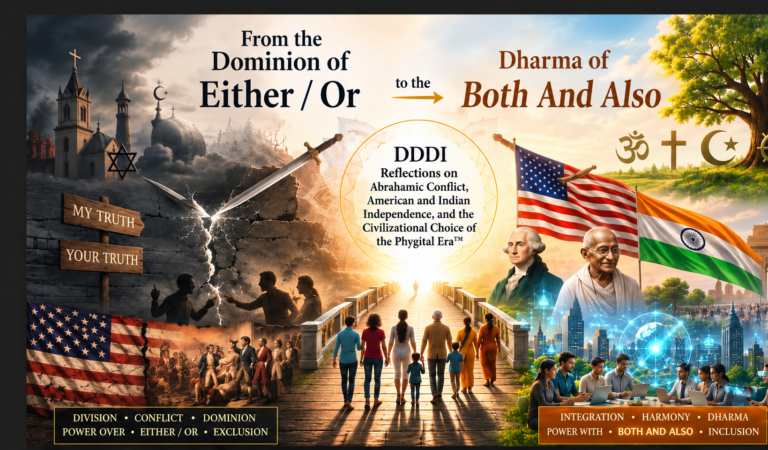
Within the Dominion–Dharma–Destiny–Identity framing, Musk’s record raises four distinct questions. Dominion asks what resources and dependencies he controls. Dharma asks what responsibilities accompany that control. Destiny asks which possible futures his enterprises help create. Identity asks whether he understands himself primarily as a builder among collaborators, an exceptional individual above institutions, or a steward of capabilities that affect everyone.
This is a normative framework, not a scientific score of his personality. Its value is to prevent achievement in one dimension from settling all the others. A launch milestone answers a question about capability. It does not answer a question about justice. A fortune answers a valuation question. It does not answer whether a community can meaningfully influence decisions that affect its future.
For the Phygital Era, a useful standard would be: increase human capability while preserving human agency. An assistive interface should expand a person’s independence; a communications network should make participation possible without arbitrary dependence; an AI system should support judgment without claiming unquestionable authority. Progress must remain open to correction by the people expected to live with it.
Musk’s enduring contribution will therefore be judged by more than what his companies can make. It will also depend on whether their achievements become reliable institutions, whether others can contest their decisions, and whether benefits outlast the force of his personality. His present record warrants serious recognition and serious scrutiny. The two obligations belong together.
The decisive test of his truth is not the confidence with which he describes humanity’s future. It is whether his power can remain answerable to evidence, shared responsibility, and the dignity of people whose future is also at stake.
Sources and further reading
Sources accessed 10 October 2026. Company publications document their own claims and stated missions; they are not independent validation of every performance claim. SWOT judgments, philosophical interpretations, and future scenarios are the analysis developed in this essay.
[1] Forbes, “Elon Musk,” real-time profile, 10 October 2026. https://www.forbes.com/profile/elon-musk/
[2] Bleecker Street, official Musk film page and theater finder. https://bleeckerstreetmedia.com/musk | https://bleeckerstreetmedia.com/editorial/find-theaters-musk
[3] CNN, Amanpour interview with Alex Gibney, 9 October 2026, rush transcript. https://prod.transcripts.cnn.com/show/ampr/date/2026-10-09/segment/01
[4] Reuters, “‘Musk’ director wants viewers to reclaim power from ‘tech oligarchs’,” 14 September 2026. https://www.reuters.com/business/media-telecom/musk-director-wants-viewers-reclaim-power-tech-oligarchs-2026-09-14/
[5] Musk film release history, with references to HBO’s acquisition and theatrical distribution reporting. https://en.wikipedia.org/wiki/Musk_%28film%29
[6] Tesla, Elon Musk biography and investor-relations biography. https://www.tesla.com/elon-musk?iframe=yes | https://ir.tesla.com/corporate/elon-musk
[7] The Washington Post, “Musk has a history of acrimonious breakups,” 6 June 2025. https://www.washingtonpost.com/business/2025/06/06/musk-breakups-altman-thiel/
[8] SpaceX, human-spaceflight milestones. https://www.spacex.com/humanspaceflight
[9] NASA, Commercial Crew Program press kit. https://www.nasa.gov/commercial-crew-program-press-kit/
[10] NASA, Commercial Orbital Transportation Services: A New Era in Spaceflight. https://www.nasa.gov/wp-content/uploads/2023/09/sp-2014-617-1.pdf
[11] Marc Tarpenning, personal professional biography; Tesla, 2020 proxy filing. https://marctarpenning.com/ | https://ir.tesla.com/_flysystem/s3/sec/000156459020027321/tsla-def14a_20200707.html
[12] Elon Musk, “The Secret Tesla Motors Master Plan,” 2 August 2006. https://www.tesla.com/secret-master-plan
[13] Starlink, 2024 Progress Report and technology overview. https://starlink.com/public-files/starlinkProgressReport_2024.pdf | https://starlink.com/na/technology
[14] Neuralink, “PRIME Study Progress Update—User Experience”; “Two Years of Telepathy.” https://neuralink.com/updates/prime-study-progress-update-user-experience/ | https://neuralink.com/updates/two-years-of-telepathy/
[15] BrainGate, publications timeline and 2006 device-control milestone. https://www.braingate.org/publications-timeline/ | https://www.braingate.org/timeline/ibci-control-of-computer-cursor-tv-prosthetic-hand-simple-robotic-arm-participants-with-sci/
[16] The Boring Company, Vegas Loop and Las Vegas Convention Center Loop. https://www.boringcompany.com/projects/las-vegas-loop | https://www.boringcompany.com/projects/las-vegas-convention-center-loop
[17] OpenAI, “Introducing OpenAI,” 11 December 2015; “OpenAI supporters,” 2018; “Introducing ChatGPT,” 2022. https://openai.com/index/introducing-openai/ | https://openai.com/index/openai-supporters/ | https://openai.com/index/chatgpt/
[18] xAI, Series B announcement and consumer FAQs. https://x.ai/news/series-b | https://x.ai/legal/faq
[19] Penguin Random House, Zero to One, by Peter Thiel with Blake Masters. https://www.penguinrandomhouse.com/books/234730/zero-to-one-by-peter-thiel-with-blake-masters/9780804139304/
[20] U.S. Department of Energy, “The History of the Electric Car.” https://www.energy.gov/articles/history-electric-car
[21] Tesla, Full Self-Driving (Supervised), product description and disclosure. https://www.tesla.com/fsd | https://www.tesla.com/legal/additional-resources?redirect=no
[22] SEC, “Elon Musk Settles SEC Fraud Charges; Tesla Charged With and Resolves Securities Law Charge,” 29 September 2018. https://www.sec.gov/newsroom/press-releases/2018-226
[23] Stanford HAI, 2026 AI Index, Technical Performance. https://hai.stanford.edu/ai-index/2026-ai-index-report/technical-performance
[24] Stanford HAI, 2026 AI Index, Economy. https://hai.stanford.edu/ai-index/2026-ai-index-report/economy
[25] U.S. Department of Energy, Tesla loan project. https://www.energy.gov/edf/tesla