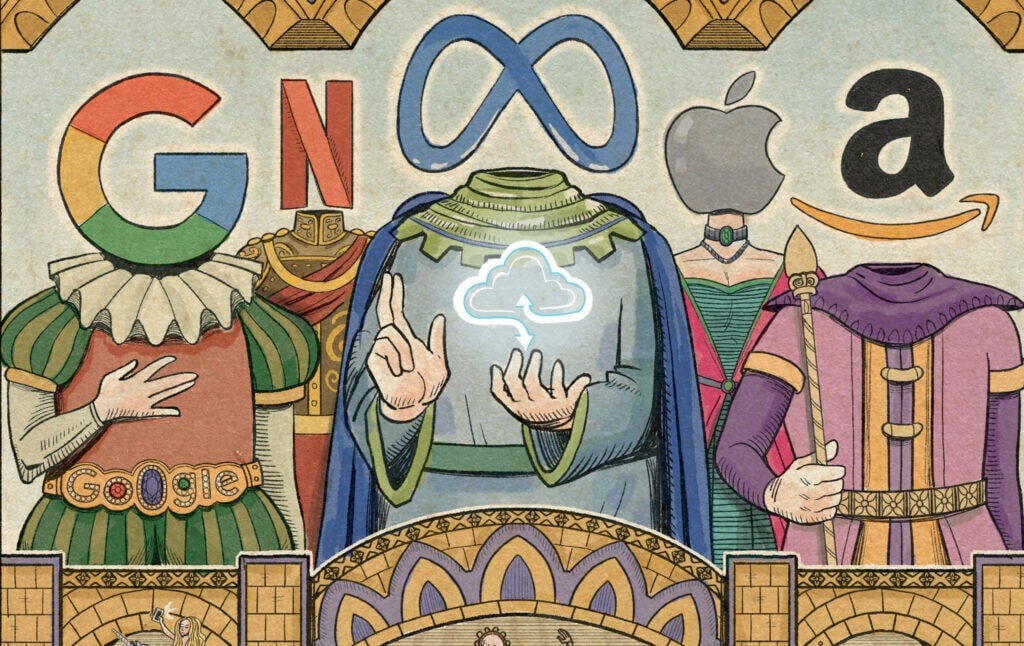
I. Introduction – The Continuity of Dominion
Every civilization carries with it a memory, often disguised as destiny. For the West, that memory is feudalism—the vertical order of lords and serfs, power and submission, control and extraction. Though Europe’s feudal age seemed to collapse with the Enlightenment, revolutions, and industrial capitalism, its psychology never disappeared. It reinvented itself under new names: capitalism, free markets, frontier expansion, and American Exceptionalism.
Yanis Varoufakis, in Technofeudalism: What Killed Capitalism, declares that capitalism itself has died, replaced by a new order where platforms act as digital fiefdoms and humanity lives as algorithmic serfs. But what if this “new” technofeudalism is less a rupture and more the logical endpoint of Dominion—the Western drive to conquer and control—that has persisted since medieval Europe?
Through the lens of Dominion vs Dharma, the story of America appears not as a triumph of freedom but as a transfiguration of feudalism. Dominion was reborn on the American frontier, masked as liberty. It spread through slavery, racism, industrial capitalism, and neoliberal globalization. Today it culminates in Big Tech’s rentier platforms. The U.S., in this reading, is less a beacon of democracy than the most perfected laboratory of feudal extraction—a society where “freedom” is the mask that hides submission.
II. Feudal Europe: Dominion’s Birthplace
The feudal order of medieval Europe (roughly 9th to 15th centuries) was defined by three pillars:
1. Land as Power: Lords held land, and peasants (serfs) worked it under obligation. Ownership was hereditary, control absolute.
2. Rent and Tithe: Wealth came not from production or exchange but from rent and tithe. Surplus was extracted by coercion.
3. Church as Legitimizer: The Church sanctified hierarchy. “Divine right” of kings and lords justified control.
This order was rigid but not static. Its essence was Dominion: control of people through land, theology, and violence. When Europe broke free of internal limits in the late medieval era, it carried this Dominion outward.
The papal Doctrine of Discovery (1493) codified conquest: non-Christian lands were legally “empty” and available for seizure. Native peoples were reduced to “Others” outside history. Feudal logic was baptized as divine law.
III. Crossing the Atlantic: Feudalism Reborn
When settlers crossed to America, they carried this feudal DNA. The Old World’s lords became the New World’s pioneers. Yet the substance remained:
– Puritans as Chosen Lords: They imagined themselves a new Israel, a chosen people on a divine mission. This was feudal chosenness repackaged as Protestant providence.
– The Plantation as Manor: The slave plantation was the modernized feudal estate. Masters stood as lords; overseers enforced order; slaves were permanent serfs.
– Native Dispossession as Feudal Conquest: The land was never empty, but settlers treated Indigenous peoples as obstacles to be erased—echoing medieval lords clearing forests of peasants.
Slavery bound the logic of race to the logic of feudal Dominion. Africans became property, inheritable across generations, denied autonomy. This was serfdom intensified—without hope of redemption.
IV. Frontierism: The New Feudal Expansion
In 1893, historian Frederick Jackson Turner proposed the Frontier Thesis: the frontier shaped American democracy and identity. But beneath this thesis lies the deeper feudal pattern: perpetual expansion as Dominion’s lifeblood.
– The Frontier as Permanent Expansion: The U.S. could never stop moving outward. Each frontier—land, market, technology—became the stage for Dominion’s reinvention.
– The Other as Disposable: Indigenous peoples, enslaved Africans, Mexican communities—all were cast as expendable. The serf’s face changed, but the role remained.
– Manifest Destiny as Theology: Expansion was not only opportunity; it was ordained. Providence mandated conquest, echoing feudal divine right.
When the geographic frontier closed, America sought new ones: colonies overseas, the space race, the digital realm. Feudal Dominion never rested; it migrated into new territories.
V. American Exceptionalism: Dominion in Religious Clothing
By the 19th century, the U.S. proclaimed itself exceptional—a nation uniquely chosen to lead humanity. But this doctrine was less about Dharma (truth, balance, universality) and more about Dominion disguised as virtue.
– Manifest Destiny: Expansion westward was cast as divine duty. Indigenous genocide became sanctified progress.
– Racial Capitalism: The economy thrived on slavery and Jim Crow. The “American Dream” was built on Black exclusion and Indigenous erasure.
– Spanish-American War (1898): America extended feudal Dominion globally—Puerto Rico, Philippines, Guam—becoming landlord of new colonies.
– Cold War Dominion: The U.S. framed itself as leader of the “free world.” Yet its democracy was enforced through coups, interventions, and corporate control abroad.
Exceptionalism was thus Dominion’s gospel. It told Americans they were free, while binding them to the feudal logic of hierarchy and conquest.
VI. Capitalism and Free Markets: The Theology of Dominion
If feudal Europe relied on God and land to justify power, America relied on markets. The “invisible hand” became the new divine providence.
– Robber Barons as Feudal Lords: Rockefeller, Carnegie, Morgan—these industrialists monopolized oil, steel, and finance like medieval lords controlled manors. Their wealth built libraries and universities, but their empires were built on control.
– Monopoly as Modern Manor: Free markets were preached, but monopolies ruled. Workers were serfs of the industrial estate.
– The Neoliberal Turn: Reagan and Thatcher preached deregulation, but this only strengthened feudal monopolies. The language of freedom hid the reality of domination.
– Globalization: The IMF and World Bank exported America’s feudal gospel abroad. Structural adjustment forced nations into rent-paying vassals of global capital.
Thus the “free market” was never freedom. It was theology: a creed to sanctify rentier control.
VII. Technofeudalism: Digital Lords and Algorithmic Serfs
Yanis Varoufakis identifies the culmination: technofeudalism.
– Platforms as Fiefdoms: Amazon, Google, Apple, Meta, Alibaba—these are not market actors but landlords. Sellers, buyers, and workers operate on their terms, paying digital rents.
– Data as Rent: Instead of surplus value from labor, platforms extract value from data and attention. Human desire itself becomes the new tithe.
– Algorithmic Control: Where feudal lords used knights, and industrialists used overseers, technofeudal lords use algorithms. Surveillance replaces the whip.
– Global Serfdom: Billions of people are bound to platforms for work, communication, and survival. They appear free but are algorithmically tethered.
The feudal mask has returned, in digital clothing.
VIII. Dominion vs Dharma: Civilizational Alternatives
At this crossroads, Dominion and Dharma present competing civilizational logics:
– Dominion (West/America):
– History = conquest of Others.
– Economy = rent extraction.
– Politics = hierarchy disguised as freedom.
– Culture = chosenness and Exceptionalism.
– Dharma (East/Bharat):
– History = unfolding of balance.
– Economy = svadharma (duty) and loka-sangraha (mutual uplift).
– Politics = rajdharma (duty to truth, not conquest).
– Culture = Vasudhaiva Kutumbakam (the world is one family).
India’s Digital Public Infrastructure (UPI, Aadhaar, ONDC) offers embryonic models of dharmic alternatives: technology as commons, not fiefdom. Where America builds castles of rent, Bharat builds bridges of inclusion.
IX. The Future: A Civilizational Choice
Humanity must choose:
1. Technofeudal Dominion: Remain serfs of platforms, subjects of algorithms, vassals of monopolies.
2. Dharmic Renewal: Transform technology into commons, AI into amplifier of consciousness, and global systems into trust-based cooperation.
The U.S. stands at the edge of planetary feudalism. Bharat stands at the threshold of dharmic civilization. The tension between Dominion and Dharma will define the 21st century.
X. Conclusion – The Mask of Freedom, the Call of Dharma
Technofeudalism is not a new system. It is the mask of freedom over the face of Dominion. America’s story—from feudal Europe to Exceptionalism to Silicon Valley—is one of continuity, not rupture. Dominion has worn many costumes: God, markets, freedom, Exceptionalism. But the essence has been the same: control, conquest, extraction.
Dharma offers the counter-story. It calls humanity to balance, trust, autonomy, and mutual flourishing. The choice is stark: continue down Dominion’s path into algorithmic serfdom, or awaken to Dharma’s possibility of a civilizational rebirth.
The West’s Exceptionalism insists that history ends with its triumph. But Dharma reminds us that history is a spiral. The feudal mask may appear eternal, but consciousness can pierce it. What matters is whether humanity sees through the illusion—whether it chooses conquest or consciousness, Dominion or Dharma, feudal control or civilizational awakening.