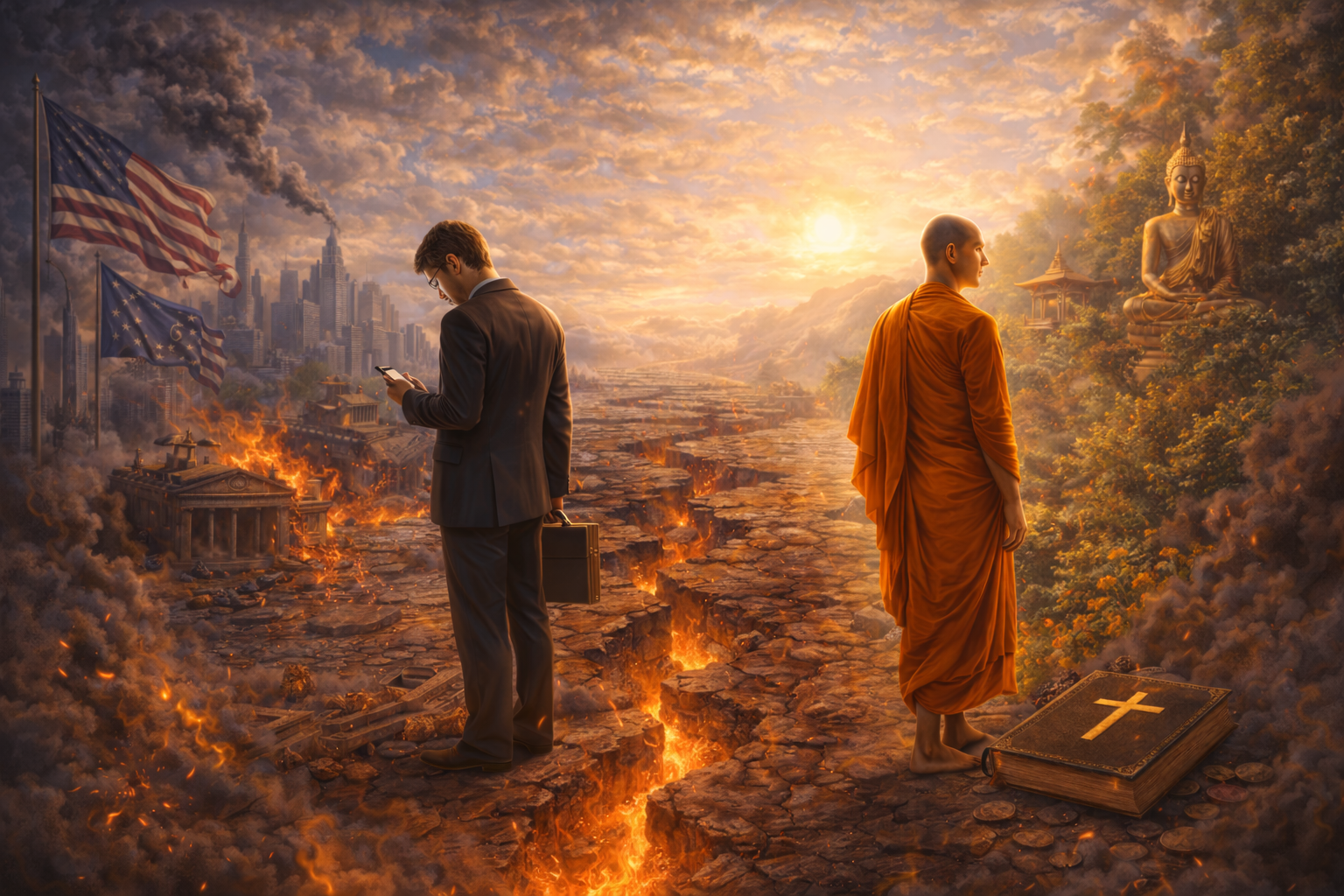
Boredom in the West is not a symptom of leisure but of imbalance—conquest without consciousness, prosperity without Presence.
By Vivek Singhal
**About the Author:**
Vivek Singhal is the author of *Dominion and Dharma: Reframing Capitalism through Conquest, Consciousness, and Civilizational Memory*. A thinker at the intersection of strategy, philosophy, and governance, he writes on the evolution of human consciousness, the role of Presence in civilizational renewal, and the need to align exponential technologies with Dharma.
Across the West, commentators speak of fatigue. Citizens are restless, despite abundance. Politics is polarized, despite democracy.
Lives are overstimulated, yet under-fulfilled. Some describe the West as “bored to death.” But boredom is not the problem itself.
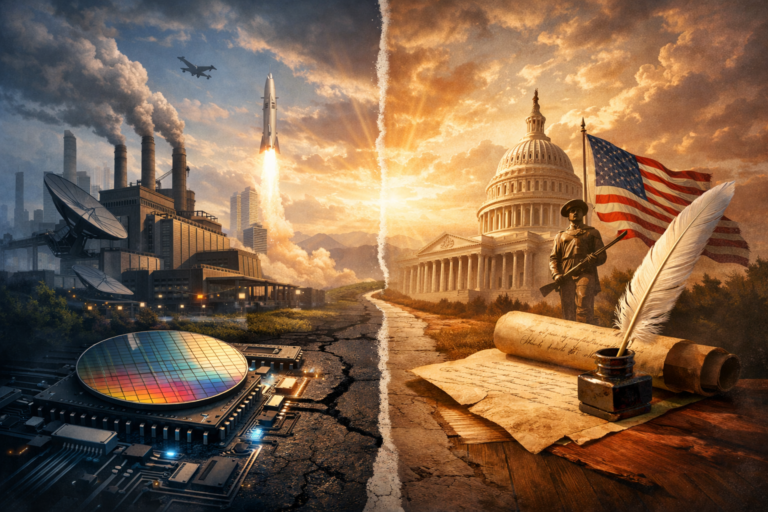
It is the symptom of a deeper crisis: the dominance of Dominion without Dharma.
Dominion is the mindset of conquest, separation, and control. It is the operating system that drove empire, industrialization, and capitalism.
Dharma, by contrast, is the principle of alignment, balance, and wholeness — an ancient grammar of integration.
Dominion has been perfected, but Dharma has been forgotten. The result is civilizational ennui: epidemics of depression, loneliness, violence, and hollow politics.
The coming era of AI and exponential technologies will not neutralize this crisis. It will amplify it.
Which operating system we choose — Dominion or Dharma — will tilt the arc of history.
—
Dominion’s story is older than capitalism. Its origins lie in Genesis 1:28 — humanity instructed to “have dominion” over the earth.
That theology became law in the Doctrine of Discovery (1450s), when papal bulls authorized conquest and enslavement of “pagan” lands.
In the 1600s, Dominion was corporatized. The Dutch East India Company (VOC) and the English East India Company (EIC) fused commerce with sovereignty.
These companies were empowered to wage war, govern territories, and extract resources. Dominion was no longer just kingly or clerical.
It was financialized and globalized.
By 1776, Dominion had been perfected in the New World. Adam Smith’s Wealth of Nations offered a philosophy of specialization and markets,
while the U.S. Declaration of Independence proclaimed liberty. Together they created capitalism as conquest disguised as freedom.
The Industrial Revolution extended this logic. Taylorism regimented human bodies as machines. Colonies supplied raw materials.
Liberty coexisted with slavery, prosperity with alienation, democracy with empire. Dominion delivered abundance, but at a cost: fractures of meaning.
The two World Wars exposed the destructive climax of this logic. Hiroshima and Nagasaki remain symbols of Dominion’s ultimate violence.
In response, the UN, Bretton Woods, and the Universal Declaration of Human Rights attempted to civilize Dominion with rules and institutions.
Yet the Cold War that followed was Dominion vs. Dominion. The U.S. and USSR pursued different ideologies but similar logics of control.
Afghanistan became a Dominion battlefield. Swiss banks laundered corruption; terrorism emerged as its shadow.
The fall of the Berlin Wall in 1989 seemed to signal capitalism’s triumph. Outsourcing, Y2K, and global supply chains promised efficiency without limits.
China rose by adapting capitalism within its civilizational framework. But 9/11 revealed the backlash: the U.S. was seen as an empire of profit, not liberation.
The Twin Towers fell — symbols of capitalism as dominion.
Neoliberal globalization reached its high point under Reagan and Thatcher: deregulation, privatization, and financial liberalization.
The 2008 crash was Dominion devouring itself. Citizens United (2010) legalized money as speech. Democracy became captive to capital.
Today, populism has become Dominion’s latest mutation. Trump, Brexit, and nationalism represent rage against the system — but reproduce the same fight–fight–fight logic.
The Zelensky–Trump Oval Office meetings (1.0 → 2.0) are Dominion staged as global spectacle.
—
What has been lost is Presence — the awareness that bridges Shoonya (emptiness) and Infinity (possibility).
My father, Swami Om Prakash Saraswati, called it होश — pure awareness.
Strategists describe it as the integrator that turns parts into wholes.
Physics itself hints at it: Newtonian mechanics saw the universe as clockwork, but relativity (E = mc²) and quantum entanglement reveal a world of inseparability,
where nothingness connects to everythingness.
Presence is not mystical. It is the missing civic capacity. Krishna taught it to Arjuna in the Gita. Ancient Rishis called it Advaita.
Gandhi expressed it as satyagraha. And in 2015, Narendra Modi offered it to the world through International Yoga Day — reframing yoga as secular Dharma.
Without Presence, societies drift into overstimulation without meaning. That is America’s story today: hollowed-out factories creating hollowed-out lives.
Opioids, suicides, and mass shootings are not random epidemics — they are symptoms of a civilizational operating system stuck in Dominion.
—
The 21st century will be defined by exponential technologies — AI, AGI, biotech, planetary networks. These are not neutral tools.
They will magnify whatever system we run.
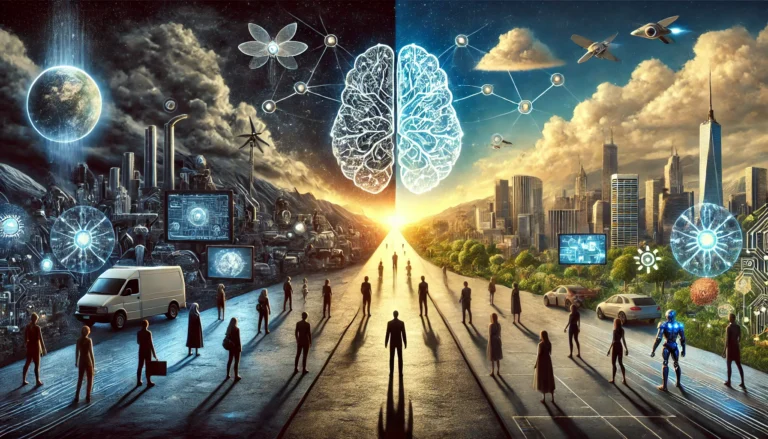
Under Dominion, they will amplify surveillance, polarization, and control.
Under Dharma, they can scaffold regeneration, co-creation, and trust.
This is the horizon of what I call Phygital Civilization: the integration of physical, digital, and consciousness.
Industrial civilization optimized matter. Digital civilization optimized information. Phygital civilization must optimize meaning — reconnecting humans as parts of a Whole.
Metcalfe’s Law — the value of a network grows with the square of its nodes — reminds us: every new connection multiplies potential.
But value is not automatic. Without Dharma, networks multiply noise and manipulation. With Dharma, networks multiply trust and Presence.
—
Three questions confront us now:
1. Is capitalism ready to embrace Dharma? Can it shift from extraction to regeneration, from GDP-only to multi-capital accounting (trust, nature, time, knowledge)?
2. What does MAGA + MIGA = MEGA mean? America First and India First can either entrench Dominion populism or converge into MEGA — Make Earth Great Again: Win–Win–Win for individual, society, and planet.
3. Can Dominion and Dharma be universalized without new universalism? Yes — if they are framed as lenses, not dogmas. Diagnostic tools for any culture: does this choice divide or integrate, extract or regenerate, inflate control or cultivate trust?
—
The West is not merely bored. It is wounded by Dominion without Dharma.
Depression, loneliness, and polarization are not private ailments; they are civilizational symptoms.
The future of AI and exponential technologies is the hinge.
They can accelerate Dominion at digital speed, or inaugurate Dharma at planetary scale.
The choice is not technological. It is civilizational.
Presence writes history. Dominion fractures it. Dharma heals it.
The task before us — as entrepreneurs, policymakers, and citizens — is to recondition capitalism itself.
If the “Pavlovian Dogs of Capitalism” can be trained to salivate not for extraction but for regeneration, then exponential technologies can tilt the arc of history.
With courage, Dominion can be harnessed by Dharma. With Metcalfe’s Law, eight billion humans can co-create a Phygital Civilization.
That is not boredom. That is destiny.