
By Vivek Singhal
Introduction: The Question of Change
Humanity’s most profound question is not “What is?” but “What becomes?” For centuries, philosophers, mystics, scientists, and ordinary seekers have struggled with the paradox of permanence and impermanence. We ask: Is reality a fixed Being, or is it an endless Becoming? The Greek Parmenides argued that Being is all there is, eternal and unchanging. Heraclitus countered: “You cannot step into the same river twice.” The Indian sages of the Upanishads, however, dissolved the duality altogether: Being and Becoming are not separate. The Shoonya (emptiness, zero) is pregnant with potential; the Anant (infinite) is the flowering of that potential. The One is Many; the Many return to the One.
In this essay, I explore Change as the essence of existence—a journey from Being to Always Becoming. I do so using the Dominion and Dharma framework, a lens that critiques the Western obsession with control, conquest, and binary either/or categorizations, while affirming the Eastern recognition of balance, interdependence, and and also thinking.
Part I: Shoonya – The Emptiness that Holds All
In Sanskrit, Shoonya means zero, emptiness, nothingness. To the Western ear, nothingness is terrifying. To the Eastern mind, emptiness is the womb of all that is. Without zero, mathematics would collapse. Without silence, music would be noise. Without pause, breath could not circulate.
Shoonya is Being before Being. It is the field of pure potential from which stars ignite, civilizations rise, and individuals are born. It is the pause before the first note, the darkness before dawn, the silence before the Word.
Part II: Dominion – The Illusion of Final Being
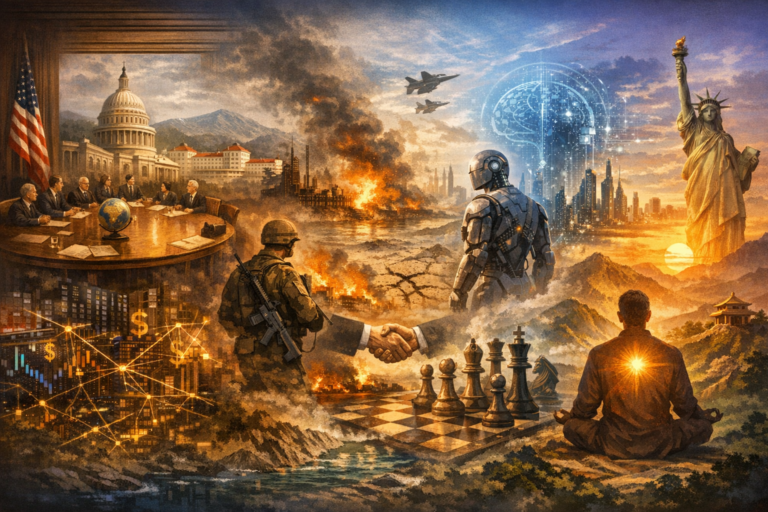
Dominion is not just political conquest but a civilizational mindset: the desire to reduce complexity to control, to define truth as monopoly, to measure life in binaries—winner vs loser, saved vs damned, human vs nature.
Dominion collapses when it collides with the truth of Becoming. The Soviet Union disintegrated. The American dream wavers. Even the Catholic Church reinterprets doctrine. Dominion promises permanence but delivers collapse.
Part III: Dharma – Becoming as Harmony and Flow
If Dominion is the obsession with Being, Dharma is the dance of Becoming. Dharma does not mean law in the rigid sense but the inner order of things, their flow and purpose. The Dharma of fire is to burn, of water to flow, of a tree to grow, of a human to awaken.
Unlike Dominion’s either/or, Dharma is and also. A human can be body and also soul. A society can be modern and also traditional. In Dharma, contradiction is not error but paradox.
Part IV: Anant – The Infinite Spiral of Consciousness
From Shoonya to Anant, the journey is circular, spiral, infinite. Anant means endless, boundless, infinite. If Shoonya is the pregnant void, Anant is the eternal flowering. Change is not linear progress to an endpoint but an infinite expansion.
In physics, the universe is not winding down to stillness but expanding. In biology, evolution never ceases. In consciousness, awareness deepens without final destination. This is Anant: no fixed being, only infinite becoming.
Part V: Tools Across History – Shaping Becoming
John M. Culkin once said: “We shape our tools and thereafter our tools shape us.” The chart below captures this profound truth across eras:
| Era / Date | Examples of Tools | Estimated Distinct Tools | Key Impacts on Humanity |
| Paleolithic (50,000 BCE) | Axes, spears, fire, needles | ~50–200 | Survival, hunting, kinship organization |
| Neolithic (10,000 BCE) | Plows, sickles, pottery wheels | ~500–2,000 | Farming, settlements, food storage |
| Bronze Age (3,000 BCE) | Bronze blades, chisels, armor | ~5,000–5,000 | Trade, urban crafts, warfare |
| Classical Era (500 BCE–500 CE) | Iron tools, aqueducts, surgical instruments | ~5,000–20,000 | Infrastructure, medicine, governance |
| Medieval (500–1500 CE) | Watermills, windmills, looms | ~20,000–50,000 | Mechanization, guild craft, agriculture |
| Industrial Revolution (1750–1900) | Steam engines, lathes, telegraphs | ~50,000–500,000 | Mass production, global trade |
| 20th Century (1900–2000) | Cars, airplanes, computers | ~500,000–5,000,000 | Consumer goods, electronics, digital age |
| 21st Century (2000–2025) | Smartphones, apps, AI, robotics | ~5,000,000+ | AI integration, physical + digital fusion |
Part VI: Spooky Phenomena – Quantum Entanglement and Always-Becoming
Einstein called it “spukhafte Fernwirkung”—translated as “spooky action at a distance.” He was describing quantum entanglement, where two particles once connected continue to influence one another instantly, regardless of distance. To the Dominion mindset, this was unacceptable—it violated the Newtonian belief in local causality. But experiments proved it real.
Entanglement is not spooky; it is Dharma in science. It shows that Being is not separate entities but interconnected nodes of Becoming. Two particles are not “either here or there” but “and also”—linked in ways classical logic cannot parse. Entanglement affirms the Upanishadic truth: Tat Tvam Asi—‘Thou art That.’
Conclusion: Change as Dharma of Becoming
Change is not a threat but the essence of existence. Shoonya is the womb, Dominion the illusion, Dharma the path, Anant the destiny. To live is to become. To resist change is to die. To embrace it is to awaken.
The Dominion mindset, rooted in either/or, traps humanity in cycles of conquest and collapse. The Dharma mindset, rooted in and also, liberates us to dance with the infinite. In this dance, emptiness is fullness, zero is infinity, Being is Becoming. Shoonya is Anant.
About the Author
Vivek Singhal is a civilizational thought leader, systems thinker, and author of *Dominion and Dharma: Reframing Capitalism through Conquest, Consciousness, and Civilizational Memory*. With a background spanning engineering, physics, and management from IIT Delhi, the University of Michigan, and the University of Chicago, he integrates Eastern wisdom and Western analysis to explore humanity’s transition from the Age of Dominion to the Age of Dharma. Through his writings and initiatives, Singhal seeks to awaken humanity to a future rooted in trust, transparency, and truth—where Shoonya and Anant guide both