
From the Poverty of Loneliness to the Wealth of Consciousness
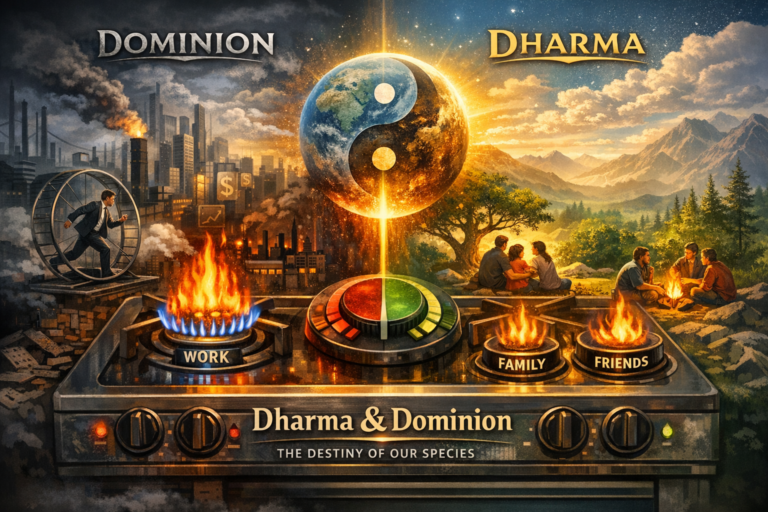
A Dominion–Dharma–Destiny–Identity White Paper for the Phygital Era
By Vivek Singhal
Founder, Dominion–Dharma–Destiny Institute
DDDI.net | 2026
Executive Summary
The modern West has achieved what most previous civilizations could scarcely imagine. It has generated extraordinary material abundance, technological capability, personal mobility, consumer choice, medical progress, and individual freedom. Yet beneath this visible prosperity lies a quieter crisis: anxiety amid convenience, loneliness amid connectivity, insecurity amid wealth, and meaninglessness amid unprecedented choice.
This paradox is sometimes described as Affluenza: a socially transmitted condition in which individuals and institutions become preoccupied with money, possessions, status, visibility, competition, and continuous consumption—while neglecting the relationships, communities, purposes, and states of consciousness that make life meaningful.
Psychologist Oliver James popularized Affluenza as a “virus” of materialistic values associated with emotional distress. His argument is that consumer society confuses manufactured wants with genuine human needs, encouraging people to pursue money, appearance, possessions, fame, and social status as substitutes for security, belonging, competence, authenticity, and love. (Amazon)
Mother Teresa identified the human consequence of this disease more directly. She observed that Western poverty was not primarily a shortage of bread, but the experience of being unwanted, unloved, and uncared for. In A Simple Path, she contrasted physical diseases treatable through medicine with loneliness, despair, and hopelessness, whose remedy must involve love and human care. (The Christian Science Monitor)
OSHO approached the same crisis from another direction. He distinguished loneliness, which is the painful experience of feeling incomplete without another, from aloneness, which is the joyful discovery of inner completeness. In his thought, modern humanity is not suffering because it possesses material wealth, but because it has pursued outer wealth without cultivating inner awareness. OSHO did not require the rejection of matter; he envisioned materialism and spirituality as complementary dimensions of one life. (Osho World)
Through the Dominion–Dharma–Destiny–Identity framework, Affluenza can be understood as:
- Dominion without Dharma: power, production, consumption, and technological mastery without moral purpose or conscious stewardship;
- Dharma displaced by desire: the replacement of meaningful responsibility by comparison, acquisition, and social performance;
- Destiny reduced to accumulation: a future measured by “more” rather than by human flourishing;
- Identity outsourced to the marketplace: the person no longer knows who they are except through income, occupation, possessions, status, ideology, or digital approval.
The cure is not poverty, anti-capitalism, withdrawal from technology, or romantic rejection of modernity. The cure is the reintegration of outer abundance and inner consciousness.
The challenge of the Phygital Era is therefore not merely to create more wealth. It is to create a civilization in which wealth circulates toward meaning, technology strengthens relationships, work supports purpose, communities restore belonging, and individuals learn to transform loneliness into creative aloneness.
Affluenza is the disease of having more while experiencing less.
Dharma is the wisdom of knowing what “more” is for.
1. The Paradox of Western Affluence
The word affluence originally conveys the idea of flow—resources flowing toward and around a person or society. In contemporary culture, however, affluence has largely become identified with accumulation:
- more money;
- larger houses;
- greater consumption;
- more prestigious occupations;
- more influence;
- more experiences;
- more followers;
- more choices;
- and more visible evidence of success.
Affluenza begins when the pursuit of these external goods ceases to serve life and instead becomes the organizing purpose of life.
It is not simply wealth.
A wealthy person need not suffer from Affluenza, and a person of modest means may still be consumed by it. Affluenza is a belief system—a cultural and psychological virus that teaches:
I am what I possess.
I am what I produce.
I am where I rank.
I am how others perceive me.
I will become fulfilled when I acquire enough.
The tragedy is contained in the final word: enough.
Within a comparison-driven system, enough never arrives.
There is always someone richer, more beautiful, more visible, more accomplished, more influential, or apparently happier.
Affluenza therefore converts abundance into experienced scarcity.
A person may possess more than previous generations but feel deprived because someone else displays more.
The system produces not only goods but dissatisfaction. Indeed, dissatisfaction becomes economically useful because the fulfilled person is a less compulsive consumer.
A civilization organized around endless consumption must repeatedly persuade people that something is missing.
2. From Local Comparison to Planetary Comparison
Human beings have always compared themselves with others. But digital media has changed the scale and intensity of comparison.
In an earlier social environment, a person might compare their life with relatives, neighbors, classmates, or colleagues. Today, the comparison group is potentially the entire connected world.
More importantly, people compare their unedited existence with the edited presentations of others.
They see:
- the vacation but not the debt;
- the promotion but not the exhaustion;
- the relationship photograph but not the conflict;
- the body but not the insecurity;
- the entrepreneurial success but not the failed ventures;
- the spiritual declaration but not the inner confusion;
- the luxury object but not the loneliness surrounding it.
The digital marketplace transforms life into performance.
Experiences are no longer merely lived. They are photographed, filtered, ranked, shared, and measured.
The person gradually shifts from asking:
“Am I living well?”
to asking:
“Does my life look successful?”
This is a profound displacement of identity.
The self becomes both the product and the marketing department.
Affluenza is therefore not only consumerism. It is the commodification of the person.
3. Mother Teresa and the Poverty of Being Unwanted
Mother Teresa offered one of the most penetrating diagnoses of Western society:
“The greatest disease in the West today is not TB or leprosy; it is being unwanted, unloved and uncared for.”
She described the poverty of the West as a poverty of loneliness and spirituality—a hunger for love that material provision alone cannot satisfy. (The Christian Science Monitor)
Her comparison was not intended to minimize hunger, homelessness, or physical suffering. Rather, she revealed that poverty has more than one dimension.
There is the poverty of insufficient material resources.
There is also the poverty of insufficient relationship.
A person can be surrounded by objects yet feel that no one truly sees them.
A person can have access to medical care yet believe that their existence matters to nobody.
A person can inhabit an expensive home without experiencing home as belonging.
A person can accumulate professional recognition while lacking one relationship in which performance is unnecessary.
Mother Teresa’s insight can be expressed as a paradox:
The materially poor may hunger for bread.
The affluent may possess bread but have no one with whom to break it.
The first poverty is visible.
The second is often hidden behind competence, consumption, professional achievement, and social performance.
This hiddenness makes Affluenza especially difficult to treat. Society praises many of its symptoms:
- relentless ambition is called drive;
- compulsive work is called commitment;
- accumulation is called success;
- status anxiety is called aspiration;
- emotional suppression is called professionalism;
- self-neglect is called sacrifice;
- and loneliness is disguised as independence.
The disease becomes socially rewarded.
4. Is Modern Life Anxious Because It Has Lost Meaning?
A central question arises:
Have we lost meaning because life has become anxious and chaotic, or has life become anxious and chaotic because we have lost meaning?
Both dynamics reinforce one another.
A frantic life leaves little time for reflection, friendship, family meals, service, contemplation, or community. Yet the absence of meaning also makes frantic activity attractive. Busyness protects the person from confronting emptiness.
When people do not know what their lives are for, measurable goals offer temporary direction:
- earn more;
- acquire more;
- rise higher;
- remain visible;
- stay busy;
- optimize everything;
- never fall behind.
Viktor Frankl described the condition of meaninglessness as an existential vacuum. When people lack purpose, they may become vulnerable to boredom, anxiety, conformity, apathy, addiction, or externally imposed ambitions.
Affluenza fills the existential vacuum with consumption.
The market says:
You do not need to discover meaning.
You need to purchase the next version of yourself.
But identity cannot be permanently purchased because every purchased identity becomes obsolete.
The new car becomes the ordinary car.
The new house becomes the familiar house.
The promotion becomes the current responsibility.
The applause fades.
The number of followers that once seemed extraordinary becomes inadequate when another person attracts more.
External fulfillment is real, but it is temporary. The problem begins when temporary satisfaction is asked to perform the work of permanent meaning.
5. The Four Eroding Connections
A meaningful life is generally supported by four forms of connection:
- close relationships;
- community;
- purposeful work;
- transcendence.
Affluenza weakens all four.
5.1 Relationships Become Transactions
Close relationships provide love, recognition, care, memory, responsibility, and emotional grounding.
Affluenza converts relationships into instruments of personal enhancement.
People may begin to evaluate others according to:
- usefulness;
- status;
- attractiveness;
- access;
- economic contribution;
- ideological agreement;
- or compatibility with a personal brand.
Love becomes conditional upon performance.
Friendship becomes networking.
Community becomes audience.
Marriage becomes lifestyle alignment.
Even parenting can become a competition through children’s achievements.
The human being is no longer encountered as a mystery but evaluated as an asset.
Mother Teresa’s “unwanted person” is not necessarily someone whom nobody knows. It may be someone surrounded by people who know only their function.
5.2 Community Becomes a Platform
Traditional communities required repeated participation, obligation, compromise, forgiveness, and physical presence.
Digital platforms offer connection without necessarily requiring belonging.
One may possess thousands of contacts without having anyone available in a moment of grief.
A platform can distribute information, but it cannot automatically create trust.
It can gather an audience, but not necessarily a community.
Community says:
You are one of us, even when you are not performing.
A platform says:
You remain visible while you continue producing engagement.
These are fundamentally different relationships.
Affluenza replaces belonging with exposure.
5.3 Work Becomes Identity
Work can provide purpose, mastery, structure, dignity, contribution, and relationships. But under Affluenza, work becomes the primary proof of personal worth.
The person does not merely perform a job.
The person becomes the job.
This explains why job loss, retirement, automation, or professional failure can feel like the death of the self.
The gig economy and remote work may provide flexibility, but they can also weaken institutional belonging, mentorship, shared rituals, and professional community. AI intensifies the issue because the fear of technological displacement is not merely the fear of lost income. It is the fear of becoming unnecessary.
The question of the AI age is therefore larger than employment:
What happens to human identity when economic productivity is no longer the primary basis of social value?
A civilization that has taught people, “You are what you produce,” is unprepared for technologies capable of producing without them.
5.4 Transcendence Becomes Consumption
The fourth connection is with something larger than the isolated self:
- God;
- Dharma;
- nature;
- humanity;
- civilization;
- service;
- beauty;
- truth;
- consciousness;
- or the cosmos.
As organized religion has weakened in parts of the West, many people have gained freedom from inherited dogma. But some have also lost ritual, sacred time, moral community, intergenerational continuity, and a narrative larger than private success.
The marketplace then offers consumer transcendence:
- luxury as salvation;
- travel as identity;
- celebrity as mythology;
- technology as immortality;
- politics as religion;
- and brands as tribes.
The need for transcendence does not disappear when religion declines.
It migrates.
When it migrates unconsciously, political ideology, nationalism, technology, or consumer culture may become substitute religions.
6. OSHO: Loneliness Is Not Aloneness
OSHO makes a critical distinction between loneliness and aloneness.
Loneliness is the pain of experiencing oneself as incomplete, abandoned, or disconnected.
Aloneness is the joy of discovering that one possesses an inner center not dependent upon constant approval, stimulation, or company.
In loneliness, the other person is needed to fill an emptiness.
In aloneness, relationship becomes an expression of abundance rather than a desperate cure for deficiency.
OSHO describes aloneness not as isolation but as inner wholeness. In his thought, love does not destroy aloneness; it allows two whole beings to meet without possessing one another. (Osho World)
This distinction illuminates Mother Teresa’s diagnosis.
Mother Teresa addresses the social wound:
The person needs love, care, recognition, and human presence.
OSHO addresses the existential wound:
The person must also discover an inner consciousness that cannot be supplied entirely by society.
Both are necessary.
Love without inner consciousness can become dependency.
Aloneness without love can become withdrawal.
The mature human being needs both:
the ability to be deeply alone without becoming lonely, and deeply connected without losing oneself.
This is not Western individualism and not collectivist absorption.
It is Aikyam—unity that does not abolish uniqueness.
7. OSHO’s Zorba the Buddha: Beyond Materialism versus Spiritualism
OSHO did not teach that material prosperity must be rejected.
He criticized both the materialist who denies inner life and the spiritualist who condemns the body, pleasure, beauty, prosperity, and the earth.
His image of Zorba the Buddha represents integration:
- Zorba celebrates the body, the earth, creativity, food, dance, love, and material life.
- Buddha represents awareness, silence, meditation, freedom from attachment, and awakened consciousness.
The future human must embody both.
This principle is essential to understanding Affluenza.
The cure for excessive consumption is not forced deprivation.
The cure for wealth without meaning is not poverty.
The cure for technological overstimulation is not the destruction of technology.
The cure is consciousness.
OSHO argued that materialism and spirituality should become complementary aspects of a unified vision of life rather than enemies. (Osho World)
Affluenza occurs when Zorba has no Buddha:
- enjoyment becomes addiction;
- ambition becomes compulsion;
- comfort becomes numbness;
- wealth becomes identity;
- freedom becomes isolation;
- and choice becomes anxiety.
An unhealthy asceticism occurs when Buddha has no Zorba:
- spirituality becomes anti-life;
- poverty becomes romanticized;
- the body becomes suspect;
- desire becomes guilt;
- and transcendence becomes escape.
The DDDI position is therefore:
Not Dominion or Dharma.
Dominion and Dharma.
Not material prosperity or spiritual awakening.
Material prosperity guided by spiritual awakening.
8. Affluenza Through the DDDI Framework
8.1 Dominion: Power Without Purpose
Dominion is the human capacity to act upon the world:
- to build;
- organize;
- invent;
- produce;
- accumulate;
- govern;
- measure;
- compete;
- and transform nature.
Western civilization developed extraordinary Dominion through science, industry, finance, military organization, corporate systems, technological innovation, and global networks.
Dominion is not inherently evil.
It has contributed to medicine, sanitation, transportation, communication, education, food production, and unprecedented material possibility.
Affluenza is not the consequence of Dominion itself.
It is the consequence of Dominion without Dharma.
When power becomes detached from purpose, the means become the end:
- economic growth for the sake of growth;
- technology for the sake of technological supremacy;
- consumption for the sake of consumption;
- work for the sake of status;
- data for the sake of control;
- and wealth for the sake of accumulation.
The system asks, “Can it be done?” before asking, “Should it be done?”
It measures value in quantities while ignoring qualities.
It knows the price of everything while forgetting the purpose of anything.
Dominion without Dharma creates the affluent but lonely human being: materially empowered, psychologically fragmented, socially compared, and spiritually homeless.
8.2 Dharma: The Forgotten Question of “What For?”
Dharma is the principle of right relationship:
- between self and society;
- freedom and responsibility;
- power and purpose;
- rights and obligations;
- consumption and stewardship;
- prosperity and justice;
- individuality and belonging;
- humanity and nature.
Dharma asks:
What is wealth for?
What is work for?
What is technology for?
What is freedom for?
What is a corporation for?
What is civilization for?
Affluenza arises when these questions disappear.
Money becomes valuable simply because it can become more money.
Attention becomes valuable because it can generate more attention.
Technology becomes valuable because it can produce greater power.
But Dharma refuses self-referential systems.
It requires every power to answer to life.
Wealth must enable human development.
Technology must enlarge responsible freedom.
Business must create real value for stakeholders.
Education must cultivate judgment, not merely employability.
Community must protect belonging without extinguishing individuality.
Dharma is not a fixed dogma imposed upon life.
It is the continuing discernment of what sustains the whole.
8.3 Destiny: From “More” to “Meaning”
Affluenza defines Destiny as upward accumulation.
A successful future means:
- higher income;
- greater influence;
- more prestigious possessions;
- broader visibility;
- and control over more resources.
This is not Destiny. It is projection.
Destiny is the future possibility that becomes available when power and purpose align.
For the West, the next civilizational achievement cannot merely be greater production. It must be the transformation of production into flourishing.
The transition is:
from abundance of objects to abundance of meaning;
from connectivity to communion;
from employment to contribution;
from consumption to creativity;
from extraction to stewardship;
from intelligence to wisdom.
The Destiny of the Phygital Era will depend not only on what AI can generate but on what human beings choose to value when generation becomes inexpensive.
When machines can produce text, images, software, analysis, and perhaps much physical labor, human Destiny cannot remain defined solely by production.
It must increasingly be defined by:
- consciousness;
- care;
- creativity;
- responsibility;
- wisdom;
- relationship;
- and meaning.
8.4 Identity: Who Am I Without My Achievements?
Affluenza is ultimately an identity disorder.
It teaches the person to answer “Who am I?” with external categories:
- my occupation;
- my income;
- my nationality;
- my political tribe;
- my possessions;
- my followers;
- my credentials;
- my lifestyle;
- my reputation.
These may describe aspects of a person. They cannot contain the whole person.
When identity is outsourced to the marketplace, the person must continuously purchase evidence of existence.
When identity is outsourced to work, rest produces guilt.
When identity is outsourced to social media, silence feels like disappearance.
When identity is outsourced to ideology, disagreement feels like personal annihilation.
When identity is outsourced to status, another person’s success feels like one’s own diminishment.
OSHO’s witnessing consciousness offers a different foundation:
I possess roles, thoughts, ambitions, and identities, but I am not reducible to them.
Witnessing does not eliminate personality. It creates enough inner distance to prevent the personality from becoming a prison. OSHO presents witnessing as the capacity to observe experiences without being wholly captured by them. (Osho World)
Identity then moves from performance to presence.
9. Affluenza as the Failure of Both Capitalism and Spirituality
Affluenza is often presented as a criticism of capitalism. That is incomplete.
Capitalism can create abundance, innovation, enterprise, choice, and distributed experimentation. Its productive capacities are real.
The disease arises when the market becomes not merely an economic mechanism but a complete philosophy of human value.
Markets can price goods.
They cannot determine what is sacred.
Markets can reward demand.
They cannot decide whether the demand is wise.
Markets can organize exchange.
They cannot by themselves create love, purpose, belonging, or transcendence.
Affluenza therefore represents a failure of capitalism to remain within its proper domain.
But it also represents a failure of religion and spirituality.
When spiritual traditions become dogmatic, authoritarian, anti-scientific, guilt-producing, or disconnected from contemporary life, people understandably leave them.
The marketplace then occupies the abandoned sacred space.
The challenge is not to restore old dogmas unchanged. It is to create a post-dogmatic spirituality capable of integrating:
- science and silence;
- technology and consciousness;
- individuality and responsibility;
- material prosperity and inner freedom;
- East and West;
- Dominion and Dharma.
OSHO’s contribution is his insistence that truth cannot be reduced to belief.
Belief borrowed from another does not produce transformation.
Awareness must be experienced.
Meditation is not the acceptance of a doctrine. It is the direct observation of the mind and the discovery of the witness beyond its compulsions.
Affluenza cannot be cured by another imposed ideology.
It must be seen consciously.
10. AI and the Coming Super-Affluenza
Artificial intelligence may increase global productive capacity dramatically. It may reduce the cost of knowledge work, design, coordination, diagnosis, entertainment, and creation.
This could generate extraordinary abundance.
It could also intensify Affluenza.
AI can create:
- infinite personalized advertising;
- artificial companions;
- synthetic celebrities;
- hyper-targeted persuasion;
- endlessly optimized entertainment;
- automated social comparison;
- and increasingly convincing simulations of intimacy.
The lonely person may be offered not community, but a subscription.
The anxious person may be offered not meaning, but perfect distraction.
The isolated person may interact with systems that simulate care while extracting data, attention, and payment.
The great risk is not that machines become human.
It is that humans become increasingly machine-like:
- continuously productive;
- measurable;
- predictable;
- optimized;
- replaceable;
- and disconnected from embodied relationship.
AI can enlarge Dominion exponentially.
It cannot automatically supply Dharma.
Indeed, the more powerful Dominion becomes, the more necessary Dharma becomes.
Without a new philosophy of human flourishing, AI may create super-affluence without belonging, super-connectivity without intimacy, and super-intelligence without wisdom.
11. From Loneliness to Aloneness to Belonging
The cure for Affluenza requires three distinct movements.
11.1 From Loneliness to Aloneness
The individual must learn to be present without constant stimulation.
This requires:
- silence;
- meditation;
- witnessing;
- embodiment;
- time in nature;
- freedom from continuous comparison;
- and the discovery that existence itself does not have to be earned.
Aloneness is not isolation.
It is inner non-dependence.
A person capable of aloneness can enter relationships without demanding that another person repair every inner wound.
11.2 From Aloneness to Relationship
Inner completeness must not become spiritual narcissism.
Human beings need care, touch, dialogue, friendship, family, mentorship, and recognition.
Mother Teresa’s message reminds us that meditation cannot substitute entirely for love.
The person who is unwanted does not merely need advice to become comfortable alone. They need to be welcomed.
A Dharmic society must therefore cultivate institutions of care, not merely techniques of self-management.
11.3 From Relationship to Community
Private relationships alone cannot bear the entire burden of meaning.
People need communities where:
- their presence matters;
- their absence is noticed;
- generations interact;
- shared rituals recur;
- contributions are recognized;
- conflicts can be repaired;
- and belonging is not dependent upon constant performance.
The future must rebuild community in forms appropriate to mobile, pluralistic, technologically mediated societies.
The answer is not compulsory conformity.
It is belonging with freedom.
Walls and bridges.
Identity and Aikyam.
12. A DDDI Prescription for the Disease of Affluenza
12.1 Redefine Wealth
Wealth should be understood as the capacity to live, relate, create, contribute, and develop—not merely the quantity of financial assets controlled.
A richer accounting system would include:
- relational wealth;
- physical health;
- mental clarity;
- meaningful time;
- community trust;
- ecological resilience;
- creative agency;
- and spiritual depth.
Money remains essential, but it becomes one form of capital rather than the definition of life.
12.2 Redesign Work
Work must move from wage identity toward purposeful contribution.
Organizations should ask:
- Does this work create genuine value?
- Do employees experience mastery and agency?
- Does technology strengthen or weaken human dignity?
- Are people treated as costs or co-creators?
- Does remote work preserve flexibility while intentionally rebuilding community?
- Can AI remove drudgery without eliminating meaning?
The organization of the future must create Resultants, not merely employees—people who participate in producing meaningful outcomes for all stakeholders.
12.3 Rebuild Local Community
Civilization needs more spaces that are neither state nor market:
- civic associations;
- learning circles;
- neighborhood gatherings;
- intergenerational programs;
- cultural institutions;
- professional communities;
- service organizations;
- and centers for dialogue.
Digital networks should extend these communities, not replace them.
12.4 Create Conscious Technology
Technology should be evaluated not only by engagement and efficiency but by its effect on:
- attention;
- agency;
- relationship;
- truth;
- childhood;
- democracy;
- and meaning.
Trust AI must ask whether a system serves human development or exploits human vulnerability.
12.5 Restore Sacred Time
Affluenza colonizes every moment with productivity, entertainment, or consumption.
Sacred time means time not evaluated by economic output:
- family meals;
- meditation;
- conversation;
- play;
- service;
- contemplation;
- celebration;
- grief;
- and rest.
A civilization incapable of stopping cannot know where it is going.
12.6 Teach Aloneness and Belonging
Education should teach children and adults how to:
- sit quietly;
- observe thought;
- identify manufactured desire;
- distinguish needs from wants;
- build friendships;
- resolve conflict;
- participate in community;
- serve others;
- and discover intrinsic interests.
Education must prepare people not only to earn a living but to live meaningfully.
Work to learn, not merely to earn.
Learn to contribute, not merely to compete.
12.7 Replace Comparison with Contribution
The question “Am I ahead?” must be supplemented by:
What am I contributing?
What am I learning?
Whom am I helping?
What relationship am I strengthening?
What future am I enabling?
What kind of person am I becoming?
Comparison ranks the isolated self.
Contribution reconnects the self with the whole.
13. A New Measure of the Good Life
The Affluenza society asks:
- How much do you own?
- How visible are you?
- How fast are you growing?
- How many people report to you?
- How efficiently do you perform?
- Where do you rank?
The Dharmic society asks:
- Are you inwardly free?
- Are you capable of love?
- Do you belong somewhere?
- Is your work meaningful?
- Does your power serve life?
- Are you becoming wiser?
- What will remain because you lived?
The issue is not whether one has succeeded externally.
The issue is whether external success expresses internal wholeness or attempts to conceal internal emptiness.
Fulfillment cannot be postponed until the entire world conforms to desire.
It must become the ground from which creation begins.
This does not produce laziness.
On the contrary, action arising from inner fullness may become more creative, less defensive, more generous, and more effective.
The person no longer works to prove the right to exist.
The person works because existence seeks expression.
Conclusion: From the Greatest Sentence to the Greatest Civilization
The Western Human Freedom Revolution declared the intrinsic dignity of the individual. It challenged inherited hierarchy and asserted that human beings possess rights not granted merely by rulers.
Yet political equality alone could not guarantee psychological wholeness.
Economic abundance could not guarantee meaning.
Technological connectivity could not guarantee belonging.
Consumer freedom could not guarantee inner freedom.
The next stage of the human freedom revolution must therefore move:
from the right to pursue happiness
toward the wisdom to understand happiness;
from freedom from external domination
toward freedom from internal compulsion;
from possessing more choices
toward developing the consciousness to choose well;
from Dominion over the world
toward Dharma within Dominion.
Mother Teresa saw the wound as loneliness—the terrible poverty of being unwanted.
OSHO saw the possibility as aloneness—the inner richness of discovering one’s own center.
DDDI joins these insights.
The human being requires both inner wholeness and outer relationship.
Neither the isolated individual nor the conforming collective is sufficient.
The future belongs to the person who can say:
I am whole within myself,
yet I belong to others.
I can create wealth,
yet wealth does not define me.
I can use technology,
yet technology does not possess my attention.
I can exercise Dominion,
yet Dharma guides its purpose.
I can honor my Identity,
yet participate in the Destiny of the whole.
Affluenza is not cured by making the affluent poor.
It is cured by making prosperity meaningful.
The objective is not less life, less creativity, less technology, or less abundance.
It is more consciousness within abundance.
More relationship within connectivity.
More responsibility within freedom.
More Dharma within Dominion.
The civilizational question of the Phygital Era is no longer merely:
How much can humanity produce?
It is:
Can humanity convert unprecedented material abundance into a civilization in which no person is materially abandoned, relationally unwanted, spiritually empty, or reduced to their economic utility?
That is the movement from Affluenza to Aikyam.
From accumulation to circulation.
From loneliness to aloneness—and from aloneness to conscious belonging.
From Dominion without Dharma to Dominion and Dharma.
DDDI Proposition
Affluenza is the condition in which external abundance conceals internal scarcity. Dominion produces the abundance; Identity becomes attached to it; Dharma is forgotten; and Destiny is reduced to acquiring more. The cure is not rejection of prosperity, but its conscious transformation into relationship, contribution, creativity, stewardship, and meaning.
Reflection Questions for Leaders and Institutions
- Does our institution create genuine human value, or merely measurable activity?
- Does our technology deepen human agency and relationship, or monetize insecurity and loneliness?
- Do our people experience belonging beyond their economic function?
- Does our culture reward contribution, or primarily comparison and visibility?
- Are we using wealth as accumulated status or circulating it toward human possibility?
- What happens to an individual’s identity when their occupational role disappears?
- How are we preparing people for an AI economy in which meaning may matter more than traditional employment?
- What forms of community, ritual, service, and transcendence are replacing the institutions that modernity has weakened?
- Can we cultivate OSHO’s aloneness without neglecting Mother Teresa’s call to love the unwanted?
- What would Dominion guided by Dharma look like in our family, organization, city, nation, and civilization?
Suggested citation
Singhal, Vivek. “The Western Disease of Affluenza: From the Poverty of Loneliness to the Wealth of Consciousness.” Dominion–Dharma–Destiny Institute White Paper Series. DDDI.net, 2026.