Abstract
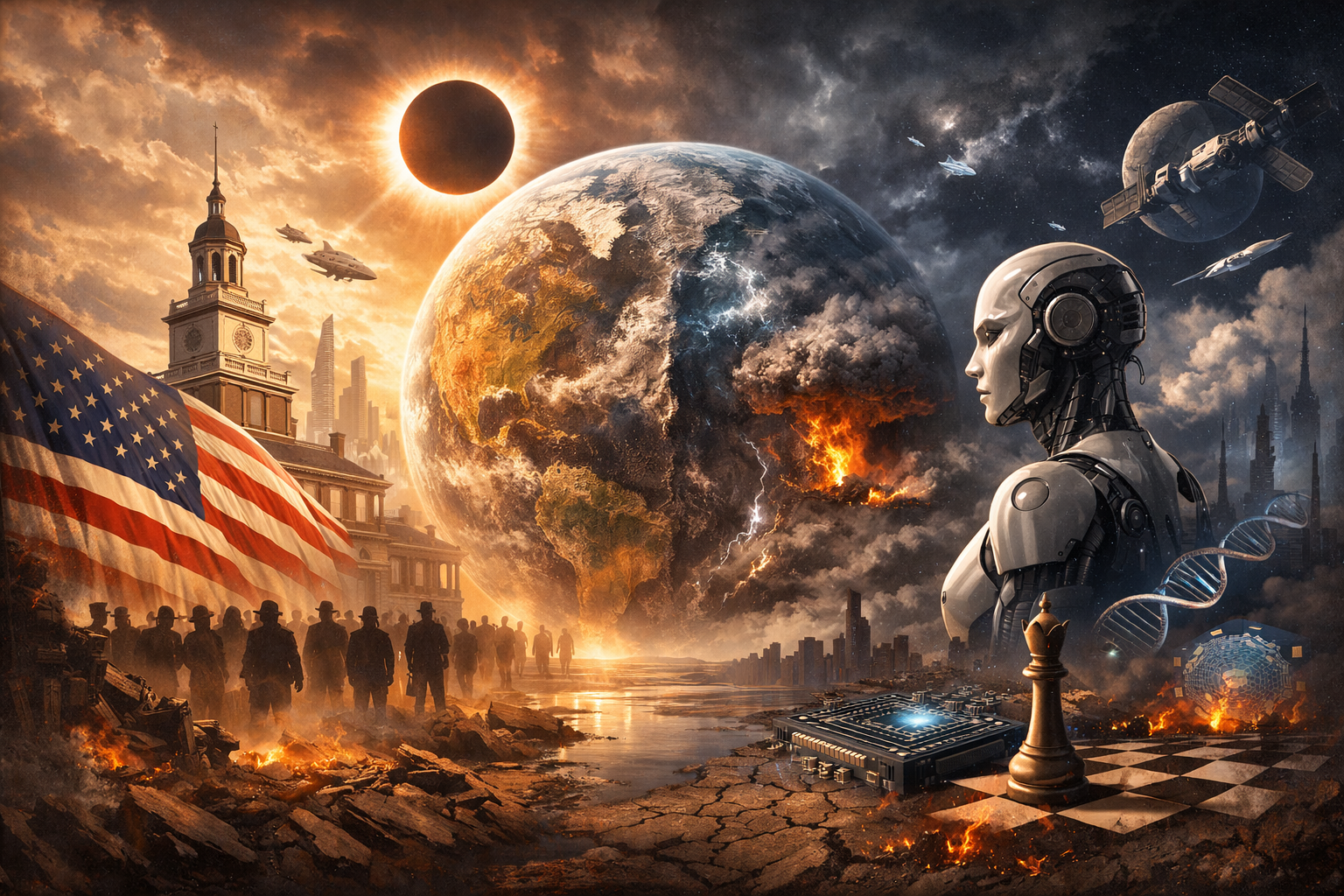
As the United States commemorates the 250th anniversary of the Declaration of Independence in 2026, humanity stands at a civilizational threshold unprecedented in recorded history. This paper examines the convergence of strategic uncertainty, systemic crises, and transformative forces that mark 2026 as an inflection point—not merely for American governance, but for the human species itself. The last time such a foundational moment occurred was July 4, 1776, when 56 signatories initiated what would become the final empire-building cycle on Earth. This paper argues that 2026 represents the beginning of a fundamentally different era: the transition from Type-1 to Type-2 civilization, where the architecture of power, governance, and human organization must be reimagined for planetary survival and flourishing.
Introduction: The Weight of the Moment
On July 4, 2026, over one million people will gather on the National Mall in Washington, D.C., for “the largest pyrotechnics display in the history of the world”[11]. Yet beneath the celebration lies a profound question: What comes after the age of empires?
The Declaration of Independence, signed by 56 founders in Philadelphia 250 years ago, inaugurated the last great experiment in empire-building—an American project that would reshape global civilization through constitutional democracy, industrial capitalism, and technological supremacy[6]. Now, as geopolitical volatility reaches unprecedented levels, as artificial intelligence rewrites the rules of power, and as planetary boundaries constrain traditional growth models, we confront a singular reality: the frameworks that built the modern world cannot sustain it into the next 250 years[1][2][3].
This is not hyperbole. Over 50% of respondents to the World Economic Forum’s Global Risk Report 2026 anticipate volatile times ahead, with uncertainty defined as “the defining theme of the global risks outlook”[1]. The Stimson Center identifies a “dissolution of order” among its top ten global risks, while EY’s Geostrategic Outlook warns that “geopolitical volatility and uncertainty will persist in 2026” as new rules emerge and old norms are discarded[3][8].
The Empire Cycle: From Foundation to Transformation
Historical analysis reveals that empires emerge in two distinct phases: first, homogenization of a core territory—standardizing language, laws, customs, weights, measures, and forging common identity—and second, outward expansion through institutionalized military and administrative power[9]. The American experiment followed this pattern precisely: constitutional consolidation (1776-1865), continental expansion (1803-1898), and global projection (1898-present).
What distinguishes 2026 is the recognition that this cycle has reached its terminus. Not through collapse or conquest, but through obsolescence. The challenges humanity now faces—climate transformation, AI governance, biosecurity, nuclear proliferation, synthetic media manipulation—cannot be addressed through traditional empire-building strategies[12]. They require civilizational coordination at scales and speeds for which no historical precedent exists.
Part I: The Strategic Crisis—Navigating Radical Uncertainty
The New Operating Environment
Strategic planning in 2026 confronts a fundamental problem: the future has become fundamentally ungovernable through conventional forecasting methods. As one analyst notes, “global economic and geopolitical uncertainty is no longer episodic”—it has become the permanent condition[2].
Consider the cascading uncertainties:
- Economic volatility: Inflation pressures coexist with technology-driven deflation; traditional monetary policy tools show diminishing effectiveness; supply chain fragmentation accelerates as “economic sovereignty” replaces efficiency optimization[8][15]
- Geopolitical fracture: The U.S. pivot to the Western Hemisphere, Europe under siege from multiple vectors, the emergence of a “Third Nuclear Era,” and what analysts call Trump’s “Economic Morass” create interdependent risk cascades[3][4]
- Technological disruption: AI capabilities advance beyond human comprehension timelines; biotech enables both miraculous cures and existential threats; synthetic media erodes epistemic foundations of democratic deliberation[7][12]
- Generational rebellion: Gen Z’s rejection of legacy institutions and social contracts creates labor market discontinuities and political realignments that traditional models cannot predict[3]
The Inadequacy of Linear Strategy
Traditional strategic frameworks—SWOT analysis, Porter’s Five Forces, scenario planning based on historical precedent—assume bounded uncertainty within stable systems. But 2026 presents unbounded uncertainty within systems undergoing phase transition[12].
Organizations attempting to navigate 2026 with conventional business strategy face what complexity theorists call “requisite variety” failure: their internal models lack sufficient complexity to match the environmental dynamics they face[5]. This explains why over 60% of major corporations report that traditional strategic planning cycles have become obsolete, replaced by continuous scenario modeling and adaptive governance structures[5][10].
The emerging approach requires three fundamental shifts:
- From prediction to preparation: Developing organizational capacities to sense, interpret, and respond to signals in real-time rather than executing pre-determined plans
- From optimization to resilience: Building redundancy, modularity, and rapid reconfiguration capabilities rather than eliminating “inefficiencies”
- From competitive advantage to systemic position: Understanding that individual organizational success depends on maintaining viable ecosystems, not just outperforming rivals[8][10]
Supply Chains as Strategic Infrastructure
Perhaps nowhere is the strategic crisis more visible than in global supply chain restructuring. The shift from just-in-time efficiency to “just-in-case” resilience represents a multi-trillion-dollar reallocation of capital and a fundamental rethinking of economic geography[8][15].
Governments worldwide pursue “de-risking and onshoring supply chains for critical products and strategic sectors,” driven by recognition that economic security and national security have become inseparable[8]. This fragments global markets, increases costs, and creates opportunities for regional powers to establish new spheres of influence.
Organizations must now manage supply chains as geopolitical instruments, conducting scenario planning around tariff shocks, climate disruptions, and political instability while maintaining operational flexibility[10][15]. This requires capabilities most firms have not developed: geopolitical intelligence, multi-jurisdiction risk modeling, and rapid supplier substitution protocols.
Part II: The Civilizational Threshold—Beyond Type-1 Organization
Defining the Phase Transition
The concept of civilizational “types” derives from the Kardashev Scale, originally developed to classify civilizations by energy consumption. A Type-1 civilization can harness all energy available on its planet; humanity currently ranks approximately 0.73 on this scale[7].
But energy is merely one dimension. The civilizational threshold we cross in 2026 involves multiple simultaneous phase transitions:
| Dimension | Type-1 (Industrial Age) | Type-2 (Planetary Age) |
| Governance | Nation-states with territorial sovereignty | Multi-level nested systems with functional sovereignty |
| Economics | Scarcity-based market capitalism | Abundance-enabled contributory systems |
| Technology | Tool augmentation of human capacity | Autonomous systems requiring alignment |
| Identity | Ethnicity, nationality, ideology | Species-consciousness + pluralistic belonging |
| Timescale | Quarterly/electoral cycles (months-years) | Intergenerational stewardship (decades-centuries) |
Table 1: Characteristics of civilizational phase transition
As philosopher Nikolai Berdyaev observed, we are witnessing “the decline of the realm of Caesar, the dissolution of state power”—not through anarchic collapse, but through the emergence of challenges that transcend territorial governance[7]. Climate change respects no borders. AI development in one jurisdiction affects global risk profiles. Biosecurity requires universal cooperation. Nuclear weapons obsolete traditional concepts of “winning” wars.
The Architecture of the Next Era
The crucial question becomes: What institutional architectures can coordinate human activity at planetary scale while preserving local autonomy, cultural diversity, and individual liberty?
This is not a technical question requiring optimization; it is a constitutional question requiring legitimacy, wisdom, and multi-civilizational dialogue. The 56 signatories of 1776 grappled with how to create a federated republic balancing state sovereignty with national coherence. The architects of 2026 must solve an exponentially more complex problem: how to create nested governance systems that can act decisively on existential threats while respecting civilizational pluralism[7][12].
Several principles emerge from current discourse:
- Subsidiarity: Decisions made at the lowest effective level, with higher-level coordination only for genuinely planetary challenges
- Interoperability: Different civilizational systems (Western liberal democracy, Chinese developmental statism, Indian civilizational democracy, Islamic governance models) must coexist and interact without requiring homogenization
- Rapid learning: Institutional structures must incorporate feedback loops operating at the speed of technological and environmental change
- Existential responsibility: Recognition that certain capabilities (advanced AI, engineered pathogens, climate modification) require species-level governance
The Role of America at 250
The United States occupies a unique position in this transition. As the nation that pioneered constitutional democracy at scale, that built the post-World War II international order, and that remains the primary generator of transformative technologies, America’s choices in 2026 will profoundly shape the civilizational trajectory[11].
Yet America also faces internal contradictions that mirror the global crisis: political polarization undermining governance capacity, economic inequality straining social cohesion, technological disruption outpacing regulatory frameworks, and generational divides over fundamental values[3][4].
The Freedom 250 celebration presents both symbol and test: Can America renew its founding commitment to “life, liberty, and the pursuit of happiness” in forms adequate to 21st-century realities? Can it model governance innovations that other nations might adapt? Can it exercise global leadership through example and partnership rather than unilateral assertion?
President Trump’s framing—”With a single sheet of parchment and 56 signatures, America began the greatest political journey in human history”—invites reflection on what the next “sheet of parchment” might contain[11]. Not a declaration of independence from empire, but perhaps a declaration of interdependence within a planetary civilization.
Part III: Converging Crises—The Vectors of Transformation
Crisis 1: The AI Governance Challenge
Artificial intelligence development has reached an inflection point where continued progress requires civilizational-level coordination. As one analysis frames it, “the architectures we build now—technical, legal, economic, cultural—will decide which future we inhabit. We do not have centuries”[7].
The challenge is threefold:
Technical alignment: Ensuring advanced AI systems pursue goals compatible with human flourishing, even as their capabilities exceed human comprehension in specific domains. This requires breakthroughs in interpretability, controllability, and value learning that current research paradigms may be insufficient to achieve.
Economic transition: AI automation promises radical abundance—the elimination of scarcity for basic necessities—but threatens massive labor displacement and wealth concentration. Navigating this requires rethinking fundamental economic structures: property rights in synthetic outputs, universal basic services, contributory models beyond wage labor[7].
Geopolitical coordination: AI development has become a primary axis of great power competition, with the U.S., China, and EU pursuing divergent regulatory approaches. Yet the risks (autonomous weapons, mass surveillance, algorithmic manipulation) require global frameworks. The tension between competitive advantage and collective safety defines the AI governance dilemma[12].
Without breakthrough institutions for AI governance, we face two equally unacceptable futures: authoritarian control over transformative technology, or chaotic proliferation beyond any meaningful oversight. The “narrow path” between these extremes requires innovations in international cooperation that transcend current geopolitical logic[7].
Crisis 2: Economic Security and Sovereignty
The post-1945 global economic order, built on assumptions of increasing integration and specialization, is fragmenting. The 2026 strategic environment is characterized by what analysts call “the geopolitics of scarcity”—nations competing for critical resources, supply chains, and technological capabilities rather than assuming mutual benefit from trade[8].
This manifests in several concrete trends:
- Reshoring and friend-shoring: Critical industries relocating to allied territories, fragmenting global markets
- Strategic stockpiling: Nations building redundancy in food, energy, minerals, and manufactured goods
- Technology sovereignty: Each major power pursuing independent capabilities in semiconductors, AI, biotech, quantum computing
- Financial weaponization: Currency systems, payment networks, and capital flows becoming tools of statecraft
For corporations, this transforms strategy fundamentally. “Operations and supply chains have consistently been the functional area most impacted by geopolitics in recent years—a trend we expect to continue in 2026″[8]. Companies must develop geopolitical intelligence capabilities, conduct multi-scenario supply chain modeling, and maintain flexibility to rapidly reconfigure operations across jurisdictions[10][15].
The deeper implication: the assumption that economic efficiency and security naturally align has collapsed. Organizations and nations must make explicit tradeoffs between optimization and resilience, between cost minimization and strategic autonomy[15].
Crisis 3: Climate and Planetary Boundaries
While less prominent in 2026 strategic discourse than AI or geopolitics, climate transformation operates as a “threat multiplier” amplifying every other challenge. Extreme weather events disrupt supply chains. Resource scarcity drives migration and conflict. Agricultural volatility destabilizes food-insecure regions[10].
The strategic implications extend beyond adaptation. Climate change is fundamentally a governance crisis: the market mechanisms that drove industrial civilization cannot price long-term planetary stability; democratic cycles measured in years cannot address processes operating over decades; national jurisdictions cannot manage global commons[12].
This creates an acute dilemma for 2026 strategists. Short-term competitive pressures drive behaviors (carbon-intensive manufacturing, resource extraction, deferred investment in sustainability) that undermine long-term viability. Without systems that can subordinate quarterly returns to intergenerational flourishing, climate transformation will continue regardless of individual good intentions.
Crisis 4: The Generational Discontinuity
Among the top ten global risks for 2026, the Stimson Center identifies “Gen Z Rebellion”—a recognition that generational change has become a strategic variable[3]. This is not merely demographic shift but a fundamental divergence in worldview, values, and institutional trust.
Generation Z (born approximately 1997-2012) demonstrates:
- Lower faith in traditional institutions (government, corporations, media) than any prior cohort
- Higher prioritization of meaning, purpose, and social impact over material accumulation
- Native fluency with digital technologies and expectation of real-time, decentralized coordination
- Acute awareness of climate, inequality, and systemic injustice coupled with skepticism about reform pathways
- Willingness to reject employment, consumption, and political participation if values are violated
For organizations, this creates talent acquisition and retention crises. For governments, it creates legitimacy challenges. For society, it creates the possibility of constructive transformation or destructive conflict—depending on whether existing power structures can adapt[3][5].
The 250th anniversary of American independence becomes particularly poignant in this context. Will Gen Z Americans experience the Declaration’s promises as living commitments or hollow rhetoric? Will they lead the renewal of American democracy or its replacement with something fundamentally different?
Crisis 5: The Information Integrity Crisis
Synthetic media, large language models, and algorithmic personalization have created what might be termed “epistemic warfare”—the systematic undermining of shared reality necessary for collective decision-making[12].
When any image can be fabricated, any voice synthesized, any evidence manufactured, and any narrative amplified to targeted audiences, the foundations of liberal democracy erode. Elections become suspect. Journalism becomes indistinguishable from propaganda. Scientific expertise becomes another “perspective” in an infinite buffet of claims[12].
This crisis compounds every other challenge: How do publics deliberate about AI governance when they cannot agree on what AI systems actually do? How do democracies respond to climate change when coordinated disinformation campaigns make basic facts politically contested? How do markets function when financial information can be weaponized?
The strategic response cannot be purely technical (better detection algorithms, authentication protocols) nor purely regulatory (content moderation, platform liability). It requires rebuilding epistemic institutions—trusted intermediaries, verification processes, communal sense-making—adequate to the speed and complexity of digital information flows[7][12].
Part IV: Strategic Responses—Building Capacity for Uncertainty
The Scenario Planning Imperative
If the future cannot be predicted, it must be imagined—systematically, rigorously, and continuously. Leading organizations have shifted from annual strategic planning to continuous scenario modeling, maintaining multiple internally consistent futures and monitoring indicators that suggest which trajectory is actualizing[5].
Effective scenario planning for 2026 requires:
- Identifying critical uncertainties: Which variables have high impact on strategy and high unpredictability? (E.g., U.S.-China relations, AI capability timelines, climate tipping points)
- Constructing diverse scenarios: Not just optimistic/pessimistic, but structurally different futures (multipolar cooperation vs. bloc confrontation vs. unipolar dominance vs. civilizational fragmentation)
- Stress-testing strategies: Evaluating planned initiatives across scenarios to identify brittleness and develop adaptive triggers
- Building optionality: Creating capabilities and relationships that provide value across multiple futures rather than optimizing for a single forecast
- Early warning systems: Designating indicators and thresholds that signal which scenario is emerging, enabling rapid strategic pivots[5][10]
This approach transforms strategy from a plan to be executed into a capacity to be exercised—the organizational ability to perceive, interpret, decide, and act as conditions evolve[1][5].
Resilience as Strategic Priority
In an environment where shocks are certain but their nature is unpredictable, resilience becomes the fundamental strategic imperative. This requires moving beyond efficiency optimization to embrace productive redundancy[10][15].
Key resilience principles include:
Diversification: Multiple suppliers, markets, revenue streams, and operational models reduce single-point failure risks. This applies to supply chains, talent pipelines, technology dependencies, and financial structures[15].
Modularity: Designing systems as loosely coupled components that can fail independently without cascading collapse. If one geographic region, supplier, or business unit faces disruption, others continue functioning[10].
Buffers and slack: Maintaining inventory, cash reserves, spare capacity, and flexible workforce arrangements creates absorption capacity for shocks. While reducing short-term returns, this improves long-term survival probability[10][15].
Rapid reconfiguration: Developing organizational capabilities to quickly redeploy resources, enter new markets, adopt new technologies, and revise business models as conditions shift. This requires modular systems, cross-functional talent, and adaptive governance[5].
Ecosystem strengthening: Recognizing that organizational resilience depends on viable supply chains, healthy communities, stable governance, and functioning infrastructure. Strategic investments in ecosystem health generate returns through reduced systemic risk[8][10].
Geopolitical Intelligence as Core Capability
For decades, geopolitical analysis was primarily the domain of governments, think tanks, and specialized advisory firms. In 2026, it has become a core organizational capability—essential for strategy, risk management, supply chain design, market entry, and capital allocation[8].
Organizations must develop:
\begin{itemize}
\item Monitoring systems: Tracking regulatory changes, political transitions, diplomatic developments, and security incidents across operational jurisdictions
\item Analytical frameworks: Translating geopolitical dynamics into business implications—how do tariffs affect costs? How do sanctions affect market access? How do political instability affect workforce availability?
\item Scenario integration: Incorporating geopolitical scenarios into strategic planning and investment decisions
\item Government engagement: Building relationships with relevant agencies, understanding policy trajectories, and participating in public-private dialogues
\item Crisis protocols: Establishing procedures for rapid response to geopolitical shocks—personnel evacuation, asset protection, communication management[8][10]
\end{itemize>
As EY notes, “companies that do this well improve their resilience to geopolitical volatility and position themselves to gain a competitive advantage”[8]. Geopolitical fluency becomes a source of strategic differentiation.
The Human Element: Leadership for Radical Uncertainty
Technology, process, and structure cannot alone navigate radical uncertainty. Leadership—the human capacity to make consequential decisions amid irreducible ambiguity—becomes paramount[2][5].
The leadership competencies required for 2026 differ from those that succeeded in more stable eras:
Comfort with ambiguity: Traditional leaders succeeded by providing clarity and direction. Leaders in 2026 must embrace uncertainty explicitly, framing it as opportunity rather than threat, and building organizations comfortable with provisional strategies and iterative adaptation[1][2].
Systems thinking: Understanding interdependencies, feedback loops, second-order effects, and emergent properties. Recognizing that optimizing one dimension (quarterly earnings, market share) may undermine systemic viability[5][10].
Moral courage: Making decisions that prioritize long-term flourishing over short-term results, that invest in resilience despite pressure for efficiency, that maintain ethical commitments when expedience beckons. This becomes critical as AI, surveillance, and manipulation capabilities increase[7][12].
Inclusive sense-making: Recognizing that diverse perspectives improve strategic perception—especially in environments where conventional wisdom frequently fails. Building teams and governance processes that surface dissent, integrate multiple frameworks, and challenge assumptions[5].
Generational bridge-building: Creating organizational cultures that harness Gen Z’s technological fluency, values commitment, and systems critique while integrating Millennial operational excellence, Gen X institutional knowledge, and Boomer wisdom[3].
Part V: The Constitutional Moment—Reimagining Governance
Why 2026 Matters: The Threshold Decade
We stand within what theorists call “the threshold decade”—a narrow window where fundamental choices about human organization will determine trajectories for centuries[7][12]. The decisions made (or deferred) regarding AI governance, climate action, economic systems, and international coordination in the 2020s will either enable planetary flourishing or lock in catastrophic paths.
This is not determinism but urgency. Complex systems exhibit path dependence: early choices constrain later options. Infrastructure built now will shape patterns for decades. Institutions established now will define default processes. Cultural narratives formed now will influence generational worldviews[12].
The 250th anniversary of American independence provides symbolic weight to this threshold moment. July 4, 1776, represented a conscious choice to experiment with new forms of governance—to declare that legitimate authority derives from consent rather than conquest, that rights are inherent rather than granted, that free people could govern themselves through constitutional frameworks[6][11].
What is the equivalent declaration for 2026? What fundamental commitments could ground a new era of human organization?
From Nation-States to Civilizational Pluralism
The Westphalian system of territorial nation-states, dominant since 1648, faces challenges it was never designed to address. Climate change, pandemics, AI safety, nuclear proliferation, financial contagion, and cyber warfare all transcend national boundaries[8][12].
Yet the alternative is not world government—a centralized authority governing all humanity. History suggests such concentration of power would become totalitarian; political theory suggests it would lack legitimacy across diverse civilizations; practical reality suggests it is unachievable[7].
The emerging framework might be termed civilizational pluralism within planetary coordination:
- Recognition that multiple civilizational systems (Western, Chinese, Indian, Islamic, African, Latin American) have legitimate claims to organize societies according to their histories, values, and contexts
- Establishment of functional coordination systems for genuinely planetary challenges—not imposing cultural uniformity but achieving operational interoperability
- Development of nested governance: local autonomy for local issues, national coordination for national challenges, regional cooperation for regional questions, planetary action for existential threats
- Creation of civilizational dialogue mechanisms—ongoing processes for negotiating shared frameworks while respecting differences
- Explicit rejection of imperial logic—no single civilization’s model should be imposed universally, but all civilizations must accept constraints necessary for collective survival[7][12]
This requires a profound shift in political imagination. For centuries, the question was: “Which nation/ideology/civilization should dominate?” The new question becomes: “How can civilizations coordinate without domination?”
The DDDI Framework: Analytical Lenses for Transformation
One promising approach to analyzing this civilizational transition is the DDDI framework—examining challenges through four complementary lenses:
Dominion: Questions of power, sovereignty, and decision-making authority. Who governs? Through what mechanisms? With what legitimacy? How is power checked and balanced? In 2026, dominion questions become acute as traditional state sovereignty confronts transnational challenges and non-state actors (technology platforms, AI systems, decentralized networks) accumulate power outside conventional frameworks.
Dharma: Questions of right action, moral obligation, and systemic responsibility. What duties do individuals, organizations, and nations bear toward each other and toward future generations? How do we adjudicate between competing values? What principles should guide behavior when consequences are uncertain? Dharma thinking becomes essential as technological capabilities (AI, biotech, climate modification) create moral dilemmas without precedent.
Destiny: Questions of trajectory, purpose, and collective aspiration. What future do we seek to create? What potential do we wish to actualize? How do we navigate between determinism and possibility? Destiny thinking helps societies move beyond reactive crisis management to proactive world-building.
Identity: Questions of belonging, meaning, and self-understanding. Who are “we”? What stories define us? How do we balance local/national/civilizational/human identities? How do we maintain cultural particularity while embracing planetary citizenship? Identity questions become critical as globalization, migration, and digital connection blur traditional boundaries.
Analyzing 2026’s challenges through these four lenses—simultaneously considering power structures (Dominion), moral frameworks (Dharma), collective aspirations (Destiny), and communal identities (Identity)—enables more comprehensive strategic thinking than single-dimension approaches[7].
Institutional Innovation: The Next 250 Years
If 1776 inaugurated constitutional democracy, what institutional innovations might 2026 inaugurate?
Several possibilities are emerging from current discourse and experimentation:
Futures councils: Governance bodies explicitly representing long-term interests and future generations, with authority to veto present-day policies that impose unacceptable risks on the future. Wales and several other jurisdictions have begun experimenting with “Futures Commissioners”—officials charged with advocating for intergenerational equity in policy debates[12].
Civilizational assemblies: Forums where representatives from different civilizational traditions engage in sustained dialogue about planetary challenges, seeking frameworks that respect diverse values while enabling coordination. These would complement rather than replace existing international institutions[7].
Algorithmic transparency regimes: International frameworks requiring disclosure of AI training data, model architectures, and deployment contexts—enabling independent assessment of risks while protecting legitimate intellectual property. This would parallel the emergence of financial transparency requirements in the 20th century[12].
Planetary trust funds: Mechanisms for financing long-term public goods (climate adaptation, pandemic preparedness, AI safety research, space resource development) through contributions from nations and corporations that benefit from global systems. These would operate outside national budgets and electoral cycles[12].
Participatory foresight processes: Systematic methods for engaging publics in imagining alternative futures, articulating values, and deliberating about tradeoffs—rebuilding democratic legitimacy in an era of expert dominance and technical complexity[7].
Civilizational AI systems: Rather than a single dominant AI (controlled by government or corporation), a plurality of AI systems reflecting different civilizational values and priorities, with interoperability protocols enabling cooperation while preserving diversity[7].
None of these alone constitute a solution. Together, they suggest directions for institutional evolution—ways humanity might organize itself that differ from both empire and anarchy.
Part VI: The Path Forward—Strategy for the Next Era
Near-Term Priorities (2026-2030)
The remainder of this decade requires specific focus on foundation-building:
- AI governance breakthroughs: Establishing international frameworks for AI safety research, capability disclosure, and deployment oversight before advanced systems become unmanageable
- Supply chain resilience: Completing the transition from fragile efficiency to robust redundancy in critical sectors—semiconductors, pharmaceuticals, food systems, energy infrastructure
- Climate adaptation acceleration: Moving beyond incremental mitigation to systematic preparation for unavoidable impacts—managed migration, drought-resistant agriculture, infrastructure hardening
- Generational bridge-building: Creating pathways for Gen Z leadership, institutional innovation, and value integration—preventing generational conflict from undermining collective action
- Information integrity restoration: Developing technical, regulatory, and social systems for maintaining epistemic commons—enabling democratic deliberation in the age of synthetic media
- Economic transition piloting: Experimenting with post-scarcity economic models—universal basic services, contributory systems, wealth distribution mechanisms—in preparation for AI-driven abundance[1][3][7][10][12]
Medium-Term Transformation (2030-2050)
The second quarter-century requires fundamental restructuring:
Governance evolution: Transitioning from pure nation-state sovereignty to nested, multi-level systems with functional coordination on planetary challenges. This may involve constitutional innovations, treaty regimes, and civilizational dialogue mechanisms developed in the 2020s[7][12].
Economic reimagining: As AI and automation eliminate scarcity in basic necessities, restructuring economic systems to distribute abundance, maintain meaning through contribution, and ensure dignity independent of wage labor. This represents a transformation as significant as the agricultural or industrial revolutions[7].
Planetary stewardship: Achieving active management of Earth systems—carbon cycles, biodiversity, water systems, climate—through coordinated action and accountable institutions. This shifts humanity from inadvertent planetary force to conscious steward[12].
Technological alignment: Ensuring that advanced AI, biotech, nanotechnology, and other transformative capabilities remain controllable and beneficial—avoiding catastrophic misuse while enabling legitimate applications[7][12].
Identity evolution: Fostering species-consciousness and planetary citizenship while preserving cultural diversity and local belonging. This requires new narratives, educational systems, and institutional designs that make “thinking globally, acting locally” psychologically and practically viable[7].
Long-Term Vision (2050-2276)
Looking toward America’s 500th anniversary in 2276—another 250-year cycle—we might envision:
A planetary civilization characterized by:
- Multiple flourishing civilizational systems, each organizing societies according to their traditions while coordinating on existential challenges
- Radical abundance in material necessities, enabling all humans to meet basic needs and pursue meaningful contribution
- Advanced AI systems aligned with human values and operating under legitimate governance frameworks
- Stable climate and thriving biosphere through active stewardship
- Expansion beyond Earth, with sustainable presence on Moon, Mars, and beyond—becoming multiplanetary species
- Intergenerational justice mechanisms that give future humans voice in present-day decisions[7][12]
This vision is not utopian fantasy but extrapolation of current trajectories if we navigate the threshold decade successfully. It is achievable—but only if the strategic, institutional, and cultural work begins now.
The Role of the Individual
Grand civilizational visions can seem abstract or overwhelming. What can individuals do?
- Develop strategic literacy: Learn to think in systems, scenarios, and long timescales. Understand the interdependencies shaping our world.
- Build bridges: Connect across generational, political, cultural, and civilizational divides. The coordination we need requires trust that transcends existing fault lines.
- Practice institutional innovation: Within organizations, communities, and governments, experiment with new forms of decision-making, resource allocation, and collective action.
- Cultivate moral courage: Make choices aligned with long-term flourishing even when short-term pressures push toward expedience. This applies to consumption, investment, employment, and civic participation.
- Tell new stories: The narratives we tell about who we are and what futures are possible shape collective imagination. Contribute to narratives that make planetary coordination and civilizational pluralism conceivable.
- Embrace uncertainty: Rather than seeking false certainty, develop capacity to act wisely amid irreducible ambiguity. This is the core competency for the threshold decade[1][5][7]
Civilizational transformation is not the work of lone heroes or singular leaders. It emerges from millions of individuals making choices that, in aggregate, shift trajectories.
Conclusion: Beyond Empire—The Invitation of 2026
The 56 founders who signed the Declaration of Independence in 1776 could not have imagined the world their action would help create: a nation spanning a continent, technologies enabling instant global communication, weapons capable of extinguishing civilization, and prosperity beyond ancient monarchs’ dreams[6][11].
Yet they grasped something essential: that fundamental transformation requires both vision and commitment—willingness to imagine alternatives to existing order and courage to act on that imagination despite uncertainty and risk.
We stand at an analogous moment. The empire-building cycle inaugurated in 1776—the attempt to organize human affairs through territorial nation-states competing for dominance—has reached its limit. The challenges we face cannot be solved through imperial logic. They require something genuinely new: coordination without domination, diversity without fragmentation, global consciousness without cultural erasure[7][12].
This is the threshold 2026 represents. Not an ending but a beginning. Not collapse but transformation. Not the last empire but the first planetary civilization.
The strategic crisis, the converging uncertainties, the systemic risks—these are not aberrations to be managed until “normal” returns. They are birth pangs of a new era. How we respond in the threshold decade will determine whether that new era represents human flourishing or catastrophic failure[1][2][3][8][12].
The celebration on July 4, 2026, with over a million people on the National Mall and “the largest pyrotechnics display in the history of the world,” should be more than commemoration[11]. It should be rededication—a conscious choice to embrace the responsibility that comes with living at a hinge point in human history.
The founders of 1776 gave us constitutional democracy, rule of law, and protection of rights. The founders of 2026—the millions of individuals, organizations, and institutions making consequential choices in this decade—have the opportunity to give future generations something equally profound: the frameworks for planetary flourishing, civilizational pluralism, and intergenerational justice.
This is not burden but invitation. Not obligation but opportunity. The chance to participate in building the next era of human organization is offered to few generations. We have that chance.
The question is not whether transformation will occur—the phase transition is already underway. The question is whether we will shape it consciously, guided by wisdom and foresight, or stumble through it reactively, driven by crisis and improvisation[12].
Strategy in the age of uncertainty requires this recognition: The future is not discovered but created. Not predicted but chosen. Not inevitable but possible.
As America celebrates 250 years since the Declaration of Independence, let us declare our interdependence—with each other, with future generations, with the living planet that sustains us, and with the civilizational diversity that enriches us.
The empire-building age is complete. The planetary age begins. The strategy we need is the strategy of conscious evolution—guiding our species through the threshold toward futures we can be proud to bequeath.
The next 250 years start now.
References
[1] World Economic Forum. (2026, March 13). Redefining corporate strategy in a more volatile world. https://www.weforum.org/stories/2026/03/how-corporate-strategy-is-changing-in-a-world-of-constant-shocks/
[2] Council on Competitiveness. (2026, January 9). Navigating uncertainty in 2026: A focus upon consumers, capital, and data. https://compete.org/2026/01/09/navigating-uncertainty-in-2026/
[3] Stimson Center. (2026, February 25). Top ten global risks for 2026. https://www.stimson.org/2026/top-ten-global-risks-for-2026/
[4] TIME Magazine. (2026, January 5). The top 10 global risks for 2026. https://time.com/7343169/top-10-global-risks-2026/
[5] The Founders Space. (2026, March 20). Business strategy news: Thrive in 2026’s uncertainty. https://thefoundersspace.com/2026/03/21/business-strategy-news-thrive-in-2026s-uncertainty/
[6] Ronald Reagan Presidential Library. (2026). America 250. https://www.reaganlibrary.gov/exhibits/america-250
[7] Bauwens, M. (2025, December 31). Towards ‘civilizational’ AI: Our central task in 2026. 4th Generation Civilization Substack. https://4thgenerationcivilization.substack.com/p/towards-civilizational-ai-our-central
[8] EY Global. (2026, February 3). Top 10 geopolitical developments in 2026. https://www.ey.com/en_gl/insights/geostrategy/geostrategic-outlook
[9] Book and Sword. (2024, January 12). Two-phase empire building. https://www.bookandsword.com/2024/01/13/two-phase-empire-building/
[10] Zurich Resilience. (2026, February 2). Key risks for 2026: How U.S. organizations can build resilience. https://zurichresilience.com/knowledge-and-insights-hub/articles/2026/02/key-risks-to-watch-for-in-2026
[11] The White House. (2026, March 11). Freedom 250. https://www.whitehouse.gov/freedom250/
[12] Fractal Trilogy. (2026, February 28). The next gate: Liminality, phase transitions, and the civilizational threshold. https://fractalthetrilogy.com/blog/the-next-gate-liminality-phase-transitions-and-the-civilizational-threshold/
[13] AI-CIO. (2026, February 26). Geopolitical volatility defines markets to start 2026. https://www.ai-cio.com/news/geopolitical-volatility-defines-markets-to-start-2026/
[14] National Bureau of Economic Research. (2001, January 31). Annexation or conquest? The economics of empire building. https://www.nber.org/papers/w8109
[15] Accountancy Age. (2025, December 15). Navigating 2026: Building resilience in a world of uncertainty. https://accountancyage.com/2025/12/16/navigating-2026-building-resilience-in-a-world-of-uncertainty/