
Dominion
An Op-Ed by Vivek Singhal | DDDI.net | March 2026
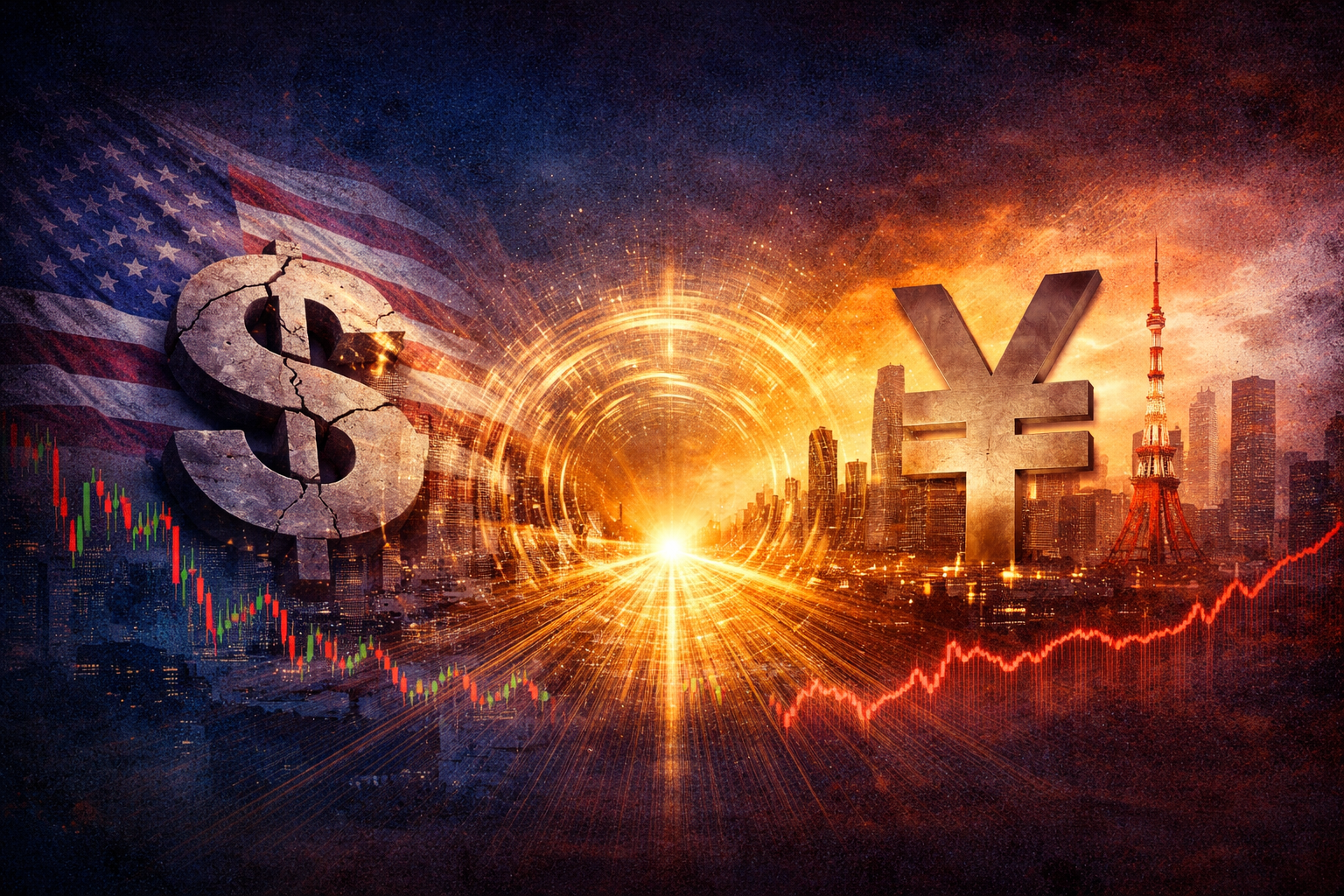
We are not merely watching a currency trade unwind. We are watching the architecture of the post-WWII financial order fracture in slow motion — precisely as humanity crosses the threshold of what I call the Twilight Singularity Tunnel: the compressed corridor of 2026–2032, where multiple intelligences — artificial, civilizational, financial, and biological — converge, collide, and reconfigure the human story.
The Japan yen carry trade is not a financial footnote. It is the canary in the coal mine of American Dominion.
What the Carry Trade Actually Is
For three decades, global hedge funds — anchored through prime brokers like Goldman Sachs and Morgan Stanley — borrowed Japanese yen at near-zero interest rates, converted them into US dollars, and invested in higher-yielding American assets, particularly US Treasuries yielding 3–5%[1]. The interest rate differential was the profit. The yen’s engineered stability was the shield. The Bank of Japan’s (BoJ) perpetual accommodation was the engine. At peak, Japan’s net international investment position stood at 85% of GDP in foreign-held assets — the largest creditor nation on Earth, quietly subsidizing American fiscal deficits every year[2].
But the engine is now running in reverse.
The BoJ raised its policy rate from -0.1% to 0.75% as of early 2026 — the first sustained tightening cycle in a generation[3]. Japan’s inflation has exceeded 2% for three consecutive years. Wages are rising at levels not seen since 1991. Business capital expenditure plans are up significantly[4]. The structural deflation that anchored Japanese rates near zero for a generation is over. In February 2026, BCA Research issued an unambiguous warning: the yen carry trade is a “ticking time bomb,” vulnerable to a catastrophic unwind reminiscent of 2008, 2015, and 2020[5][6]. Michael Burry has echoed the same alarm. As of late January 2026, yen surges and dollar weakness suggest the unwind may already be accelerating[7].
What happens when it unwinds? Investors sell US Treasuries. They convert dollars back into yen to repay loans. The result: a one-two punch of rising US bond yields and a strengthening yen[8]. Critically, domestic Japanese savers and institutions — now earning real returns at home — stop recycling surplus savings into American debt[1]. The silent subsidy of US fiscal dominance evaporates. Over the past year through January 2026, the dollar has declined 10% against major currencies[9].
This is not just a market event. Through the DDDI lens, it is a civilizational inflection point.
The DDDI Framework: Four Lenses on a Fracturing World
The Dominion-Dharma-Destiny-Identity (DDDI) framework, developed at DDDI.net, provides the analytical architecture to understand what is truly at stake when the yen carry trade unwinds in 2026 — not just in markets, but for the human species.
Dominion: The Dollar’s Sunset
Dominion — the capacity to set rules, extract tribute, and define the boundaries of the possible — is the foundational currency of civilizational power. America’s greatest act of Dominion in the 20th century was not military; it was monetary. The Bretton Woods system, the Nixon shock’s petrodollar architecture, and the role of the US Treasury market as the world’s “risk-free” asset were together the most sophisticated extraction mechanism in human history. Nations that ran current account surpluses — Japan, China, Germany, the Gulf states — were compelled to recycle those surpluses back into dollar-denominated assets, financing American consumption and deficit spending[2].
The carry trade was Dominion operating at its most elegant: America borrowed the world’s savings at near-zero cost, deployed them as geopolitical leverage, and paid back with dollars it could print. The yen carry unwind — combined with China’s gradual reduction of Treasury holdings, BRICS de-dollarization efforts, and the dollar’s sharp 10% decline over the past year through January 2026[9] — signals that this Dominion architecture is entering its twilight.
The dollar has not collapsed. MIT economist Kristin Forbes notes a “growing gap between demand for the dollar and demand for US Treasuries” — a divergence that “can persist, but when it closes, it can do so quickly”[10]. Yet analysts at Davos 2026 confirmed what DDDI analysis has long argued: the dollar’s dominance is secure for now, not because of American strength, but because “international trade currently has limited alternatives”[11]. We are entering a world of contested monetary multipolarity, where the euro, yuan, yen, and even gold-backed digital instruments compete for the reserve function[12].
This is not America’s demise. It is America’s transformation — from unipolar hegemon to first among several. The question is whether American leadership has the strategic wisdom to manage this transition or whether it will resist it, triggering the very crisis it fears. As Harvard economist Kenneth Rogoff warned at Davos 2026, “We lived for decades in a world where trust in the dollar was taken for granted. Once that trust weakens, investors don’t necessarily move to another currency — they move into real assets”[10].
Dharma: Japan’s Moral Monetary Reckoning
Dharma — the civilizational principle of right order, purposeful duty, and systemic integrity — illuminates Japan’s side of this equation with striking clarity. Japan’s decision to normalize interest rates is, in dharmic terms, an act of self-respect. For decades, the BoJ suppressed rates to protect the US Treasury market and maintain export competitiveness — at the cost of penalizing Japanese savers, hollowing out domestic investment, and inflating a debt-to-GDP ratio now the highest in the developed world[1][4].
Japan’s inflation now exceeds 2%. Wages are rising. Labour shortages are at their most severe since the 1991 bubble era[4]. The dharma of a sovereign central bank — to serve its domestic population — now requires rate normalization. The carry trade’s death is thus not a crisis of Japan’s making; it is Japan finally honoring its own dharmic covenant with its citizens.
There is a deeper civilizational lesson here. Any system built on the suppression of another civilization’s dharma — whether through monetary coercion, trade dependency, or political subordination — carries the seeds of its own destabilization. The yen carry trade was a temporary arbitrage of Japan’s dharmic deferral. That deferral is over.
Destiny: The Twilight Singularity Tunnel
Destiny in the DDDI framework refers to the long-arc historical forces that civilizations cannot negotiate away — the structural trajectories shaped by demography, technology, resource distribution, and the physics of compound change. We are entering the most compressed Destiny corridor in recorded human history.
I call 2026–2032 the Twilight Singularity Tunnel — a period when multiple intelligences converge simultaneously:
- Artificial Intelligence: Dario Amodei of Anthropic has predicted that “powerful AI” could arrive as early as 2026, calling it a “singularity”-type moment[13]. OpenAI’s Sam Altman has written of “The Gentle Singularity.” DeepMind’s Demis Hassabis places a 50% probability of AGI by 2030[14]. AGI-adjacent systems are now embedded in financial markets, geopolitical decision-making, and military systems. The same AI that manages trillion-dollar carry trade positions can amplify a liquidity crisis at machine speed.
- Financial Intelligence: Central bank algorithms, high-frequency trading, and quantum-enhanced risk models mean the next carry trade unwind will not take weeks — it will take hours. BCA Research estimates that as of October 2025, the total value of forwards held by global hedge and principal trading firms reached ¥35 trillion, while the overall value of forwards, FX swaps, and currency swaps soared to ¥2,281 trillion[6]. The 2024 flash unwind — when the yen briefly surged and global equities lost trillions in days — was a preview.
- Civilizational Intelligence: The BRICS bloc, the Global South, and Indo-Pacific re-alignments represent the awakening of civilizational strategic consciousness — nations and cultures reclaiming their dharmic sovereignty from a Western-centric financial order. China now conducts oil transactions with Iran and Russia predominantly in renminbi[11]. The dollar’s role as the sole settlement currency for global energy is ending.
- Biological Intelligence: Post-pandemic, nations are now factoring human capital resilience, demographic collapse (particularly in Japan, China, and Europe), and longevity economics into long-term monetary strategy. Japan’s wage growth and labor shortages represent a demographic reckoning that monetary policy can no longer defer.
These four intelligences are not running in parallel. They are colliding inside the Twilight Singularity Tunnel. The yen carry trade is the first major detonation in that tunnel. It will not be the last.
Identity: Who Is America, Now?
Identity — the civilizational self-concept that governs a nation’s choices, alliances, and responses to crisis — may be the most consequential dimension of all in 2026.
America faces an identity crisis of historic proportions. Under President Trump’s second term, the MAGA framework is attempting to re-assert American Dominion through tariffs, re-industrialization, and dollar weaponization. Yet simultaneously, the structural conditions that sustained that Dominion — cheap Japanese capital, Chinese manufacturing subsidies, Gulf petrodollar recycling — are all unwinding at once[1][7][9]. The Trump administration’s Genius Act, establishing a framework for US dollar-backed stablecoins, represents an attempt to preserve dollar hegemony through technological innovation[11]. Yet as Columbia economist Jeffry Frieden warned at Davos 2026, “It takes decades to build trust and very little time to damage it”[10].
The fundamental Identity question America must answer is: Are you the architect of a rules-based international order, or its largest free-rider? The yen carry trade unwind forces this reckoning because it exposes that American fiscal dominance was never purely earned — it was partly gifted by allied nations whose own dharmic interests were subordinated to a US-led system. As that system fractures, America’s identity as the “indispensable nation” must evolve.
The DDDI framework suggests that civilizations which cannot adapt their identity during Destiny inflection points do not merely decline — they crystallize, becoming brittle monuments to a past they can no longer sustain.
Global Implications for the Human Species
The stakes extend far beyond bond yields and currency pairs. The yen carry trade unwind, occurring inside the Twilight Singularity Tunnel, has species-level consequences:
1. The End of the Debt-Financed Civilization Model. The Western model of economic growth — funded by sovereign debt recycled through allied nations — is reaching its thermodynamic limit[1][2]. When Japan’s capital flows home, when China reduces Treasury exposure, when Gulf states diversify into yuan and gold, the US government faces a structural funding gap. Forbes warns of “early warning signs in US debt markets,” noting that investors appear “less willing to pay a premium for dollar-denominated government debt”[10]. This forces a choice between fiscal austerity, monetary inflation, or — most dangerously — geopolitical coercion to maintain capital captivity. Each path reshapes the human political economy.
2. AI-Amplified Financial Contagion. The next carry trade unwind will be executed at AI speed. When algorithmic systems detect a yen surge, they will simultaneously liquidate correlated positions across equities, crypto, emerging market bonds, and commodities — in microseconds. The 2026 financial system has no circuit breaker calibrated for this velocity. The human species is operating 19th-century institutional governance on top of 22nd-century financial machinery.
3. Civilizational Rebalancing and the India Opportunity. As the dollar-centered order fractures, civilizations with strong internal dharmic coherence — large populations, growing productivity, diversified trade relationships, and cultural continuity — will gain strategic ground. India, positioned at the intersection of the Global South and the Western democratic order, with a young demographic dividend and a diaspora deeply embedded in American financial and technology institutions, stands as the single most consequential swing civilization in this rebalancing. The MAGA-MIGA synthesis — America’s industrial renaissance aligned with India’s Viksit Bharat ambition — represents the most promising civilizational alliance in the Twilight Singularity Tunnel.
4. The Sovereign Human Question. At the deepest level, the yen carry trade unwind is a symptom of a civilization that outsourced its economic sovereignty to financial engineering. As multiple intelligences — artificial, financial, civilizational — converge, the central question for the human species becomes: Who governs the governors? Who controls the AI systems managing ¥2,281 trillion in carry positions[6]? Who audits the central bank algorithms? Who speaks for the human beings whose livelihoods are restructured in milliseconds by decisions made in data centers?
This is the existential Destiny question of the Twilight Singularity era. The answer will determine whether humanity emerges from the tunnel transformed — or consumed by it.
The DDDI Prescription: Navigating the Tunnel
The Twilight Singularity Tunnel is not a catastrophe to be avoided. It is a passage to be navigated with civilizational wisdom. The DDDI framework suggests four imperatives:
- Dominion: America must transition from unilateral to cooperative monetary leadership — building new Bretton Woods-style frameworks that legitimize a multipolar reserve system while preserving democratic values as the organizing principle. The dollar’s dominance will be “protected at all costs,” as analysts note[11], but protection through coercion breeds systemic fragility. Protection through legitimacy breeds resilience.
- Dharma: Every nation must fulfill its sovereign duty to its own people first — Japan’s rate normalization is a model of dharmic monetary courage that other nations, including the US, must emulate through fiscal discipline. Nations that subordinate domestic dharma to external Dominion systems accumulate resentment that eventually destabilizes the entire order.
- Destiny: Civilizations must invest now in the institutions, alliances, and governance frameworks that will manage the convergence of multiple intelligences — AI governance bodies, multilateral financial early-warning systems, and new human-AI constitutional compacts. The absence of such frameworks doesn’t prevent the convergence; it merely ensures the convergence will be chaotic rather than coordinated.
- Identity: America must rediscover its founding identity — not as empire, but as idea. The America that built Bretton Woods, the Marshall Plan, and the internet was an America that understood that its Dominion was most durable when it was shared. That identity is not lost. It is waiting to be reclaimed.
Conclusion
The yen carry trade is unwinding. The dollar’s unchallenged hegemony is twilighting. Multiple intelligences are awakening simultaneously. And humanity stands at the entrance of a tunnel whose exit it cannot yet see.
But civilizations that enter tunnels with wisdom, courage, and a clear sense of their own dharma — their purpose, their duty, their identity — do not disappear in the darkness.
They emerge, transformed, into a new light.
The question for 2026 is not whether we enter the tunnel. We already have. The question is whether we have the civilizational intelligence to navigate it.
Vivek Singhal is the Founder of the Dominion Dharma Destiny Identity Institute (DDDI.net) and a strategic advisor on US-India relations, civilizational futures, and AI governance. He writes at the intersection of geopolitics, technology, and civilizational philosophy.
References
[1] The Japan Carry Trade Unwinding. (2026, March 2). Market Research Blog. https://blog.marketresearch.com/the-japan-carry-trade-unwinding
[2] Yen Carry Trade Collapse: Global Market Impact Guide. (2025, November 26). Discovery Alert. https://discoveryalert.com.au/yen-carry-trade-collapse-2025-global-impacts/
[3] The Japanese Yen Carry Trade: What Investors Need to Know in 2026. (2026, March 17). Substack. https://substack.com/home/post/p-187407613
[4] USD/JPY outlook: Why the carry trade is breaking down. (2025, December 14). Deriv. https://deriv.com/blog/posts/usdjpy-carry-trade-breaking-down
[5] Yen carry trade is a ‘ticking time bomb,’ warns BCA research. (2026, February 10). The Japan Times. https://www.japantimes.co.jp/business/2026/02/11/markets/yen-carry-trade-time-bomb/
[6] Why this analyst says the yen carry trade is “a ticking time bomb”. (2026, February 15). Yahoo Finance. https://finance.yahoo.com/news/why-analyst-says-yen-carry-083004883.html
[7] Yen jumps in broad hit to dollar as Japan intervention risks grow. (2026, January 25). Reuters. https://www.reuters.com/world/asia-pacific/view-yen-jumps-broad-hit-dollar-japan-intervention-risks-grow-2026-01-26/
[8] How Japan’s Yen Carry Trade Could Trigger a Global Liquidity Crisis. (2025, November 28). LinkedIn. https://www.linkedin.com/pulse/how-japans-yen-carry-trade-could-trigger-global-liquidity-shah-uhyff
[9] What the data shows—and doesn’t show—about the future of the dollar. (2026, February 3). Atlantic Council. https://www.atlanticcouncil.org/blogs/what-the-data-shows-and-doesnt-show-about-the-future-of-the-dollar/
[10] Davos 2026: Dollar dominance secure for now, but debt and policy risks loom. (2026, January 20). Economic Times. https://economictimes.com/news/international/global-trends/davos-2026-dollar-dominance-secure-for-now-but-debt-and-policy-risks-loom/
[11] US dollar: ‘Wounded hegemon’ or secure as most powerful currency on earth. (2026, January 27). Al Jazeera. https://www.aljazeera.com/news/2026/1/27/us-dollar-wounded-hegemon-or-secure-as-most-powerful-currency-on-earth
[12] America Might Not Rule, but the Dollar Still Does. (2026, February 25). The New York Times. https://www.nytimes.com/2026/02/25/opinion/us-dollar-china-currency-eu.html
[13] 2026 Singularity? Muskian Comment Is Backed By Real Stuff. (2026, January 5). Forbes. https://www.forbes.com/sites/johnwerner/2026/01/05/2026-singularity-muskian-comment-is-backed-by-real-stuff/
[14] AGI/Singularity: 9,800 Predictions Analyzed. (2026, February 23). AIMultiple. https://aimultiple.com/artificial-general-intelligence-singularity-timing