Four New India Abroad Columns on Aram, Porul, Inbam and the Phygital World Order
Thinking of the Future; Acting in the Present®
| Prepared as a four-part opinion series for New India Abroad September 2026 |
COLUMN 1 | NEW INDIA ABROAD
Why Modi Gave Putin the Thirukkural
Bharat’s Civilizational Message to BRICS+
By Vivek Singhal | Founder, DDDI Institute
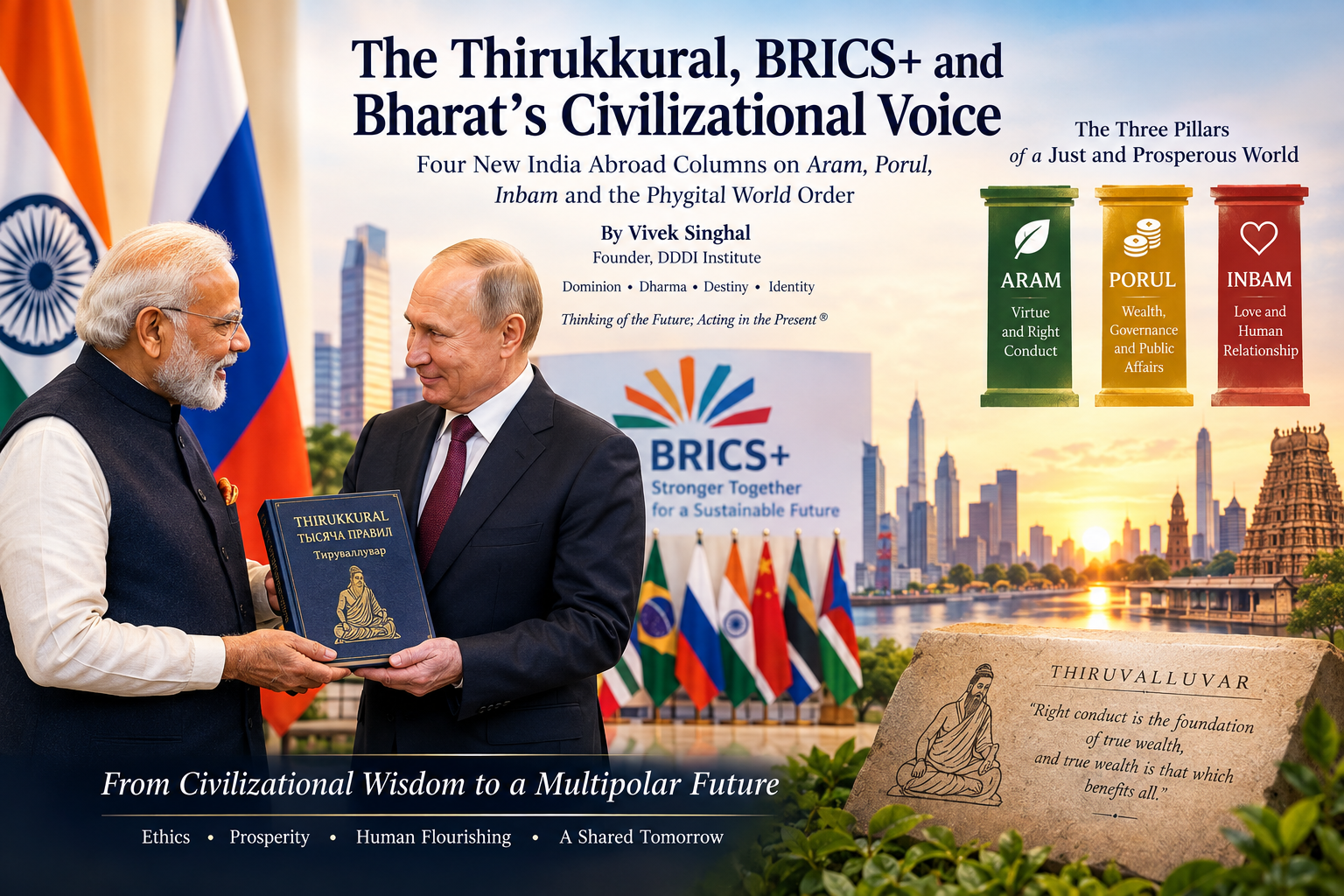
Suggested visual: Prime Minister Narendra Modi presenting President Vladimir Putin with the Russian translation of the Thirukkural, New Delhi, Sept. 11, 2026.
At first glance, it was simply a diplomatic gift.
Prime Minister Narendra Modi meeting Russian President Vladimir Putin in New Delhi and presenting him with a Russian translation of the Thirukkural might appear to belong to the familiar choreography of summit diplomacy.
It deserves to be read much more seriously.
At a moment when BRICS is debating currencies, sanctions, energy, trade, technology and the architecture of a changing international order, India chose to place in the hands of the Russian president not a treatise on military strategy, economics or geopolitics, but the wisdom of Thiruvalluvar.
The symbolism is extraordinary.
The Thirukkural consists of 1,330 compact couplets organized around three great dimensions of human existence: Aram, or virtue and right conduct; Porul, encompassing wealth, governance and public affairs; and Inbam, the world of love and human relationship.
In other words, more than a millennium before modern political economy separated ethics from economics, Thiruvalluvar was asking a question the contemporary world badly needs to recover:
What is wealth for, and by what ethical principles should power be exercised?
That question could hardly be more relevant to BRICS+.
The enlarged BRICS now contains 11 members and represents roughly half of humanity. India is hosting the 2026 summit under the theme Building for Resilience, Innovation, Cooperation and Sustainability.
Yet BRICS faces a choice.
It can become merely another coalition seeking a larger share of global power. Or it can help develop a more plural, equitable and responsible architecture of global governance.
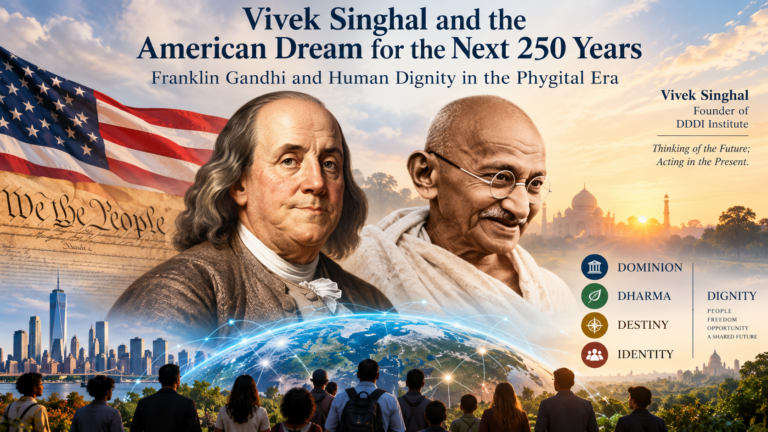
The distinction is the difference between what I call Dominion and Dharma.
Dominion asks: Who controls the resources, institutions and rules?
Dharma asks: For what purpose, by what principles and for whose flourishing should that power be used?
The twentieth century produced competing systems – capitalism, communism, socialism, nationalism and various combinations of them. Each sought command over resources and institutions.
The twenty-first century requires something different.
Artificial intelligence, biotechnology, planetary supply chains, digital currencies, autonomous systems and global communications are making humanity more interdependent even as geopolitical competition intensifies.
Power without wisdom now carries consequences beyond borders.
The gift of the Thirukkural therefore deserves to be seen as more than cultural diplomacy. It was a reminder that Bharat possesses something increasingly scarce in global affairs: civilizational memory capable of connecting power with responsibility.
Perhaps the most important contribution India can make to BRICS is not another institution. It is another question:
Can Porul – wealth and power – once again be governed by Aram?
If BRICS+ can answer that question, it might become more than a counterweight to the West. It could become a laboratory for a genuinely plural global civilization.
COLUMN 2 | NEW INDIA ABROAD
From Aram-Porul-Inbam to BRICS+
What Thiruvalluvar Can Teach a Multipolar World
By Vivek Singhal | Founder, DDDI Institute
Suggested visual: BRICS leaders / India at BRICS+; use a clean diplomatic or summit image.
The emerging multipolar world is usually discussed in the vocabulary of power.
GDP. Population. Military capability. Technology. Energy. Currencies. Supply chains.
But civilizations are not sustained by power alone. They survive through legitimacy, trust and a shared understanding of what power is for.
This is why Prime Minister Narendra Modi’s decision to present President Vladimir Putin with a Russian-language Thirukkural in New Delhi on the eve of the BRICS leaders’ summit deserves more attention than the customary summit photograph.
Thiruvalluvar organized human life around three interconnected domains:
Aram – ethical conduct. Porul – wealth, governance and institutional capability. Inbam – love, relationship and human flourishing.
The order matters.
Porul does not disappear. Civilizations require prosperity, security, administration, trade and technological capability. But Porul cannot become sovereign over human life. It must operate inside a larger moral architecture.
Modernity reversed that relationship.
Economics became progressively detached from ethics. Technology became identified with progress. GDP became a surrogate for national success. Financial value became confused with human value.
The consequences are increasingly visible.
The world has become wealthier and technologically extraordinary, yet it simultaneously faces declining trust, ecological instability, information warfare, loneliness, attention addiction and the possibility that artificial intelligence may concentrate unprecedented power in a handful of states and corporations.
Thiruvalluvar’s framework is therefore remarkably contemporary.
BRICS+ is often described as the institutional expression of an emerging multipolar order. But multipolarity by itself solves very little.
Replacing one center of Dominion with several centers of Dominion does not create Dharma.
A truly new global order would need to ask: Can economic development preserve human dignity? Can technological sovereignty coexist with global responsibility? Can nations pursue national interest without turning interdependence into weaponry? Can capital generate prosperity without consuming social and natural capital? Can AI enhance human agency rather than simply automate it?
These are not Western questions or Eastern questions. They are human questions.
India occupies a potentially distinctive position because its civilizational traditions contain a vocabulary for connecting the material and the moral.
The Thirukkural is one such vocabulary. So is Dharma. So is the idea that life cannot be reduced to possession or production.
This should become part of India’s contribution to BRICS+. Not moral preaching. Not nostalgia. And certainly not the claim that ancient wisdom already contains the technical solutions to contemporary problems.
Rather, Bharat can bring something more useful: a framework for asking better questions.
The global order has accumulated enormous Porul. It now urgently needs Aram.
And unless both ultimately serve Inbam – the possibility of meaningful human flourishing – we will merely construct more efficient machinery for competing forms of Dominion.
The task before BRICS+, therefore, is larger than de-dollarization. It is the rehumanization of political economy.
COLUMN 3 | NEW INDIA ABROAD
Modi, Xi and the 1,330 Couplets
Can India and China Rediscover Civilizational Diplomacy?
By Vivek Singhal | Founder, DDDI Institute
Suggested visual: Modi-Xi bilateral image; caption should reference Xi’s 2019 encounter with the Thirukkural tradition, not imply a 2026 book gift.
President Xi Jinping’s return to India for the 2026 BRICS summit carries obvious geopolitical significance.
India and China are the world’s two largest civilizational states by population scale, major technological powers and central actors in the emerging Asian and global order. They are also competitors with unresolved disputes.
That makes another, less remembered encounter particularly interesting.
During the Modi-Xi informal summit in Tamil Nadu in 2019, Xi was shown a sari containing all 1,330 couplets of the Thirukkural. Modi explained Thiruvalluvar and the importance of the Tamil classic to his Chinese guest.
The episode acquires new meaning seven years later.
In 2026, Modi has presented Vladimir Putin with a Russian translation of the same work. Perhaps the Thirukkural is quietly becoming part of India’s vocabulary of civilizational diplomacy.
India-China relations will not be repaired by poetry.
Border disagreements, trade imbalances, strategic competition and security concerns are real. But civilizations also require intellectual frameworks within which disagreement can be managed without turning rivalry into permanent enmity.
Both India and China are heirs to traditions far older than the modern nation-state.
The India-China relationship therefore contains two stories simultaneously.
One is the familiar geopolitical story: border, trade, technology, military power, the Indian Ocean, the Indo-Pacific, BRICS, SCO and American power.
The other is a much older civilizational story.
Buddhism moved from India into China. Chinese pilgrims such as Xuanzang travelled through India in search of knowledge. Ideas, texts, merchants and technologies crossed Asia centuries before contemporary national borders existed.
This older memory matters.
For DDDI Institute, the twenty-first-century challenge can be understood as the transition from Dominion to Dharma.
Dominion is unavoidable. Nations need power. India must possess technological capacity, industrial depth, military deterrence and economic strength. China will pursue the same.
But power need not exhaust the relationship.
Dharma asks whether power can be bounded by responsibility and whether competition can occur without destroying the larger system upon which everyone depends.
The Thirukkural’s architecture offers a useful metaphor.
Aram – responsibility. Porul – prosperity and power. Inbam – human flourishing.
Neither India nor China benefits if Porul overwhelms Aram. And neither can achieve lasting prosperity if rivalry undermines the conditions for human flourishing across Asia.
This is why the Modi-Xi encounter at BRICS should be watched for more than agreements.
The deeper question is whether two ancient civilizations can rediscover the capacity to think beyond zero-sum modern geopolitics.
India and China need not become allies. They do need a vocabulary for coexistence.
The 1,330 couplets Xi encountered in Tamil Nadu may contain a useful beginning.
COLUMN 4 | NEW INDIA ABROAD
BRICS+ Does Not Need Another Ideology
It Needs a Dharma for the Phygital Era
By Vivek Singhal | Founder, DDDI Institute
Suggested visual: BRICS+ summit or technology/global-governance image.
Every world order eventually creates institutions reflecting the technological and economic realities of its age.
The Bretton Woods system emerged from one era. The United Nations emerged from another. BRICS+ is emerging in a radically different environment.
Artificial intelligence. Digital money. Robotics. Quantum technologies. Global data networks. Biotechnology. Climate constraints. An increasingly multipolar distribution of economic power.
BRICS members now speak increasingly about trade in national currencies, new payment systems, technological cooperation, infrastructure, energy and financial sovereignty. Modi has described the world economy as undergoing profound structural shifts, while the 2026 agenda emphasizes innovation, resilient supply chains, startups and cooperation.
These developments matter.
But BRICS risks making the same mistake that earlier systems made: believing that changing who controls the machinery automatically changes the nature of the machinery.
It does not.
De-dollarization is not Dharma. Multipolarity is not Dharma. Digital sovereignty is not Dharma. Artificial intelligence is not Dharma.
These are capabilities. They belong to what Thiruvalluvar called Porul and what DDDI describes as Dominion.
The real question is what governs them.
The Phygital Era requires something resembling a new civilizational operating system. I call this DharmaOS™.
Its premise is straightforward: Technology must serve human agency. Capital must serve VALUE creation rather than extraction alone. Markets must function inside social and ecological systems. Artificial intelligence must augment rather than colonize human decision-making. Power must carry responsibility proportional to its reach. And progress must ultimately be measured by the flourishing of human beings rather than merely the expansion of transactions.
Thiruvalluvar provided an ancient architecture remarkably suited to this challenge: Aram -> Porul -> Inbam.
Ethics governs capability. Capability creates the conditions for flourishing.
DDDI adds a fourth dimension increasingly urgent in the AI age: Identity.
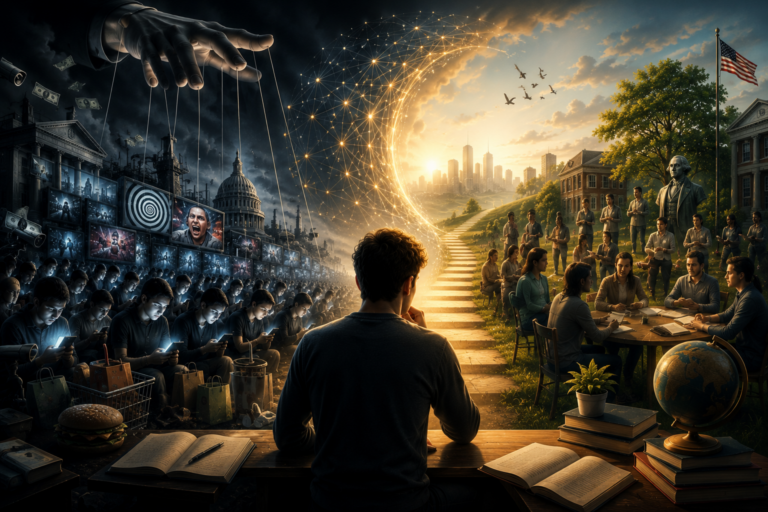
Because algorithms are beginning to mediate not only what we buy but what we see, believe and eventually understand ourselves to be.
The coming struggle may therefore be less about capitalism versus socialism than about something much deeper: human agency versus systems capable of programming human behavior.
That makes cognitive sovereignty as important as monetary sovereignty.
BRICS+ can build alternative payment networks. But will its citizens control their own attention?
It can construct AI infrastructure. But who defines the objectives of those machines?
It can create new development banks. But what definition of development will they finance?
It can reduce dependence on Western institutions. But will it reproduce the same extractive logic under different management?
This is where Bharat can make a distinctive contribution.
India should not seek merely a greater seat at the old table. It should help redefine what the table is for.
The Thirukkural given to Vladimir Putin is therefore a small object carrying a very large idea.
A civilization cannot survive on Porul alone.
Power needs Aram. Prosperity needs purpose. Technology needs wisdom.
And the emerging multipolar world needs something greater than another ideology.
It needs a Dharma for the Phygital Era.
EDITORIAL APPENDIX – NOT FOR PRINT UNLESS DESIRED
Fact-Check & Image Notes
Putin gift: Verified by the Prime Minister of India official site: on Sept. 11, 2026, Modi stated that he presented President Putin with a Russian translation of the Thirukkural, carrying Thiruvalluvar’s wisdom across languages and borders.
BRICS timing: The bilateral meeting occurred in New Delhi on Sept. 11, ahead of the BRICS leaders’ summit scheduled for Sept. 12-13, 2026. The copy uses “on the eve of” or equivalent wording where timing matters.
Xi / Thirukkural: Do not caption any 2026 Modi-Xi image as a Thirukkural gift unless separately verified. The established historical connection used in Column 3 is Xi’s 2019 Tamil Nadu visit, when he was shown a sari featuring all 1,330 couplets and Modi discussed Thiruvalluvar with him.
Style: The four columns are intentionally written as opinion essays. DDDI terms such as Dominion, Dharma, Identity, Phygital Era and DharmaOS are conceptual framing rather than claims of official BRICS policy.
Primary editorial sources
- Prime Minister of India, “PM meets with the President of the Russian Federation on the sidelines of BRICS Summit,” Sept. 11, 2026.
- The Indian Express, reporting on the 2026 BRICS summit agenda and Modi-Putin engagement, Sept. 2026.
- Times of India, coverage of the 2019 Modi-Xi Tamil Nadu informal summit and the Thirukkural sari.
Recommended publication sequence
1. Putin / Thirukkural: immediate current-news hook
2. Aram-Porul-Inbam: the larger BRICS+ civilizational argument
3. Modi-Xi: India-China civilizational diplomacy
4. DharmaOS: the forward-looking DDDI conclusion for the Phygital Era
Suggested author bio
Vivek Singhal is the founder of DDDI Institute (Dominion, Dharma & Destiny Institute), a civilizational strategy platform examining governance, technology, political economy and human agency in the emerging Phygital Era. He is the author of Dominion and Dharma and works at the intersection of strategic systems thinking, value creation and civilizational renewal.