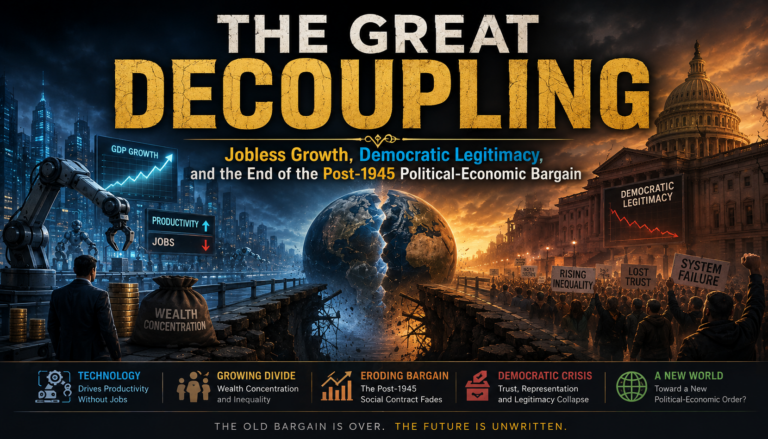
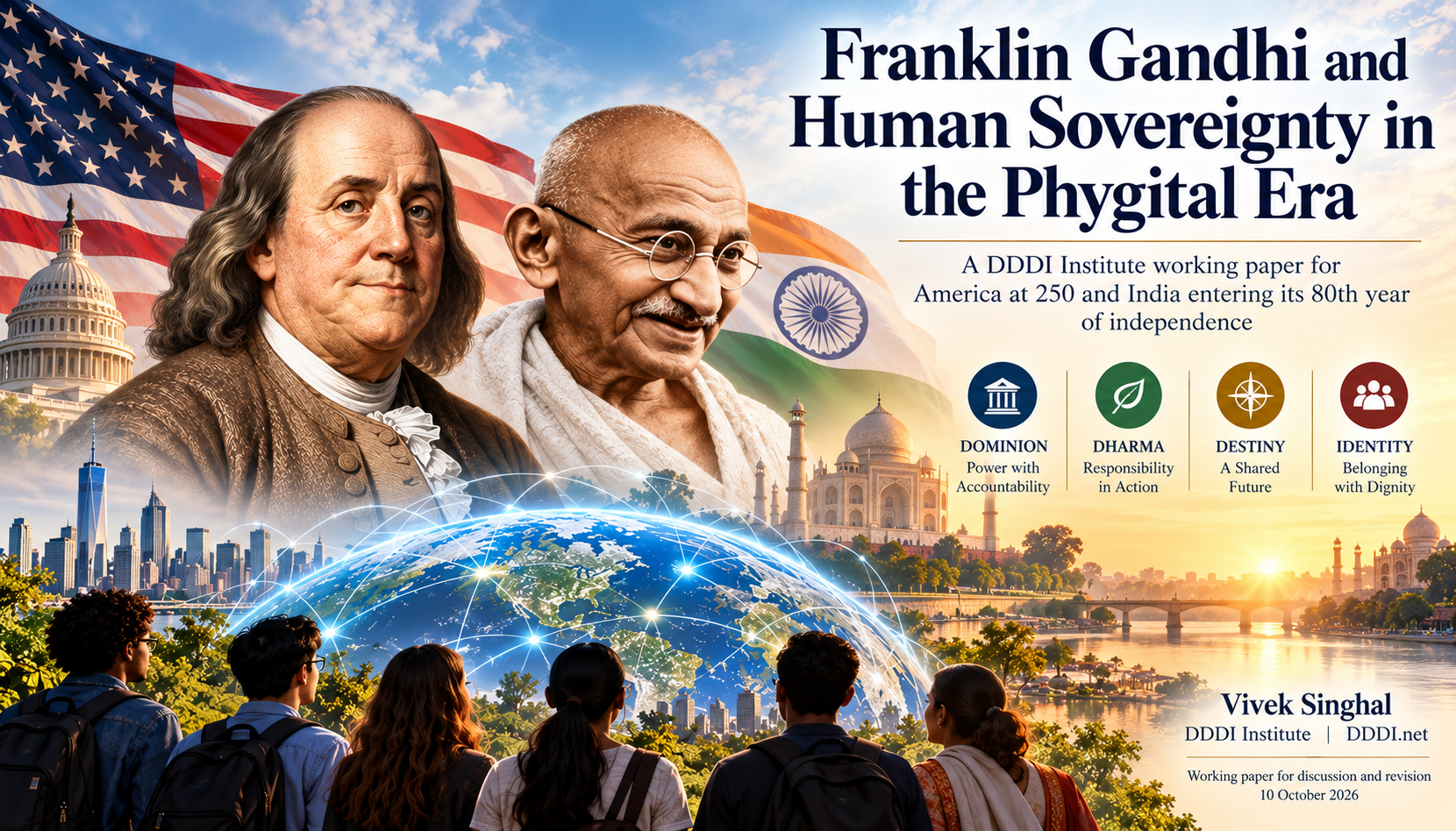
Founder of DDDI Institute
DDDI Institute Working White Paper | October 2026
Thinking of the Future; Acting in the Present.
DDDI.net
The proposition
The American experiment will deserve another 250 years of commitment if it continues to enlarge the circle of people who can live with dignity, exercise meaningful freedom, and help shape their common future. Technological leadership can strengthen that experiment. Its deeper purpose must remain human flourishing. This paper proposes a DDDI agenda for connecting national renewal with conscious interdependence, beginning in local communities and extending to the international order.
Benjamin Franklin and Mahatma Gandhi provide the two principal points of reference. Franklin represents the practical imagination that turns knowledge, enterprise, association, and diplomacy into durable institutions. Gandhi represents the moral imagination that connects freedom with self-rule, disciplined action, and responsibility for the means by which power is exercised. Their differences matter as much as their affinities. Together, they help us ask what kinds of innovation the Phygital Era requires.
Two October 2026 events sharpen that question. The American innovation summit presented a program of scientific ambition. Secretary of State Marco Rubio’s Athens address offered a civilizational argument for renewed Western power. This essay welcomes the determination to build while asking how that determination can serve dignity across nations and generations. It develops an independent DDDI interpretation rather than claiming that either event endorsed this framework.
The proposed pivot is from commemorating independence to practicing responsible interdependence. DOI250 becomes an invitation to renew the promise of 1776 through 2276. DDDI’s four dimensions—Dominion, Dharma, Destiny, and Identity—provide the questions; dignity supplies their common standard; local experiments provide the means to learn.
My American Dream at the meeting of two anniversaries
As I celebrated the Declaration of Independence’s 250th anniversary in the setting of a Gandhi birthday celebration, I found myself bringing two inheritances into the same conversation. One is the American promise that human beings possess rights that government does not create. The other is the Gandhian insistence that freedom must be practiced in the way we live, organize, and treat one another. For an American who came from Bharat, these inheritances belong together.
I arrived in the United States in 1970. My journey through engineering, graduate study, business, corporate management, entrepreneurship, mentoring, and impact investing taught me to respect the American capacity for reinvention. Education and opportunity enabled me to cross boundaries that might once have seemed fixed. Yet the meaning of the American Dream has also grown for me. Achievement carries a responsibility to ask what possibilities we are leaving to others.
My American Dream now includes the freedom to create value and the opportunity to contribute to a society in which others can do the same. It includes institutions capable of correcting themselves, communities capable of hearing disagreement, and technologies that expand human capability. It includes a country sufficiently confident in its identity to learn from other civilizations without surrendering its own.
In this personal interpretation, Franklin and Gandhi stand among the greatest innovators shaping the last 250 years. I choose them as exemplars of civilizational innovation, not as winners of an objective ranking. Much of Franklin’s institution-building preceded 1776; its influence continued into the period we commemorate. Gandhi’s work belongs to a later struggle against British rule, in a different society and through markedly different methods. The relationship between them is an invitation to think across time, not a claim that they followed a single program.
The October 4, 2026 Oak Brook Library presentation and discussion on whether civilization is at a crossroads gave this inquiry a local setting. The task now is to turn the question into sustained civic work. This paper sets out my proposed direction for that work and invites criticism, additions, and practical participation.
The unfinished promise of 1776
I call the Declaration’s assertion of human equality and unalienable rights the “Greatest Sentence Ever Written.” That is my statement of its moral importance, not a historical ranking. The Declaration affirms equality, life, liberty, and the pursuit of happiness, and grounds legitimate government in the consent of the governed. Thomas Jefferson drafted it; Franklin and other members of the Committee of Five participated in its preparation before Congress adopted it. Franklin was a contributor, not its sole author. [1, 2]
The promise was larger than the society that announced it. Enslavement, the exclusion of women from political equality, and the dispossession of Indigenous peoples expose the distance between universal language and actual power. A serious commemoration must hold that distance in view. The promise remains valuable partly because it can be turned against the exclusions practiced in its name.
I therefore understand the American experiment as a continuing obligation to make professed principles more real. Its renewal requires the capacity to acknowledge failure and extend participation. Pride becomes more credible when it can withstand evidence; criticism becomes more constructive when it helps improve institutions.
The next 250 years will introduce circumstances the founders could not anticipate. What does consent mean when decisions are shaped by systems people cannot inspect? What does liberty mean when access to work, information, and essential services depends on private digital infrastructure? What does the pursuit of happiness require when material output expands but agency, belonging, or security do not? These are contemporary applications of the founding questions.
My phrase “life, liberty, and the pursuit of interdependence” is a proposed ethical extension. It does not replace the Declaration’s text. It recognizes that personal freedom becomes practicable through relationships and institutions: families, schools, markets, public services, reliable information, and an inhabitable world. Responsible interdependence should strengthen each person’s freedom to choose.
Two challenges to British imperial power
Franklin and Gandhi participated in struggles that challenged British imperial authority in different centuries. The empire commonly associated with the phrase “the sun never sets” provides a powerful connection between their stories. Historical precision strengthens that connection: Britain was not the first global empire. Portuguese and Spanish overseas expansion preceded its global ascendancy, and the sun-never-sets expression was also applied to Spain. [3, 4]
Nor did the American Revolution and Indian independence confront an identical imperial system. Britain’s empire changed substantially between the eighteenth and twentieth centuries. The loss of the American colonies did not end it; imperial expansion continued elsewhere. India’s independence in 1947 formed part of a much later transformation of colonial rule.
Neither Franklin nor Gandhi acted alone. American independence involved armed struggle, political organization, and foreign assistance. Franklin’s diplomacy helped secure the 1778 French alliance; his achievement depended on partners and on circumstances extending beyond his personal influence. [5] Indian independence emerged through mass participation, competing political visions, negotiations, and the circumstances following the Second World War. Its achievement was accompanied by Partition, displacement, and violence. [6]
The comparison matters because each struggle questioned a structure that presented its authority as durable and legitimate. A system can possess military superiority, commercial reach, and administrative sophistication while failing to justify its treatment of those it governs. DDDI’s question is how people recognize that failure and build arrangements with a stronger basis of consent.
The lesson must not become an inherited hostility toward Britain or British people. It concerns institutions and the exercise of power. Contemporary Britain, America, India, and other societies can all participate in examining the shared history and preventing its harmful patterns from returning in new forms.
Franklin and the invention of civic capacity
Franklin’s innovation extended beyond devices. His association with the Library Company of Philadelphia, the Union Fire Company, the American Philosophical Society, and Pennsylvania Hospital illustrates a practical commitment to institutions through which people could do more together. These organizations connected individual initiative with benefits that exceeded the reach of any one participant. [7]
My reading of Franklin emphasizes a sequence that remains useful: notice a common problem, bring interested people together, mobilize resources, create a working arrangement, and improve it through experience. The significance lies in the ability to make cooperation durable. An institution stores knowledge, assigns responsibilities, and gives later participants a place to begin.
This is an important corrective to a narrow understanding of innovation. A faster processor can be an innovation. So can a better way for a neighborhood to learn, a fairer mechanism for resolving disputes, or a public institution that earns trust by making its decisions understandable. The next American century will depend on both technological invention and civic competence.
Franklin also reminds us that admired innovators can change morally. He had owned enslaved people and published advertisements connected to slavery. Late in life he became an outspoken abolitionist, and in 1790 signed a petition seeking action against slavery and the slave trade. His record contains both complicity and reform. [8]
For DDDI, that complexity is useful. A living civilization must allow people to reconsider inherited practices and expose contradictions in their own achievements. Reverence that prevents criticism blocks the very learning that makes renewal possible. Franklin’s example invites us to build institutions capable of improving their founders’ work.
Gandhi and the innovation of self rule
Gandhi broadened the practice of resistance through disciplined noncooperation, civil disobedience, and constructive work. The Salt Satyagraha made an everyday necessity a focus of opposition to colonial rule. His constructive programme connected the struggle for independence with the preparation of society for self-government. His writings on Hind Swaraj and constructive action make freedom a question of social practice as well as political authority. [9, 10]
My interpretation of Gandhi begins with the relationship between means and ends. The methods through which a movement obtains power help shape the society it can subsequently build. A struggle conducted through dehumanization may carry that habit into its victory. A movement that develops discipline, mutual responsibility, and practical self-help prepares capacities that political independence alone cannot supply.
Gandhi’s relevance to a technological age is therefore a question, rather than a ready-made endorsement of modern tools: does an innovation increase people’s ability to govern their lives? A service may offer convenience while making its users dependent on decisions they cannot challenge. A national economy may expand while communities lose the skills and institutions needed to influence their future.
Swaraj, applied here as a DDDI interpretation, includes the ability to understand the systems that shape one’s life, to participate in their governance, and to refuse unjust arrangements without losing every means of survival. Digital literacy, accessible appeals, meaningful alternatives, and community capability become practical forms of self-rule.
Gandhi’s approach was neither uncontested nor sufficient by itself to produce a just postcolonial society. Independence did not prevent Partition’s suffering. His legacy must remain open to examination by those whose experiences complicate its heroic telling. The point of placing him beside Franklin is to invite demanding inquiry into freedom, not to establish untouchable authorities.
What the two innovators teach together
Franklin and Gandhi should not be collapsed into the same model. Franklin participated in a revolution sustained by war and alliances. Gandhi made nonviolent discipline central to his public method. Their settings, ideas about industry, and approaches to political change differed.
Their juxtaposition nevertheless offers a productive discipline for the future. Franklin asks whether we can organize and build. Gandhi asks what our methods do to people and whether they increase self-rule. A technically brilliant institution can fail the second test. A morally attractive aspiration can fail the first if it never develops a workable form.
I propose bringing their questions into every major innovation initiative. Who can participate? What useful capacity is being created? How is authority justified? Can people withdraw, criticize, or seek remedy? What practices will remain after the founder leaves? What does success require of those who bear the costs?
This is the meaning I give to collaborative abundance. The familiar DDDI expression “1+1=11” is a metaphor for the additional possibilities created by cooperation. It is not a numerical claim. Cooperation earns its promise when institutions make participation credible and the resulting value is shared in ways participants can recognize as fair.
The 2026 invitation to build again
The October 8 American summit on Science A New Golden Age announced more than $6 billion in combined commitments across government, industry, academia, and philanthropy. Its initiatives included AI tools and computing credits, scientific infrastructure, support for young researchers, national missions, and experimentation with research institutions. The $2.4 billion industry commitment to the Genesis Mission comprised tools and compute credits, not simply unrestricted cash. Announcements must be distinguished from completed spending and demonstrated public benefit. [11]
The summit also honored Elon Musk, Sergey Brin, Jensen Huang, and Lisa Su with National Medals of Science, and Michael Dell and Satya Nadella with National Medals of Technology and Innovation. These recognitions placed private technological leadership prominently within the administration’s account of scientific progress. [12]
A DDDI response should welcome the ambition to discover and build while widening the measures of achievement. The questions include the accessibility of research resources, the independence of inquiry, the distribution of resulting benefits, and the ability of smaller institutions to participate. A research ecosystem must develop future innovators as well as celebrate established ones.
Rubio’s October 7 Athens speech argued for Western renewal through confidence, excellence, national power, and stronger alliances. He connected secure supply chains, reindustrialization, energy, advanced technologies, and space exploration with the preservation of sovereignty. His appeal to ancient Greece supplied a historical narrative for present ambition. He advocated Western leadership; he did not announce DDDI’s Phygital Era, demonstrate the arrival of singularity, or propose an equitable multipolar order. Those are separate questions considered in this essay. [13]
The speech’s connection between exploration and conquest deserves particular examination. Discovery can expand human understanding; conquest imposes authority over other people. A future exploration agenda needs an explicit account of how it will preserve the first without making the second its assumed entitlement.
Taken together, the summit and speech offer an opening for a serious public conversation about capability and purpose. My response is to ask how the capacity to build can be joined to the capacity for ethical restraint, institutional correction, and cooperation across civilizational boundaries.
The Phygital Era and the uncertainty of its destination
DDDI uses Phygital Era to describe the increasing interaction of physical and digital life. Its website places technology within a larger inquiry into power, responsibility, consciousness, identity, and the futures created by present choices. [14] Here, the term serves as an organizing framework for civic inquiry, not a declaration that a universally recognized historical period has begun.
Technological convergence describes the combination of capabilities. Consider a possible research system in which computational models propose a material, automated equipment tests it, and the results inform new designs. The public value would depend on the reliability of the process, access to its benefits, and the purposes chosen for it. Faster iteration alone cannot answer those questions.
Singularity is a hypothesis about a profound transformation associated with advanced intelligence and accelerating change. It should not be treated as a scheduled event or as a substitute for evidence about actual systems. We can prepare for substantial disruption without claiming certainty about its timing or final form.
Multipolarity concerns the distribution of geopolitical power. Technological convergence does not determine that distribution. Capabilities might spread across countries and communities, or become concentrated in a small number of states and corporations. Several powerful centers might cooperate, or compete in ways that reduce everyone’s security.
A useful DDDI scenario exercise would therefore examine three possible directions: concentrated technological dominion, fragmented technological rivalry, and accountable interdependence. These are analytical possibilities, not forecasts. Each should be tested against observable decisions about infrastructure, access, ownership, institutional oversight, and international cooperation.
My preference is accountable interdependence. It combines the ability to act with recognition of the consequences of that action for others. It requires nations to retain meaningful choices while creating agreements for problems no nation can responsibly manage alone.
Four dimensions and one standard of dignity
Dominion asks who has the capacity to shape outcomes. The question applies to governments, firms, communities, and individuals. In the Phygital Era it includes control over computation, energy, communications, data, and the rules of participation. DDDI should examine where that capacity is useful, where it is concentrated, and whether it can be challenged.
Dharma asks how power should be exercised. In this paper it refers to responsibility, balance, ethical action, and right relationship, rather than a requirement to adopt a particular religion. Its practical expressions include truthfulness, proportionality, stewardship, and duties toward those affected by decisions.
Destiny asks what futures present arrangements make more likely. It brings time into the assessment. A decision that produces immediate gains may weaken the institutions needed for later generations to flourish. Conversely, investment in learning, trust, and resilience may take years to show its full value.
Identity asks who we understand ourselves to be. People may be rooted in a family, locality, nation, faith, or civilizational inheritance while also recognizing obligations to humanity. Public institutions should make room for those overlapping identities. An identity that requires the humiliation of others is a fragile basis for durable cooperation.
Dignity connects the four dimensions. A person should not have to demonstrate exceptional productivity to deserve humane treatment. At the same time, a dignified society should help people develop their capacities and contribute. The practical challenge is to reward excellence while preserving equal moral standing and meaningful opportunity.
This yields a demanding test for a golden age. Does greater power improve the conditions under which people can live, learn, choose, contribute, and seek justice? Answering requires evidence from ordinary lives as well as scientific milestones and financial results.
An American Dream compatible with other nations dreaming
I want America to remain a place where ambition can become useful work and where newcomers can help renew the national story. That aspiration can coexist with the hopes of people in India, China, Europe, Africa, Latin America, and elsewhere. National success need not require permanent insecurity for others.
This proposition does not remove genuine conflicts of interest. Some technologies create security risks; some dependencies can be exploited; some governments act coercively. Responsible interdependence requires the ability to resist coercion, diversify essential capabilities, and negotiate from a position of credibility. It also requires avoiding the assumption that every gain by another society is a loss to one’s own.
DDDI’s Great Power Dharma Protocol is proposed here as a framework for discussion, not an existing treaty. Its first task would be to identify shared survival interests, establish dependable communication, and create verifiable commitments around specific risks. The work should begin with concrete domains where cooperation can be assessed, rather than a general promise of goodwill.
Possible domains include notification and consultation around dangerous technological incidents, cooperative scientific missions addressing essential human needs, and procedures for reviewing the civilian consequences of strategic competition. Proposals would require expert scrutiny, negotiated definitions, and independent means of assessing compliance. No voluntary label can substitute for those institutions.
ChIndUS, in my framework, offers one place to explore these questions among China, India, and the United States. It should not become a claim that three countries may decide the future for everyone else. Other states, smaller communities, and affected populations need meaningful participation. Multipolarity acquires moral value only when it enlarges agency and reduces domination.
A practical pivot beginning in Oak Brook
The scale of the argument must not make action feel remote. Franklin’s civic practice and Gandhi’s constructive work both direct attention toward what people can organize together. Oak Brook can become a place to test this approach through a voluntary DDDI civic learning initiative, developed with interested residents and willing partners.
During a proposed first 90 days, participants could select one local question connected to technological change: access to trustworthy information, intergenerational learning, help navigating digital services, or the impact of AI on local work. The choice should emerge from listening rather than a predetermined assumption about what residents need.
A small working group would then apply Data, Decision, Design, and Impact. It would gather a modest baseline, identify who should participate in decisions, build a limited pilot, and evaluate its results. An intergenerational learning pilot, for example, could record whether participants become more confident checking information or completing a chosen digital task. Personal data collection should be limited and voluntary.
The first year should produce a public account of what was attempted, what changed, what failed, and what will be revised. Roles should be explicit: a convenor to maintain the process, participants to define the need, a project lead to coordinate delivery, and a reviewer to question the evidence. Partners should join by agreement; the proposal does not presume a commitment from the library or any other institution.
DDDI should invite manuscript reviewers, mentors, mentees, educators, technologists, civic volunteers, and constructive critics. The aim is a repeatable practice of inquiry and action. Expansion to DuPage County, Illinois, and other communities should follow demonstrated usefulness and local interest.
This is how a civilizational conversation earns practical credibility. People should be able to point to an improved capability or relationship and explain how their participation helped create it.
A horizon from 2026 to 2276
The next 250 years cannot be governed by a detailed forecast. They can be approached through durable principles, revisable institutions, and recurring public review. Long horizons should make us more careful about irreversible harm and more generous in building capacities that later generations can use differently.
By 2031, the proposed DDDI work should be judged by a small number of completed pilots, credible evaluations, and a record of learning. By 2051, the aspiration is a wider network of communities able to examine technology and power through a shared language of dignity. These are proposed milestones, not predictions or commitments already secured.
In 2076, the tricentennial should ask whether the gains of innovation have widened effective freedom. In 2126, the question should include whether institutions can still adapt without abandoning equal moral standing. In 2276, the greatest achievement would be a civilization whose members possess enough agency to revise our assumptions and enough security to do so peacefully.
DDDI should avoid a single score that hides tradeoffs. A public assessment can track several dimensions together: access to learning and essential services; the ability to question consequential decisions; meaningful opportunities to contribute; the distribution of benefits and burdens; and the quality of stewardship for future generations. Disagreement about the measures should itself be part of democratic inquiry.
The American Dream I want to help carry forward
I do not understand the American Dream as a completed inheritance. It is a responsibility renewed by those who receive its opportunities and by those who still seek inclusion in its promise. As an immigrant from Bharat, I want to contribute both gratitude for what America made possible in my life and a willingness to ask what it must become next.
Franklin helps me see freedom as a practical enterprise: knowledge shared, institutions built, relationships organized, problems addressed. Gandhi asks me to examine the habits of power within that enterprise: the dignity of the participant, the ethics of the method, and the capacity for self-rule. Their legacies invite continued correction as well as admiration.
The American innovation summit and Rubio’s call for renewal make the question of power immediate. DDDI’s contribution is to bring purpose, identity, and responsibility into the same decision. We should be capable of building extraordinary technologies and of asking who they serve. We should be capable of loving a country and of recognizing that humanity’s future cannot be secured by one country alone.
My invitation at DOI250 is to continue the experiment with greater consciousness. Let the next generation inherit institutions it can improve, technologies it can question, identities it can inhabit without contempt for others, and a world in which freedom remains possible.
The work begins with the people willing to meet, think, test, and act together. That is the American Dream I want DDDI to help carry toward 2276.
Questions for readers and prospective participants
What does this account of Franklin and Gandhi illuminate, and what does it leave out? Which proposed measure of dignity could be tested in your community? Where does technological dependence most threaten meaningful self-rule? What forms of national cooperation could reduce shared danger without erasing legitimate differences? Which part of this paper should DDDI revise before turning it into a program?
DDDI welcomes historically grounded corrections, alternative interpretations, and concrete proposals for civic experiments. The paper is an invitation to develop the inquiry with others.
About the author
Vivek Singhal is a first-generation American immigrant from Bharat, an engineer, former corporate executive, entrepreneur, mentor, and impact investor. He founded Strategic Business Management in 1985 and is the founder of DDDI Institute. His education includes a B.Tech. from IIT Delhi, an MS in Electrical and Computer Engineering and an MBA from the University of Michigan, and the University of Chicago Graham School Basic Program. He writes and convenes dialogue on the relationship between power, responsibility, identity, and human futures. DDDI.net.
Sources and further reading
The numbered references support historical and current-event claims. The personal reflections and proposed DDDI agenda express the author’s perspective. Official announcements establish what was announced, rather than independently verifying subsequent outcomes. The 2026 event accounts draw on published texts and announcements rather than a claim to summarize every summit session. Sources consulted October 2026.
[1] National Archives. Declaration of Independence transcript. https://www.archives.gov/founding-docs/declaration-transcript
[2] National Archives. The Declaration of Independence A History. https://www.archives.gov/founding-docs/declaration-history
[3] World History Encyclopedia. Portuguese Empire. Context for European overseas empires preceding British global ascendancy. https://www.worldhistory.org/Portuguese_Empire/
[4] The Phrase Finder. The empire on which the sun never sets. Historical usage including Spain and Britain. https://www.phrases.org.uk/meanings/the-empire-on-which-the-sun-never-sets.html
[5] United States Department of State Office of the Historian. French Alliance French Assistance and European Diplomacy during the American Revolution 1778 to 1782. https://history.state.gov/milestones/1776-1783/french-alliance
[6] National Army Museum. Independence and Partition 1947. https://www.nam.ac.uk/explore/independence-and-partition-1947
[7] Library Company of Philadelphia Papers Project. History of Share 3. August 25 2025. https://librarycompany.org/librarycompanypapersproject/2025/08/25/history-of-share-3/
[8] National Archives. Benjamin Franklin’s Anti Slavery Petitions to Congress. https://www.archives.gov/legislative/features/franklin
[9] Gandhi Heritage Portal. Background to the Salt Satyagraha. https://www.gandhiheritageportal.org/te/background-to-the-salt-satyagraha
[10] Gandhi Smriti and Darshan Samiti. Constructive Programme. https://gandhismriti.gov.in/programmes/constructive-programme
Gandhi Heritage Portal provides Hind Swaraj and Constructive Programme among its primary texts. https://www.gandhiheritageportal.org/
[11] White House. Fact Sheet on Science Initiatives announced October 8 2026. https://www.whitehouse.gov/fact-sheets/2026/10/fact-sheet-trump-administration-announces-the-most-ambitious-set-of-science-initiatives-this-century/
Related report Science A New Golden Age July 2026. https://www.whitehouse.gov/science/
[12] White House. National Medals of Science and National Medals of Technology and Innovation October 8 2026. https://www.whitehouse.gov/releases/2026/10/president-trump-presents-national-medals-of-science-and-national-medals-of-technology-and-innovation/
Summit video supplied for this essay. https://www.youtube.com/watch?v=uTQ1V-wn0ZQ
[13] United States Department of State. Secretary of State Marco Rubio Remarks at the Pnyx Athens October 7 2026. Text reproduced by Forth. https://www.forth.news/lists/state/CfoJXxzr9D1pXoCPW3FsZ
Official source. https://www.state.gov/releases/office-of-the-spokesman/2026/10/secretary-of-state-marco-rubio-remarks
Speech video supplied for this essay. https://www.youtube.com/watch?v=4_R6ASsy35g
[14] DDDI Institute. Framework and institutional vision. https://dddi.net/