
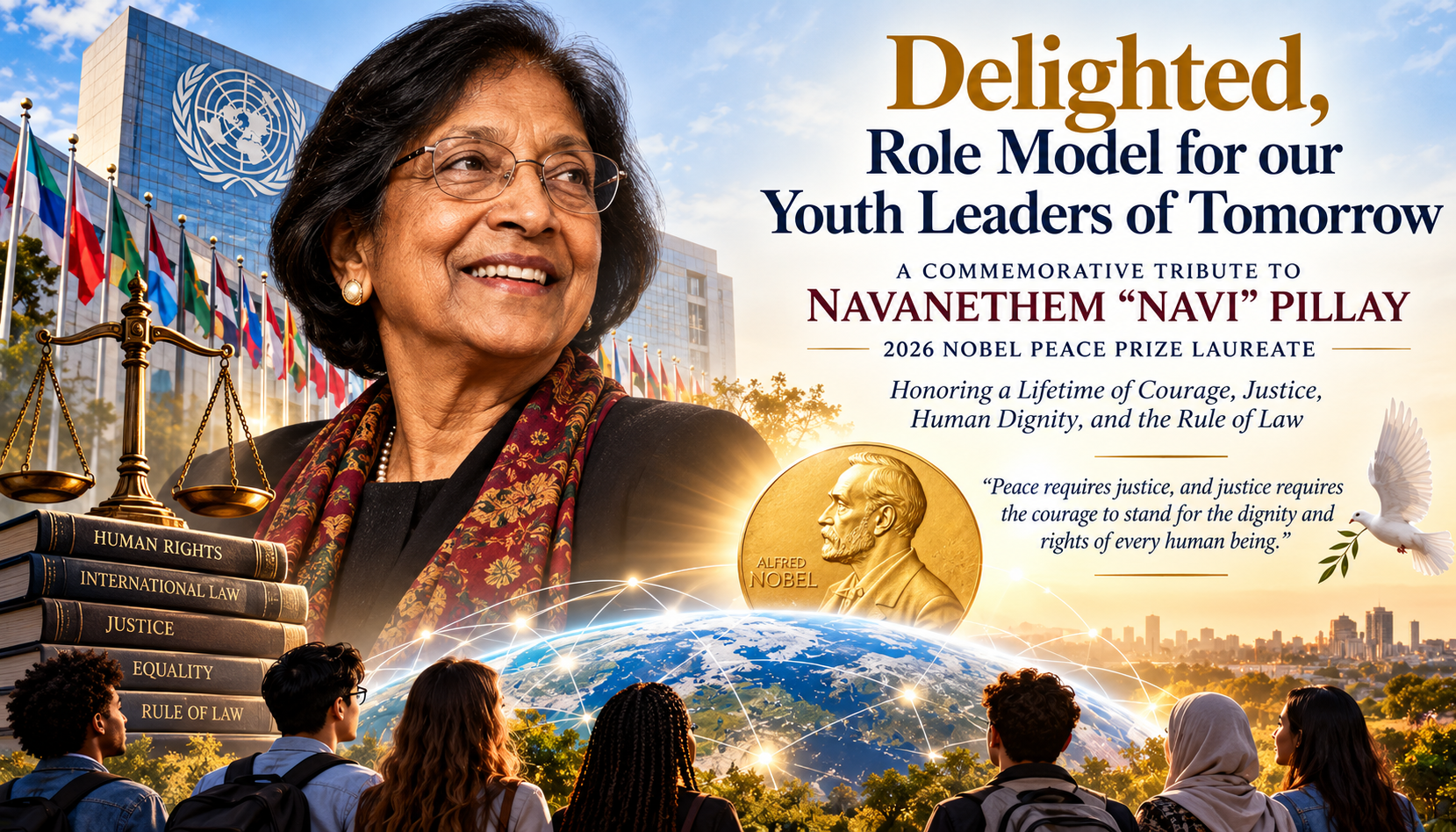
A COMMEMORATIVE TRIBUTE TO NAVANETHEM “NAVI” PILLAY
2026 NOBEL PEACE PRIZE LAUREATE
Honoring a Lifetime of Courage, Justice, Human Dignity, and the Rule of Law
“Peace requires justice, and justice requires the courage to stand for the dignity and rights of every human being.”
I. A DISTINGUISHED TRIBUTE
The DDDI Institute proudly extends its heartfelt tribute to Navanethem “Navi” Pillay, the distinguished South African jurist, international human rights advocate, and recipient of the 2026 Nobel Peace Prize.
Her recognition by the Norwegian Nobel Committee honors a remarkable lifetime devoted to advancing international law, defending fundamental human rights, strengthening accountability for grave international crimes, and affirming the principle that every human being deserves dignity and equal protection under the law.
Pillay’s journey from apartheid-era South Africa to the highest levels of international justice demonstrates the enduring importance of courage, perseverance, professional integrity, and service to humanity.
Her life’s work reminds us that peace is more than the absence of armed conflict. Lasting peace requires justice, respect for human rights, the protection of vulnerable communities, and institutions capable of holding individuals and governments accountable under the law.
Through this tribute, the DDDI Institute celebrates her distinguished achievements and the principles her career represents for present and future generations.
Navanethem “Navi” Pillay, the pioneering South African jurist and 2026 Nobel Peace Prize laureate, traces her deep commitment to non-violence and human dignity back to her roots in Hindu dharma and her experience growing up under apartheid. Born in Durban to a poor South African family of Indian Tamil descent, her upbringing was heavily anchored in traditional values. [1, 2, 3]
The Influence of Hindu Dharma & Family Values
Pillay has explicitly credited her religious upbringing with establishing her firm ethical foundation. Reflecting on her childhood, she noted that her family was “brought up in the Hindu religion which imposed heavy moral standards”. [1]
- Dignity and Strict Morals: Despite financial hardships—her father was a bus driver—her parents instilled rigid principles centered on faith, character, and inherent human worth. [1, 2]
- Gender Equality: While traditional or colonial structures of the time often disadvantaged women, Pillay’s parents used their Hindu values to emphasize equal treatment for both boys and girls. They fiercely prioritized education, ensuring Pillay and her sisters went to school rather than being forced into early arranged marriages, an intervention she attributes as the catalyst for her legal career. [1, 2, 3]
The Connection to Non-Violence (Ahimsa) and Justice
In Hindu dharma, the principle of Ahimsa (non-violence) is not merely the absence of physical conflict, but the active pursuit of harmony, justice, and the prevention of harm to all living beings. Pillay translated this cosmic and moral duty into a lifelong legal crusade against systemic violence: [1]
- Combating State and Structural Violence: Facing the structural degradation of the apartheid regime, Pillay turned to international law as her weapon of peace. She spent decades defending anti-apartheid activists, proving that the law could be used non-violently as a “beacon of hope” to dismantle oppressive regimes. [1, 2, 3, 4]
- Redefining Violence Globally: As a judge on the International Criminal Tribunal for Rwanda, Pillay was instrumental in a historic breakthrough: legally establishing that rape and sexual violence constitute acts of genocide. Her work effectively widened the global legal definitions of violence to better protect women and vulnerable populations. [1, 2, 3]
- The Rule of Law over Warfare: Upon awarding her the Nobel Peace Prize, the Norwegian Nobel Committee emphasized that her career embodies how international law serves as the ultimate foundation for resolving conflicts non-violently. By holding warlords, dictatorial states, and perpetrators of genocide accountable, she replaced the cycle of violent retribution with systematic justice. [1, 2, 3, 4]
Through a seamless blend of her heritage’s moral framework and global legal frameworks, Navi Pillay transformed the Hindu principles of moral duty (dharma) and non-injury (ahimsa) into a universal language of human rights. [1, 2]
Would you like to explore specific landmark cases Navi Pillay judged, such as her work during the Rwanda Tribunal, or look closer at her contributions to the South African Constitution?
Christian Science Monitor – CSMonitor.comDignity defined in a Nobel Peace PrizeGetting your Trinity Audio player ready… “From the Rwandan woman who testified despite her trauma. From the Sri Lankan mother wh…
Lacuna MagazineAn interview with Navi Pillay – Lacuna MagazineNov 1, 2016 — Apartheid shaped her formative experiences and her early practice as a lawyer. Navanethem Pillay was born in 1941 to a poor family…
The HinduWho is Navi Pillay? 5 facts about 2026 Nobel peace prize …Oct 9, 2026 — Justice Pillay has worked for the rights of women and children, and victims of domestic violence. As a member of the Women’s Natio…
Show all
AI responses may include mistakes. Learn more
II. FULL PROFILE: NAVANETHEM “NAVI” PILLAY
Full name: Navanethem Pillay
Commonly known as: Navi Pillay
Nationality: South African
Year of birth: 1941
Place of birth: Durban, South Africa
Heritage: Indian Tamil
Profession: Lawyer, jurist, international judge, and human rights advocate
Distinguished international appointment: United Nations High Commissioner for Human Rights, 2008–2014
Major international judicial appointments: International Criminal Tribunal for Rwanda and International Criminal Court
International recognition: 2026 Nobel Peace Prize
Principal areas of contribution: Human rights, international criminal law, gender justice, accountability for international crimes, equality, and the rule of law.
The Norwegian Nobel Committee recognized Pillay for her efforts to promote peace and international law, emphasizing her contribution to the development of international legal institutions and the prosecution of war crimes, crimes against humanity, and genocide.
III. EARLY LIFE: A JOURNEY THAT CHALLENGED DISCRIMINATION
Born in Durban, South Africa, in 1941, Navi Pillay grew up during apartheid, a system of institutionalized racial segregation and discrimination.
Her upbringing exposed her to the profound inequalities that shaped South African society. As a member of a family of Indian Tamil descent, she experienced the realities of a social and political system that imposed significant barriers on people who were not classified as white.
Rather than allowing those circumstances to determine her future, Pillay pursued education and a career in law.
Her early experiences helped shape her commitment to equality, fairness, and the protection of people whose rights were threatened by discriminatory institutions.
She came to understand that the law could serve two very different purposes: it could be used to maintain injustice, or it could become an instrument for challenging injustice and protecting human dignity.
Pillay chose the latter path.
Her life subsequently became an example of how professional knowledge, determination, and principled advocacy can help transform institutions and expand the protection of human rights.
IV. EDUCATIONAL BACKGROUND AND LEGAL TRAINING
Pillay pursued her undergraduate legal education at the University of Natal in South Africa, earning:
- Bachelor of Arts (BA): 1963.
- Bachelor of Laws (LLB): 1965.
She later continued her legal studies at Harvard University in the United States, earning:
- Master of Laws (LLM): 1982.
- Doctor of Juridical Science (SJD): 1988.
Her advanced legal training strengthened her understanding of international law, human rights, and the legal principles governing the conduct of states and individuals.
Her educational journey also demonstrated the importance of making professional opportunities accessible to talented individuals regardless of their racial, social, or economic circumstances.
Pillay’s academic achievements laid the foundation for a career that would take her from legal practice in South Africa to influential positions within the international judicial system.
V. A PIONEER IN SOUTH AFRICAN LAW
In 1967, Pillay established her own legal practice in Natal Province, becoming the first woman to establish a law practice in the province.
At a time when racial discrimination and gender inequality restricted professional opportunities, this achievement represented a significant milestone.
As a lawyer, she defended people targeted for their opposition to apartheid and worked to expose abuses against political prisoners.
Her legal advocacy included efforts to strengthen prisoners’ access to legal representation and to challenge mistreatment in detention.
Among the political prisoners whose rights she defended were opponents of apartheid, including Nelson Mandela and other activists associated with the struggle for democratic equality.
Her work was not simply about individual legal disputes. It formed part of a broader effort to ensure that the legal system could be used to protect people against arbitrary power and institutional discrimination.
Pillay’s early career established a central theme that would remain throughout her professional life: the law must protect human beings, particularly when their rights are threatened by those exercising power.
VI. HISTORIC APPOINTMENT TO SOUTH AFRICA’S HIGH COURT
In 1995, following the end of apartheid, Pillay was appointed to South Africa’s High Court.
She became the first Black woman appointed as a judge to the country’s High Court.
The appointment represented an important milestone in the transformation of South Africa’s legal institutions following decades of racial exclusion.
Her transition from defending individuals against an oppressive system to serving on the bench reflected the changing possibilities of a society moving toward democratic governance and equality before the law.
Her appointment also demonstrated the importance of including diverse professional experiences and perspectives within judicial institutions.
Pillay’s subsequent international appointments would build upon this foundation, bringing her knowledge of discrimination, criminal justice, and human rights to some of the world’s most consequential legal proceedings.
VII. INTERNATIONAL CRIMINAL TRIBUNAL FOR RWANDA
In 1995, Pillay joined the United Nations International Criminal Tribunal for Rwanda, established to prosecute individuals responsible for genocide and other serious violations of international humanitarian law during the 1994 Rwandan genocide.
She served as a judge for eight years and became the Tribunal’s President in 1999, holding that position until 2003.
Her judicial service contributed to the development of international criminal law, particularly in the recognition and prosecution of sexual violence committed during armed conflict.
One of the Tribunal’s most significant legal milestones was the 1998 Akayesu judgment.
In that case, the Tribunal recognized that rape and sexual violence could constitute acts of genocide when committed with the requisite intent to destroy a protected group.
The judgment helped establish an important legal precedent concerning the relationship between sexual violence, genocide, and crimes against humanity.
It also demonstrated that atrocities committed against women and girls during conflict must not be dismissed as incidental consequences of war.
Pillay’s contribution to this period of international jurisprudence forms an important part of her legacy in the advancement of gender justice and accountability for mass atrocities.
The Rwanda Tribunal helped establish that international criminal proceedings could recognize the experiences of victims whose suffering had historically been neglected or inadequately addressed.
VIII. SERVICE AT THE INTERNATIONAL CRIMINAL COURT
From 2003 to 2008, Pillay served as a judge at the International Criminal Court in The Hague, Netherlands.
The Court was established to prosecute individuals accused of the most serious crimes of concern to the international community, including genocide, crimes against humanity, war crimes, and, under applicable conditions, the crime of aggression.
Her appointment placed her among the judges contributing to the development of a permanent international criminal justice institution.
The International Criminal Court operates under the Rome Statute and is distinct from the International Court of Justice, which principally adjudicates legal disputes between states and provides advisory opinions when authorized.
Pillay’s experience at the International Criminal Court expanded her contribution to international justice and reinforced the principle that individuals may bear criminal responsibility for serious violations of international law.
Her work also illustrated the challenges faced by international judicial institutions as they seek to apply legal standards consistently across different countries, conflicts, and political circumstances.
IX. UNITED NATIONS HIGH COMMISSIONER FOR HUMAN RIGHTS
One of the most prominent chapters of Pillay’s career began in 2008, when she became United Nations High Commissioner for Human Rights.
She served in this position from September 2008 through August 2014.
As the United Nations’ principal human rights official, she worked to promote respect for fundamental freedoms, equality, and the protection of vulnerable populations.
Her responsibilities included drawing international attention to human rights violations, supporting the development of human rights standards, and encouraging governments to fulfill their obligations under international law.
Her work addressed issues including:
- The protection of fundamental human rights and freedoms.
- Accountability for serious human rights violations.
- The rights of women and girls.
- Equality and protection against discrimination.
- The rights of vulnerable and marginalized communities.
- The responsibilities of states under international human rights law.
- The importance of civil society in strengthening human rights protections.
Pillay’s tenure reinforced the importance of independent human rights monitoring and international cooperation.
She emphasized the role of civil society and the participation of affected communities in improving the protection of human rights.
Her leadership also reflected the principle that human rights are universal and should not depend on a person’s nationality, race, gender, religion, political affiliation, or social circumstances.
X. ADVANCING WOMEN’S RIGHTS AND EQUALITY
Pillay’s commitment to equality extended beyond the courtroom.
She co-founded Equality Now, an international organization dedicated to advancing the rights of women and girls.
She also participated in South Africa’s Women’s National Coalition, which contributed to efforts to secure constitutional protections against discrimination.
Her work reflected the recognition that formal equality must be supported by practical legal protections and institutions capable of addressing discrimination.
Through her legal advocacy and international service, Pillay contributed to the broader effort to recognize sexual violence as a serious international crime and to strengthen accountability for abuses committed against women during conflict.
Her career illustrates the importance of ensuring that women and girls are treated as rights-holders entitled to justice, protection, and equal participation in society.
The significance of this work extends beyond individual cases. It contributes to the development of legal principles that can guide courts, governments, and institutions in protecting people against discrimination and abuse.
XI. SERVICE AT THE INTERNATIONAL COURT OF JUSTICE
Pillay’s involvement in international adjudication continued through her service as an ad hoc judge at the International Court of Justice.
The International Court of Justice, based in The Hague, is the principal judicial organ of the United Nations.
In 2019, she was appointed as an ad hoc judge in the case brought by The Gambia against Myanmar under the Genocide Convention.
The case concerns allegations of violations of the Convention relating to the treatment of the Rohingya people.
An ad hoc judge is appointed for a particular case under the Court’s rules and is distinct from a permanently elected member of the Court.
This appointment continued Pillay’s longstanding engagement with the legal obligations of states and the international community’s responsibility to address allegations of genocide.
Her judicial experience across different international institutions demonstrates the complexity of applying international law to disputes involving mass violence, state responsibility, and the protection of civilian populations.
XII. HER WORK ON THE OCCUPIED PALESTINIAN TERRITORY AND ISRAEL
From 2021 to 2025, Pillay chaired the United Nations Independent International Commission of Inquiry on the Occupied Palestinian Territory, including East Jerusalem, and Israel.
The Commission investigated alleged violations of international law and reported on its findings.
Its work became particularly controversial following the escalation of the Israel-Gaza conflict after the Hamas-led attacks of October 7, 2023.
A 2025 Commission report concluded that Israel had committed genocide in the Gaza Strip. Israel rejected that conclusion.
These findings and the responses to them became the subject of significant international dispute.
In recognizing Pillay, the Nobel Committee emphasized her broader contribution to international law, accountability, and the strengthening of legal institutions.
Her work in this area illustrates the politically sensitive and contested environment in which international investigations operate. The Commission’s findings should be distinguished from a final judicial determination by a competent court.
The DDDI Institute recognizes the importance of impartial legal processes, credible investigations, protection of civilians, and accountability under international law, regardless of the identity of the alleged perpetrator or victim.
XIII. THE 2026 NOBEL PEACE PRIZE
On October 9, 2026, the Norwegian Nobel Committee announced that the Nobel Peace Prize for 2026 would be awarded to Navanethem “Navi” Pillay.
The Committee cited her efforts to promote peace and international law.
Its announcement highlighted her contribution to the development of international legal institutions and her role in advancing the prosecution of war crimes, crimes against humanity, and genocide.
The Committee also emphasized the importance of strengthening the international rule of law at a time when judicial institutions face significant political pressures.
The recognition placed Pillay among the distinguished individuals whose work has helped shape international discussions about peace, human rights, and accountability.
Her award underscores a central principle of international justice: sustainable peace requires more than diplomatic agreements. It also depends on legal standards, credible institutions, and the willingness to hold individuals accountable for serious violations.
For the DDDI Institute, this recognition provides an opportunity to reflect on the relationship between justice, ethical leadership, and the responsibility of institutions to protect human dignity.
XIV. THE PRINCIPLES THAT DEFINE HER LEGACY
1. Courage in the face of discrimination
Pillay’s early legal career demonstrated the importance of confronting discriminatory systems and defending people whose rights are threatened.
2. Equality before the law
Her professional journey reflects the principle that justice should not be determined by race, gender, social standing, or political power.
3. Accountability for international crimes
Her work at international tribunals contributed to legal mechanisms designed to address genocide, crimes against humanity, and other grave violations.
4. Recognition of victims’ experiences
Her judicial contributions helped advance the recognition of sexual violence as a potential instrument of genocide and a serious international crime.
5. Independence of judicial institutions
Her career highlights the importance of judges and legal institutions being able to apply the law without improper political interference.
6. International cooperation
Her service across South African and United Nations institutions demonstrates the importance of cooperation in addressing violations that affect the international community.
7. Human dignity as a universal principle
Her work reflects the idea that every person deserves legal protection and that no individual should be excluded from justice because of identity or circumstance.
XV. A MESSAGE TO THE NEXT GENERATION
Navi Pillay’s life offers a powerful lesson to students, educators, legal professionals, public servants, and emerging leaders.
Her achievements demonstrate that meaningful change often begins with the willingness to challenge injustice, even when established institutions resist change.
Her journey shows that education can become a tool for social transformation, professional excellence can serve the public good, and legal knowledge can help protect people whose rights are threatened.
For young people who aspire to careers in law, public service, diplomacy, education, or human rights advocacy, her example reinforces the importance of developing both professional competence and ethical responsibility.
A society’s progress should not be measured solely by its economic development or institutional strength. It should also be measured by how it protects the vulnerable, treats people fairly, and responds when fundamental rights are violated.
Pillay’s career invites future generations to consider how their own knowledge, skills, and opportunities can contribute to a more just and peaceful world.
XVI. THE DDDI INSTITUTE’S COMMEMORATIVE TRIBUTE
The DDDI Institute extends its sincere congratulations to Nobel Peace Prize laureate Navanethem “Navi” Pillay.
We honor her distinguished service, her contribution to international justice, and her longstanding commitment to human rights and the rule of law.
Her career reminds us that peace is strengthened when justice is accessible, when victims are heard, when discrimination is challenged, and when institutions uphold their responsibilities.
We recognize the importance of education, ethical leadership, professional integrity, and international cooperation in building a world where human dignity is respected.
We also acknowledge that the advancement of human rights requires continued effort. Legal principles must be translated into meaningful protections, and institutions must remain committed to fairness, accountability, and the equal application of the law.
May Pillay’s example inspire individuals and institutions to pursue justice with courage, defend human dignity with conviction, and work toward peaceful solutions grounded in law and mutual respect.
XVII. CLOSING STATEMENT
A LEGACY OF COURAGE. A COMMITMENT TO JUSTICE. A VISION OF LASTING PEACE.
Navi Pillay’s recognition with the 2026 Nobel Peace Prize celebrates a distinguished career dedicated to the advancement of international law and the protection of human rights.
From her early legal practice in apartheid-era South Africa to her service on international courts and as United Nations High Commissioner for Human Rights, her professional journey has been closely connected to the struggle for equality, accountability, and justice.
Her achievements remind us that the rule of law is not merely a collection of legal procedures. It is a framework through which societies seek to protect people from abuse, resolve disputes peacefully, and establish accountability for serious wrongdoing.
The DDDI Institute honors her contribution and encourages future generations to carry forward the principles of fairness, responsibility, compassion, and respect for human dignity.
May her example continue to inspire a world in which justice is pursued without fear or favor, human rights are respected universally, and peace is strengthened through the faithful application of law.
Presented with respect and admiration by the DDDI Institute.
In honor of Navanethem “Navi” Pillay, 2026 Nobel Peace Prize laureate.