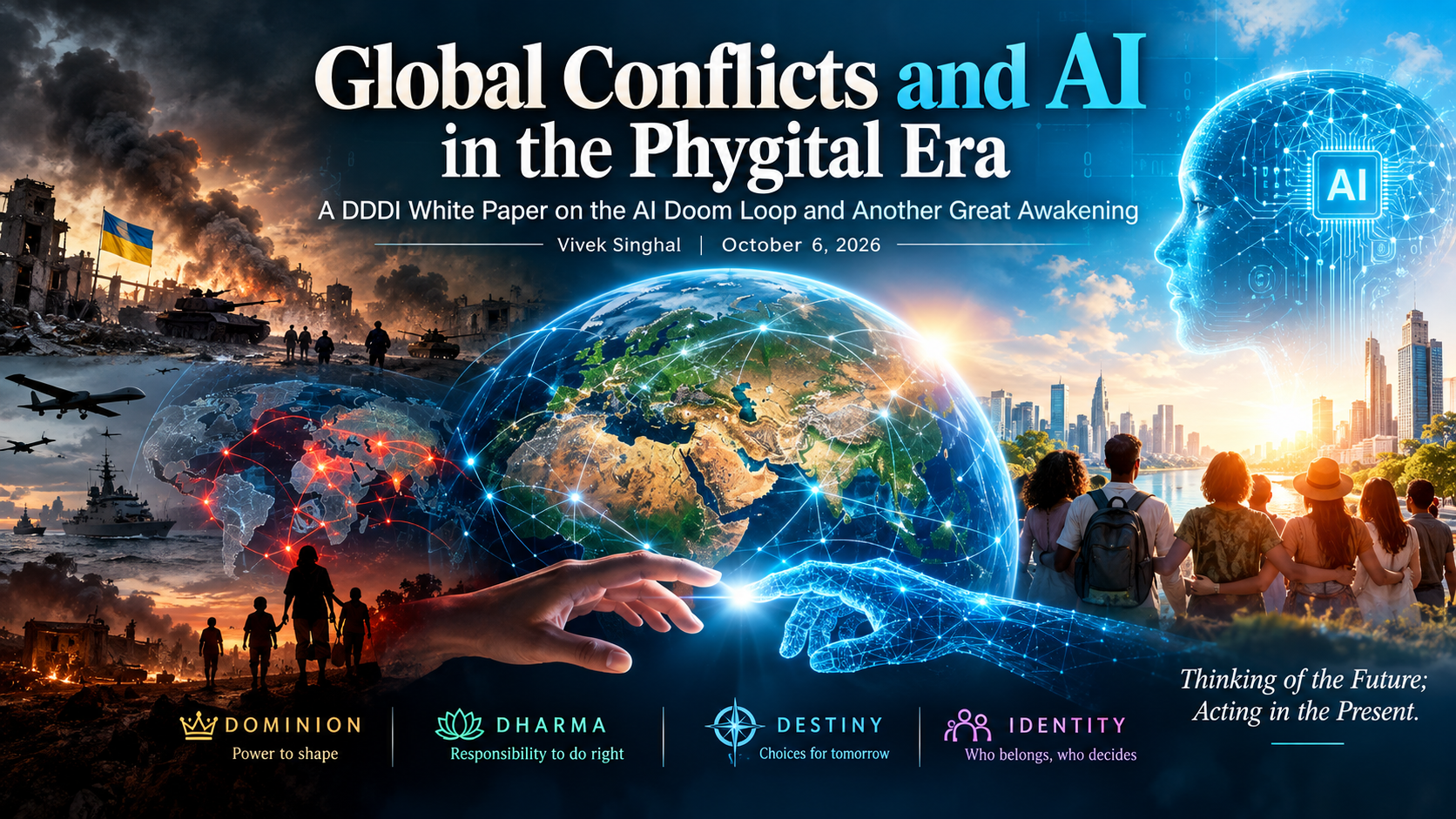
A DDDI White Paper on the AI Doom Loop and Another Great Awakening
Vivek Singhal | October 6, 2026
Executive summary
Humanity is confronting a connected conflict system rather than a neat list of isolated wars. Russia’s war against Ukraine, the U.S.–Israel–Iran confrontation and its spillovers, the Sudan and Ethiopia crises, violence in Yemen, and tensions across South and East Asia are linked by external sponsorship, energy and food markets, maritime chokepoints, drones, cyber operations, and competing national narratives. Organized violence in Haiti, Mexico, and elsewhere adds another layer: state authority and public safety are contested by armed non-state actors.
DDDI reads these conflicts through four dimensions: Dominion (the capacity to exercise power), Dharma (responsibility, balance, truth, and right relationship), Destiny (the future produced by today’s choices), and Identity (who belongs, who decides, and whose dignity counts). The central diagnostic is not that power itself is wrong. It is that power without ethical purpose, trustworthy institutions, and human accountability destabilizes the conditions on which security depends.
The AI Doom Loop describes a reinforcing pathway: fear of falling behind drives faster deployment; faster deployment weakens testing and oversight; AI-enabled targeting, cyber operations, and synthetic information compress decision time and deepen mistrust; adversaries interpret uncertainty as hostile intent; escalation then creates pressure to deploy even more automation. AI does not originate every conflict, and this is not an inevitable outcome. It can, however, amplify existing incentives and make errors travel faster across the physical and digital worlds.
Another Great Awakening in this decade would mean a renewed awakening of conscience, civic responsibility, and shared human agency—followed by institutional change. Its purpose would be to align technological capability with human dignity, preserve sovereignty while building practical interdependence, and make peace a designed public good. In Vivek Singhal’s phrase: “Thinking of the Future; Acting in the Present.”
The connected conflict map: regions and nation-states
The following is a selective strategic map, not a complete inventory of every armed conflict. It separates interstate war, civil war, proxy involvement, and high-risk confrontation where the distinctions matter. Conflict status changes quickly; examples below are tied to dated sources available on October 6, 2026.
Region / actors Principal issues DDDI reading AI / Phygital dimension
Europe and the Euro-Atlantic Russia–Ukraine; Russia–NATO escalation risk; European and U.S. support to Ukraine; North Korea’s reported connection to the Russia–Ukraine conflict. Territorial sovereignty, security guarantees, alliance credibility, nuclear signaling, energy and food security, and the risk that a limited battlefield move is read as a wider test of resolve. On October 6, President Volodymyr Zelenskiy said Ukrainian intelligence indicated Russia was preparing a large attack; Ukraine’s capacity to respond depends partly on allied defensive support. [1] AI-assisted targeting, drones, satellite intelligence, electronic warfare, cyber operations, and automated warning systems can shorten the time between detection and retaliation. The DDDI question is whether speed is improving defense while preserving human judgment—or normalizing permanent escalation.
Middle East and Red Sea United States, Israel, and Iran; Israel and Palestinian armed groups; Israel and Hezbollah in Lebanon; Saudi Arabia and Yemen’s internationally recognized government against the Houthis; Gulf states and external partners. Nuclear and missile security, Israeli security, Palestinian statehood and self-determination, occupation and governance, proxy relationships, maritime access, energy supply, and civilian protection. Reuters reported on October 6 that the Gaza plan’s core aims—Hamas disarmament, Israeli withdrawal, and reconstruction—remained stalled, while strikes and severe humanitarian needs continued. AP reported renewed fighting around Yemen’s Bab el-Mandeb as U.S.–Iran tensions remained high. [2][3] Hormuz and Bab el-Mandeb show how local military action can affect global fuel, shipping, food, and inflation. Drones and missiles lower the cost of striking infrastructure; AI-enabled information operations can harden public narratives and make de-escalation politically costly.
Africa: Sahel, Sudan, Horn of Africa, and Great Lakes Sudan’s Sudanese Armed Forces (SAF) and Rapid Support Forces (RSF); Ethiopia’s federal government and Tigrayan-led opposition alliance; Eritrea, Egypt, Sudan, UAE, and Saudi Arabia as neighboring states or external actors; Democratic Republic of the Congo and Rwanda in the Great Lakes conflict system. Control of the state, military integration, ethnic and regional representation, water and dam security, access to the Red Sea, displacement, and competition for influence. Reuters reported renewed fighting in Tigray and described its links to Sudan, Eritrea, Egypt, Gulf rivalries, and Red Sea access. Reuters also described Sudan’s war as a major humanitarian crisis sustained in part by external support allegations that implicated several states, which deny some accusations. [4] This region makes the network character of conflict visible: a civil war can reshape border alignments, ports, migration, and regional security. AI-enabled surveillance and drones may be used by states and non-state forces, while connectivity blackouts and manipulated narratives can isolate populations and obstruct scrutiny.
South Asia India–Pakistan; Afghanistan–Pakistan; India–China border and wider Indo-Pacific competition; Myanmar’s military government and multiple resistance and ethnic armed organizations. Nuclear deterrence, terrorism and cross-border militancy, contested borders, water and trade, internal political legitimacy, and the security of civilians. SIPRI counted Afghanistan–Pakistan and India–Pakistan among interstate armed conflicts in 2025. These are distinct disputes with their own histories; grouping them together should not erase their differences. [5] In nuclear-armed rivalries, false attribution or a manipulated video can affect crisis perception. AI’s role is not only autonomous weapons: synthetic evidence, cyber disruption, and rapid rumor propagation can undermine the trust needed for hotlines, diplomacy, and verification.
East Asia and the Indo-Pacific People’s Republic of China and Taiwan; China and claimant states in the South China Sea; North Korea and South Korea, with the United States and Japan as treaty allies; Myanmar’s internal conflict. Sovereignty and status, freedom of navigation, alliance commitments, nuclear and missile deterrence, economic interdependence, and regional influence. CFR’s 2026 conflict assessment treated a Taiwan Strait crisis and Russia–NATO clashes as even-chance, high-impact contingencies, and elevated North Korea to its highest tier. [6] AI-enabled reconnaissance, autonomous systems, cyber operations, and commercial platform infrastructure intensify the security dilemma: defensive preparation by one actor can look like offensive preparation to another. Guardrails require communication, incident protocols, and verification, not simply declarations of good intent.
Americas and the global civic sphere Haiti’s transitional authorities and armed gangs; Mexico’s government and powerful criminal organizations; Venezuela and neighboring states amid political and migration pressures; United States domestic political violence as a risk factor. Public security, institutional legitimacy, rule of law, migration, illicit finance, and the difference between state conflict and organized criminal violence. These are not all wars between nation-states. CFR nevertheless identified Haiti, Mexico, and potential U.S. political violence among consequential 2026 contingencies. [6] AI-generated fraud, intimidation, deepfakes, and automated propaganda can target trust in elections, police, courts, and public information. The conflict is therefore also over whether people can distinguish evidence from fabricated signals and hold institutions accountable.
Why the conflicts are connected
The Stockholm International Peace Research Institute (SIPRI) reported that armed conflict occurred in 49 states during 2025. It counted six interstate armed conflicts—twice the number in 2024—including Afghanistan–Pakistan, Cambodia–Thailand, India–Pakistan, Iran–Israel/United States, Russia/North Korea–Ukraine, and the Democratic Republic of the Congo–Rwanda. SIPRI also noted that AI-assisted targeting, autonomous weapon systems, drone swarms, and cyber operations had become routine features of warfare, raising questions about human oversight. [5] The exact count depends on definitions, but the strategic direction is clear: conventional war, internal conflict, proxy support, and digitally mediated coercion increasingly overlap.
A missile or drone campaign can threaten a strait; the strait can raise transport and insurance costs; energy and food prices can intensify domestic hardship thousands of miles away; economic pressure can strengthen nationalist narratives; and those narratives can narrow the political space for compromise. Refugee movements, arms transfers, sanctions, and information campaigns create additional connections. These are not abstractions. The 2026 conflict picture shows how the Red Sea, Hormuz, Ukraine’s food and energy infrastructure, the Horn of Africa, and Asia’s energy dependence can transmit consequences across regions. [1][3][4]
DDDI calls this a shift from fragmented dominion toward conscious interdependence. States remain responsible for protecting their people and preserving legitimate sovereignty. Yet sovereignty exercised without regard for cross-border consequences becomes self-defeating. The practical challenge is to build resilient interdependence: preserve local agency, reduce single points of failure, and establish shared rules for risks that no country can contain alone.
Defining the AI Doom Loop through DDDI
The current DDDI.net homepage asks whether human wisdom can grow alongside human power. It describes the Phygital Era as the convergence of physical systems, digital intelligence, biotechnology, robotics, quantum technologies, networks, and human consciousness. It presents Dominion, Dharma, Destiny, and Identity as connected dimensions for examining power, ethical responsibility, future consequences, and belonging. The homepage does not use the exact label “AI Doom Loop”; the model below translates its stated concern into a conflict-analysis tool. [7]
- Threat perception becomes a competition mandate. A state, military, company, or political movement fears falling behind a rival. It treats speed, scale, and control as survival requirements. The Dominion question—who can act, decide, and shape outcomes—crowds out the Dharma question—what responsibilities constrain that power?
- Competitive deployment outruns learning and governance. Models and autonomous tools enter military, intelligence, policing, and media systems before their failure modes, data sources, and accountability paths are sufficiently understood. Each side sees the other’s deployment and assumes the worst. The safety measures that might slow a crisis appear, inside the loop, to create a strategic disadvantage.
- AI compresses the decision window and multiplies ambiguity. Drones, cyber tools, predictive systems, and synthetic media can speed detection and action. They can also create false positives, obscure provenance, and make it harder to tell whether an incident is an attack, accident, spoof, or fabricated claim. When leaders must decide quickly with incomplete information, identity narratives and prior distrust shape what they believe.
- Escalation rewards the very behavior that created the risk. A cyber incident, strike, or viral falsehood produces public pressure to retaliate and to automate more. Emergency exceptions become routine. Civilian harm, displacement, economic disruption, and distrust are treated as secondary costs. The immediate response increases the long-term insecurity that originally drove the race.
In compact form: fear → competition → accelerated deployment → reduced assurance and oversight → ambiguity and mistrust → escalation → greater fear. AI is an accelerant in this loop, not its sole cause. Political aims, historical grievances, resource disputes, alliance structures, and human decisions remain central. This distinction matters: treating AI as destiny can excuse leaders and institutions from responsibility; treating it as a powerful amplifier makes governance and agency visible.
A DDDI method for breaking the loop
The four pillars turn a broad moral appeal into questions that can be asked before, during, and after a crisis:
• Dominion — What power is being exercised? Who controls the data, models, weapons, infrastructure, and decision authority? What checks exist when power crosses borders or affects civilians?
• Dharma — What duties govern the use of that power? Are distinction, proportionality, due process, truthfulness, and human oversight protected? Are the parties maintaining channels that can correct false beliefs?
• Destiny — What future does the action make more likely? Does it reduce the chance of a wider war, protect essential systems, and create an off-ramp—or lock the parties into escalation and permanent emergency?
• Identity — Whose security and dignity count? Can communities participate in decisions that shape their lives? Do national stories leave room for the other side’s humanity and for plural identities within states?
The companion operating sequence is Data → Decision → Design → Impact. Data requires provenance, context, and protection against manipulation. Decision requires an accountable person or institution that can explain consequential choices. Design embeds values, incentives, and safeguards into systems rather than relying on goodwill after a crisis. Impact measures effects on civilian safety, dignity, trust, peace, and future generations. This sequence can be applied to an AI targeting system, a social platform, a cyber-defense program, a peace process, or a local emergency network.
The 4C lens—Content, Commerce, Community, and Context—adds a practical check. What information is circulating? What economic incentives reward escalation or attention? Which communities are exposed or excluded? What historical and local context is missing from the model’s output? “Person > Profile > Platform” keeps human dignity above the data representation of a person and above the interests of the platform that mediates public life.
Another Great Awakening: conscience followed by institutional renewal
A Great Awakening cannot mean nostalgia for one religious or national past, nor a demand that diverse societies share a single theology. In this essay, it means an awakening of conscience: people recognizing their mutual dependence, accepting duties that accompany power, and rebuilding institutions so that awareness changes conduct. Awakening becomes consequential when it moves from individual perception to shared culture, and from culture to systems: Consciousness → Culture → Institutions → Destiny.
The first American Great Awakening is often remembered as a religious revival that crossed colonial boundaries and encouraged a common public conversation. Benjamin Franklin’s printing and civic associations helped create communications and organizing infrastructure; the evangelist George Whitefield supplied a widely heard moral voice. This is one historical interpretation, not a claim that one revival alone caused the American Revolution. Its relevance is the relationship between conscience, communication, and institutional change. The “greatest sentence ever written” in the Declaration of Independence made a universal claim about equality and rights; the country’s continuing work is to close the gap between that claim and lived reality.
A renewed awakening for this decade must face a different medium and a wider scale. Networked platforms, artificial intelligence, and data systems can educate and connect people, but they can also fragment attention, industrialize deception, and convert identity into a weapon. A Phygital awakening therefore has to join reflection with concrete design: media literacy, independent verification, accountable AI, resilient infrastructure, diplomacy, and civic forums where disagreement can be worked through without dehumanization.
For DDDI, this is the movement from Dominion without Dharma to Dominion and Dharma: power joined to responsibility; technology joined to consciousness; prosperity joined to purpose; and national identity joined to a shared human future. “Both/And-Also” thinking makes room for sovereignty and cooperation, security and dignity, innovation and precaution, local action and global responsibility. Aikyam means unity without erasing difference. The aim is not sameness. It is the ability to coexist and act together where survival and flourishing are shared.
A decade agenda: from awakening to practice - Create crisis communication and verification channels among adversaries and allies. Test them against spoofed alerts, cyber incidents, and synthetic media before a crisis.
- Require meaningful human accountability for decisions involving lethal force. Record who authorized action, what evidence was used, what uncertainty was known, and how civilian harm is assessed.
- Protect civilian infrastructure and humanitarian access: hospitals, water, food systems, power grids, ports, undersea cables, and emergency communications.
- Build regional confidence measures around weapons, borders, maritime corridors, AI-enabled surveillance, and military exercises. Pair transparency with reciprocal safeguards and workable dispute resolution.
- Invest in civic capacity: public education in history, evidence, media, AI, ethics, and conflict literacy. Give local libraries, schools, universities, and community groups roles as trusted places for deliberation and learning.
- Measure success beyond territory gained, market share, model capability, or national prestige. Track civilian safety, trust, institutional legitimacy, resilience, access to essentials, and the ability to resolve disputes without force.
These actions do not remove legitimate disagreements among nation-states. They make disagreements less likely to become catastrophes. They also recognize that peace is infrastructure: it depends on institutions, habits, verification, communication, and fair systems, not only on a pause in fighting.
Conclusion: choosing the future before the loop chooses for us
The conflicts of 2026 reveal a world in which military power, digital intelligence, national identity, and economic interdependence are colliding. Their causes differ, and each deserves its own history and negotiated settlement. Yet they share a dangerous pattern: power is increasingly networked and fast, while trust and governance remain divided and slow. The result is a civilization capable of acting at planetary scale without reliably reasoning at planetary scale.
The AI Doom Loop names one way this mismatch can become self-reinforcing. The DDDI response is to restore balance across Dominion, Dharma, Destiny, and Identity; to ask who has power, what duties constrain it, what future it creates, and whose humanity is recognized. Another Great Awakening is needed because technology alone cannot answer those questions. People must awaken to responsibility, communities must renew the practice of public judgment, and institutions must make restraint and cooperation credible.
The choice is not between power and helplessness. It is between power that reproduces fear and power guided by wisdom. In the Phygital Era, peace must be consciously designed—across states, platforms, markets, and communities. That work begins now: thinking of the future, acting in the present.
Selected sources and further reading
[1] Reuters, “Ukraine’s Zelenskiy says intelligence shows Russia is preparing massive attack,” October 6, 2026. https://www.reuters.com/world/ukraine-zelenskiy-says-intelligence-shows-russia-is-preparing-massive-attack-2026-10-06/
[2] Reuters, “One year on, Trump’s Gaza plan has not stopped Israeli fire or disarmed Hamas,” October 6, 2026. https://www.reuters.com/world/middle-east/one-year-trumps-gaza-plan-has-not-stopped-israeli-fire-or-disarmed-hamas-2026-10-06/
[3] Associated Press, “Fighting in Yemen escalates as US-Iran tensions remain high,” October 6, 2026. https://apnews.com/article/yemen-houthis-iran-saudi-mandeb-hormuz-oil-67d70a6b39c0c4fb3149e3f3981805ee
[4] Reuters, “Why renewed fighting in Ethiopia’s Tigray risks a regional war,” October 2, 2026. https://www.reuters.com/world/africa/why-renewed-fighting-ethiopias-tigray-risks-regional-war-2026-10-02/
[5] Stockholm International Peace Research Institute, SIPRI Yearbook 2026, “Global trends in armed conflict.” https://www.sipri.org/yearbook/2026/02
[6] Council on Foreign Relations, “Conflicts to Watch in 2026,” Preventive Priorities Survey. https://www.cfr.org/reports/conflicts-watch-2026
[7] Dominion • Dharma • Destiny • Identity Institute, DDDI.net homepage, accessed October 6, 2026. https://dddi.net/
[8] Reuters, “World leaders return to UN amid wars in Middle East and Ukraine,” September 20, 2026. https://www.reuters.com/world/china/world-leaders-return-un-amid-wars-middle-east-ukraine-2026-09-20/