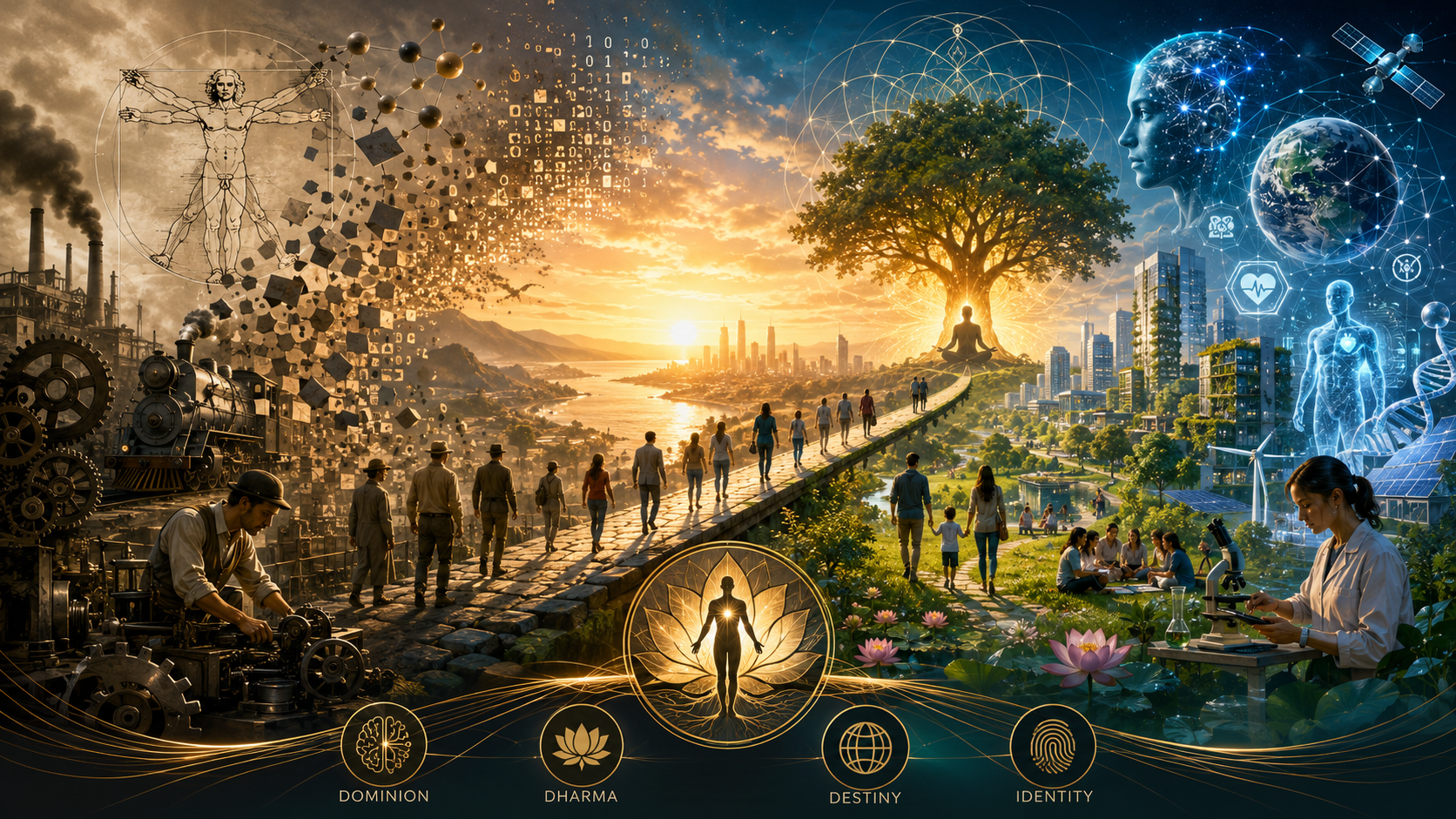
Humanity’s Passage from the Newtonian Machine Age to an Einsteinian–Quantum Phygital Civilization
A DDDI Institute White Paper
Vivek Singhal | Dominion, Dharma & Destiny Institute | DDDI.net | 2026
Executive Summary
Human civilization is entering a transition more consequential than the Industrial Revolution. The old Newtonian worldview—built around separable objects, linear causation, mechanical efficiency and centralized control—is being overlaid by a new reality shaped by artificial intelligence, precision medicine, synthetic biology, neurotechnology, robotics, quantum science and pervasive digital networks.
Tony Robbins, Peter Diamandis and Robert Hariri’s Life Force provides an accessible account of this transformation in medicine. Its central promise is that healthcare is moving from generalized treatment of disease toward earlier detection, individualized intervention, biological repair and the extension of healthy life. The book draws on interviews with more than 150 scientific and medical pioneers and emphasizes precision medicine, regenerative medicine and technologies intended to improve healthspan rather than merely postpone death.
Ray Kurzweil places these developments within a larger theory of exponential technological change. His singularity thesis anticipates an increasing convergence between human and machine intelligence, with artificial intelligence, biotechnology and nanotechnology progressively extending human capacities.
Yet neither technological acceleration nor biological longevity answers the deepest civilizational question:
What kind of human being should these technologies help us become?
The DDDI framework—Dominion, Dharma, Destiny and Identity—provides the missing architecture.
- Dominion asks what humanity can increasingly know, design and control.
- Dharma asks what ought to guide that power.
- Destiny asks what future our accumulated choices are creating.
- Identity asks who or what the human being becomes in a blended biological, physical and digital reality.
This paper argues that humanity is not simply passing from Newton to Einstein, or from industrial machines to intelligent machines. We are passing from a civilization organized around separation to one forced to recognize interdependence.
Advaita offers an important philosophical lens for this transition. Advaita literally signifies “non-secondness”: ultimate reality is not constituted by independently self-existing fragments but by an underlying nondual reality. Classical Advaita should not be confused with quantum mechanics, nor should either be used as scientific proof of mystical manifestation. Nevertheless, Advaita offers a civilizational philosophy capable of interpreting technological convergence without reducing the human being to either matter alone or disembodied consciousness alone.
The central DDDI thesis is therefore:
\boxed{ \text{Exponential Dominion} + \text{Civilizational Dharma} = \text{Conscious Destiny} }
But this synthesis becomes real only through an evolved Identity:
\boxed{ \text{Human} \rightarrow \text{Augmented Human} \rightarrow \text{Phygital Human} \rightarrow \text{Integrated Conscious Steward} }
The objective is not to escape humanity through technology. It is to enlarge human capability without abandoning human wisdom.
I. The End of the Purely Newtonian Human
Newtonian physics transformed civilization by making nature mathematically intelligible. Matter could be divided into objects; objects could be measured; forces could be calculated; machines could be designed; and production could be scaled.
This worldview became more than a theory of mechanics. It became a model for institutions.
The factory treated labor as interchangeable input.
The hospital divided the body into organs and specialties.
The school divided knowledge into subjects.
The corporation divided value into departments.
The nation-state divided humanity into sovereign territories.
The economy separated private gain from social consequence.
The Newtonian paradigm gave humanity extraordinary Dominion. It enabled industrial production, mass transportation, modern engineering, public infrastructure and large-scale medicine.
But it also encouraged a category error: because systems can be analyzed as parts, we began to imagine that they exist only as parts.
A human being became:
\text{Body} = \sum (\text{organs}+\text{cells}+\text{chemical reactions})
A company became:
\text{Enterprise} = \sum (\text{capital}+\text{labor}+\text{assets})
Society became:
\text{Nation} = \sum (\text{individual citizens})
Yet living systems possess relationships, feedback loops, memories and emergent qualities that cannot be understood by examining isolated components alone.
The challenge is not to reject Newton. Aircraft, bridges, medical devices and manufacturing systems continue to depend upon classical mechanics. The change is that Newtonian reality is no longer sufficient as civilization’s total worldview.
The emerging order is blended:
- physical and digital;
- biological and computational;
- individual and networked;
- material and informational;
- local and planetary;
- human and machine.
DDDI calls this the Phygital Era.
II. Einstein, Quantum Theory and the Limits of Separation
Einstein displaced the notion of absolute space and absolute time. Relativity showed that measurements of space and time depend upon frames of reference, while mass and energy are related rather than fundamentally disconnected.
Quantum theory introduced a different challenge. At microscopic scales, physical systems are described probabilistically; measurement plays a role in determining which properties are manifested in a given experiment; and particles cannot always be represented as classical objects possessing independently fixed attributes.
These discoveries do not mean that positive thinking can collapse a financial possibility into a bank balance. The quantum observer effect is frequently misapplied in manifestation teachings. In physics, “observation” refers to physical interaction and measurement, not necessarily to human desire.
Nevertheless, modern physics undermined the naïve assumption that reality consists only of isolated, solid objects moving through an absolute container.
The philosophical lesson is not:
“Consciousness can magically command the universe.”
It is:
“Reality is more relational, contextual and complex than the classical machine metaphor suggested.”
This distinction is essential to DDDI.
Quantum vocabulary must not become a substitute for evidence. But neither should scientific caution blind us to the larger cultural transition from objects to relationships, certainty to probability, and linear control to complex systems.
III.
Life Force: The Biological Frontier of Exponential Dominion
Life Force popularizes the proposition that medicine is moving from reacting to illness toward predicting, preventing and potentially repairing it.
Precision medicine seeks to use differences in genetics, environment and lifestyle to improve prevention and treatment rather than applying exactly the same intervention to every person. The NIH’s All of Us program is explicitly designed to accelerate research in this direction through diverse health and biological data.
The book’s broad technological themes can be organized into six transitions.
1. From Population Averages to the Individual
Traditional medicine often asks:
What generally works for patients with this diagnosis?
Precision medicine increasingly asks:
What is most likely to work for this particular individual, given their biology, history, environment and behavior?
The emerging health profile is not a single medical record. It is a dynamic data system:
H_i(t) = f(G,E,L,B,C)
where:
- G = genome,
- E = environment,
- L = lifestyle,
- B = biomarkers,
- C = clinical history,
- t = time.
Health becomes a continuously evolving pattern rather than a static diagnosis.
2. From Episodic Testing to Continuous Sensing
Wearable and ambient devices increasingly allow health to be monitored between clinical visits.
The old model was:
\text{Symptoms} \rightarrow \text{Appointment} \rightarrow \text{Test} \rightarrow \text{Treatment}
The emerging model is:
\text{Continuous data} \rightarrow \text{Pattern recognition} \rightarrow \text{Early warning} \rightarrow \text{Preventive intervention}
The human body becomes partly legible as a living data stream.
3. From Diagnosis by Scarcity to Diagnosis by Abundance
Earlier medicine often suffered from insufficient information. Exponential medicine faces the opposite challenge: too much heterogeneous information for unaided human cognition.
AI can help identify patterns across imaging, laboratory results, genomic data and medical histories. The crucial role of AI is therefore not to replace the physician, but to augment perception:
\text{Clinician} + \text{AI} + \text{Patient context} > \text{Clinician alone}
This is the first important form of blended intelligence.
4. From Treating Symptoms to Repairing Biology
Regenerative medicine seeks to replace or repair damaged cells, tissues and organs rather than only managing symptoms.
Its frontier includes:
- cell therapies;
- tissue engineering;
- gene therapies;
- organ regeneration;
- biomaterials;
- immune reprogramming;
- molecular and cellular repair.
But promise must be distinguished from proof. The U.S. Food and Drug Administration continues to warn that many marketed stem-cell, tissue and exosome products are unapproved and may expose patients to serious harms.
A DDDI white paper must therefore resist two opposite errors:
\text{Blind rejection of innovation} \quad \text{and} \quad \text{blind acceptance of promotion}
Dharma requires evidence, informed consent, safety, transparency and accountability.
5. From Standardized Drugs to Programmable Medicine
Biology is increasingly treated as something that can be read, modeled and selectively altered.
This does not mean that life is merely software. Biological systems are adaptive, embodied, evolutionary and deeply context-dependent. Yet the analogy to programming captures a real transition:
\text{Observe biology} \rightarrow \text{Model biology} \rightarrow \text{Design intervention} \rightarrow \text{Measure response} \rightarrow \text{Iterate}
AI and synthetic biology can accelerate this design–build–test–learn cycle. The convergence promises medical, agricultural and environmental advances, while also creating biosecurity and governance risks.
6. From Lifespan to Healthspan
The most important distinction in Life Force is not between life and death, but between years lived and years lived with vitality.
A simplistic objective is:
\max(\text{lifespan})
A better objective is:
\max(\text{healthspan}\times\text{agency}\times\text{meaning})
Living longer without physical independence, cognitive vitality, belonging or purpose is not necessarily human progress.
Longevity must be linked to Life Dharma.
IV. Kurzweil and the Logic of Exponential Convergence
Kurzweil’s singularity thesis is based not simply on the existence of faster computers, but on the interaction of multiple accelerating technologies.
In a linear worldview:
P(t)=P_0+kt
Progress increases by a roughly constant amount over time.
In an exponential model:
P(t)=P_0e^{rt}
The rate of change itself compounds.
Human intuition is usually linear. We expect tomorrow to resemble a slightly improved version of today. Exponential systems can appear unimpressive at first and then transform institutions rapidly once they cross thresholds of performance, affordability and adoption.
Yet no real technology follows a perfect exponential curve forever. Physical constraints, capital requirements, regulation, social resistance and diminishing returns matter. Technologies often progress through multiple S-curves:
\text{Experiment} \rightarrow \text{Rapid growth} \rightarrow \text{Maturity} \rightarrow \text{New paradigm}
The singularity is therefore best interpreted not as a guaranteed calendar event, but as a hypothesis about accelerating convergence.
The core convergences are:
Artificial intelligence
Machines increasingly perform perception, prediction, language generation, scientific modeling and decision support.
Synthetic biology
Living systems can increasingly be measured, engineered and programmed for particular functions.
Neurotechnology
Interfaces between nervous systems and machines may restore functions, interpret neural activity and eventually expand human–machine interaction.
Robotics
Intelligence becomes embodied and capable of acting in physical environments.
Nanotechnology and advanced materials
Interventions become smaller, more precise and more intimately integrated with biological and physical systems.
Quantum technologies
Certain classes of computation, measurement and communication may operate through specifically quantum effects, though their timelines and scalable applications differ sharply from popular rhetoric.
The singularity is therefore not one machine becoming conscious on one morning. It is the thickening of an intelligence layer across civilization.
\text{Human cognition} + \text{machine cognition} + \text{biological design} + \text{network coordination} = \text{civilizational intelligence}
The decisive question is whether this intelligence will be coherent or fragmented, liberating or controlling, Dharmic or extractive.
V. The Phygital Human
The Phygital Era is not merely the use of digital tools in physical life. It is the increasing impossibility of drawing a clean boundary between the two.
A person’s health may be shaped by:
- their biological body;
- a wearable sensor;
- an AI health model;
- a digital medical record;
- a genomic database;
- an implanted device;
- a human clinician;
- an algorithmic recommendation;
- an insurance platform;
- a social network.
The individual is therefore no longer only an isolated organism. The person becomes a node within an extended cognitive and biological system.
This produces a new equation of identity:
\text{Phygital Identity} = \text{Biological Self} + \text{Psychological Self} + \text{Digital Self} + \text{Relational Self} + \text{Institutional Self}
But this equation also contains danger.
Who owns the biological data?
Who controls the algorithmic model?
Can an insurer penalize a person for predicted illness?
Can employers demand continuous health monitoring?
Can wealthy individuals purchase cognitive and biological enhancements unavailable to others?
Can a state convert preventive medicine into compulsory surveillance?
The same technology can enlarge freedom or institutional Dominion.
Therefore:
\text{Augmentation without sovereignty} = \text{dependency}
\text{Personalization without privacy} = \text{surveillance}
\text{longevity without equality} = \text{biological class hierarchy}
Phygital reality requires not fewer human rights, but an expanded architecture of rights.
VI. Advaita: Nonduality Without Confusion
Advaita is often translated as nondualism, though “non-secondness” is philosophically more precise. It holds that ultimate reality is not divided into wholly independent, self-sufficient entities.
Advaita does not say that distinctions are useless. The physician and patient remain distinct in practical life. A human body is not identical to an AI server. A harmful action is not equivalent to a compassionate action.
Rather, Advaita distinguishes between the relative world of multiplicity and the deeper unity in which that multiplicity appears.
This is highly relevant to the technological age.
The Newtonian-industrial mind says:
Human or machine.
Nature or technology.
Individual or society.
Matter or consciousness.
East or West.
The Advaitic mind asks:
What larger reality makes these apparent opposites interdependent expressions of one unfolding whole?
The DDDI answer is not to erase difference, but to transcend the assumption that difference requires separation.
This is Both–and–also civilization.
- Human and machine.
- Biology and information.
- Individual sovereignty and collective responsibility.
- Dominion and Dharma.
- Diversity and unity.
- Science and meaning.
- Mortality and transcendence.
Advaita must not be used to claim that quantum theory confirms Vedanta. They operate through different methods and answer different questions.
Quantum physics asks:
What mathematical structure best predicts physical observations?
Advaita asks:
What is the ultimate nature of self, awareness and reality?
Their intersection is philosophical, not evidentiary.
Advaita gives meaning to convergence. It does not provide laboratory proof for technological or metaphysical claims.
VII. The Wealth Formula Reinterpreted for Exponential Civilization
The earlier Wealth Formula proposed:
CI+QF+IP+OE+IF=AM
where:
- CI = Conscious Intention;
- QF = Quantum Field Influence;
- IP = Infinite Probabilities;
- OE = Observer Effect;
- IF = Intentional Focus;
- AM = Accelerated Manifestation.
For DDDI, this should not be treated as literal quantum mathematics. It can, however, be transformed into a framework for exponential value creation.
Conscious Intention becomes Conscious Civilizational Purpose
Technology does not determine its own purpose.
CI= \text{What future are we consciously choosing?}
For health technology, the intention may be:
- longer healthy lives;
- universal access to prevention;
- restoration of bodily function;
- reduction of avoidable suffering;
- enhancement of human agency.
Without a conscious purpose, innovation defaults to whatever can attract capital, attention or power.
Quantum Field Influence becomes the Convergent Opportunity Field
The useful meaning of the “field” is the surrounding network of knowledge, capital, institutions, technologies and human relationships.
QF \rightarrow COF = \text{Convergent Opportunity Field}
An AI advance may accelerate protein design.
A sensor advance may improve clinical trials.
A materials breakthrough may enable an implant.
A data platform may reveal disease patterns.
A regulatory innovation may expand safe access.
The field is not magical. It is systemic.
Infinite Probabilities become Expanding Option Space
Exponential technologies enlarge the number of pathways through which a problem may be addressed.
IP = \text{Scientific possibilities} \times \text{technological combinations} \times \text{institutional models}
Yet possibilities are not equally probable, safe or desirable. DDDI therefore adds evaluation:
\text{Possibility} \rightarrow \text{Evidence} \rightarrow \text{Ethical assessment} \rightarrow \text{Experiment} \rightarrow \text{Scale}
Observer Effect becomes Measurement and Reflexivity
In social and technological systems, what we measure influences what institutions optimize.
When healthcare measures only procedures, it rewards procedures.
When corporations measure only quarterly profit, they optimize quarterly profit.
When AI systems measure engagement, they maximize engagement—even when it damages attention.
Therefore:
\text{Measurement} \rightarrow \text{incentive} \rightarrow \text{behavior} \rightarrow \text{system outcome}
The DDDI observer effect is not mind-over-matter. It is the power of metrics, models and attention to reorganize human behavior.
Intentional Focus becomes Strategic Concentration
Exponential possibility can produce paralysis. Civilizations, institutions and individuals need priorities.
IF = \frac{\text{attention devoted to high-leverage purpose}} {\text{total available attention}}
The question is not whether humanity can invent everything. It is whether we can direct sufficient intelligence toward what matters most.
Accelerated Manifestation becomes Accelerated Responsible Realization
The DDDI reformulation is:
\boxed{ \text{Conscious Purpose} \times \text{Convergent Technologies} \times \text{Expanded Options} \times \text{Truthful Measurement} \times \text{Focused Execution} = \text{Accelerated Realization} }
This outcome must remain subject to Dharma:
\boxed{ AR= (CP\times CT\times EO\times TM\times FE) \;\big|\;Dharma }
The vertical bar means “constrained or guided by.”
Acceleration without Dharma is not advancement. It is merely velocity.
VIII. DDDI: The Civilizational Operating System
1. Dominion: Expanding Capability
Dominion includes humanity’s ability to:
- decode genomes;
- model proteins;
- engineer cells;
- interpret neural signals;
- build intelligent machines;
- detect disease early;
- restore lost functions;
- extend healthy life.
Dominion answers:
What can we do?
Its risk is hubris.
The ability to modify life can create the illusion that humanity completely understands life. But complex systems routinely produce unintended consequences.
The DDDI principle is:
\text{Power of intervention} \leq \text{depth of understanding} + \text{capacity for correction}
Where uncertainty is high, reversibility and monitoring become essential.
2. Dharma: Directing Capability
Dharma asks:
- Is the intervention safe?
- Is the evidence honest?
- Is consent meaningful?
- Who bears the risk?
- Who receives the benefit?
- Does it increase freedom or dependence?
- Does it preserve dignity?
- Is it ecologically and socially sustainable?
Dharma is not a brake on innovation. It is the steering system.
\text{Innovation without Dharma} = \text{uncontrolled acceleration}
\text{Innovation with Dharma} = \text{directed evolution}
3. Destiny: Choosing the Human Future
Destiny is not prediction. It is path dependence.
Each technological choice alters the options available to future generations.
D_{t+1} = f(D_t,\ C_t,\ I_t,\ G_t)
where:
- D_t = inherited conditions,
- C_t = present choices,
- I_t = institutional design,
- G_t = governance.
Humanity’s technological destiny could take several forms:
The commercial destiny
The human becomes a permanent customer of optimization platforms.
The authoritarian destiny
The human becomes a continuously measured and behaviorally managed subject.
The stratified destiny
The wealthy gain access to longevity and enhancement while others receive minimal care.
The Dharmic destiny
Exponential technologies are treated as shared civilizational capacities used to reduce suffering, enlarge agency and preserve plural human flourishing.
Destiny is the result of design.
4. Identity: Who Is the Human Now?
This is the deepest DDDI pillar.
Is the human:
- a biological machine to be repaired?
- a consumer of enhancement?
- a data-generating organism?
- a soul temporarily embodied?
- a co-creator with technology?
- a steward of life?
- an evolving expression of consciousness?
The Phygital Age may destroy old identities faster than institutions can create new ones.
When memory can be externalized, what is knowing?
When cognition can be augmented, what is intelligence?
When bodies can be modified, what is natural?
When digital agents act in our name, what is agency?
When lifespan expands, what gives a life urgency and meaning?
DDDI proposes:
The human being is neither obsolete biology nor an all-powerful controller. The human is a conscious, relational and responsible steward capable of integrating biological life, technological intelligence and civilizational purpose.
IX. From Healthcare to Human Capability
The old healthcare equation is:
\text{Healthcare} = \text{diagnosis}+\text{treatment}
The Life Force equation expands it:
\text{Health} = \text{prevention}+\text{precision}+\text{regeneration}+\text{healthspan}
The DDDI equation goes further:
\boxed{ \text{Human Flourishing} = \text{Health} \times \text{Agency} \times \text{Purpose} \times \text{Belonging} \times \text{Wisdom} }
If any factor approaches zero, longevity loses much of its civilizational meaning.
A person may be biologically healthy but socially isolated.
Cognitively augmented but morally immature.
Long-lived but purposeless.
Digitally connected but psychologically fragmented.
The future of medicine cannot be separated from the future of education, work, community and meaning.
Healthspan must become contributionspan: the period during which a person can learn, love, create, mentor, serve and participate meaningfully.
X. A DDDI Policy Agenda for the Phygital Life-Force Era
Create a right to biological and neural sovereignty
Individuals should possess meaningful rights over genomic, biometric, neural and behavioral data.
Consent must be:
- understandable;
- revocable;
- specific;
- proportionate;
- free from coercion.
Separate validated medicine from technological theater
Promising therapies should be evaluated through transparent clinical evidence. Marketing must not outrun proof.
Hope is indispensable, but hope sold without evidence becomes exploitation.
Make preventive and precision medicine broadly accessible
If advanced diagnostics and prevention remain restricted to the wealthy, exponential medicine will deepen inequality.
A Dharmic health system must ask not only whether innovation exists, but whether access is fair.
Govern AI as an accountable participant
AI recommendations affecting diagnosis or treatment should be traceable, contestable and subject to qualified human oversight.
The patient must never become merely an input to an opaque optimization system.
Establish benefit-sharing for biological data
When institutions derive commercial or scientific value from population-scale biological data, contributing communities should share in the benefits through access, investment, infrastructure or public value.
Preserve the right not to be enhanced
In competitive environments, optional enhancement can become functionally compulsory.
A worker may be “free” to refuse cognitive monitoring but lose employment opportunities. A student may be “free” to avoid enhancement but face augmented peers.
Human dignity requires protection for both the freedom to adopt and the freedom to decline.
Build a global biosecurity Dharma
AI-enabled synthetic biology offers great benefits but also dual-use risks. Governance must combine innovation, responsible access, monitoring, international coordination and human oversight.
Educate for wisdom, not only technical fluency
The next generation needs:
- scientific literacy;
- systems thinking;
- ethical reasoning;
- contemplative awareness;
- intercultural understanding;
- entrepreneurial capability;
- civic responsibility.
The purpose of education must evolve from producing employees for industrial systems toward preparing stewards for intelligent systems.
XI. The New Human Wealth
In the Industrial Era, wealth was largely measured through control over land, machinery, labor and capital.
In the Phygital Era, wealth increasingly includes:
- healthspan;
- attention;
- trustworthy data;
- knowledge;
- intelligence;
- relationships;
- biological resilience;
- computational access;
- creative agency;
- time;
- meaning.
Thus:
\text{Total Human Wealth} = F+B+C+R+M+S
where:
- F = financial capital;
- B = biological capital;
- C = cognitive and creative capital;
- R = relational capital;
- M = moral and meaning capital;
- S = social and institutional capital.
A civilization can become financially richer while becoming biologically sicker, cognitively distracted, socially lonely and institutionally untrustworthy.
That is not wealth. It is imbalance.
The DDDI Wealth Formula is therefore:
\boxed{ \text{Sustainable Human Wealth} = \frac{ \text{Life Force} \times \text{Creative Force} \times \text{Trust} \times \text{Purpose} \times \text{Contribution} }{ \text{Extraction} + \text{Fragmentation} + \text{Fear} + \text{Entropy} } }
Money remains important. It is a medium of exchange, a store of value and a mechanism for coordinating human activity. But money is not identical to abundance.
True abundance is the expansion of meaningful options without the destruction of the systems upon which those options depend.
XII. From Zorba the Buddha to Einstein the Buddha
Osho’s image of Zorba the Buddha joined earthly vitality with spiritual awareness: celebration without unconsciousness, and consciousness without rejection of life.
The Phygital Era requires a further synthesis: Einstein the Buddha.
Einstein represents:
- curiosity;
- scientific imagination;
- relational reality;
- intellectual courage;
- humility before mystery.
Buddha represents:
- awareness;
- freedom from compulsive craving;
- compassion;
- disciplined inquiry into suffering;
- inner liberation.
Einstein without Buddha may create enormous power without inner maturity.
Buddha without Einstein may preserve inner wisdom while remaining unable to shape technological civilization.
Einstein the Buddha is therefore:
\text{Scientific Intelligence} + \text{Contemplative Awareness} + \text{Ethical Responsibility}
This is not a hybrid personality for a few exceptional individuals. It is the required identity architecture for a civilization wielding exponential power.
Conclusion: Singularity as Advaitic Responsibility
The singularity is often imagined as the moment machines exceed human intelligence.
But intelligence is not wisdom.
Prediction is not purpose.
Optimization is not Dharma.
Longevity is not meaning.
Connection is not communion.
Information is not realization.
Capability is not civilization.
The true singularity will not occur when the machine becomes more like the human. It will occur when humanity can no longer pretend that biology, technology, economy, consciousness and civilization are separable systems.
That is the Advaitic insight of the Phygital Era:
Not sameness, but non-separateness.
Human and machine remain distinct, but their destinies become intertwined.
Individual and civilization remain distinct, but each shapes the other.
Dominion and Dharma remain conceptually distinct, but sustainable progress requires their union.
Science and spirituality use different methods, but humanity requires both empirical truth and existential orientation.
The Newtonian Era taught humanity how to separate, measure and control the parts.
The Einsteinian and quantum revolutions taught us that frame, relationship and probability matter.
The Kurzweilian age teaches us that technologies can converge and accelerate.
Life Force teaches us that biological limitations once treated as fixed may increasingly become measurable, preventable or modifiable.
Advaita teaches us that beneath multiplicity lies non-separateness.
DDDI integrates these lessons into a civilizational imperative:
\boxed{ \text{Dominion without Dharma} \rightarrow \text{accelerated fragmentation} }
\boxed{ \text{Dominion with Dharma} \rightarrow \text{conscious evolution} }
\boxed{ \text{Conscious evolution} = \text{Life Force} \times \text{Wisdom} \times \text{Stewardship} }
Humanity’s highest destiny is not to become an immortal machine, nor to retreat from technology into an imagined spiritual past.
It is to become capable of holding exponential power without losing compassion, preserving diversity without denying unity, extending life without emptying it of meaning, and blending physical and digital reality without surrendering human sovereignty.
The goal of the Phygital Era must therefore be larger than singularity.
It must be Aikyam—integrated unity:
One humanity, many identities; one living Earth, many civilizations; many intelligences, guided by a shared Dharma of flourishing.
That is the journey from Life Force to Life Dharma—from merely adding years to life toward adding consciousness, contribution and civilizational wisdom to every year humanity is given.