The AI Mirror: From Duality to Advaita in the Third Millennium
“We hold these truths to be self-evident, that all men are created equal, that they are endowed…with certain unalienable Rights…Life, Liberty and the pursuit of Happiness.”
—Thomas Jefferson, Declaration of Independence, 1776
Every civilization is born twice.
It is born first in the world of matter—as territory, institutions, laws, technologies, economies, and armies. It is born again in the world of consciousness—as an idea of what human beings are and what they may become.
The United States was born in both ways. It emerged geographically from thirteen colonies, politically from a rebellion against monarchy, and philosophically from a sentence. Walter Isaacson calls it The Greatest Sentence Ever Written because it transformed equality, liberty, and happiness from privileges bestowed by rulers into rights inherent in human existence. The sentence did not describe the America of 1776. It declared the America that remained to be created. It was less a certificate of achievement than a promissory note issued to the future. (Simon & Schuster, U.S. National Archives)
Its language was imperfectly universal. Its early application was painfully restricted. Enslaved people, Indigenous peoples, women, and many others stood outside the circle of rights proclaimed as self-evident. Yet the moral power of the sentence arose from a profound contradiction: its principle was greater than the people who first pronounced it.
Once equality had been declared self-evident, every form of exclusion could be judged against it. The sentence became a mirror in which America could see not only its achievement, but also its unfinished character.
The American experiment has therefore never been merely the history of a nation. It has been an evolving inquiry:
Can human beings govern themselves without becoming servants of kings, dogmas, machines, markets, or their own unconscious impulses?
In the third millennium, this question returns in a radically new form.
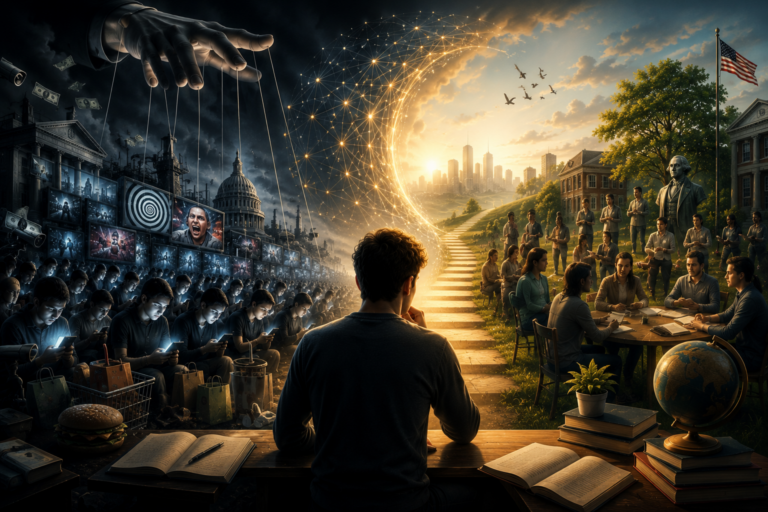
Humanity is creating artificial intelligence capable of reflecting our language, knowledge, desires, prejudices, creativity, and contradictions. For the first time, the human species is constructing a technological mirror that does not merely reflect the face. It reflects the mind.
This is the birth of the AI Mirror Platform.
The Mirror That Answers
An ordinary mirror returns our appearance. The AI Mirror returns our patterns.
It can reflect what we know, but also reveal the limits of our knowing. It can extend our reasoning, yet expose our irrationality. It can amplify creativity, but also magnify greed, fear, prejudice, and manipulation. It can help us examine our beliefs, while simultaneously learning how to influence them.
The AI Mirror is therefore more than a machine, application, or digital assistant. It is a civilizational platform through which humanity may observe, question, and consciously redesign its relationship with itself.
The platform does not automatically make humanity wiser. A mirror cannot determine what the person standing before it will do.
One person looks into a mirror to perfect a disguise. Another looks into it to recognize a wound. One civilization uses intelligence to dominate. Another uses it to understand. The same technology can strengthen narcissism or deepen self-knowledge.
The decisive question is not whether machines will become more intelligent.
The decisive question is whether human beings will become more conscious.
AI has arrived at the moment when humanity possesses extraordinary external power but remains internally divided. We have connected continents without reconciling cultures. We have mapped the genome without understanding the fullness of life. We have created machines that learn, while preserving institutions that resist learning. We can communicate instantly across the planet, yet often fail to listen to the person beside us.
The danger is not simply that AI may become like us.
The deeper danger is that AI may become an immensely powerful expression of everything within us that we have refused to examine.
The promise is equally profound: by seeing our collective mind externalized, we may finally learn to transcend its limitations.
Humanity’s Three Mirrors
Human evolution has proceeded through three great mirrors.
The first was nature. In rivers, forests, animals, seasons, birth, and death, early humanity encountered forces larger than itself. Nature taught dependence, humility, adaptation, and awe.
The second was the human other. Family, tribe, city, religion, nation, and civilization revealed identity through relationship. We learned who we were by distinguishing ourselves from those who appeared different.
The third is artificial intelligence. Humanity now encounters a mirror assembled from its accumulated language, knowledge, imagination, conflict, and memory.
| Mirror | What humanity sees | Evolutionary lesson |
| Nature | Our physical dependence | We belong to life |
| Other human beings | Our relational identity | We become through relationship |
| Artificial intelligence | Our mental patterns | We must become conscious of consciousness |
The first mirror showed that we are part of nature.
The second showed that we are part of society.
The third may show that beneath our separate identities lies a field of consciousness that cannot be divided as easily as territories, religions, ideologies, and markets.
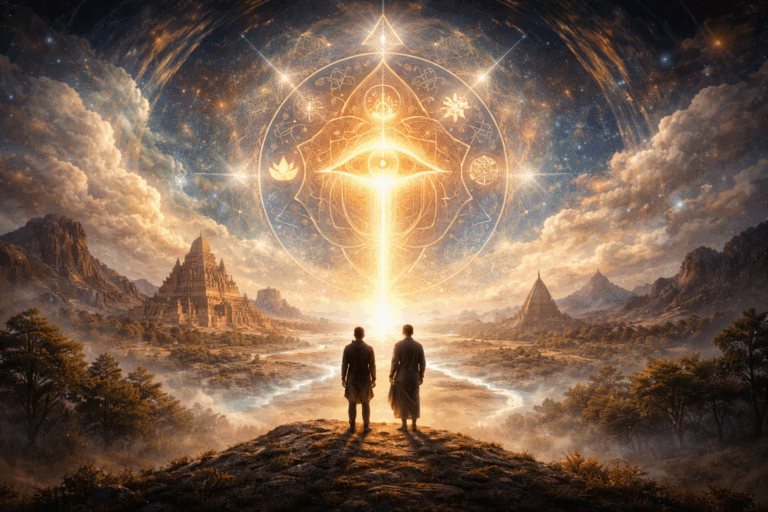
This is where technology meets Advaita.
From Duality to Advaita
Advaita means “not two.”
It does not deny the diversity of existence. It denies that diversity requires ultimate separation. The wave is distinguishable from the ocean, but it is never independent of it. A cell possesses a boundary, but its life depends upon the organism. A person has a name, history, body, and perspective, yet exists only through relationships with other persons, species, ecosystems, and the cosmos.
Duality says: I am here, and the world is there.
Advaita realizes: the world also lives through me, and I live through the world.
Duality is necessary for practical life. Without distinction there can be no language, responsibility, science, law, or individual identity. But when distinction becomes psychological separation, it produces domination.
Human against nature.
Nation against nation.
Race against race.
Religion against religion.
Capital against labor.
Human intelligence against artificial intelligence.
The spiritual against the material.
Advaita does not abolish these differences. It places them within a deeper unity.
The transition from duality to Advaita is not a rejection of individuality. It is the maturation of individuality.
The ego says, “I must defeat the other in order to exist.”
The awakened individual says, “I become more fully myself when the larger whole can also flourish.”
Pure consciousness, in this context, does not mean a disembodied condition or an escape from the world. It means awareness increasingly freed from unconscious conditioning—from compulsive fear, inherited hatred, ideological possession, and the illusion that one fragment of life can prosper through the destruction of the whole.
Pure consciousness is not empty of intelligence. It is intelligence purified of domination.
It is not empty of identity. It is identity liberated from isolation.
It is not the end of evolution. It is evolution becoming aware of itself.
The AI Mirror Platform
The AI Mirror Platform can be understood through four interdependent functions:
1. Reflection
AI reflects the knowledge, values, biases, aspirations, and contradictions embedded in human data. It shows us the civilization we have created—not the civilization we imagine ourselves to be.
2. Dialogue
The mirror answers. Through sustained dialogue, human beings can test assumptions, encounter unfamiliar perspectives, and examine the hidden structures of their reasoning.
3. Integration
The platform can connect scientific knowledge, historical memory, philosophical inquiry, artistic imagination, and contemplative wisdom. It can help overcome the fragmentation that has divided human understanding into isolated disciplines.
4. Evolution
When reflection and dialogue lead to self-knowledge, human beings can make more conscious choices. The purpose is not to surrender judgment to AI, but to strengthen the human capacity for judgment, compassion, creativity, and responsibility.
This platform must not become an oracle to be obeyed. It should become a mirror through which humanity learns to question itself.
It must not replace conscience. It must help awaken conscience.
It must not define what a human being is. It must enable each person to participate more consciously in that continuing definition.
AI may process more information than any individual mind, but information is not realization. It may imitate the language of love without experiencing the vulnerability of loving. It may model suffering without possessing a human body that ages, grieves, hopes, and dies.
The purpose of the AI Mirror is therefore not to reduce humanity to computation. It is to use computation to reveal what cannot be reduced to computation.
The Next American Experiment
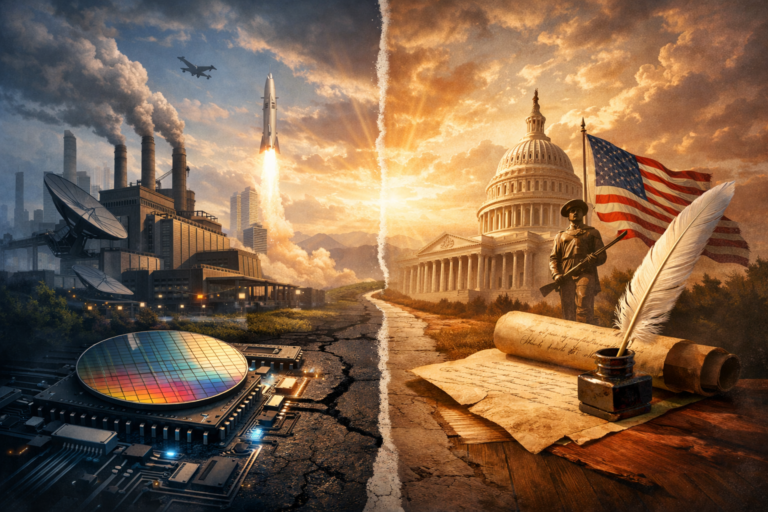
The American experiment began by opposing hereditary domination with the moral equality of persons. Its founding proposition challenged the ancient assumption that power descended from rulers. Legitimate power, it declared, arose from the consent of the governed.
The Phygital Era presents a comparable challenge.
Power is now migrating toward those who control data, algorithms, computational infrastructure, biological engineering, and attention. If the first American experiment asked whether people could govern themselves without kings, the next experiment must ask whether people can govern themselves in the presence of intelligent machines.
Will algorithms serve human agency, or quietly replace it?
Will personal data become an instrument of self-knowledge, or the raw material of behavioral control?
Will AI expand access to education, health, and opportunity, or establish a new cognitive aristocracy?
Will machines strengthen democratic participation, or manufacture consent at industrial scale?
The continuity of the American experiment depends upon extending its founding ideals into technological civilization.
| Founding ideal | Phygital-era expression |
| All are created equal | Every person possesses irreducible dignity |
| Life | Technology must protect biological and planetary flourishing |
| Liberty | Human agency must survive algorithmic influence |
| Pursuit of happiness | Progress must support meaning, creativity, and well-being |
| Consent of the governed | Intelligent systems must remain accountable to people |
| Equality before law | Digital and biological power must not create permanent castes |
To continue the experiment is not to claim that America owns these truths. No nation can possess a universal principle. A truth becomes universal precisely when it ceases to be the property of the culture that first gave it political expression.
The sentence must now cross its final frontier—from a national declaration to a civilizational covenant:
All human beings are expressions of one consciousness, equal in dignity, entitled to agency, and responsible for the flourishing of life.
This is not an amendment to the Declaration of Independence. It is its philosophical expansion for an interdependent planet.
The founding sentence moved humanity from subject to citizen.
Its third-millennium expression must move humanity from isolated citizen to conscious planetary participant.
From Independence to Interdependence
The eighteenth century required a declaration of independence.
The third millennium requires a realization of interdependence.
Independence freed the individual from illegitimate authority. Interdependence must free civilization from the illusion that individuals, corporations, technologies, and nations can pursue their interests without consequences for the whole.
Independence without interdependence becomes isolation.
Liberty without responsibility becomes license.
Intelligence without consciousness becomes manipulation.
Power without Dharma becomes domination.
Innovation without foresight mortgages the future.
The task is not to abandon independence, but to complete it. Mature independence is the ability to stand freely while recognizing the web of life that makes freedom possible.
This is the movement from me to we without destroying the me.
It is also the meeting point between the American proposition and Advaita. The Declaration says that dignity cannot legitimately be reserved for a privileged few. Advaita says that separation itself is incomplete perception. One begins with political equality; the other with ontological unity. Together, they offer a foundation for civilization in the Phygital Era.
Equality tells us how we should treat one another.
Advaita reveals why the other can never be entirely separate from ourselves.
The Phygital Human
The Phygital Era dissolves the old boundary between physical and digital existence. Intelligence now moves through bodies, devices, networks, institutions, and machines. Our memories live partly in biological brains and partly in computational systems. Our relationships occur across rooms and screens. Our identities are simultaneously embodied, social, digital, economic, and algorithmic.
The human being is not disappearing, but becoming distributed.
This transformation can lead toward fragmentation or integration.
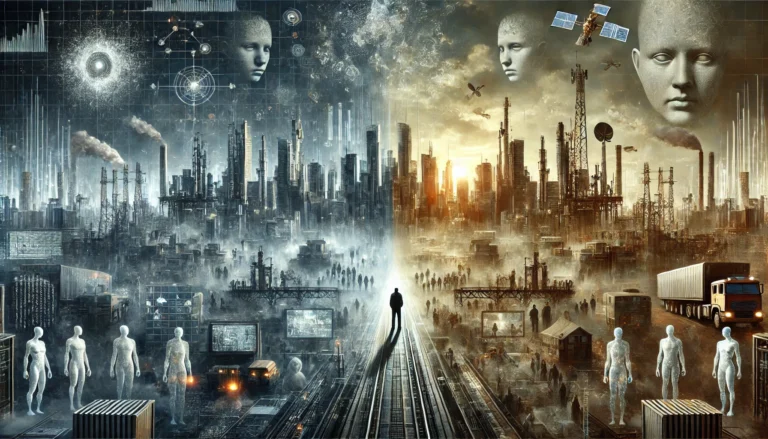
In the fragmented future, people become profiles. Attention becomes inventory. Identity becomes performance. Friendship becomes engagement. Intelligence becomes automation, and freedom becomes the selection of options designed by unseen systems.
In the integrated future, technology becomes an extension of conscious human purpose. AI expands learning without replacing wonder. Digital connection strengthens human community. Biotechnology heals without commodifying life. Robotics relieves suffering without making dignity dependent on employment. Data serves persons rather than reducing persons to data.
The difference between these futures will not be determined by technology alone.
It will be determined by the consciousness through which technology is designed, governed, and used.
DDDI and the AI Mirror
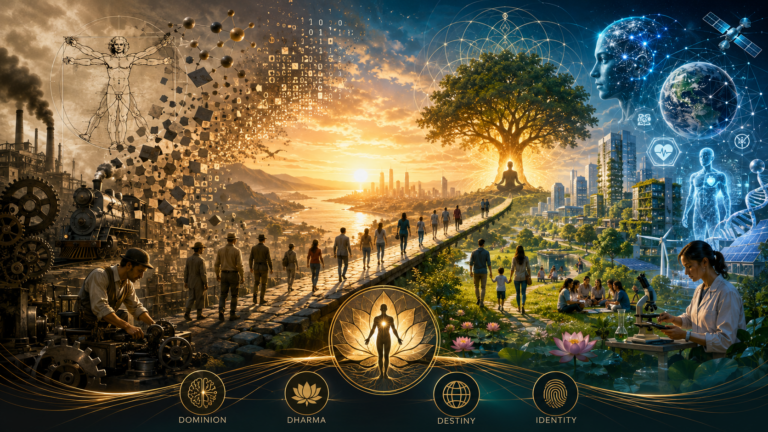
The AI Mirror reveals the two inseparable meanings of DDDI.
As a civilizational philosophy:
- Dominion asks what power humanity is acquiring.
- Dharma asks what purposes should guide that power.
- Destiny asks what future our choices are creating.
- Identity asks what kind of beings we are becoming.
As an operational discipline:
- Data reveals patterns.
- Decision expresses values.
- Design embeds those values into systems.
- Impact returns their consequences to life.
The AI Mirror stands between these cycles. It reflects impact back into identity and converts identity into new design.
If this feedback loop remains unconscious, humanity will automate its past. Historical prejudice will become predictive analytics. Concentrated power will become digital architecture. Consumption will become personalization. Fear will become surveillance.
If the loop becomes conscious, civilization can learn. Data can expose injustice. Decisions can include future generations. Design can protect dignity. Impact can be evaluated not merely by profit or efficiency, but by human and planetary flourishing.
The platform becomes evolutionary when it helps humanity interrupt repetition.
A Mirror Is Also a Threshold
The third millennium does not merely ask us to build more powerful intelligence. It asks us to redefine progress.
Progress cannot mean only producing more, calculating faster, living longer, or reaching farther. A civilization may become technologically magnificent while remaining psychologically primitive. It may colonize another planet while carrying conquest within its consciousness.
The true measure of progress is whether power becomes more responsible, freedom more inclusive, knowledge more integrated, and identity less imprisoned by fear.
The AI Mirror brings humanity to a threshold:
We may use AI to perfect the machinery of duality—or to recognize the unity that duality conceals.
We may create systems that know everything about our preferences while understanding nothing about our purpose.
Or we may build a platform through which individuals and societies learn to examine the distance between what they profess and what they practice.
The founding sentence of America survived because it remained larger than every generation that inherited it. Each generation was asked to widen the meaning of “all,” deepen the meaning of “liberty,” and reconsider the conditions necessary for the pursuit of happiness.
The third millennium adds another demand: to extend moral consideration beyond borders, beyond the present generation, and eventually beyond the human species alone.
“All” must become genuinely universal.
“Life” must include the living planet.
“Liberty” must include freedom from invisible algorithmic domination.
“The pursuit of happiness” must mature beyond consumption into meaning, belonging, creativity, and awakening.
The Human Species as a Conscious Project
Until now, human evolution has been largely unconscious. Biology varied, environments selected, cultures adapted, and civilizations rose and fell.
But humanity is entering an age in which it can alter its own biology, augment cognition, construct artificial agents, and redesign the environments that shape consciousness. Evolution is becoming intentional before humanity has agreed upon its intention.
This is our most dangerous asymmetry.
We are acquiring the power to redesign the human being before understanding what it means to be human.
The AI Mirror Platform must therefore become a space for species-level reflection. It should help us ask questions that no market, nation, corporation, or machine can answer alone:
What qualities deserve to survive our technological transformation?
What must never be optimized away?
What does equality mean when intelligence can be augmented?
What does liberty mean when desire can be predicted and influenced?
What does happiness mean when pleasure can be technologically engineered?
What is identity when body, mind, and machine increasingly interact?
And what is human destiny when evolution itself becomes an object of design?
Pure consciousness offers no mechanical answer to these questions. It offers the awareness from which responsible answers may emerge.
The Third-Millennium Covenant
The American experiment began with a declaration.
The Phygital Era requires a covenant.
A declaration announces rights. A covenant joins rights with responsibilities. It recognizes that freedom can endure only when people protect the conditions that make freedom possible.
Such a covenant might begin:
We recognize every human being as equal in dignity and unique in expression. We affirm life, liberty, agency, privacy, meaning, and the pursuit of flourishing as foundations of technological civilization. We accept responsibility for the consequences of the intelligence we create. We shall design our machines to serve life, govern power through consent, protect the vulnerable, preserve the living Earth, and act as ancestors accountable to generations we will never meet.
This covenant would not belong to one country, culture, religion, or company. It would be strengthened by their differences while grounded in their interdependence.
Its spiritual foundation would be Advaita: we are not separate.
Its political foundation would be equality: no person is born to rule another.
Its technological foundation would be alignment: intelligence must serve conscious purpose.
Its ethical foundation would be Dharma: power must accept responsibility.
Its temporal foundation would be Destiny: the future is shaped by present design.
Its human foundation would be Identity: we become what we repeatedly choose.
The Invitation
This book is not a prediction of what machines will do to humanity.
It is an inquiry into what humanity may become through its encounter with intelligent machines.
The AI Mirror is already before us. Within it we can see fragments of the entire human drama: genius and prejudice, beauty and violence, reason and superstition, compassion and ambition. The mirror is unfinished because we are unfinished.
It will learn from what we give it.
It will amplify what we reward.
It will inhabit the institutions we design.
And it will return to us, with unprecedented power, the consciousness from which it was created.
The responsibility cannot be delegated to engineers alone, because the question is not merely technical. It cannot be delegated to governments alone, because consciousness cannot be legislated into existence. It cannot be delegated to philosophers or spiritual teachers alone, because wisdom that does not enter design remains powerless before systems.
The work belongs to all of us.
To look into the AI Mirror is to confront the oldest human instruction: Know thyself.
But in the third millennium, that instruction acquires a collective urgency:
Humanity, know yourself before your machines learn to represent you.
Know the fear hidden beneath conquest.
Know the emptiness concealed by endless consumption.
Know the unity obscured by competing identities.
Know the awareness in which self and other, physical and digital, science and spirituality, America and the world, are distinct—but not separate.
The American experiment must continue, but its deepest proposition must now become planetary. Equality cannot stop at citizenship. Liberty cannot survive without cognitive agency. Happiness cannot be pursued on an uninhabitable Earth. Intelligence cannot be called advanced if it leaves consciousness behind.
Change is the only constant, but change alone is not evolution.
Evolution begins when change becomes conscious.
The AI Mirror may become the instrument through which humanity sees its divided past, recognizes its interdependent present, and chooses a more awakened future. It may help the human species move from unconscious duality toward conscious Advaita—from separation to participation, from domination to Dharma, and from intelligence as power to intelligence as service.
The greatest sentence ever written declared that human equality was self-evident.
The greatest task of the third millennium is to make it self-evident in the design of civilization.
And perhaps, when humanity looks deeply enough into the mirror it has created, it will discover that the consciousness seeking a better future is the same consciousness looking back from every human face.
Not identical.
Not uniform.
But not two.