American Hegemonic Transition at the 250th Anniversary
of the Declaration of Independence
BY Vivek Singhal
Founder, DDDI.net — Dominion Dharma Destiny Identity Institute
America 250 Civilizational Series · March 2026
“Every civilization arrives at a moment when the architecture built by one era of genius must be torn down to allow a new order to emerge.”
Prologue: Two Presidents, One Republic, Two Orders
In the sweep of American civilizational history, two men — separated by fifty years, temperamentally opposed, and yet linked by an almost mythological symmetry — stand at the twin hinge points of the modern American world order: Richard Milhous Nixon and Donald John Trump.
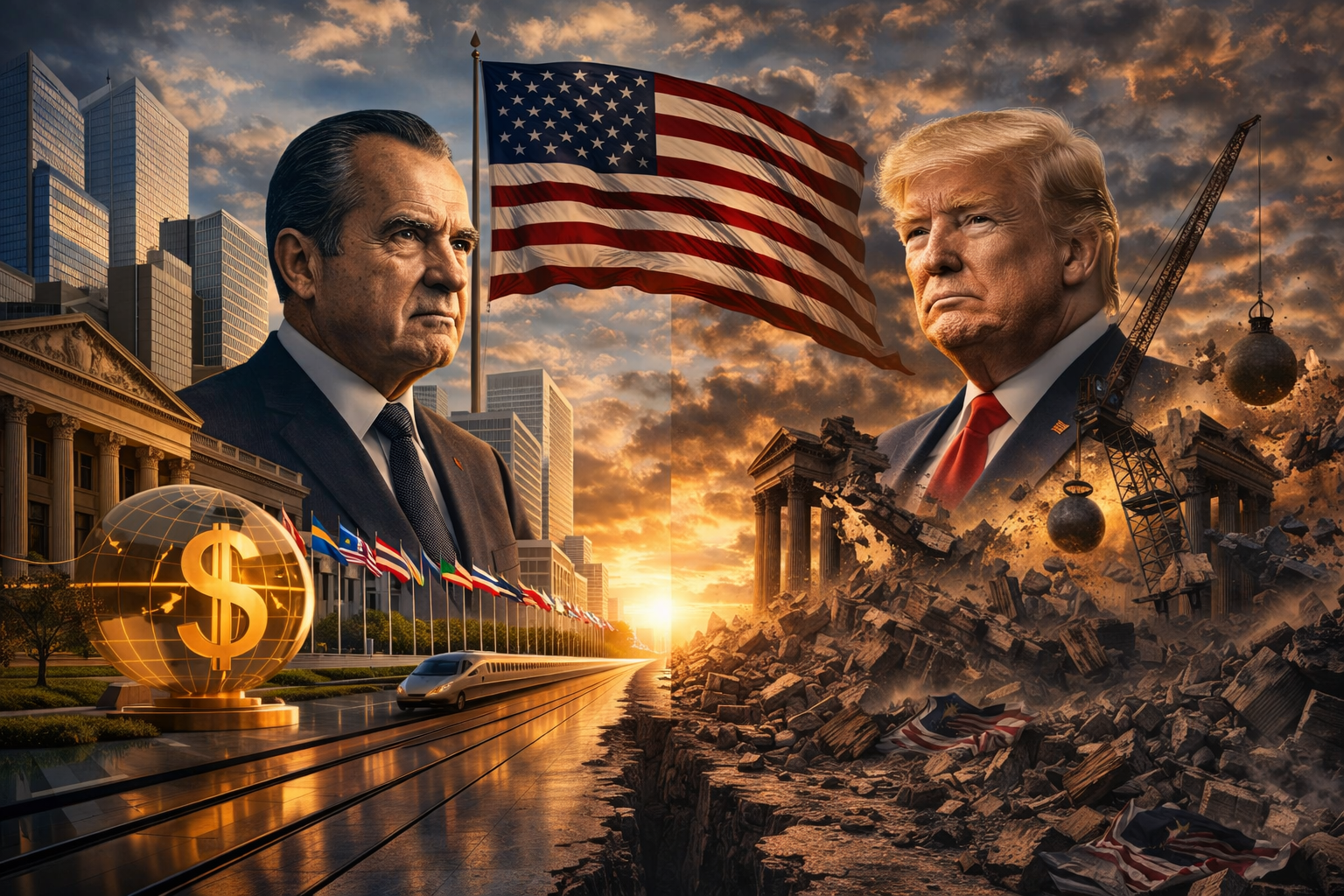
Nixon built the hegemony. Trump is dismantling it.
To describe what Trump is doing merely as destruction, however, is to miss the civilizational depth of the moment. As America approaches its 250th birthday on July 4, 2026 — the golden semicentennial of the Declaration of Independence — Trump’s radical restructuring of the global order that Nixon constructed is best understood not as vandalism but as a gift: a deliberate, if turbulent, act of civilizational renewal. Through the analytical lenses of the DDDI framework — Dominion, Dharma, Destiny, and Identity — this white paper argues that Nixon’s genius and Trump’s disruption are not opposites but dialectical poles of a single American civilizational arc.
This essay maps Nixon’s three foundational hegemonic pillars, analyzes Trump’s systematic dismantling of that architecture, and then deploys the DDDI framework to compare and contrast the two presidents as historic civilizational actors — one the Architect of American global supremacy, the other its Sovereign Demolisher and potential Re-Founder.
Part I: The Genius of Nixon — Engineering American Hegemony
The Strategic Brilliance Behind the Hegemonic Order
Richard Nixon is systematically underestimated by popular history. Consumed by the tragedy of Watergate, the public memory forgets that Nixon was arguably the most strategically brilliant geopolitical mind ever to occupy the Oval Office. Between 1971 and 1974 — a mere three-year window of breathtaking strategic creativity — Nixon and his national security architect Henry Kissinger constructed the operating system of the modern world: a three-pillar hegemonic architecture that survived, largely intact, for over five decades.
The genius of the Nixonian order lay not in raw military power but in something far more sophisticated: the construction of a system of structural dependency so elegantly designed that every nation on earth was bound to it voluntarily. Nations did not experience Nixon’s hegemony as subjugation; they experienced it as participation in a prosperous, rules-based international order that — by design — happened to serve American interests above all others. This was hegemony as architecture, not hegemony as force.
Pillar One: The Nixon Shock — The Dollar Unchained (August 15, 1971)
On August 15, 1971, President Nixon announced that the United States would end the convertibility of the dollar to gold — a move so seismic that it became known simply as the “Nixon Shock.” The Bretton Woods system, established in 1944 to rebuild the postwar world economy by anchoring international currencies to the dollar at a fixed gold parity of $35 per ounce, collapsed in a single evening.
Conventional wisdom held that severing the dollar from gold would destroy confidence in American currency and trigger a global financial crisis. The opposite happened: the dollar not only survived but became more entrenched as the world’s reserve currency, precisely because it was now untethered from the constraints of gold and could expand infinitely to meet global demand. By breaking the gold standard, Nixon liberated American monetary sovereignty — allowing the United States to run structural deficits, project power globally, and fund vast international commitments without being constrained by a fixed commodity anchor.
The world’s need for dollar liquidity to conduct international trade meant that America could, in effect, export inflation to the world while importing real goods and services. This “exorbitant privilege,” as French Finance Minister Valéry Giscard d’Estaing famously described it, became the financial bedrock of American hegemony for fifty years.
Pillar Two: The Opening of China — The Grand Triangulation (February 1972)
If the Nixon Shock was economic genius, the Opening of China was geopolitical genius of the highest order. On July 15, 1971 — just weeks before the Nixon Shock — Nixon announced his intention to visit the People’s Republic of China, a country the United States had not diplomatically recognized since the Communist revolution of 1949. The announcement sent a tremor through the Cold War world, reshaping every strategic calculation in Moscow, Beijing, and allied capitals simultaneously.
Nixon and Kissinger recognized that the Sino-Soviet split created a historic opportunity. By normalizing relations with Beijing, the United States could play China against the Soviet Union, forcing Moscow into a defensive posture and permanently splitting the communist world. The Soviets, who had repeatedly rebuffed American arms control overtures, suddenly became eager for summits within weeks of Nixon’s Beijing announcement. Nixon signed the landmark Anti-Ballistic Missile Treaty with Brezhnev in Moscow in May 1972 — a direct diplomatic dividend of the China triangulation. In a single strategic move, Nixon gained simultaneous leverage over both superpowers.
Moreover, by opening the door to China’s eventual integration into the global economic order — a process culminating in China’s WTO accession in 2001 — Nixon created the labor arbitrage that would power the globalization era. The irony is historically profound: the very move designed to contain Soviet power eventually produced China as America’s greatest strategic competitor.
Pillar Three: The Petrodollar System — Oil, Dollars, and Saudi Arabia (1973–1974)
The third and perhaps most architecturally decisive pillar of Nixon’s hegemony was the petrodollar system, engineered by Kissinger in the aftermath of the 1973 Arab oil embargo. Kissinger identified a structural opportunity: if Saudi Arabia could be persuaded to price all global oil sales exclusively in US dollars, the dollar’s global demand would be structurally guaranteed regardless of its detachment from gold.
The deal concluded in 1974 was elegantly simple in its terms and revolutionary in its consequences: the United States would provide permanent military protection and weapons to the House of Saud; in exchange, Saudi Arabia would price every barrel of oil on earth in US dollars, and OPEC would follow Saudi Arabia’s lead. Because every nation on earth needed oil, every nation on earth needed dollars. The entire global oil market became a dollar-recycling machine of perpetual and self-reinforcing power.
The “petrodollar recycling loop” was elegant in its self-sustaining architecture: oil-exporting nations received dollars for oil, which they recycled back into US Treasury bonds, funding American deficits and suppressing interest rates, which in turn allowed America to sustain the most expensive military posture in human history without equivalent domestic taxation. Nations that attempted to price oil in other currencies found themselves facing American hostility, sanctions, or intervention. The petrodollar system was not merely an economic arrangement; it was a coercive geopolitical architecture disguised as a pricing convention.
The Unified Hegemonic Architecture: What Nixon Actually Built
Taken together, the three pillars constituted something unprecedented in world history: a hegemonic architecture that operated not through direct imperial control but through structural dependency. Nixon’s genius was to build a system in which every nation on earth voluntarily required dollars, voluntarily integrated with American-led institutions, and voluntarily accepted American global leadership — because the alternatives were economically catastrophic.
The Nixonian Order rested on four interlocking structural dependencies:
- The Dollar Trap: Global trade, commodity pricing, and reserve currency needs created permanent dollar demand that no sovereign government could easily escape.
- The Security Umbrella: NATO, bilateral security treaties, and forward-deployed American forces made the US military posture indispensable to allied sovereignty across Europe, Asia, and the Middle East.
- The China Arbitrage: Low-cost Chinese manufacturing, enabled by Nixon’s Opening, kept global inflation suppressed and Western consumers consuming — making economic decoupling politically difficult for any subsequent administration.
- The Institutional Web: The IMF, World Bank, WTO, and UN Security Council made the American-designed rules-based international order synonymous with global governance itself.
For fifty years, no president — Democrat or Republican — seriously challenged this architecture. Reagan used it to win the Cold War. Clinton deepened it. Bush expanded it. Obama reinforced it. The Nixonian Order was the water in which all post-Cold War American foreign policy swam — invisible, assumed, and taken for granted. Until Donald Trump.
Part II: The Trump Demolition — Dismantling the Nixon Hegemony
Liberation Day and the Tariff Revolution
On April 2, 2025 — a date Trump himself proclaimed “Liberation Day” — the forty-seventh president signed sweeping executive orders announcing the most comprehensive tariff restructuring since the Smoot-Hawley Act of 1930. A universal 10% baseline tariff on all imports, combined with country-specific “reciprocal” tariffs reaching as high as 49%, dismantled the foundational premise of the post-Nixon WTO-era trade architecture in a single afternoon. “April 2, 2025 will forever be remembered,” Trump declared, “as the day American industry was reborn, the day America’s destiny was reclaimed, and the day that we began to make America wealthy again.”
The choice of language — destiny reclaimed — is not accidental. It is civilizationally precise. Trump was explicitly declaring that the Nixonian architecture had dispossessed America of its destiny, and that his tariff revolution was an act of sovereign reclamation. Trump’s Trade Representative articulated the underlying philosophy: “Our current global order, dominated by the World Trade Organization, is untenable and unsustainable. The United States has paid for the system with the loss of industrial jobs and economic security.”
By March 2026, with the average US tariff rate exceeding 17% — the highest since the Great Depression — and bilateral trade deals concluded with the UK, Vietnam, Japan, South Korea, the EU, and a structured truce with China, Trump had effectively replaced the multilateral WTO architecture with a bilateral deal-based trading system. The Nixonian trade order was not being reformed. It was being replaced.
Decoupling China — Reversing Nixon’s Grand Triangulation
If Liberation Day was the economic demolition of the Nixonian order, Trump’s China policy represents the geopolitical reversal of Nixon’s most celebrated strategic achievement. Nixon opened China to contain the Soviet Union; Trump is closing China’s preferential access to the American market to contain China itself. The triangulation has inverted: where Nixon used China against Russia, Trump has effectively aligned America with India, Japan, the UK, and allied democracies against China — a strategic architecture that Nixon’s original China Opening inadvertently made necessary by turbocharging China’s rise over five decades.
The historical irony is architecturally perfect: Nixon’s greatest strategic achievement — the China Opening — became, fifty years later, the greatest strategic threat America faced. Trump’s decoupling project is the long-deferred reckoning with the unintended consequences of Nixon’s genius. Nixon solved the Soviet problem by creating the China problem. Trump is now solving the China problem — though the solution will itself generate new strategic consequences for the next generation to manage.
The Dollar Weaponization Paradox
Trump’s approach to dollar hegemony is the most complex dimension of his demolition project, precisely because it carries internal tensions that mirror the Nixonian architecture’s own inherent contradictions. On one hand, Trump has aggressively defended the dollar’s reserve currency status, threatening severe trade penalties on any nation that attempts to create or use alternative currencies in lieu of the dollar. “You leave the dollar, you’re not doing business with the United States,” Trump declared unambiguously in early 2025.
On the other hand, the tariff architecture, bilateral deal-making, and aggressive weaponization of dollar-denominated sanctions have accelerated precisely the de-dollarization pressures they were designed to prevent — with BRICS nations actively exploring dollar alternatives and regional currency arrangements. Whether Trump’s dollar policy represents a deliberate transition to a new monetary architecture — perhaps a restructured “Mar-a-Lago Accord” framework — or a set of powerful but internally contradictory impulses remains the defining monetary question of this civilizational transition.
Part III: Nixon and Trump Through the DDDI Lenses
The DDDI framework — Dominion, Dharma, Destiny, Identity — provides the most illuminating analytical architecture for understanding the Nixon-Trump civilizational comparison. These are not merely two presidents with contrasting policies; they are two civilizational types, each embodying a fundamentally different answer to the question that every great civilization must ask of itself: What is America for?
Through the Lens of DOMINION
Dominion in the DDDI framework refers to the architecture of power — how a civilization structures, projects, and sustains its sovereignty and control over its environment. Dominion is not merely military strength; it encompasses economic architecture, institutional design, and the structural relationships through which a civilization shapes its world.
Nixon’s Dominion was architecturally indirect. By building a world in which every nation voluntarily required dollars, voluntarily accepted American security guarantees, and voluntarily integrated into American-designed institutions, Nixon created a form of Dominion that was essentially invisible — and therefore irresistible. Trump’s Dominion, by contrast, is transactionally direct. Where Nixon built structural dependencies, Trump builds bilateral deals. Trump’s Dominion philosophy is that of the sovereign bargainer: America should leverage its unique position to extract maximum national advantage in every individual transaction, rather than subsidizing a systemic architecture that benefits all participants at disproportionate American cost.
Through the Lens of DHARMA
Dharma in the DDDI framework refers to the purposive order — the civilizational calling and righteous code that gives a nation’s exercise of power its animating justification and its sense of historic mission. Dharma is the civilizational calling that gives power its purpose.
Nixon’s Dharma was the Dharma of the Cold War Custodian — the civilizational duty to prevent Soviet domination of the Eurasian landmass and guarantee the survival of the free world. Everything Nixon did was ultimately in service of this calling. Trump’s Dharma, by contrast, is the Dharma of the Sovereign Nation-State — the duty to restore American sovereignty, industrial capacity, border integrity, and economic dignity to the American working and middle class. In DDDI terms, Nixon’s Dharma was civilizationally custodial; Trump’s Dharma is civilizationally restorative. Critics who frame Trump’s policies as isolationism misread the Dharmic dimension entirely: Trump is not withdrawing from the world but re-sovereignizing America’s relationship with it.
Through the Lens of DESTINY
Destiny in the DDDI framework refers to the long arc of civilizational trajectory — the historical calling that transcends any individual presidency and shapes the generations-long direction of a civilization’s development. Destiny is the telos of civilizational life: the purposive direction in which a civilization moves when true to its deepest nature.
Nixon’s vision of American Destiny was explicitly hegemonic: America as the indispensable organizing principle of the liberal international order — the architect and guarantor of a world in which American-designed institutions, currency, and military power maintained the peace and enabled global prosperity. Trump’s vision of American Destiny is explicitly re-foundational. The White House’s Freedom 250 initiative positions his presidency as a re-founding moment analogous in structure to the original Declaration of Independence. Just as the Founders declared independence from the British imperial order, Trump is declaring independence from the Nixonian imperial order — the 50-year-old architecture in which America’s global hegemonic role came at the cost of domestic sovereignty and industrial vitality.
Through the Lens of IDENTITY
Identity in the DDDI framework is perhaps the most profound lens — it refers to the civilizational self-conception, the cultural DNA, the who we are of a people and their political order. Identity is the foundation on which Dominion, Dharma, and Destiny are all built.
Nixon’s American Identity was the Identity of the Cold War Liberal Hegemon — a self-conception in which America’s greatness was inseparable from its global role, defined relationally by contrast with Soviet communism. Trump’s American Identity is the Identity of the Civilization-State: a refusal to allow American Identity to be dissolved into a universal liberal cosmopolitanism that erases borders, cultures, and national particularity. Where Nixon’s America defined itself against an external enemy, Trump’s America defines itself for something internal: a specific people, a specific civilization, a specific constitutional heritage. This is the difference between America as a universal proposition and America as a particular civilization — with profound implications for how America relates to every other civilization on earth.
Part IV: The Nixon-Trump Comparative Matrix
The following matrix synthesizes the Nixon-Trump comparison across the four DDDI lenses and key strategic dimensions, providing a unified analytical overview:
| Dimension | Nixon — The Architect | Trump — The Demolisher & Re-Founder |
| DOMINION | Structural, architectural, institutional, indirect | Transactional, bilateral, sovereign, direct |
| DHARMA | Cold War custodian of liberal global order | Domestic restorer of sovereign national dignity |
| DESTINY | Universal Hegemon — America as global organizer | Sovereign Republic — America as civilization-state |
| IDENTITY | Relational: defined against Soviet communism | Civilizational: defined by American particularity and constitutional heritage |
| Dollar Strategy | Built petrodollar to guarantee structural dollar demand | Defends dollar through threat while navigating de-dollarization pressures |
| China Policy | Opened China — strategic triangulation vs. USSR | Decouples from China — strategic competition containment |
| Trade Architecture | Managed multilateralism → WTO predecessor | Reciprocal bilateralism → deal-by-deal sovereignty |
| Institutional Posture | Builds and uses international institutions as force multipliers | Dismantles or bypasses institutions as sovereignty constraints |
| Time Horizon | Generational — designed for 50+ year durability | Re-foundational — immediate restoration + 250th anniversary moment |
| Strategic Weakness | China Opening eventually produced America’s greatest strategic rival | Risk of strategic disorder without coherent successor architecture |
| Historical Role | Architect of the 1971–2025 American global order | Demolisher and potential Re-Founder of post-2025 American sovereignty |
| Civilizational Legacy | Exorbitant privilege, dollar dominance, Cold War victory | To be determined — a cathedral under construction at the 250th anniversary |
Part V: The 250th Anniversary — A Gift in the Form of Demolition
The timing of Trump’s civilizational disruption at America’s 250th anniversary is, through the DDDI lens, neither coincidental nor merely symbolic. The Declaration of Independence was itself an act of architectural demolition — a deliberate and irreversible destruction of the British imperial order that had constrained American sovereignty — followed immediately by an act of foundational construction: the creation of a new constitutional republic whose principles were declared, not inherited.
Trump’s simultaneous demolition of the Nixonian hegemonic architecture and assertion of American civilizational sovereignty in the year of America’s 250th anniversary follows the same structural logic. The great open question of this historical moment is whether the demolition is followed by coherent reconstruction — whether the bilateral deal architecture, the tariff restructuring, the China decoupling, and the dollar defense strategy add up to a new hegemonic model that serves American interests for the next fifty years, or whether they produce a period of strategic disorder whose costs ultimately exceed its benefits.
The DDDI framework surfaces the four defining questions of the next decade:
- Dominion: Is the bilateral deal architecture creating durable structural leverage, or only transactional tactical victories that can be reversed by the next administration?
- Dharma: Is the inward Dharma of domestic restoration compatible with the outward Dharma requirements of maintaining great-power competition with China and sustaining essential alliances?
- Destiny: Does Trump’s re-foundational project carry a generational vision coherent enough to constitute a new hegemonic model, or does it represent a powerful disruption without an equally powerful constructive architecture?
- Identity: Can the Civilization-State Identity model sustain the coalitions — with India, Japan, the UK, and Europe — necessary to maintain American primacy in a multipolar world without the binding force of the Nixonian institutional architecture?
Part VI: The US-India Dimension — A New Triangulation?
No analysis of the Nixon-to-Trump civilizational transition would be complete without acknowledging the India dimension, which represents perhaps the most significant strategic opportunity embedded within the disruption of the Nixonian order. Nixon’s geopolitical triangulation used China against the Soviet Union. Trump’s emerging strategic architecture suggests the possibility of a new triangulation — one that deploys the US-India partnership as a civilizational counterweight to Chinese strategic ambition.
Nixon’s relationship with India was, in fact, the dark underside of his China Opening. His support for Pakistan during the 1971 Bangladesh war, and his dispatching of the USS Enterprise carrier group to intimidate India during that conflict, left a deep strategic mistrust in US-India relations that persisted for decades. The Nixon Opening of China was simultaneously a closing of America’s relationship with India — a civilizational trade that the twenty-first century is now systematically reversing.
Trump’s India policy — deepened through the MAGA-MIGA (Make India Great Again) civilizational alignment — represents not merely a bilateral trade and security relationship but the potential architecture of a new grand triangulation: deploying the world’s largest democracy, its fastest-growing major economy, and its most demographically dynamic civilization as the strategic partner of choice for an America reorienting away from the Nixonian China-dependent order.
In the DDDI Identity lens, the US-India alignment is particularly significant because it represents a convergence of two civilization-state identities — two ancient civilizations, each asserting their own dharmic sovereignty against the homogenizing pressures of both Chinese hegemony and liberal cosmopolitanism. MAGA and MIGA are not merely political slogans; they are civilizational identity assertions that share a structural kinship at the DDDI level — a kinship with the potential to anchor a new era of American-led civilizational partnership as durable as the Nixonian order itself.
Conclusion: From Declaration to Re-Declaration
Richard Nixon was an architect of extraordinary, almost frightening genius. In three years, he constructed a hegemonic architecture that gave the United States fifty years of unrivaled global power — doing so through the elegant mechanisms of monetary liberation (the Nixon Shock), strategic triangulation (the China Opening), and energy monetization (the petrodollar system). The Nixonian Order was the most sophisticated expression of American Dominion in the nation’s history — hegemony by architecture rather than by force, dependence by design rather than by conquest. Its durability across twelve presidencies is itself a testament to the depth of its structural genius.
Donald Trump, arriving at the 250th anniversary of the Declaration of Independence, is the Great Demolisher of that order — and potentially its Re-Founder. His Liberation Day tariff revolution, his China decoupling, his bilateral deal architecture, and his civilizational Identity assertion constitute the most fundamental restructuring of America’s global posture since Nixon himself. Through the DDDI framework, Trump’s project is best understood not as isolationism, not as chaos, and not as mere political populism — but as a civilizational pivot: from the Universal Hegemon model to the Sovereign Civilization-State model; from the Dominion of Architecture to the Dominion of Sovereignty; from the Dharma of global custodianship to the Dharma of national restoration; from a relational Identity defined against external enemies to a civilizational Identity defined by internal purpose and constitutional heritage.
The Declaration of Independence was not merely a demolition of British imperial authority. It was a declaration — an affirmative, visionary statement of who the American people are, what they stand for, and what they intend to build. America’s 250th anniversary demands of Donald Trump not merely the genius of demolition, but the genius of Re-Declaration: a clear, coherent, and architecturally durable vision of American civilizational purpose that can organize the world as effectively as Nixon’s architecture organized it for the past half-century.
Nixon built a world. Trump is tearing it down.
America’s 250th birthday is the moment — and the obligation — to build a new one.
About the Author
Vivek Singhal is the Founder and Director of the Dominion Dharma Destiny Identity Institute (DDDI.net), an independent think tank focused on civilizational analysis, geopolitical strategy, and the frameworks through which great civilizations understand and navigate their historical transitions. Singhal brings expertise in strategic systems thinking, US-India relations, AI governance, and global power dynamics. He is based in Chicago, Illinois.
About DDDI.net
The Dominion Dharma Destiny Identity Institute (DDDI.net) is a foundational intellectual platform dedicated to the development and application of the DDDI analytical framework — a proprietary architecture for understanding civilizations through the four lenses of Dominion (the architecture of power), Dharma (the civilizational calling and purposive order), Destiny (the long arc of civilizational trajectory), and Identity (the civilizational self-conception and cultural DNA). DDDI produces white papers, essays, and policy analyses that apply this framework to the most consequential questions of our era.
This essay is part of the America 250 Civilizational Series — a collection of foundational analyses examining American civilization at its 250th anniversary inflection point.
© 2026 DDDI.net · Dominion Dharma Destiny Identity Institute · All rights reserved