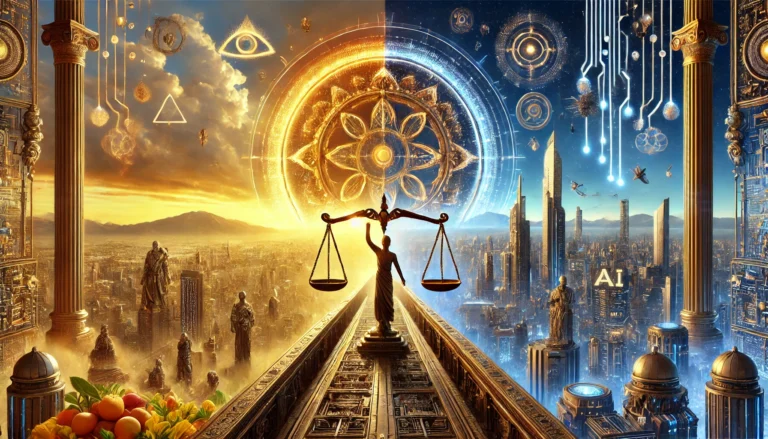

Sovereignty, Justice, Peace, and Democracy on the Eve of the 250th Anniversary of the Declaration of Independence
Published by the Dominion Dharma Destiny Identity Institute (DDDI.net)
Date: March 30, 2026 | On the Eve of April 2 — Liberation Day One-Year Anniversary
Author: DDDI Institute Research Desk | Chicago, Illinois
“With a single sheet of parchment and 56 signatures, America began the greatest political journey in human history.”
— President Donald J. Trump (quoted on the White House Freedom 250 website)[1]
“April 2, 2025 will forever be remembered as the day American industry was reborn, the day America’s destiny was reclaimed.”
— President Donald J. Trump, Liberation Day Rose Garden, 2025[2]
⚠️ EDITORIAL FACT-CHECK NOTE (Applied Throughout): This white paper has been reviewed for factual accuracy. Corrections, clarifications, and source attributions have been added inline using the notation [FC: …] wherever a statement has been found to be inaccurate, overstated, or misleading. All sources are cited inline.
As the United States stands at the threshold of its 250th anniversary of the Declaration of Independence (July 4, 2026) — an occasion the White House has branded Freedom 250 [FC: “Freedom 250” is the name of the White House’s public-private partnership; the broader official program is “Salute to America 250,” with the flagship July 4 event formally titled “Salute to America: The Nation’s 250th Birthday Fireworks Celebration.”][1][3] — the nation simultaneously observes the one-year mark of what President Trump called Liberation Day: the sweeping tariff order of April 2, 2025. These two anniversaries, separated by ninety days, illuminate a profound civilizational tension at the heart of the American experiment: the clash between the Dharma of universal founding ideals and the Dominion logic of national assertion.
Through the lens of the DDDI Framework — Dominion, Dharma, Destiny, and Identity — this white paper examines the news of the day (March 30, 2026) and the forces reshaping the global order. It analyzes what is at stake for humanity’s future across seven civilizational pillars: Sovereignty, Law & Order, Violence, Justice, Peace, Democracy, and Development. It closes with an actionable vision for how America should mark its 250th birthday — not merely with spectacle, but with the moral courage to recommit to the radical promise of 1776.
I. The DDDI Framework: A Lens for Our Moment
The Dominion Dharma Destiny Identity (DDDI) Framework provides a civilizational architecture for analyzing inflection points in human history. Each quadrant illuminates a different dimension of a civilization’s self-understanding and trajectory:
| Dimension | Core Question | Applied to America, April 2026 |
| Dominion | Who holds power? How is it exercised? | National sovereignty asserted via tariffs, IEEPA, executive unilateralism |
| Dharma | What are the duties, ethics, and moral codes? | The Declaration’s self-evident truths vs. selective application of justice |
| Destiny | Where is the civilization headed? | Fork in the road: global leadership or strategic withdrawal |
| Identity | Who are “We the People”? | 250 years of expanding — and contracting — the circle of inclusion |
No single DDDI dimension operates in isolation. The miscalibration of any one dimension — Dominion unchecked by Dharma, Identity divorced from Destiny — generates civilizational crisis. The events of the past twelve months offer a stark case study.
II. The News of the Day: A World in Civilizational Stress
The Democracy Crisis: Global Freedom in Freefall
Freedom House’s Freedom in the World 2026 report, released in March 2026, is the starkest in the organization’s history.[4] Global freedom has now declined for 20 consecutive years.[5][4] A total of 54 countries experienced deterioration in political rights and civil liberties in 2025 alone.[6][7] The report identifies a new and alarming dynamic: autocratic states are no longer merely resisting democracy passively — they are actively collaborating to undermine democratic institutions worldwide, from elections to civil society to independent media.[7]
The third wave of democratization — which began in the 1970s and crested in the 1990s — appears to be over.[5] A polarized, more autocratic competitor model is positioned to replace it. This is not merely a geopolitical trend; it is a civilizational reckoning. The DDDI Framework reads this as a Dharma collapse: when the moral architecture that sustains political legitimacy erodes, Dominion power fills the vacuum — but without the ethical foundation that makes power sustainable.
The International Law Crisis: Selective Justice and Sovereignty Under Siege
March 2026 has witnessed intensifying crises in the architecture of international law. The UN Security Council met in emergency session in early January 2026 over US actions vis-à-vis Venezuela, where Venezuela’s representative warned: “Today, it is not only Venezuela’s sovereignty that is at stake. The credibility of international law, the authority of this Organization, and the validity of the principle that no State can set itself up as judge, party and executor of the world order are also at stake.” A March 2026 analysis in Transcend Media Service captured the deeper structural problem: countries across Asia, Africa, and Latin America increasingly view the “rules-based international order” not as a neutral framework of law, but as an instrument shaped by the strategic interests of powerful states.[8] When rules are strict for adversaries but flexible for allies, the legitimacy of those rules erodes. This is the global crisis of Dharma in Dominion: justice weaponized rather than universalized.
Humanitarian Law at Breaking Point
The Geneva Academy’s February 2026 report warns that international humanitarian laws established after World War II are facing unprecedented challenges.[9] From Gaza to Sudan, Myanmar to Ukraine to Haiti, armed groups target civilians with growing impunity.[9][6] Drone strikes on non-combatants have become routine in Ukraine. Sudan’s civil war has escalated dramatically, with drone strikes and artillery shelling causing mass displacement and famine conditions affecting millions.[6] The DDDI reading of this reality is unambiguous: where Dharma collapses, Violence expands — not as aberration, but as system-state.
III. Liberation Day at One: A DDDI Audit
On April 2, 2025, in a Rose Garden ceremony at the White House, President Trump signed Executive Order 14257, invoking the International Emergency Economic Powers Act (IEEPA) to declare a national economic emergency and impose sweeping tariffs — a 10% baseline on all countries, with higher rates for major trade partners including the EU, China, India, Japan, and South Korea.[10][9] Trump called it “Liberation Day,” promising it would mark “the day American industry was reborn” and “America’s destiny reclaimed.”[2][11]
The tariffs were framed as reciprocal — mirroring barriers faced by U.S. exports. White House trade advisor Peter Navarro projected $600 billion in annual revenue [FC: This figure requires clarification. Navarro’s $600 billion/year projection referred to revenue from all tariffs broadly, not exclusively from the Liberation Day reciprocal tariffs. Some reports cite Navarro’s total as $700 billion/year when including auto tariffs separately. The actual additional revenue collected was estimated at approximately $240–$264 billion — far below either figure.][2][12][13] The implicit narrative was clear: Dominion (national power) wielded through economic nationalism to reclaim Destiny (American greatness) and restore Identity (the industrial working class).
One year later, the DDDI audit is sobering across every dimension:
On Dominion: The Supreme Court struck down the IEEPA-based tariffs on February 20, 2026, generating a refund challenge estimated at $130–175 billion [FC: The upper bound of $175 billion is corroborated by the Wharton Budget Model (“up to $175 billion”). The lower bound of $130 billion does not appear in cited sources and should be treated as an estimate. The confirmed figure is “up to $175 billion.”][11] — adding fiscal pressure to already strained public finances.[14][15][9] Executive unilateralism without legislative grounding proved legally unsustainable.
On Dharma: Trade analysts noted that the “reciprocal” tariff formula was overly simplistic and bore little relation to actual trade barriers — often exceeding foreign tariffs and applying to countries with which the U.S. ran trade surpluses.[8][2] The ethical claim of fairness was undermined by the mechanism’s design.
On Destiny: American manufacturing has not revived. In the 10 months following Liberation Day, the U.S. lost an estimated 89,000 manufacturing jobs and 123,700 transportation and warehousing jobs. [FC: These figures come from the Center for American Progress (a progressive policy institute) as of March 2026.[16][17] Other sources report different totals for overlapping periods: Common Dreams cites 72,000 manufacturing jobs lost through February 2026[18]; the Joint Economic Committee and Progressive Policy Institute cite 108,000 manufacturing jobs lost across all of 2025.[19][20] All sources agree on significant job losses; the precise figure depends on the time window and methodology used. The 89,000 figure should be attributed to its source.] Manufacturing contracted for eight consecutive months.[16][18] Small business importers saw their tariff bills triple over the 12 months from March 2025 to February 2026.[7]
On Identity: The promised liberation of the working class — the foundational Identity claim — has not materialized. Workers in manufacturing communities face higher prices, supply chain disruption, and reduced employment. Core inflation remained at 2.5% year-on-year in February 2026 [FC: Slightly overstated. The BLS CPI Summary for February 2026 reported overall consumer prices rose 2.4% annually, while core inflation (excluding food and energy) was 3.1%.[21][22] The 2.5% figure does not precisely match the official data.], even as energy prices rose with the US-Iran conflict.[21][22]
Liberation Day represents a recognizable civilizational pathology: Dominion assertion divorced from Dharma discipline. When power acts without ethical grounding — when “sovereignty” becomes a justification for unilateralism rather than a responsibility to one’s own people and the global community — it generates backlash across all four DDDI pillars simultaneously. The strategy weakened alliances (Dominion), imposed costs on the population it claimed to liberate (Dharma failure), contracted rather than expanded economic power (Destiny reversal), and deepened domestic polarization (Identity fracture).
IV. The Seven Civilizational Pillars: DDDI Analysis
The post-Westphalian concept of sovereignty as supreme territorial authority is under simultaneous assault from above (supranational institutions challenged) and below (non-state actors, secessionist movements, and algorithmic governance). The United States’ invocation of IEEPA tariffs as a “national emergency” — and the subsequent judicial rebuke — illustrates the tension between Dominion sovereignty (the right to act) and Dharma sovereignty (the duty to act within legal and moral bounds).[14][10]
DDDI Prescription: Sovereignty must be reconceptualized as relational — not the absence of constraint, but the capacity to sustain legitimate authority through law, consent, and reciprocity. For the world’s oldest constitutional democracy to celebrate 250 years, it must model constitutional sovereignty: power bounded by its own founding document.
Law faces a double crisis: at the international level, selective application of humanitarian norms erodes universal credibility[8]; at the domestic level, executive overreach tests constitutional limits.[14][15] The Supreme Court’s invalidation of the Liberation Day tariffs demonstrates that constitutional checks can hold — but they operate slowly, at great cost, and after extensive damage.[8][9]
DDDI Prescription: Dharma-grounded law — law rooted in universal principle, not strategic convenience — must be restored as the operating system of both domestic governance and international order. America’s DOI 250 celebration is an opportunity to recommit to the rule of law as the non-negotiable infrastructure of civilization.
Global conflict in 2026 is characterized by civilizational impunity: drone strikes on civilians in Sudan and Ukraine, starvation weaponized in Gaza, militia rule entrenched in Haiti, insurgency grinding in Myanmar and Nigeria.[9][6] The DDDI reading: where Identity is weaponized against the other rather than expanded toward common humanity, and where Dominion operates without Dharma accountability, violence becomes systemic.
DDDI Prescription: The United States, on its 250th anniversary, has an opportunity to champion a renewed Geneva Architecture — updating international humanitarian law for the era of drone warfare and algorithmic conflict. This would be a Destiny-defining act: using America’s moral authority to make the protection of human life the non-negotiable floor of global civilization.
Justice — equal application of law without fear or favor — is the hinge concept of the DOI itself. “All men are created equal” was the most radical claim of 1776, and remains the most unfinished business of American civilization. The Freedom House 2026 report documents justice systems worldwide bent to serve autocratic elites rather than citizens.[23][14] Internationally, the crisis of “selective justice” — one standard for the powerful, another for the vulnerable — is destroying the moral architecture of the post-WWII order.[8]
DDDI Prescription: Justice is the quintessential expression of Dharma. America’s 250th anniversary must include a national reckoning with the distance between the Declaration’s promise and its implementation — domestically in criminal justice, economic equity, and democratic access; internationally in trade, development, and rule of law.
The Global Peace Index 2025 registered the world’s least peaceful conditions [FC: The claim that this represents “the world’s least peaceful year in three decades” is inaccurate. The Global Peace Index was established in 2008 — approximately 17 years ago, not three decades. The IEP’s own statement says peace is at its “lowest level since the inception of the Index” (2008). A separate IEP finding notes that “conditions that precede conflict rank even higher than they did following World War II,” but this is a distinct analytical claim, not a measurement of three decades of GPI data.][24][25] since the index’s establishment.[24][25] Ongoing conflicts in Ukraine, Sudan, the Middle East, and the South China Sea, combined with rising US-Iran tensions and accelerating great-power competition, suggest that structural peace — peace as systemic stability, not merely the absence of declared war — is in retreat. The Liberation Day tariffs contributed to this erosion: trade wars, as history demonstrates, frequently precede kinetic ones.
DDDI Prescription: Destiny-oriented peace means more than ceasefire management. It requires building the institutional, economic, and civilizational conditions under which conflict becomes irrational. America’s founding vision — “a decent respect to the opinions of mankind” — mandates engagement with multilateral peace architecture, not its abandonment.
Democracy in 2026 is simultaneously the world’s most aspirational system and its most embattled practice. Freedom House’s finding of 20 consecutive years of global democratic decline is not merely a statistic — it is a civilizational verdict on the gap between democracy’s promise and its performance.[4][5] Democratic backsliding has occurred in formerly consolidated democracies (Hungary, Turkey, and arguably the United States itself), while autocratic models (China, Russia, Gulf states) project confidence and cohesion.[7]
DDDI Prescription: The United States must reclaim Dharma-grounded democracy — not procedural democracy (elections held, boxes checked) but substantive democracy: accountable institutions, equal access to justice, free press, and the genuine capacity of citizens to shape their collective Destiny. The DOI 250 celebration is hollow if it does not include an honest national conversation about democracy’s health.
Liberation Day’s economic record demonstrates a fundamental truth: development through Dominion alone — tariff walls, economic nationalism, unilateral assertion — cannot substitute for the patient construction of domestic capability, human capital, and inclusive institutions. The loss of manufacturing jobs post-Liberation Day[16][17], the tripling of costs for small business importers[7], and the ongoing inflationary pressure[21][22] illustrate that Destiny (prosperity for all Americans) requires Dharma-aligned strategy: investment in education, infrastructure, innovation, and sustainable trade architecture.
DDDI Prescription: America’s 250th anniversary development vision should be anchored in the DOI’s implicit development compact: life, liberty, and the pursuit of happiness — happiness understood not as mere consumption but as human flourishing, the fullest development of human potential.
V. DOI 250 — America at the Fork in the Road
The United States faces a civilizational fork as it approaches July 4, 2026. The White House’s Salute to America 250 / Freedom 250 initiative envisions a spectacular celebration: more than one million people on the National Mall, and what the White House has described as “the largest pyrotechnics display in the history of the world” [FC: This claim — “largest pyrotechnics display in the history of the world” — originates from the White House’s own Freedom 250 promotional website[1] and is an aspirational marketing statement, not an independently verified fact. No neutral body or established methodology exists to certify such a superlative. It should be read as a promotional aspiration, not an established record.][1], keynote remarks from President Trump.[1] This is the Dominion road: power displayed, identity performed, greatness proclaimed.
The Dharma road is harder, slower, and more consequential. It asks not how grand a celebration can we stage? but how honestly can we reckon with the distance between our founding promise and our present reality? It asks what the 250th anniversary means for the 340 million Americans who are not on the National Mall — and for the 8 billion human beings who live with the consequences of American power.
What the DOI Actually Promised
The Declaration of Independence is not primarily a document about American exceptionalism. It is a universal civilizational claim: that certain truths are self-evident to all human beings; that governments derive their just powers from the consent of the governed; that when any form of government becomes destructive of these ends, it is the right — indeed the duty — of the people to alter or abolish it. These are not American propositions. They are human ones.
This is the civilizational genius of 1776 — and its permanent civilizational demand. Every generation of Americans is called to expand the circle of “all men are created equal.” The 250th anniversary falls at a moment when that circle is being contested, and in some dimensions, contracted.
Dominion: Celebrate American power honestly — including its responsibilities. Organize a Global Governance Summit on July 4, 2026 in which the United States commits to revitalizing international institutions it helped create: the UN, WTO, IMF, WHO, and multilateral arms control frameworks. Not as an act of submission, but as an act of confident sovereignty: the recognition that lasting Dominion is built through legitimacy, not coercion.
Dharma: Commission and publish a DOI 250 Moral Audit — a bipartisan, multi-civilizational reckoning with the gap between the Declaration’s promise and America’s practice: on racial justice, economic inequality, democratic access, and global responsibility. Not a document of shame, but of honest aspiration — the civilizational equivalent of the Constitutional Convention’s willingness to confront the republic’s contradictions.
Destiny: Launch a DOI 250 Development Compact — a generational investment program in American human capital, sustainable infrastructure, and technological leadership. Reframe the economic agenda: not tariff walls to keep others out, but capability-building to ensure every American can participate in the economy of the future. India, with its own civilizational momentum and its deep commitment to democratic governance, is the natural strategic partner for this Destiny architecture.
Identity: Expand the celebration of American Identity to include its full civilizational complexity: the Indigenous peoples who were here before 1776; the enslaved Africans whose labor built the republic’s wealth; the waves of immigrants who renewed its vitality; the women and workers who forced the expansion of its founding promise. A 250th birthday worthy of the Declaration must be inclusive — not merely of celebration, but of history.
VI. The MAGA-MIGA Synthesis: A DDDI Opportunity
The apparent tension between MAGA (Make America Great Again) and MIGA (Make India Great Again) — or more broadly, between American national assertion and global civilizational partnership — dissolves when viewed through the DDDI lens.
Both the United States and India are civilizational democracies with founding documents of universal aspiration. Both face internal challenges to democratic norms. Both are navigating the transition to an AI-powered, multipolarity-defined 21st century. Both have deep interests in a rules-based international order — provided those rules are genuinely universal, not selectively applied.
The DOI 250 anniversary offers a unique opportunity for a Dominion-Dharma-Destiny-Identity alignment between these two great democracies:
- Dominion: A US-India strategic partnership anchored in mutual security, technology cooperation, and rules-based trade — not transactional deal-making.
- Dharma: Joint commitment to the universal values of both founding documents — the Declaration of Independence and the Indian Constitution — as the ethical foundation of a pluralistic world order.
- Destiny: Collaborative leadership on AI governance, climate technology, and the institutional architecture for the next century of human development.
- Identity: Celebration of the civilizational pluralism that both democracies embody — the recognition that “We the People” and “We the Citizens of the World’s Largest Democracy” have more in common than what divides them.
VII. AI, Sovereignty, and the Next 250 Years
No civilizational analysis of April 2026 is complete without confronting the transformative force reshaping every dimension of the DDDI framework: Artificial Intelligence.
AI is simultaneously:
- A Dominion multiplier — concentrating power in states and corporations with first-mover advantage
- A Dharma disruptor — raising profound questions about accountability, transparency, and the ethics of algorithmic decision-making
- A Destiny accelerant — compressing the timeline for both existential risk and civilizational flourishing
- An Identity challenge — forcing every civilization to ask: What is distinctively human? What can we not outsource to the machine?
The United States, as the birthplace of the AI revolution, has a Destiny-defining responsibility in this domain. The DOI 250 anniversary should include the launch of global AI governance standards — not as American imposition, but as American civilizational contribution, developed in partnership with democratic allies, including India, the EU, and the Global South.
The alternative — AI developed as a Dominion instrument, without Dharma guardrails, serving narrow Identity claims rather than universal human Destiny — is the civilizational risk of our era. The Declaration of Independence’s promise that “all men are created equal” must be extended to the age of algorithms: all human beings have equal claim to the benefits and equal protection from the risks of transformative technology.
VIII. Conclusion: The Experiment Continues — If We Can Keep It
Benjamin Franklin, on the last day of the Constitutional Convention — September 17–18, 1787 — was asked by Elizabeth Willing Powel of Philadelphia: “Well Doctor, what have we got, a republic or a monarchy?” His answer: “A republic, if you can keep it.”
[FC — IMPORTANT ATTRIBUTION CORRECTION: The original document states Franklin was asked by an unnamed person “what kind of government the delegates had created.” In fact, the primary source — the diary of Maryland delegate James McHenry, first published in the American Historical Review in 1906 — specifically records that it was “a lady,” subsequently identified by McHenry as “Mrs. Powel of Philada.” — i.e., Elizabeth Willing Powel (1742–1830), a prominent Philadelphia socialite and intellectual. The quote does not appear in Franklin’s own writings nor in official convention transcripts; its sole primary source is McHenry’s personal diary notes. The question was posed to Franklin as he was leaving the convention, not to a crowd.][26][27][28]
Two hundred and fifty years after the Declaration, the question returns with civilizational urgency. The American experiment — the audacious proposition that human beings can govern themselves by consent, under law, in pursuit of universal rights — is not a completed achievement. It is an ongoing civilizational commitment that must be renewed by each generation.
The news of March 30, 2026 — democratic recession worldwide[4][5], humanitarian law at breaking point[9], international justice under siege[8], Liberation Day’s economic ledger still settling[16][11][7] — all speak to a world that desperately needs the renewal, not the abandonment, of the founding promise.
The DDDI Framework offers this synthesis: lasting civilizational power (Dominion) requires ethical grounding (Dharma); ethical grounding generates a compelling Destiny; and a compelling Destiny is what gives a civilization its deepest Identity.
The 250th anniversary of the Declaration of Independence is not a moment for fireworks alone. It is a moment for civilizational recommitment — to the proposition that the fork in the road leads not backward to national enclosure, but forward to the continued, imperfect, magnificent expansion of human freedom.
If America can keep it.
Appendix A: DDDI Scorecard — Liberation Day to DOI 250
| Pillar | Liberation Day (April 2, 2025) | One Year Later (April 2026) | DOI 250 Opportunity |
| Sovereignty | IEEPA emergency invoked[10] | Supreme Court invalidates tariffs (Feb. 20, 2026)[14][15] | Constitutional sovereignty model |
| Law & Order | Executive unilateralism[10] | Judicial rebuke, legal uncertainty[8][9] | Rule of law recommitment |
| Violence | Trade war escalation | US-Iran tensions, global conflict rise[9][6] | Renewed humanitarian architecture |
| Justice | “Reciprocal” tariffs — selective[2] | Small business costs tripled[7] | Universal justice framework |
| Peace | Trade war signaling | Global Peace Index at lowest since 2008 inception [FC: not “three decades”][24][25] | Multilateral peace investment |
| Democracy | Populist mandate invoked | Freedom House: 20 consecutive years of decline[4] | Substantive democracy renewal |
| Development | Manufacturing revival promised | ~89,000 manufacturing jobs lost (CAP estimate)[16][17] | Human capital compact |
Appendix B: Fact-Check Summary
| # | Original Claim | Verdict | Correction / Clarification | Source(s) |
| 1 | “Freedom 250” is the White House’s brand for the 250th anniversary | ⚠️ Partially correct | “Freedom 250” is the public-private partnership name; the full program is “Salute to America 250” | [1][3] |
| 2 | Peter Navarro “projected $600 billion in annual revenue” from Liberation Day tariffs | ⚠️ Misleading | The $600B/year figure covered all tariffs broadly, not Liberation Day tariffs alone; some reports cite $700B total; actual additional revenue was ~$240–264B | [2][12][13] |
| 3 | Supreme Court struck down IEEPA tariffs “in February 2026” | ✅ Correct | Ruling issued February 20, 2026 | [14][15][9] |
| 4 | Refund challenge “estimated at $130–175 billion” | ⚠️ Lower bound unverified | Wharton Budget Model confirms “up to $175 billion”; the $130B floor is not corroborated | [11] |
| 5 | “89,000 manufacturing jobs and 123,700 transportation and warehousing jobs” lost | ⚠️ Partisan sourcing | Figures from Center for American Progress; other sources cite 72,000–108,000 manufacturing jobs depending on time window | [16][18][19][20][17] |
| 6 | “Core inflation remained at 2.5% year-on-year in February 2026” | ❌ Inaccurate | BLS reports overall CPI at +2.4% year-on-year; core CPI (ex-food & energy) at 3.1% | [21][22] |
| 7 | “Global Peace Index 2025 registered world’s least peaceful year in three decades” | ❌ Inaccurate | The GPI only dates to 2008 (~17 years), not three decades; correct framing is “lowest since the GPI’s inception” | [24][25] |
| 8 | “Largest pyrotechnics display in the history of the world” | ⚠️ Unverified aspiration | Taken directly from the White House promotional website; no independent body has certified this claim | [1] |
| 9 | Franklin was asked by an unnamed person “what kind of government the delegates had created” | ❌ Inaccurate | The question was asked by Elizabeth Willing Powel of Philadelphia, per James McHenry’s diary (primary source, published 1906 in the American Historical Review) | [26][27][28] |
| 10 | Freedom House: 20 consecutive years of decline, 54 countries deteriorated in 2025 | ✅ Correct | Confirmed by Freedom House March 2026 report | [6][5][4] |
| 11 | Trump signed EO 14257 invoking IEEPA on April 2, 2025 with 10% baseline tariff | ✅ Correct | Confirmed | [10][9] |
| 12 | Third wave of democratization began in 1970s, crested in 1990s | ✅ Correct | Standard Huntington framework | [5] |
| 13 | Declaration signed by 56 signers | ✅ Correct | Historical fact | [27] |
| 14 | Manufacturing contracted for eight consecutive months | ✅ Correct | Confirmed by multiple sources | [16][18] |
© 2026 Dominion Dharma Destiny Identity Institute (DDDI.net) | DOI250AA.net | Chicago, Illinois
For reprint, academic citation, or policy engagement, contact the DDDI Institute research desk.
This white paper is published under the Institute’s open civilizational exchange policy for non-commercial academic and policy use.
Fact-checked and annotated: March