
When Media, Politics, Desire, and Democracy Collided
In 1976, as the United States approached its bicentennial, a remarkable cultural collision took place. Democratic presidential nominee Jimmy Carter gave an interview to Playboy in which he discussed religion, morality, temptation, and human imperfection. One word, “lust,” became the headline.
Thirteen years earlier, Playboy had published what it presented as an exclusive interview with Indian Prime Minister Jawaharlal Nehru. Nehru later stated that he had never given such an interview and that the article was assembled from statements he had made elsewhere.
The two episodes were very different. Carter actually gave the interview and his words were recorded. Nehru disputed the existence of the interview itself. Yet both episodes reveal the extraordinary power of media to place political authority, private identity, sexuality, and cultural values within the same frame.
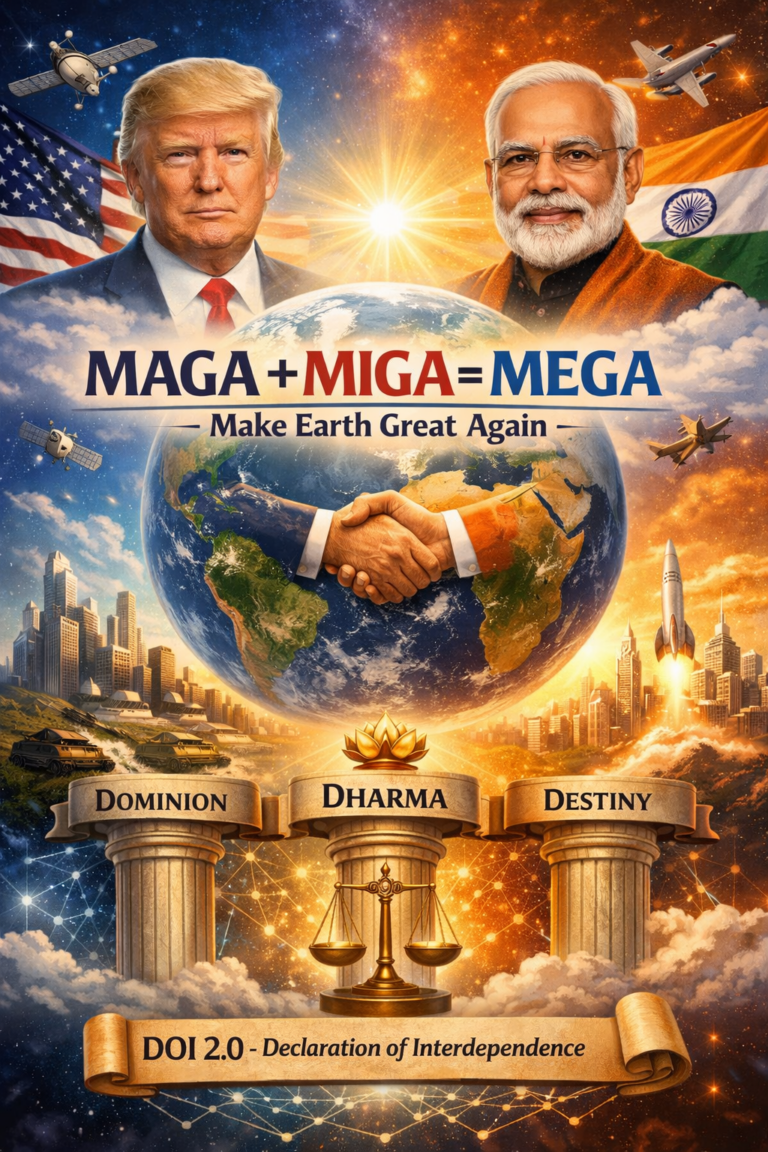
The DDDI™ Institute examines these events through four concepts: Dominion, Dharma, Destiny, and Identity.
Carter and the Meaning of “Lust”
Carter’s controversial remarks came from a discussion of the Sermon on the Mount. Referring to Matthew 5:27–28, he acknowledged that he had experienced sexual temptation and argued that recognizing one’s own weakness should prevent one from judging others as morally inferior.
The important distinction is between what Carter actually said and what the public conversation turned it into.
Carter’s statement was not simply a declaration of sexual appetite. It was part of a theological argument about
inner responsibility, forgiveness and humility.
The DDDI paper describes this as a Dharma statement delivered through a Dominion medium.
The medium mattered enormously. Playboy was a magazine whose commercial identity was closely associated with the presentation of the female body and with a more permissive approach to sexuality. Carter entered that environment carrying a religious argument about the moral significance of looking at another person.
The result was almost inevitable: the theological context disappeared while the word “lust” remained.
When a Sentence Becomes a Headline
The Carter episode demonstrates how media can transform meaning without necessarily fabricating words.
The words were authentic. The context changed.
Carter’s larger argument concerned the fallibility shared by ordinary people and political leaders. But the public received a much simpler identity: the presidential candidate who talked about lust in Playboy.
The political consequences were significant. The episode generated ridicule, tightened the campaign environment and contributed to concern among evangelical voters. Carter nevertheless won the 1976 election.
The more lasting effect may have been cultural rather than electoral. A statement intended to express Christian humility became part of a political narrative about whether Carter’s religious identity was credible.
In DDDI™ terms, a Dharma statement had been extracted and converted into a Dominion commodity.
Nehru and the Interview That Wasn’t
The 1963 Playboy presentation of Jawaharlal Nehru provides a strikingly different case.
The magazine presented the article as an exclusive conversation with India’s prime minister. It included his views on nuclear weapons, Gandhi, democracy, materialism and India’s place in the world.
But Nehru subsequently denied giving the interview.
In a letter to Dorothy Norman in October 1963, he said that the material was a collection of extracts from statements and interviews he had given over time. He repeated the position in Parliament in December of that year.
The magazine itself had included an editorial note explaining that the Indian Embassy had challenged the description of the material as an exclusive interview.
This creates an important distinction.
Carter’s words were his, but their meaning was compressed. Nehru’s words were largely his, but the form in which they were presented was not authorized by him.
Both cases demonstrate the power of the publisher to determine the setting in which a public figure’s voice would be encountered.
Hugh Hefner and the American Arc
At the center of both stories stands Hugh Hefner.
Hefner did not create Carter’s theology or Nehru’s political philosophy. What he created was a powerful media environment in which political interviews, cultural commentary, consumer products and the female body appeared together.
The first issue of Playboy appeared in 1953. Its circulation eventually reached millions, making it one of the most influential American magazines of the postwar era.
The magazine’s influence extended beyond photographs. It published interviews with major political and cultural figures, including Martin Luther King Jr., Malcolm X, Fidel Castro and Jimmy Carter.
Hefner also promoted an identity for American men built around urban sophistication, consumption, leisure, technology, sexuality and a rejection of traditional Puritan restraint.
The DDDI paper calls this an unofficial American sentence: the idea that liberation could include the freedom to look, desire and consume.
That sentence existed alongside America’s official founding sentence about equality, liberty and the pursuit of happiness.
The Industrialization of Looking
The paper argues that Hefner’s deeper historical significance lies in the transformation of desire into a scalable media product.
Print photography made the body reproducible. Color printing made it attractive and widely distributable. The magazine made it monthly. Clubs made it physical. Video made it private and on-demand. The internet made it virtually unlimited.
The smartphone and algorithmic platforms have extended the same basic process into everyday life.
This does not mean Hefner invented sexual desire or pornography. Rather, he helped develop a respectable, commercial pipeline connecting desire, image, attention and consumption.
The paper argues that this altered male-female relations by making spectatorship increasingly central to the experience of sexuality.
Two Revolutions, Two Civilizational Grammars
The white paper then places the American experience alongside India’s independence movement.
America’s 1776 declaration established a powerful proposition: individuals possess rights that precede government.
India’s independence movement developed a different but related vocabulary. The 1930 Purna Swaraj declaration asserted the right of Indians to freedom, while Nehru’s 1947 “Tryst with Destiny” speech expressed India’s entry into a new historical era.
The DDDI distinction is significant.
The American revolutionary grammar emphasized rights against Dominion.
The Gandhian Indian grammar emphasized swaraj as Dharma, or self-rule as both political freedom and inner responsibility.
Both traditions sought to place the human person above domination, although they approached that objective differently.
The Greatest Sentence
Walter Isaacson has described the second sentence of the Declaration of Independence as “the greatest sentence ever written.”
Its power rests on a simple proposition: human beings possess inherent rights and government exists within, rather than above, those rights.
But the sentence contained an unresolved contradiction. The society that proclaimed universal equality excluded women, Native peoples and enslaved people from its practical application.
The American story therefore became an ongoing effort to make the sentence true for people who had initially been excluded from its “we.”
The DDDI paper sees this unfinished work as essential to understanding the present.
The Phygital Aftermath
The central question now extends beyond print media.
Digital platforms have inherited and accelerated the mechanisms that Playboy helped normalize. Images can now be reproduced instantly, distributed globally and selected algorithmically.
The result is a Phygital environment in which physical identity, digital identity, desire, attention and commerce increasingly overlap.
The paper’s final insight is that a civilization can simultaneously proclaim that the person is an end in themselves while developing systems that treat the person as an image, data point, consumer or commodity.
That tension cannot be resolved simply by condemning desire or celebrating freedom.
It requires keeping the categories distinct.
Dominion extracts. Dharma binds. Destiny describes the future a people believe they are creating. Identity asks who they are when the cameras are off.
The question raised by the paper is ultimately larger than Carter, Nehru or Hefner:
Can the pursuit of happiness remain genuinely human when looking, desire and identity become industrialized and algorithmically managed?
And can a rights-bearing civilization remember that a human right is not the same thing as a market opportunity?