Reframing Civilizational Renewal Through the DDDI Framework in the Context of 2026
The proposed formulation MAGA + MI³GA = MEGA can be reframed as a civilizational systems thesis rather than a partisan slogan. In this frame, MAGA does not merely mean “Make America Great Again” as contemporary political branding; it becomes a historical inquiry into the American founding, especially the ontological and epistemological rupture introduced by the Declaration of Independence in 1776. MI³GA refers to the civilizational triad of India, Iran, and Israel, three ancient knowledge-bearing civilizations whose metaphysical, ethical, legal, spiritual, and cultural traditions shaped humanity before the modern nation-state became the dominant organizing form. MEGA, or Make Earth Great Again, then becomes the synthesis: a planetary framework that asks whether human governance can be redesigned by integrating the American founding proposition of rights with older civilizational traditions of duty, wisdom, transcendence, law, memory, and cosmic order.
The context of 2026 matters because the United States is approaching the 250th anniversary of the Declaration of Independence, a symbolic moment for reassessing the sentence Walter Isaacson famously calls one of the greatest ever written: the Declaration’s claim that all men are created equal, endowed with unalienable rights, including life, liberty, and the pursuit of happiness. That sentence redesigned the grammar of political legitimacy. It asserted that government derives authority not from conquest, dynasty, priesthood, empire, tribe, or divine monarchy, but from human equality, consent, and rights. Yet the twenty-first century also reveals the incompleteness of a purely rights-centered anthropology when detached from duties, civilizational memory, ecological restraint, family formation, technological humility, and spiritual seriousness.
The DDDI framework can therefore be used as a disciplined interpretive structure. For this white paper, DDDI is treated as a four-stage framework: Discover, Define, Design, and Implement. The goal is to discover the civilizational resources embedded in America, India, Iran, and Israel; define the crisis of human nature and governance in 2026; design a synthetic civilizational operating model; and implement principles that could move societies from ideological fragmentation toward planetary stewardship.
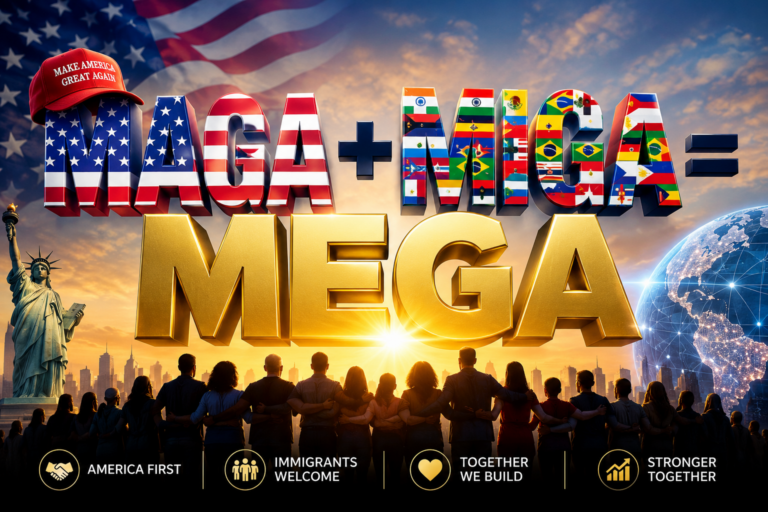
I. The Core Equation: MAGA + MI³GA = MEGA
MAGA, in this framework, should be stripped of narrow electoral meaning and reinterpreted historically. It becomes a question: what made America great at the level of first principles? The answer is not merely military power, economic scale, constitutional design, or technological supremacy. America’s original greatness came from a proposition: political order must be justified before the dignity of the human person. The Declaration of Independence transformed governance from a system of inherited authority into a system accountable to human equality and consent.
MI³GA introduces the civilizational depth that America often lacks because of its relative historical youth. India contributes dharma, plural metaphysics, consciousness studies, civilizational continuity, non-dual inquiry, grammar, logic, yoga, and the idea that freedom without self-mastery is incomplete. Iran contributes the moral drama of truth versus falsehood, light versus darkness, kingship accountable to cosmic order, poetic humanism, Zoroastrian ethical dualism, and Persian civilizational statecraft. Israel contributes covenant, law, prophetic ethics, historical memory, moral monotheism, exile-survival consciousness, and the insistence that history itself is morally charged.
MEGA is the attempted synthesis. It asks whether Earth can be made “great again” not by returning to a past empire, religion, or ideology, but by recovering the civilizational wisdom lost in modern abstraction. The American founding gave the modern world rights. India reminds the world that rights require duties and self-knowledge. Iran reminds the world that civilization depends on truth, beauty, and moral order. Israel reminds the world that law, covenant, and memory bind a people across catastrophe. MEGA emerges when rights, duties, truth, memory, and stewardship are integrated into a new civilizational grammar.
II. The 1776 Ontological Break
The Declaration of Independence did not merely create a political separation between colonies and crown. It altered the ontology of governance. Before 1776, most political systems assumed that human beings were governed by hierarchy: monarch over subject, empire over province, priestly authority over lay society, aristocracy over commoner, conqueror over conquered. The Declaration asserted a radical counter-ontology: all human beings possess an equal moral status prior to government.
That statement also changed epistemology. Political truth was no longer to be known solely through tradition, royal decree, or sacred hierarchy. It could be reasoned from self-evident principles. Government became subject to moral audit. The governed could judge the governors. Revolution became legitimate when political authority violated the natural rights it existed to secure.
Walter Isaacson’s focus on the Declaration’s great sentence is important because that sentence condensed an entire civilizational revolution into a single moral architecture. “All men are created equal” gave ontology. “Endowed by their Creator with certain unalienable Rights” gave metaphysical grounding. “Life, Liberty and the pursuit of Happiness” gave anthropology. “Governments are instituted among Men” gave political design. “Deriving their just powers from the consent of the governed” gave legitimacy. This is why the sentence still matters in 2026.
But the sentence also created unresolved tensions. It proclaimed equality while slavery endured. It spoke of men while women were excluded. It invoked a Creator while later secular modernity tried to preserve rights without metaphysical grounding. It elevated liberty while leaving unclear how liberty should be disciplined by virtue. The 250th anniversary should therefore not be a celebration alone. It should be an audit.
III. Why America Alone Is Not Enough
America’s founding proposition is magnificent but incomplete. It establishes political equality but does not fully answer what a human being is for. It protects liberty but does not guarantee wisdom. It limits government but does not produce virtue. It secures rights but does not always cultivate duties. It defends pursuit of happiness but leaves happiness vulnerable to consumerism, loneliness, addiction, and technological manipulation.
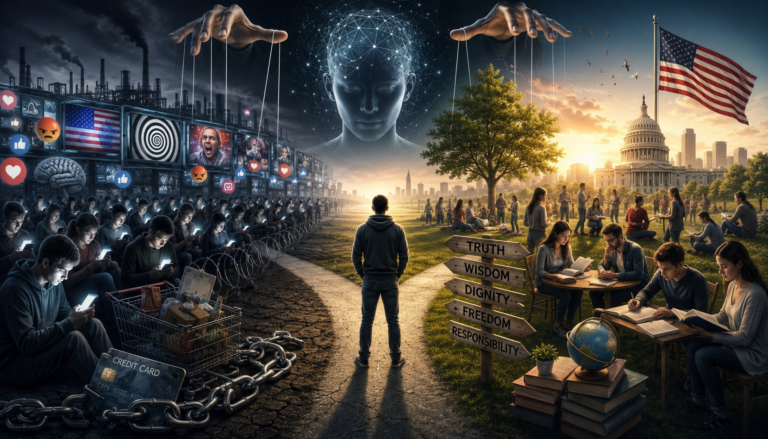
In 2026, the American model faces several pressures. Institutional trust is weakened. Digital platforms shape perception. Artificial intelligence challenges labor, authorship, education, and sovereignty. Family structures are strained. Loneliness and mental health crises expose the limits of material abundance. Political polarization turns citizenship into tribal combat. Rights-language remains powerful, but rights without shared moral anthropology can become endless litigation among isolated selves.
This is where MI³GA enters the equation. India, Iran, and Israel are not invoked as perfect civilizations. They are invoked as deep civilizations. Their value lies in memory, metaphysics, endurance, and long-cycle thinking. They remind modern America that human beings are not merely rights-bearing individuals. They are also duty-bearing persons, memory-bearing descendants, truth-seeking minds, family-embedded beings, spiritually restless creatures, and ecological participants.
IV. India’s Contribution: Dharma and Consciousness
India’s civilizational contribution to MEGA is the concept of dharma. Dharma cannot be reduced to religion, law, morality, or duty, although it includes elements of all four. It is the principle of right ordering: personal, social, cosmic, ecological, and spiritual. Where America emphasizes rights, India asks: what duties sustain the conditions under which rights remain meaningful?
India also contributes a sophisticated science of consciousness. The Upanishads, Vedanta, Buddhism, Jainism, Yoga, Nyaya, Samkhya, and other traditions all investigate the mind, self, perception, suffering, liberation, and knowledge. In an age of artificial intelligence, this is not antiquarian. It is urgent. If machines can simulate intelligence, humans must rediscover wisdom. If algorithms can capture attention, humans must cultivate attention. If biotechnology can manipulate life, humans must ask what life is for.
India also models pluralism at civilizational scale. It contains debate among dualists, non-dualists, theists, atheists, ritualists, renunciants, materialists, grammarians, logicians, poets, scientists, and mystics. This plurality was not always peaceful, but it was intellectually fertile. For MEGA, India offers the principle that unity need not require uniformity.
V. Iran’s Contribution: Truth, Beauty, and Moral Order
Iran’s contribution is often misunderstood because modern geopolitical narratives obscure ancient civilizational depth. Before modern state conflict, Iran represented a vast world of ethical, poetic, imperial, and metaphysical imagination. Zoroastrian thought dramatized existence as a struggle between truth and falsehood, order and chaos, light and darkness. That framing remains powerful in an age of disinformation, synthetic media, propaganda, and epistemic collapse.
Iran also contributes the civilizational role of beauty. Persian poetry, architecture, gardens, music, and metaphysical literature insist that civilization is not merely governed; it is cultivated. A society without beauty becomes administratively functional but spiritually barren. MEGA requires beauty because human beings do not live by efficiency alone.
Iranian statecraft also offers lessons in plural imperial management, cultural transmission, and the relationship between kingship and cosmic legitimacy. The best of the Iranian tradition asks rulers to be guardians of order, not mere accumulators of power. In modern terms, governance must be judged by whether it aligns human systems with truth, justice, beauty, and restraint.
VI. Israel’s Contribution: Covenant, Law, and Memory
Israel contributes the civilizational grammar of covenant. A covenant is not a contract. A contract manages interest; a covenant binds identity, obligation, memory, and destiny. The Hebrew Bible and Jewish civilizational experience place law at the center of collective survival. Law is not merely coercion. It is remembrance enacted.
Israel also contributes the prophetic tradition. Prophets do not merely predict; they indict. They hold power accountable to justice, call societies back to moral seriousness, and refuse to let ritual substitute for righteousness. In the MEGA framework, this prophetic function is essential because technological civilization can become powerful without becoming good.
Jewish history also demonstrates the power of memory under conditions of exile, persecution, dispersion, and return. A civilization survives when it can carry its homeland in language, law, liturgy, family, and study. In 2026, when many societies suffer from historical amnesia, Israel’s deeper contribution is the discipline of remembrance.
VII. The DDDI Framework Applied
Discover
The first task is to discover the buried civilizational assets inside each tradition. America contributes rights, consent, constitutionalism, individual dignity, entrepreneurial energy, and institutional experimentation. India contributes dharma, consciousness, plural metaphysics, disciplined inquiry, and duty. Iran contributes truth, beauty, moral dualism, poetic imagination, and order. Israel contributes covenant, law, memory, prophetic ethics, and survival through study.
Discovery also requires recovering what modernity forgot. The modern age often reduces human beings to consumers, voters, data points, workers, patients, or preference-maximizers. Civilizations saw more. They saw humans as souls, citizens, ancestors, descendants, moral agents, worshippers, learners, householders, stewards, and seekers.
Define
The second task is to define the crisis. The crisis of 2026 is not only political. It is ontological. Societies no longer agree on what a human being is. Is the human person a biological machine, a rights-bearing individual, a spiritual being, an economic actor, a gendered self-construction, a citizen, a child of God, a node in a network, or a bundle of data? Governance collapses into conflict when anthropology is unsettled.
The epistemological crisis is equally severe. Societies no longer agree on how truth is known. Science, revelation, tradition, reason, identity, emotion, algorithmic ranking, state authority, and market incentives all compete as truth systems. Without shared epistemic discipline, democracy becomes spectacle and civilization becomes noise.
Design
The third task is to design a MEGA civilizational model. Such a model would not create a world government or homogenized culture. It would establish principles for a planetary civilization of rooted civilizations. It would defend the dignity of the person, the duties of the person, the sanctity of memory, the discipline of truth, the need for beauty, the reality of transcendence, and the obligation of stewardship.
This design must balance America’s liberty with India’s dharma, Iran’s truth-order, and Israel’s covenantal memory. It must preserve national sovereignty while encouraging civilizational dialogue. It must use technology without worshipping it. It must protect markets while subordinating them to human flourishing. It must defend rights while restoring duties.
Implement
The fourth task is implementation. MEGA must become educational, institutional, technological, ecological, and diplomatic. Schools should teach civilizational literacy, not only technical skills. Universities should compare knowledge systems seriously, not as museum artifacts. Technology companies should be governed by human dignity, not only engagement metrics. Diplomacy should move beyond transactional realism toward civilizational understanding. Families and communities should be treated as infrastructure, not private lifestyle choices.
Implementation also requires new metrics. Gross domestic product is insufficient. A MEGA framework would measure civilizational health through family stability, educational depth, ecological resilience, institutional trust, mental health, cultural creativity, intergenerational continuity, truthfulness of public discourse, and human capacity for meaning.
VIII. Current Context in 2026
The year 2026 sits at a hinge point. America’s semiquincentennial invites a return to first principles. But the world around America is no longer unipolar. India is rising as a demographic, technological, spiritual, and geopolitical force. Israel remains central to questions of law, identity, conflict, innovation, memory, and survival. Iran remains a civilizational actor whose ancient identity exceeds its modern regime structure. Artificial intelligence is accelerating questions once reserved for theology and philosophy: What is intelligence? What is agency? What is consciousness? What should humans delegate, and what must never be delegated?
The old twentieth-century categories are inadequate. Left versus right is too thin. Liberal versus authoritarian is important but incomplete. Secular versus religious is too crude. Globalist versus nationalist is too binary. The deeper question is whether human beings can govern themselves under technological conditions that magnify desire, fear, speed, manipulation, and power.
MEGA, properly framed, is not a slogan of domination. It is a call for civilizational maturity. Earth becomes great again when humanity remembers what greatness means. Greatness is not mere expansion. It is alignment with truth, dignity, duty, beauty, memory, liberty, and restraint.
IX. Risks and Misreadings
The first risk is partisan capture. If MAGA is used only as a contemporary political brand, the broader framework collapses. The white paper must distinguish historical America from electoral mobilization.
The second risk is civilizational romanticism. India, Iran, and Israel are not pure symbols. Each has internal fractures, historical injustices, and modern conflicts. Their value lies not in perfection but in depth.
The third risk is theological flattening. These civilizations cannot be reduced to interchangeable spirituality. Their differences matter. India’s dharma, Iran’s truth-order, and Israel’s covenant are not the same concept.
The fourth risk is imperial overreach. “Make Earth Great Again” must not imply a single civilizational authority managing the planet. It should mean a federated moral grammar among civilizations.
The fifth risk is nostalgia. Earth was not simply better before 1776. The premodern world contained slavery, empire, patriarchy, caste hierarchy, persecution, disease, and violence. The point is not to reverse the Declaration, but to complete it by reconnecting rights to duties, liberty to virtue, and governance to wisdom.
X. Policy and Institutional Recommendations
A MEGA framework would begin with education. Every serious education system should teach civilizational literacy: American founding principles, Indian dharmic thought, Iranian truth-and-beauty traditions, Jewish covenantal law, Greek reason, Chinese harmony, African communal ethics, Indigenous ecological knowledge, and modern science. The purpose is not relativism. The purpose is depth.
Second, public institutions should restore duty-language alongside rights-language. Citizens should understand liberty as responsibility-bearing freedom. Rights protect dignity; duties sustain civilization.
Third, technological governance should include civilizational ethics. Artificial intelligence should be evaluated not only for productivity and safety, but for its effect on attention, memory, agency, family, education, labor, truth, and human dignity.
Fourth, diplomacy should include civilizational councils. Nations often negotiate interests while ignoring metaphysical self-understanding. A durable peace architecture must understand how civilizations narrate time, law, land, suffering, and destiny.
Fifth, the 250th anniversary of the Declaration should become a global reflection, not only an American commemoration. The question should be: what did 1776 reveal, what did it fail to resolve, and what must the next 250 years repair?
XI. Conclusion
MAGA + MI³GA = MEGA becomes intellectually serious only when it moves beyond slogan into structure. America contributes the modern political grammar of rights, equality, consent, and constitutional legitimacy. India contributes dharma, consciousness, pluralism, and disciplined self-mastery. Iran contributes truth, beauty, moral order, and poetic civilization. Israel contributes covenant, law, memory, and prophetic accountability.
The Declaration of Independence changed the world because it relocated political legitimacy in the dignity of the human person. But in 2026, humanity must ask whether dignity can survive without duty, whether liberty can survive without virtue, whether technology can serve wisdom, and whether Earth can be governed without civilizational memory.
The answer is MEGA: not a return to the past, but a recovery of depth. Not world empire, but world responsibility. Not ideological conquest, but civilizational synthesis. Not the management of human nature as data, but the reverence for human nature as moral, spiritual, relational, rational, and free.
The next great sentence must not replace the Declaration’s greatest sentence. It must complete it:
All persons are created equal, endowed with dignity, bound by duty, awakened through truth, sustained by memory, and responsible for the Earth they inherit.