India’s Midstream Strategy, China’s Material Dominion, and the Dharma of Optionality in a ChIndUS World
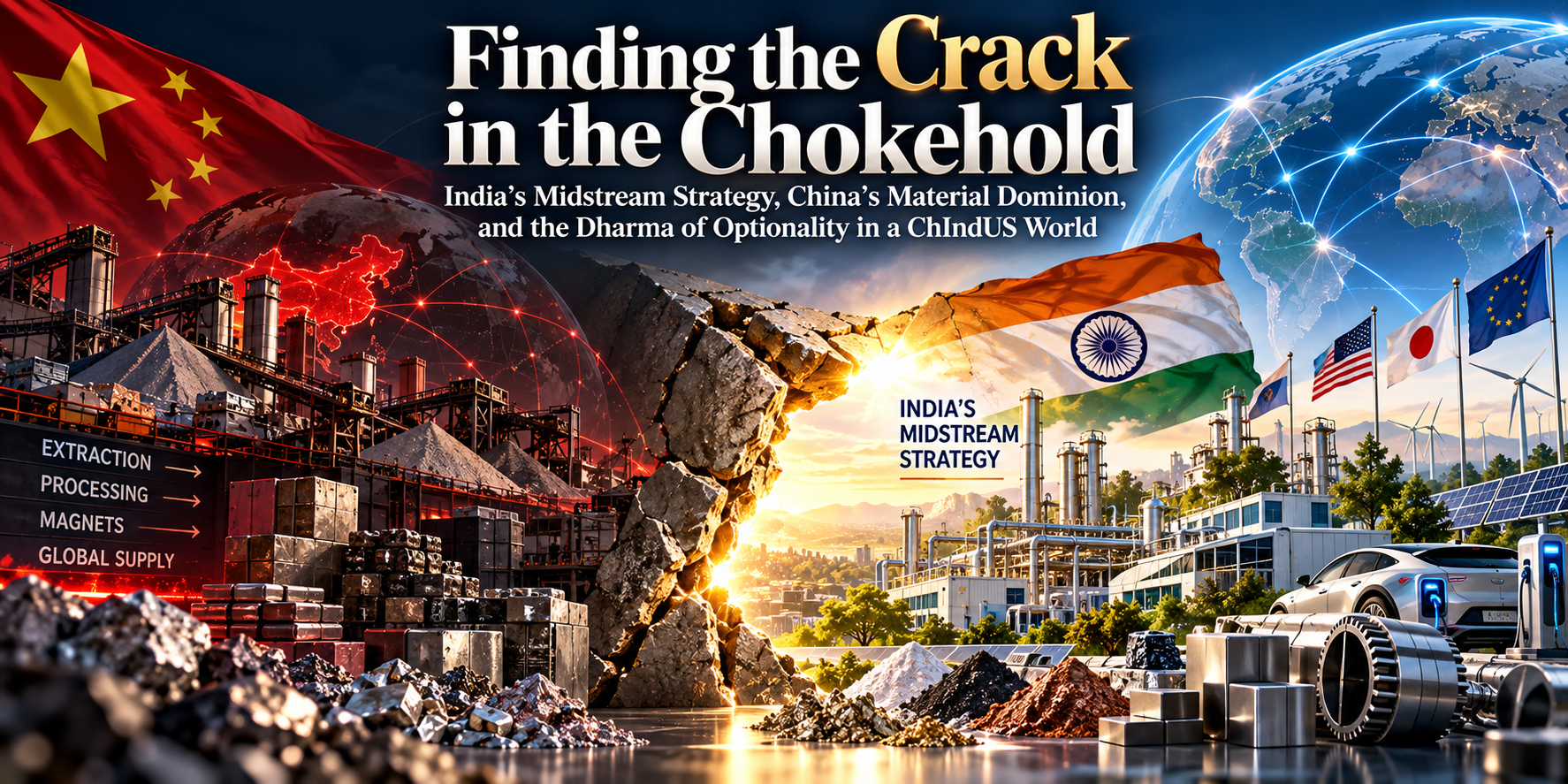
China’s dominance of critical mineral processing has become one of the defining strategic questions of the emerging global economy. The issue is not simply who possesses rare-earth deposits. It is who controls the processing, refining, alloying and manufacturing stages that transform raw materials into the components required by modern industry, defense, energy and technology.
A recent members-only briefing, India’s GENIUS Strategy To Break China’s Most Dangerous Chokehold, argues that India has identified a vulnerability in China’s supply-chain dominance. The DDDI Institute’s analysis takes that argument further, asking whether India can turn this opening into something more durable: strategic optionality rather than another form of dependency.
The distinction is important. Finding a weakness in another power’s system is not the same as building an alternative system of your own.
From Mining to the Midstream
The central argument is straightforward: ore is geology, but processing is power.
China has spent decades developing control over the midstream of critical minerals. Its influence extends beyond mining into rare-earth separation, metallization, alloying and the production of permanent magnets. These capabilities are particularly important because rare-earth magnets are essential to electric vehicles, wind turbines, advanced electronics and precision defense systems.
According to the white paper, China controls roughly 85–90 percent of rare-earth separation and has similarly strong positions in several downstream materials and technologies. India, meanwhile, imported approximately 53,700 tonnes of rare-earth permanent magnets in FY25, with more than 90 percent by quantity coming from China.
The vulnerability became visible in April 2025, when China introduced export licensing requirements affecting seven heavy rare earths, including dysprosium and terbium, as well as related magnets. The episode demonstrated how control over a relatively narrow stage of a supply chain can create leverage across much larger industrial systems.
The strategic question for India is therefore not simply how to mine more minerals. It is how to develop the capabilities that turn minerals into industrial power.
India’s Emerging Response
India has begun building a policy framework around that objective.
The National Critical Mineral Mission, approved in January 2025, provides a seven-year framework covering exploration, mining, processing and recycling. The white paper also highlights the ₹7,280 crore Rare Earth Permanent Magnet scheme, designed to create 6,000 tonnes per year of integrated sintered-magnet capacity across five units.
India has also announced four Rare Earth Corridors, pursued overseas mineral assets through KABIL, and considered strategic stockpiling.
Together, these measures represent an important shift. India is moving from concern about mineral dependence toward an attempt to build a complete domestic ecosystem.
But the DDDI analysis cautions against declaring victory too early.
A magnet plant cannot be created by a press release. Separation chemistry, solvent-extraction systems, metallization, alloying, sintering and qualification for demanding industrial and defense applications require time, expertise and sustained investment.
China’s position was developed over decades. India is still building the foundations.
The Real Meaning of “Finding the Crack”
The phrase “finding the crack” is useful because it identifies a point of vulnerability in what can appear to be an impenetrable system.
But the DDDI Institute argues that a crack only becomes strategically meaningful if it becomes a corridor.
India’s objective should therefore not be to replace Chinese dominance with Indian dominance. It should be to create optionality.
Optionality means multiple sources, multiple partners, multiple processing routes and sufficient domestic capability that no single country can easily bring India’s industrial system to a halt.
This is where the DDDI distinction between Dominion and Dharma becomes important.
Dominion organizes power around control of chokepoints. Dharma asks what responsibilities accompany that power.
A strategic minerals policy guided by Dharma would therefore have obligations not only to national security, but also to workers, communities, ecosystems, trading partners and future generations.
The Six Capitals of Strategic Sovereignty
The white paper applies DDDI’s six-capital framework to India’s critical-mineral challenge: Financial, Human, Intellectual, Social, Natural and Consciousness capital.
Financial capital means patient investment capable of supporting industries that may take years to mature.
Human capital means developing chemists, metallurgists, engineers and technicians capable of operating sophisticated processing facilities. The paper identifies India’s IITs and NITs as potential sources for building this specialized workforce.
Intellectual capital means acquiring and developing the process knowledge behind separation and magnet production. Partnerships with Japan, Korea and Europe, the paper argues, should involve meaningful technology transfer rather than simply turning India into a toll-processing location.
Social capital involves trusted relationships with countries and institutions across the supply chain, including the Minerals Security Partnership, Quad partners, trade networks and India’s global engineering diaspora.
Natural capital requires a different approach to extraction. Recycling should become a strategic priority, followed by cleaner industrial parks and overseas investments that recognize restoration responsibilities.
Finally, Consciousness capital asks a deeper question: What does the material mean?
The same rare-earth atom can become part of a missile, an electric vehicle or a village pump. The material itself is neutral. The systems and purposes surrounding it determine its consequences.
The ChIndUS Triangle
The white paper places India’s mineral strategy within the broader ChIndUS relationship among China, India and the United States.
Washington seeks greater resilience in critical supply chains and views India as an important alternative to China. Beijing has an interest in maintaining its economic relationship with India while preserving its own strategic advantages. New Delhi, meanwhile, seeks investment and cooperation without surrendering strategic autonomy.
This creates a delicate three-way relationship.
For India, the objective is not simply to become a “China+1” manufacturing destination. The deeper goal is to possess enough industrial capability to make independent choices.
The paper puts the principle starkly: sovereignty means having the ability to say no without starving your own factories.
That is why India’s midstream strategy matters beyond rare-earth magnets. It is ultimately about the capacity to make decisions without being trapped by a single supplier, market or geopolitical patron.
From Crack to Corridor
The DDDI Institute proposes a practical agenda for turning the emerging opening into durable capability.
First, own the joint, not the headline. Processing capacity should receive as much attention as new mining projects.
Second, recycle before prospecting. Recovering critical materials from used magnets, motors and electronics can reduce dependence while new mines and processing facilities are being developed.
Third, build deeper strategic stockpiles. The paper argues that reserves measured in weeks provide limited protection against prolonged disruption. Strategic planning should consider much greater depth.
Fourth, buy process knowledge, not just equipment. Technology-transfer requirements should become central to partnerships with foreign companies.
Fifth, prepare for the interaction between geopolitics and supply chains. India’s border relationship with China and its economic relationship with China cannot always remain in separate compartments.
Finally, India should measure progress across all six capitals rather than relying solely on tonnes produced or money invested. A meaningful public dashboard could track skilled workforce development, intellectual-property milestones, ecological restoration, partner relationships and days of strategic stockpile coverage.
The Crack Is a Test of Character
The central message of the DDDI white paper is ultimately larger than rare earths.
India may indeed have identified a vulnerability in China’s material dominance. The National Critical Mineral Mission, magnet-production incentives, processing corridors, overseas mineral investments and strategic stockpiling all indicate movement toward greater resilience.
But the real test is what India does with that opportunity.
If India simply replaces one dominant supplier with another, the structure of the chokehold remains. The hand controlling the chokepoint has changed, but the chokepoint itself survives.
The alternative is Dharma of optionality: diversified partnerships, domestic capability, ecological responsibility, skilled human capital, technology ownership and strategic autonomy.
That path is slower and less dramatic than declaring victory. But it offers something more durable.
The goal is not to create another monopoly.
It is to create a world in which no single power controls the neck of the hourglass.
The crack has appeared. The question now is whether India can turn it into a path toward genuine sovereignty, shared resilience and a more multipolar industrial order.
READ THE FULL MANUSCRIPT –Finding the Crack in the Chokehold