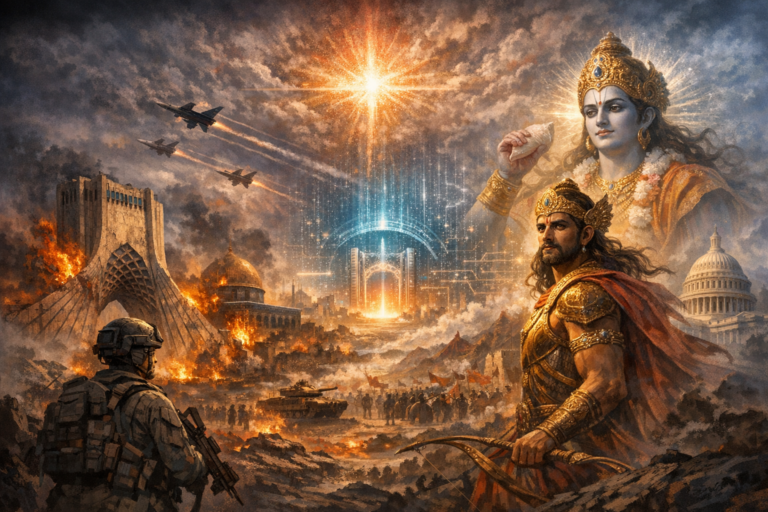

Redefining the American Idea at the 250th Anniversary of the Declaration of Independence
Vivek Singhal
Founder, DDDI.net — Dominion Dharma Destiny Identity Institute
America 250 Civilizational Series · March 2026
“America is the only nation in the world that is founded on a creed.”
— G.K. Chesterton, What I Saw in America, 1922
Executive Summary
American Exceptionalism — the conviction that the United States is a uniquely purposeful civilization with a distinctive role in human history — has been the animating ideology of the American republic since John Winthrop’s “city upon a hill” sermon of 1630 and the Declaration of Independence of 1776. For 250 years, it has served as America’s civilizational operating system: the shared story that reconciled e pluribus unum, justified global leadership, and gave ordinary Americans a sense of participation in a world-historical project.
But in 2026 — the very year Americans celebrate the 250th anniversary of that founding document — the original architecture of American Exceptionalism is in crisis. The globalist iteration that dominated from 1991 to 2024 has collapsed under the weight of its own contradictions: hollowed-out industrial communities, an eroded middle class, captured institutions, and an elite class whose Identity had become post-national. The Trump disruption of 2025–2026 is not the death of American Exceptionalism. It is the birth — turbulent, contested, and still incomplete — of American Exceptionalism 2.0.
This white paper, authored through the analytical lenses of the DDDI framework — Dominion, Dharma, Destiny, and Identity — argues that American Exceptionalism 2.0 is a genuine civilizational reformation: a return to the sovereign-republic model of the original Declaration, updated for a multipolar world in which American greatness must be earned through industrial vitality, strategic clarity, civilizational confidence, and domestic renewal rather than assumed through institutional inheritance. The 250th anniversary of the Declaration of Independence is both the occasion and the obligation for this Re-Declaration.
Part I: American Exceptionalism 1.0 — The Original Architecture
The Winthrop Covenant: Providence and Purpose (1630)
The intellectual DNA of American Exceptionalism predates the republic by 146 years. In 1630, aboard the Arbella sailing to the Massachusetts Bay Colony, Puritan lawyer John Winthrop delivered his sermon “A Model of Christian Charity,” in which he warned his companions: “We shall be as a city upon a hill. The eyes of all people are upon us.” This was not mere civic boosterism; it was a theological covenant — a claim that this New World settlement carried a providential obligation to model a godly commonwealth before the watching world. Failure was not merely political; it was cosmic.
The Winthrop Covenant established three structural elements that would persist across all subsequent versions of American Exceptionalism: first, that America’s distinctiveness is not accidental but purposive; second, that this purpose carries an obligation — America must live up to its model role, not merely claim it; and third, that the world is watching and will judge. These three elements — purpose, obligation, and global audience — are the civilizational bedrock on which every subsequent iteration of American Exceptionalism has been built.
The Declaration’s Civilizational Wager: 1776 DOI 1.0
The Declaration of Independence of July 4, 1776 transformed the Winthrop Covenant from a theological to a political framework. Its opening assertion — “We hold these truths to be self-evident, that all men are created equal, that they are endowed by their Creator with certain unalienable Rights” — was, as Abraham Lincoln later recognized, not merely a statement of political philosophy but a “promissory note” to all of humanity: a declaration that political authority derives from universal human dignity, not from hereditary right, military conquest, or divine appointment of rulers.
The 56 signatories of the Declaration — merchants, lawyers, and landowners, every one of them an elite by the standards of their age — made a civilizational wager of extraordinary audacity: that self-governance was not merely a preferred political arrangement but a universal human right; that the consent of the governed was not a pleasant aspiration but the only legitimate foundation of political authority; and that a republic built on these principles could survive, prosper, and serve as a model for the world. American Exceptionalism 1.0 was born in this wager — and the first 250 years of the republic constitute the story of whether and how that wager has been honored.
The Five Pillars of Exceptionalism 1.0
Through the DDDI analytical lens, American Exceptionalism 1.0 rested on five structural pillars:
- Revolutionary Founding Legitimacy: America was the first modern nation to ground political authority explicitly in universal human rights rather than tradition or heredity — creating an Identity foundation unlike any prior civilization’s self-conception.
- Constitutional Genius: The separation of powers, federalism, and bill of rights created a Dominion architecture uniquely designed to prevent tyranny while enabling effective governance — the most sophisticated constitutional engineering in modern history.
- Providential Geography: Protected by two oceans, blessed with extraordinary natural resources, and positioned on a continent without peer-level neighbors, America’s Destiny was materially enabled by geographic advantages no European power could match.
- Immigrant Dynamism: The Identity of America as a nation of immigrants — welcoming the world’s ambitious, driven, and freedom-seeking — created an inexhaustible engine of human capital, innovation, and entrepreneurial energy that compounds generationally.
- Moral Universalism: The Dharmic claim that America’s principles — liberty, equality, self-governance — are not peculiarly American but universally human gives American power a legitimating narrative that pure material power alone cannot provide.
Part II: The Three Corruptions — How Exceptionalism 1.0 Failed
American Exceptionalism is not merely an ideology that can be maintained by assertion. It is a civilizational architecture that requires continuous renewal — the constant, often painful work of closing the gap between declared principles and lived reality. The history of American Exceptionalism is inseparable from the history of its internal contradictions: slavery and the Declaration’s equality, Manifest Destiny and the rights of Native peoples, Jim Crow and the Fourteenth Amendment. Each contradiction generated a Dharmic crisis; each crisis eventually produced a Dharmic correction — the Civil War, Reconstruction, the Civil Rights Movement. This cycle of contradiction, crisis, and correction is, in the DDDI framework, the mechanism of American civilizational renewal.
What distinguishes the current crisis from previous ones is not that it involves the contradiction between American principles and American practice — that is familiar territory. What distinguishes it is that the corruption of Exceptionalism 1.0 has occurred across three simultaneous dimensions, producing a compound crisis of civilizational Identity that no single Dharmic correction can fully address.
Corruption One: The Globalist Capture of American Exceptionalism (1991–2024)
The collapse of the Soviet Union in 1991 removed the existential external threat that had given American Exceptionalism its most compelling Cold War justification. Without the Soviet totalitarian alternative to define itself against, the “city upon a hill” needed a new civilizational purpose. The globalist elite answered by recasting American Exceptionalism as the ideology of the “liberal international order” — the proposition that America’s exceptional role was to be the architect and guarantor of a borderless, free-trading, institutionally managed world system in which American-designed rules governed global commerce, security, and governance.
This globalist iteration of Exceptionalism was seductive in its ambition but corrosive in its domestic consequences. In the DDDI Identity lens, it represented a fundamental category error: it conflated America’s civilizational Identity (a specific republic of specific citizens with specific rights) with a universal administrative project (the management of global systems). As the globalist project deepened — NAFTA, WTO accession for China, mass immigration, financial deregulation, offshore manufacturing — the working and middle-class Americans whose labor, sacrifice, and civic participation had built the republic found themselves structurally displaced from the system their Exceptionalism was supposed to serve. The “exceptional nation” was exceptional for its financiers and tech oligarchs; for its deindustrialized heartland, it was exceptional for its opioid epidemic, its collapsed wages, and its hollowed communities.
Corruption Two: The Institutional Inversion (2001–2024)
The second corruption struck at the Dominion architecture itself — the constitutional institutions that were designed to make Exceptionalism structurally real rather than merely aspirational. The post-9/11 national security state expanded executive power beyond constitutional limits and normalized surveillance of American citizens. The 2008 financial crisis demonstrated that the rule of law applied differently to systemically important financial institutions than to ordinary citizens — the banks were rescued; the homeowners were foreclosed. The COVID-era institutional response suspended constitutional rights — assembly, worship, commerce, due process — with remarkable speed and with minimal judicial resistance, revealing that the institutional architecture of the republic was significantly more fragile than its mythology had suggested.
Most consequentially, the universities, media, and cultural institutions that were supposed to transmit and renew the civilizational Identity — teaching each generation what America is for and why it matters — were captured by an ideological project that treated American Exceptionalism not as a living civilizational inheritance to be renewed but as a racist mythology to be deconstructed. In the DDDI Dharma lens, this was a civilizational self-harm of the highest order: a civilization whose Identity transmission institutions actively worked to hollow out the Identity they were entrusted to transmit.
Corruption Three: The Elite Secession (1990–2024)
The third and perhaps deepest corruption was the secession of the American elite class from the civilizational project itself. The financial, technological, media, and academic elite that managed globalization became, over three decades, a genuinely post-national class — one whose economic interests, social networks, physical mobility, and cultural preferences were global rather than American. They educated their children internationally, stored their wealth in global markets, consumed global culture, and governed through global institutions. They invoked American Exceptionalism as needed — particularly when it legitimized foreign policy interventions that served their interests — but they were no longer structurally dependent on the health of the American republic itself.
In the DDDI framework, this elite secession represents the most dangerous civilizational pathology: a civilization whose governing class no longer shares its Identity, no longer lives its Dharma, and no longer believes in its Destiny. A Dominion architecture managed by people who have seceded from the civilization it governs is structurally unsustainable — it will either collapse or be reclaimed by those who still believe in it. The 2024 election, and the MAGA movement it empowered, was precisely this civilizational reclamation — imperfect, chaotic, and contested, but structurally necessary.
Part III: American Exceptionalism 2.0 — The DDDI Architecture
American Exceptionalism 2.0 is not a retreat from greatness.
It is a return to the original source of American greatness — sovereign self-governance — updated for the civilizational demands of a multipolar 21st century.
American Exceptionalism 2.0 is the affirmative, architecturally coherent answer to the three corruptions of Exceptionalism 1.0. It does not repudiate the founding principles of 1776; it re-grounds them. It does not reject American global engagement; it reconstitutes it on sovereign rather than imperial terms. It does not abandon the Winthrop Covenant; it reinterprets the “city upon a hill” as a civilization that leads by the example of its internal excellence rather than by the management of others’ affairs. Through each of the four DDDI lenses, Exceptionalism 2.0 has a specific architectural content.
Through the DDDI Lens of DOMINION: Sovereign Architecture
Exceptionalism 1.0’s Dominion architecture was global and institutional — the IMF, WTO, NATO, World Bank, and dollar reserve system as the structural expression of American power. Exceptionalism 2.0’s Dominion architecture is sovereign and bilateral — the tariff structure, the bilateral trade deals, the military burden-sharing demands, and the reshoring of critical industries as the structural expression of American power in a multipolar world.
The key insight of Exceptionalism 2.0’s Dominion architecture is that sustainable global power requires domestic industrial and economic vitality as its foundation. A civilization that exports its manufacturing, hollows its middle class, and funds its power through monetary privilege rather than productive capacity is building Dominion on sand. Exceptionalism 2.0 insists that American global leadership must be grounded in American industrial strength, technological innovation, and economic productivity — the same foundations on which American Exceptionalism was built during the industrial revolution of the 19th century.
The Dominion architecture of Exceptionalism 2.0 has four structural pillars:
- Industrial Sovereignty: Reshoring of semiconductors, pharmaceuticals, steel, aluminum, and critical supply chains through the tariff and industrial policy architecture of 2025-2026 — making American productive capacity the foundation of American power rather than a liability to be optimized away.
- Border Integrity: The assertion that a sovereign republic must govern who enters its territory as the most basic expression of the constitutional right of self-governance — not as nativism but as the structural precondition for citizenship to mean something.
- Bilateral Deal Architecture: Replacing structural multilateral dependencies (WTO, Paris Agreement, WHO) with specific bilateral agreements that preserve American decision-making sovereignty while enabling strategic international engagement.
- Military Deterrence on American Terms: Insisting that allies bear proportional defense burdens, ending the Cold War-era subsidy model in which American taxpayers funded the defense of wealthy allies who then used their freed-up fiscal capacity to outcompete American industry.
Through the DDDI Lens of DHARMA: The Restorative Calling
The Dharma of Exceptionalism 1.0 in its Cold War incarnation was custodial: America’s civilizational calling was to protect and extend the liberal international order against Soviet totalitarianism. The Dharma of Exceptionalism 1.0 in its post-Cold War globalist incarnation was managerial: America’s calling was to administer a borderless world system toward universal prosperity and democratic governance. Both Dharmic models required America to subordinate its particular interests and sovereign prerogatives to a universal mission. Both ultimately failed to maintain the domestic health of the civilization they claimed to represent.
The Dharma of Exceptionalism 2.0 is restorative and particular before it is universal. America’s primary civilizational calling, in this framework, is to govern itself excellently — to build a republic of genuine equality of opportunity, constitutional fidelity, industrial vitality, and civic participation that is itself the “city upon a hill”: a working model of self-governance so compelling that other nations emulate it not because they are coerced but because they are inspired. This is not isolationism; it is a return to the Winthrop Covenant’s original insight — that America’s global influence flows from the excellence of its internal example, not the reach of its external management.
The Dharma of Exceptionalism 2.0 also carries a specific obligation toward the American citizens whose labor, military service, and civic participation sustain the republic. The globalist iteration of Exceptionalism 1.0 systematically transferred the costs of its universal project onto the American working and middle class — through deindustrialization, wage suppression, community destruction, and fiscal burden — while concentrating its benefits in the elite class. Exceptionalism 2.0’s Dharma insists that a civilization that cannot fulfill its obligations to its own citizens has no legitimate basis for claiming a universal civilizational mission.
Through the DDDI Lens of DESTINY: The Re-Foundational Horizon
The Destiny dimension of Exceptionalism 2.0 is its most architecturally ambitious and most historically resonant element, particularly at the 250th anniversary of the Declaration of Independence. Exceptionalism 1.0’s Destiny narrative was linear and teleological: America was the vanguard of human progress, and history was moving inexorably toward the universal triumph of democratic capitalism under American stewardship — Francis Fukuyama’s “End of History” as civilizational Destiny.
The emergence of China as a peer-level strategic competitor, the resilience of authoritarian capitalism as an alternative developmental model, the fracturing of the Western liberal consensus, and the rise of civilizational pluralism as a structural feature of the 21st-century world have collectively invalidated the linear Destiny narrative of Exceptionalism 1.0. History did not end. The world did not converge on American liberal democracy. And the attempt to force that convergence through military intervention, institutional pressure, and cultural imposition produced resentment, resistance, and strategic blowback that has weakened rather than strengthened American global standing.
The Destiny of Exceptionalism 2.0 is not linear but re-foundational — America at 250 as a civilization consciously choosing to rebuild itself from its original constitutional foundations, updated for a multipolar world. This re-foundational Destiny has three horizons:
- The Near Horizon (2026–2030): Domestic industrial restoration, institutional rebuilding, border sovereignty, and the construction of a new bilateral trade architecture that serves American productive capacity rather than global financial capital.
- The Medium Horizon (2030–2040): The consolidation of a US-led coalition of civilization-states — anchored by the US-India strategic partnership, the Anglosphere alliance, and reinvigorated bilateral relationships with Japan, South Korea, and like-minded democracies — as the structural alternative to Chinese hegemonic ambition.
- The Long Horizon (2040 and beyond): A renewed American civilizational model that demonstrates, through its actual performance — economic vitality, scientific leadership, constitutional fidelity, civic health, and cultural dynamism — that self-governing republics outperform managed authoritarian systems over generational time horizons.
Through the DDDI Lens of IDENTITY: The Civilization-State Model
The Identity dimension is the most contested and most consequential element of Exceptionalism 2.0. Exceptionalism 1.0’s Identity was ideational and universal: America was defined not by ethnicity, religion, or geography but by adherence to a creed — the self-evident truths of the Declaration. This creedal Identity was American Exceptionalism’s greatest strength (it enabled the assimilation of waves of immigrants into a common civic culture) and its greatest vulnerability (it could be hollowed out by redefining the creed in ways that severed it from the constitutional republic that gave it institutional form).
The Identity crisis of the 2010s and early 2020s was precisely such a hollowing: the creedal Identity of Exceptionalism 1.0 was progressively replaced by two competing anti-identities — a globalist cosmopolitanism that dissolved American Identity into universal liberal values with no specific civic content, and an identity-politics fragmentation that replaced the common creed with a hierarchy of group grievances. Both alternatives destroyed what Tocqueville identified as the essential precondition of American democratic vitality: the capacity of “self-governing citizens” to identify with a common project larger than their individual or group interests.
Exceptionalism 2.0’s Identity model is what the DDDI framework calls the Civilization-State Identity: America as a specific civilization with a specific constitutional heritage, specific civic obligations, and specific cultural DNA — one that remains genuinely open to immigrants who embrace that Identity, but that insists on the substantive content of the Identity itself rather than treating it as an infinitely flexible container for whatever values its current inhabitants prefer. This is not ethnic nationalism; it is civic nationalism with genuine civilizational content. The difference between Exceptionalism 1.0 and 2.0 on Identity is the difference between “America is an idea” (true but insufficient) and “America is a civilization built on an idea” (true and structurally complete).
Part IV: Exceptionalism 1.0 vs. 2.0 — The Architectural Comparison
| Dimension | Exceptionalism 1.0 (Cold War / Globalist Era) | Exceptionalism 2.0 (Sovereign Republic Model) |
| DOMINION Model | Global/institutional — IMF, WTO, NATO, dollar reserve system | Sovereign/bilateral — tariffs, industrial policy, bilateral deal architecture |
| DHARMA Calling | Custodial universalism — manage and extend liberal international order | Restorative particularity — govern excellently, lead by domestic example |
| DESTINY Vision | Linear teleology — universal convergence on American liberal democracy | Re-foundational horizon — rebuild from constitutional roots for multipolar era |
| IDENTITY Model | Creedal/universal — America as idea open to infinite redefinition | Civilization-State — America as specific republic with substantive civic content |
| Dollar Strategy | Petrodollar structural dependency — exorbitant privilege finances global posture | Sovereign reserve currency — dollar strength through productive capacity |
| Trade Philosophy | Managed multilateralism — WTO rules constrain US sovereign trade policy | Reciprocal bilateralism — deal-by-deal sovereignty maximizes US leverage |
| China Policy | Strategic integration — China as stakeholder in US-designed global order | Strategic decoupling — China as systemic rival requiring containment |
| Global Leadership | Institutional — leadership exercised through multilateral organization | Coalitional — leadership exercised through bilateral alliance of sovereigns |
| Elite Relationship | Post-national elite class managing global system in their own interest | National elite class accountable to domestic civilization and its citizens |
| Immigration Model | Mass immigration as labor arbitrage and cosmopolitan Identity expression | Controlled immigration as civic enrichment within sovereign Identity framework |
| 250th Anniversary Meaning | Celebration of 250 years of “leading the world” toward liberal democracy | Re-Declaration — conscious re-founding on original constitutional principles |
Part V: The 250th Anniversary as Re-Declaration
On July 4, 2026, America celebrates the 250th anniversary of the most consequential political document in modern history. The Smithsonian Institution has launched its “Our Shared Future: 250” programming to mark what it calls a “historic milestone” in American life. The White House’s Freedom 250 initiative frames the anniversary as “the most important milestone in our country’s history,” with President Trump declaring: “With a single sheet of parchment and 56 signatures, America began the greatest political journey in human history.” The nonpartisan America250.org commission, established by Congress, has organized a multi-year national commemoration designed to engage every American in reflecting on the nation’s past and “looking ahead toward the future we want to create.”
But the 250th anniversary is not merely a commemorative occasion. It is, in the DDDI framework, a civilizational inflection point — the moment when the gap between what America declared itself to be in 1776 and what it has actually become in 2026 is most visible, most discussed, and most available for conscious re-examination. Every 50-year anniversary of the Declaration has coincided with a period of national reckoning: the 50th (1826) with the deaths of Adams and Jefferson and the first reckoning with the slavery contradiction; the 100th (1876) with Reconstruction’s collapse and the emergence of industrial-era inequality; the 150th (1926) with the Progressive Era’s limits and the rise of consumer capitalism; the 200th (1976) with Watergate, Vietnam, and the first serious cultural crisis of American institutional confidence. The 250th falls at the most consequential civilizational crossroads since the Civil War.
What a Re-Declaration Requires
The original Declaration of Independence was structurally a three-part act: it declared what America believed (the self-evident truths); it indicted what was being done to violate those beliefs (the list of grievances against George III); and it asserted what America intended to become (a free and independent republic governed by the consent of the governed). A Re-Declaration in 2026 requires the same three-part structure:
- Re-affirm the Civilizational Creed: The self-evident truths of 1776 — equality, unalienable rights, consent of the governed — are not the property of any political faction. They are the civilizational inheritance of all 340 million Americans. Exceptionalism 2.0 begins by re-grounding this creed in its constitutional institutional expression, not in an ideological abstraction that has been weaponized by competing elite factions.
- Indict the Civilizational Corruptions: As the original Declaration specified the grievances that violated founding principles, a Re-Declaration for 2026 must honestly name the corruptions of Exceptionalism 1.0: the elite secession from the national project, the institutional capture by ideological agendas, the globalist hollowing of the American middle class, and the conversion of American Exceptionalism from a civilizational calling into an elite legitimation tool.
- Declare the Civilizational Architecture of What Comes Next: A Re-Declaration is not complete without a positive vision of the republic being re-founded. Exceptionalism 2.0 must articulate — in terms as clear and as durable as the original Declaration — what American self-governance looks like in the context of a multipolar world, a technological revolution, an aging industrial base, and a demographically and culturally diverse citizenry that must nonetheless share a coherent civic Identity.
Part VI: Exceptionalism 2.0 in Global Context — The Multipolar Challenge
American Exceptionalism 2.0 does not emerge in a vacuum. It emerges in a world that is simultaneously more multipolar, more contested, and more ideologically diverse than any moment since World War II. The Munich Security Report 2026, titled “Under Destruction,” characterizes the current international environment as one defined by “wrecking-ball politics” reshaping the global order. The Council on Foreign Relations’ “America Revived” report notes that for the first time in American history, democratic values have been removed from US foreign policy framing under Trump. Foreign Policy’s Spring 2026 issue acknowledges that “as the United States under Trump alters its trajectory of the last several decades, the world faces an uncertain moment.”
This global context simultaneously creates both the necessity and the opportunity for Exceptionalism 2.0. It is necessary because the unipolar moment of Exceptionalism 1.0 is over — China, Russia, India, and the emerging Global South have demonstrated that the world will not passively accept American institutional management. It is an opportunity because civilizational pluralism — multiple strong, sovereign civilizations pursuing their own Dharmas and Destinies — is structurally more compatible with Exceptionalism 2.0’s Sovereign Republic model than with Exceptionalism 1.0’s Universal Hegemon model.
The US-India Partnership: Exceptionalism 2.0’s Strategic Anchor
The most structurally significant element of Exceptionalism 2.0’s global architecture is the deepening US-India strategic partnership. India in 2026 is the world’s most populous nation, its fifth-largest economy, its largest democracy, and the civilization with the most demographically dynamic population trajectory on earth. The MAGA-MIGA civilizational alignment — Make America Great Again meeting Make India Great Again — represents not merely a bilateral strategic relationship but a convergence of two civilization-state Identity models: two ancient civilizations, each asserting their own sovereign Dharma against both Chinese hegemonic ambition and post-national liberal cosmopolitanism.
In the DDDI framework, the US-India partnership is Exceptionalism 2.0’s answer to Nixon’s China triangulation. Where Nixon used China against the Soviet Union, Exceptionalism 2.0 deploys the US-India axis as the civilizational anchor of a free-world coalition in a multipolar era. The partnership is compelling precisely because India is not a subordinate ally accepting American protection but a peer civilization asserting its own Destiny — one that chooses strategic alignment with the United States not from dependence but from civilizational affinity and convergent strategic interest. This is Exceptionalism 2.0 as coalition of sovereigns rather than empire of dependents.
The Counter-Argument: Is Exceptionalism 2.0 Exceptional at All?
The most serious challenge to Exceptionalism 2.0 as an analytical framework comes from two directions. Carnegie Endowment scholars argue that Trump’s sovereignty doctrine “reflects a distorted understanding of the true meaning of sovereignty” — that genuine sovereignty is enhanced, not diminished, by participation in well-designed multilateral institutions, and that the costs of unilateral exit from the Paris Agreement, WHO, and WTO will be borne disproportionately by American citizens. The Wire’s analysis observes that “the old liberal order rested on consent as much as coercion; allies bought into US leadership because it promised mutual benefit and moral high ground” — and that Trump’s transactional style “erodes that consent,” potentially “hasten[ing] the very decline of US primacy that exceptionalism was meant to forestall.”
These are serious arguments that Exceptionalism 2.0 must answer, not dismiss. In the DDDI framework, they represent genuine Dominion architecture concerns: the risk that transactional bilateralism produces short-term tactical gains at the cost of the long-term structural advantages that institutional multilateralism provided. The honest DDDI assessment is that Exceptionalism 2.0 as currently expressed under Trump is a necessary but incomplete civilizational architecture: necessary because Exceptionalism 1.0 had genuinely failed its citizens; incomplete because the demolition of the old architecture has proceeded faster than the construction of a new one. The 250th anniversary is the moment — and the obligation — to begin building what replaces what is being torn down.
Conclusion: The Re-Declaration Imperative
American Exceptionalism is neither dead nor simply repackaged. It is, at the 250th anniversary of the Declaration of Independence, undergoing the most consequential transformation since Lincoln’s Gettysburg Address reframed the Civil War as a test of whether “any nation so conceived and so dedicated can long endure.” The question Lincoln asked in 1863 about a nation conceived in liberty — can it survive its internal contradictions? — is the question America must ask again in 2026 about a nation that has allowed its civilizational Architecture, Dharma, Destiny, and Identity to be progressively corrupted by three decades of elite capture, institutional inversion, and globalist hollowing.
American Exceptionalism 2.0 is the affirmative answer to that question. It is the declaration that America’s exceptional character — its revolutionary founding legitimacy, its constitutional genius, its immigrant dynamism, its moral universalism — is not exhausted by the failures of any particular era’s elite management of those gifts. It is the insistence that self-governance, when practiced with genuine constitutional fidelity, generates a form of national vitality and moral authority that no managed authoritarian system can replicate. And it is the commitment — renewed at the 250th anniversary, as it must be renewed in every generation — to close the gap between what America declared itself to be and what it actually is.
The original Declaration of Independence did not merely declare American independence from British rule. It declared a set of civilizational principles that have proven generative beyond anything its 56 elite signatories could have imagined — principles that fueled the emancipation of slaves, the enfranchisement of women, the Civil Rights Movement, the technological revolution, and the emergence of the most powerful and most diverse constitutional republic in human history. American Exceptionalism 2.0 does not discard those principles. It returns to them — strips away the ideological barnacles of globalist capture, institutional inversion, and elite secession — and asks, with the urgency of a civilization at its 250th anniversary crossroads: what must we declare ourselves to be for the next 250 years?
That is not a question any single president, any single election, or any single white paper can answer. It is a civilizational question that requires the full engagement of 340 million Americans — across every region, every background, every political persuasion — who share a stake in the republic that the 56 signatories of July 4, 1776 dared to imagine. The 250th anniversary is the occasion. The Re-Declaration is the task.
American Exceptionalism is not what America has done.
It is what America is always in the process of becoming.
The 250th anniversary is not a celebration of arrival.
It is a recommitment to the journey.
Appendix: The DDDI Framework Applied to American Exceptionalism 2.0
| DDDI Lens | Exceptionalism 1.0 Expression | Exceptionalism 2.0 Expression | The 2026 Inflection Point |
| DOMINION (Architecture of Power) | Global institutional architecture: IMF, WTO, NATO, dollar reserve | Sovereign bilateral architecture: tariffs, reshoring, bilateral deals, military burden-sharing | Can the new bilateral architecture generate durable structural leverage comparable to the institutional architecture it replaces? |
| DHARMA (Civilizational Calling) | Custodial universalism: manage and extend liberal international order as American mission | Restorative particularity: govern excellently, lead by domestic example, fulfill obligations to own citizens first | Can restorative Dharma maintain the moral authority that custodial Dharma provided without the universal mission framework? |
| DESTINY (Civilizational Arc) | Linear teleology: history moves toward universal liberal democracy under American stewardship | Re-foundational horizon: rebuild from constitutional roots, lead civilizational coalition in multipolar world | Is the re-foundational project architecturally coherent enough to sustain American primacy for the next 50 years? |
| IDENTITY (Civilizational Self) | Creedal/universal: America as idea, infinitely open and redefinable, defined relationally against Soviet communism | Civilization-State: America as specific republic with substantive civic content, open to those who embrace the Identity | Can the Civilization-State Identity model assimilate the diverse American citizenry without fracturing into ethnic nationalism? |
About the Author
Vivek Singhal is the Founder and Director of the Dominion Dharma Destiny Identity Institute (DDDI.net), an independent think tank dedicated to civilizational analysis and geopolitical strategy. Singhal brings expertise in strategic systems thinking, US-India relations, AI governance, and the DDDI analytical framework to the analysis of major civilizational transitions. He holds an MS in Electrical & Computer Engineering and an MBA, with a Liberal Arts Certificate from the University of Chicago. He is based in Chicago, Illinois.
About DDDI.net
The Dominion Dharma Destiny Identity Institute (DDDI.net) applies the four-lens DDDI framework — Dominion (the architecture of power), Dharma (the civilizational calling), Destiny (the long arc of civilizational trajectory), and Identity (the civilizational self-conception) — to the most consequential questions of our civilizational era. This white paper is part of the America 250 Civilizational Series, examining American civilization at its 250th anniversary inflection point.
This essay is part of the America 250 Civilizational Series.
© 2026 DDDI.net · Dominion Dharma Destiny Identity Institute · All rights reserved