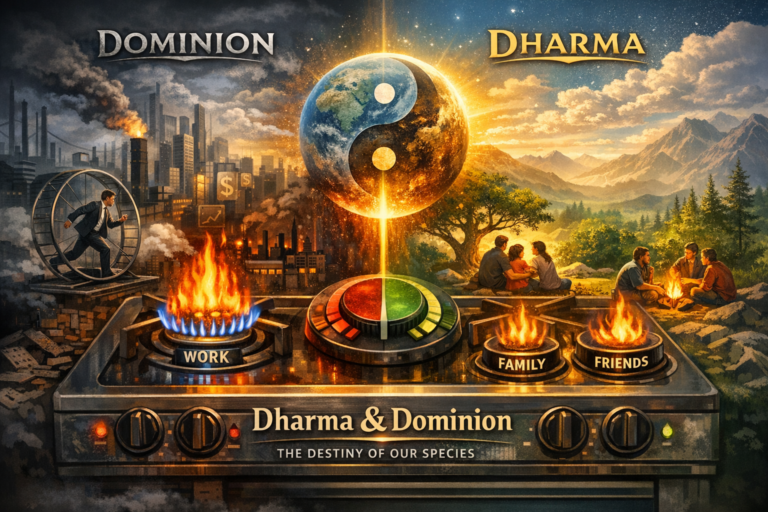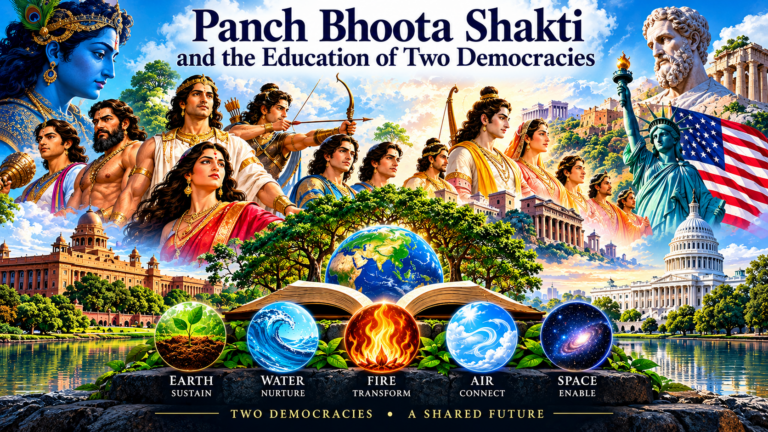
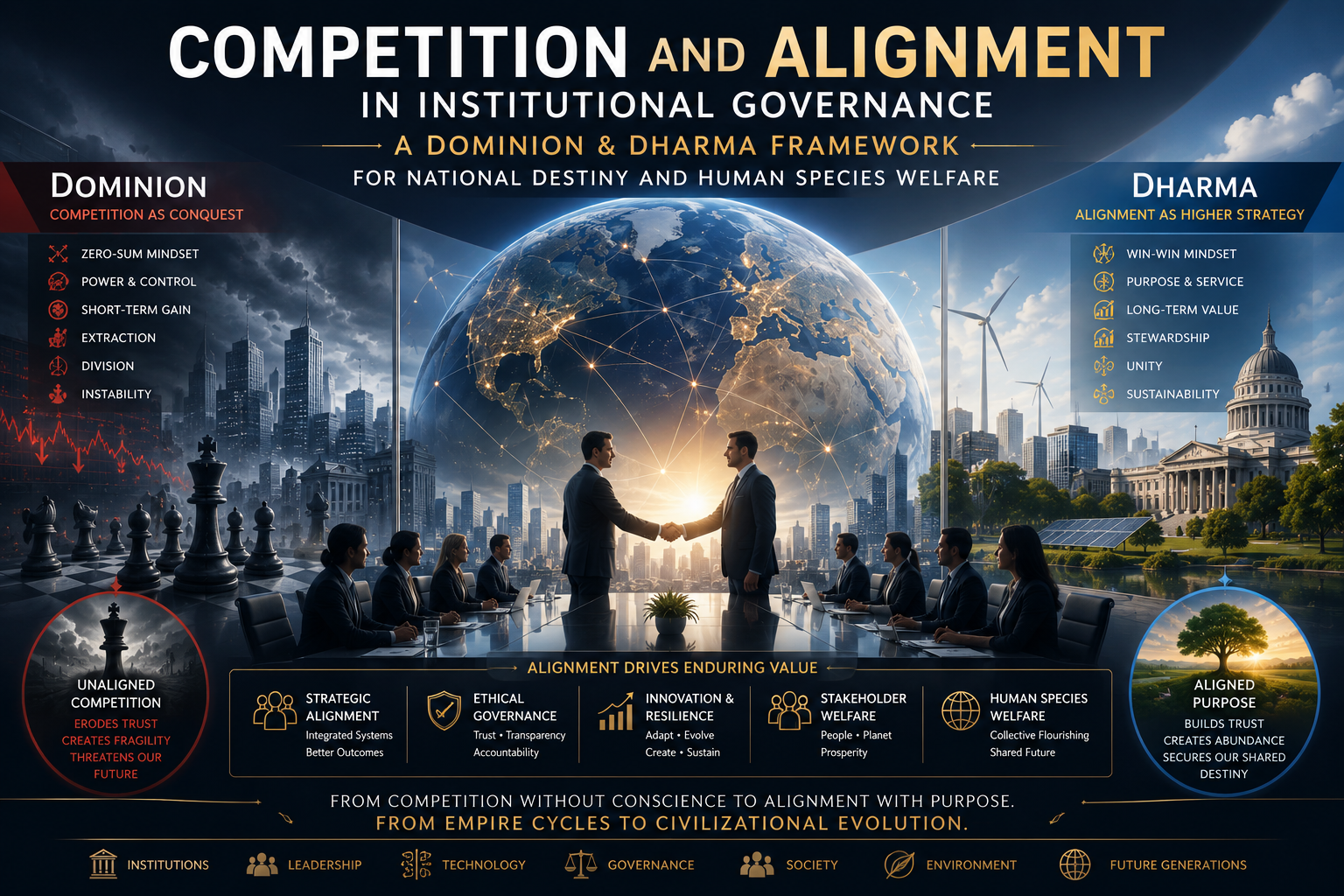
Competition and Alignment in Institutional Governance: A Dominion & Dharma Framework for National Destiny and Human Species Welfare In moments of crisis—rising inflation amid geopolitical conflict, partisan accusations over economic pain, or institutional gridlock—the choice between raw competition and conscious alignment reveals itself not as abstract theory but as the decisive force shaping institutional integrity, national trajectories, and the long-term viability of human civilization.
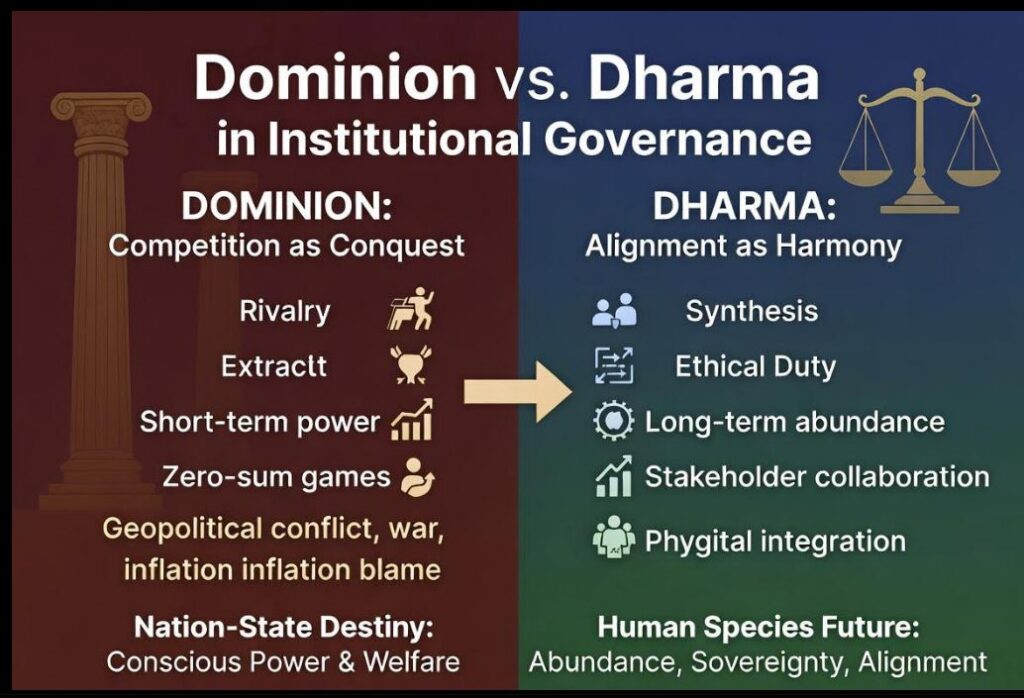
Governance and management of institutions, whether corporate boards, nation-state apparatuses, or emerging AI-augmented systems, operate at the intersection of these two impulses. One path, rooted in Dominion, treats competition as conquest: zero-sum extraction of power, resources, and narrative control. The other, grounded in Dharma, reframes competition as a disciplined instrument within alignment—harmonizing individual ambition, institutional purpose, and collective welfare toward enduring abundance rather than fleeting supremacy.
This essay advances a synthesis: healthy competition remains essential for innovation, accountability, and vitality, yet it must be subordinated to alignment mechanisms that serve the destiny of nation-states and the welfare of the human species at both individual and collective levels. Drawing from civilizational memory—the Bhagavad Gita’s call for nishkama karma (action without attachment to fruits), integral yoga traditions emphasizing synthesis over fragmentation, and modern strategic systems thinking—the framework of Dominion and Dharma offers a diagnostic and prescriptive lens for the Phygital era.
Dominion: Competition as Conquest in Institutional Life Dominion logic views institutions as arenas of rivalry. In corporate management, this manifests as aggressive market share battles, short-term shareholder primacy, and executive compensation structures that reward extraction over stewardship.
Governance becomes theater: boards captured by factional interests, regulatory arbitrage, and quarterly earnings pressure that externalizes costs onto workers, communities, and ecosystems. Nationally, it appears in partisan warfare where opposition parties or rival power centers prioritize scoring points over coherent policy—evident in contemporary debates where economic hardship from energy shocks and conflict is weaponized for political gain rather than addressed through unified strategy.
Globally, Dominion fuels resource contests, technological arms races, and proxy conflicts that risk cascading into wider instability, undermining the very sovereignty they purport to defend. The costs are measurable and compounding. Misaligned competition erodes trust, fragments collective intelligence, and generates brittle systems vulnerable to shock. When governance prioritizes conquest—whether of markets, narratives, or territory—individual agency atrophies into cynicism or burnout, while institutional purpose drifts from service to self-perpetuation.
At the species level, unchecked Dominion dynamics accelerate existential risks: environmental overshoot, misaligned artificial intelligence optimized for narrow objectives, and geopolitical escalations that threaten billions. This is the logic of empire cycles, not conscious evolution.
Dharma: Alignment as the Higher Strategy Dharma, by contrast, defines alignment as the integration of means and ends with cosmic and ethical order—rta in Vedic terms, righteous duty attuned to the whole. In institutional governance and management, alignment means ensuring that structures, incentives, decision protocols, and cultural norms converge on long-term value creation for stakeholders across time horizons.
Strategic alignment research consistently demonstrates that organizations achieving fit between business strategy, IT capabilities, human systems, and governance processes outperform peers in innovation, resilience, and sustainable returns. Values-aligned governance builds trust capital that pure competitive positioning cannot replicate. At the nation-state level, Dharma-aligned governance transcends partisan competition by anchoring institutions in constitutional or civilizational principles that prioritize the welfare of the whole—“we the people” not as slogan but as operational north star.
This does not eliminate political contest; it channels it. Elections, debate, and policy rivalry remain vital for surfacing ideas and correcting errors, yet they operate within guardrails that prevent the capture of state power for factional or personal aggrandizement. When crises arise—economic dislocation from external shocks, for instance—alignment demands synthesis: coherent responses that address root causes rather than amplifying division.
Individually, Dharma calls leaders, citizens, and knowledge workers to align personal competitive drive (ambition, excellence, contribution) with larger duty. The Gita’s warrior-arjuna archetype is instructive: action is required, yet it must arise from discernment of one’s role in the larger order, not egoic conquest. This inner alignment scales outward. Institutional leaders who practice it design incentive systems that reward stewardship; citizens who embody it demand accountability while resisting the seduction of perpetual outrage. Collectively, Dharma alignment manifests in multi-stakeholder models, cooperative federalism or international frameworks that convert potential rivals into co-creators of shared abundance, and governance architectures for emerging technologies that embed ethical constraints from the outset.
Phygital integration—fusion of physical institutions with digital intelligence—amplifies both risks and possibilities. AI systems governed by Dominion logic optimize for narrow metrics at species expense; those aligned to Dharma principles can serve as mirrors and amplifiers of human wisdom, enabling coordination at scales previously impossible. The Synthesis: Competition Within Alignment The mature position rejects the false binary. Competition is not abolished; it is contextualized.
Markets disciplined by effective regulation and stakeholder accountability generate dynamism without predation. Political systems that encourage vigorous debate yet enforce constitutional alignment prevent gridlock or authoritarian drift. Geopolitically, nation-states can pursue competitive advantage in technology, trade, and ideas while aligning on foundational interests—avoiding catastrophic war, preserving open commons, advancing human dignity—that no single power can secure alone.
This synthesis is not utopian. It requires deliberate institutional design: decision frameworks that surface long-term consequences, independent oversight mechanisms insulated from short-term capture, and cultural narratives that celebrate contribution over conquest. It draws on the best of both traditions—Western analytical rigor in systems design and Eastern emphasis on harmony and self-knowledge—without romanticizing either.
In the emerging Phygital landscape of agentic AI, synthetic biology, and distributed intelligence, such alignment is no longer optional; it is the precondition for species-level sovereignty and flourishing. Toward Destiny and Welfare For any nation-state, the choice between Dominion and Dharma governance determines whether it becomes a transient power center in a cycle of rise and decline or a steward of civilizational continuity. The former yields episodic victories purchased at mounting human and ecological cost. The latter cultivates resilient prosperity, cultural confidence, and the capacity to contribute to—rather than merely compete within—a multipolar order.
For the human species, the stakes are existential. Continued Dominion competition in an era of weapons of mass destruction, climate thresholds, and powerful general intelligence risks the “last war before the new world”—a terminal conflict or systemic collapse from which recovery is uncertain. Dharma alignment opens the alternative: conscious evolution toward abundance, where technological capacity serves awakened purpose rather than amplifying ancient drives.
At the individual level, this begins with self-mastery: cultivating the discernment to compete fiercely in one’s domain while remaining anchored in service to larger wholes—family, community, nation, species. At the institutional level, it demands governance redesign: boards and executives evaluated not only on financial returns but on their contribution to systemic health; public institutions measured by their success in fostering aligned competition rather than factional extraction. The path forward is neither naïve harmony nor ruthless realism. It is the disciplined integration that the wisest traditions have always pointed toward: competition as the spark of vitality, alignment as the container that prevents the spark from becoming conflagration. Institutions that internalize this dialectic—whether corporations, governments, or the emerging architectures of global cooperation—will not merely survive the coming decades.
They will help author a future in which nation-states fulfill their highest destiny and the human species realizes welfare worthy of its potential. In an age of profound transition, governance is destiny. The question is no longer whether we compete, but to what end—and whether our institutions are aligned to serve that end. The choice, renewed daily in boardrooms, legislatures, and individual conscience, remains ours to make.