This DDDI™ Institute white paper examines India and the United States as constitutional republics with different histories, institutions, and civilizational traditions. Rather than claiming that either system derives directly from the other, it places Indian epic memory, Greek political thought, American founding traditions, and constitutional thought into a comparative educational framework. Sacred narratives are treated as interpretive metaphors, while historical and constitutional claims are distinguished.
The central concept is Shakti, understood as the capacity to create, sustain, protect, remember, resist, and transform. The paper argues that power becomes legitimate when guided by Dharma: duties, dignity, restraint, relationships, and responsibility. Education therefore plays a crucial role in teaching citizens how to translate power into legitimate authority and peaceful institutional action.
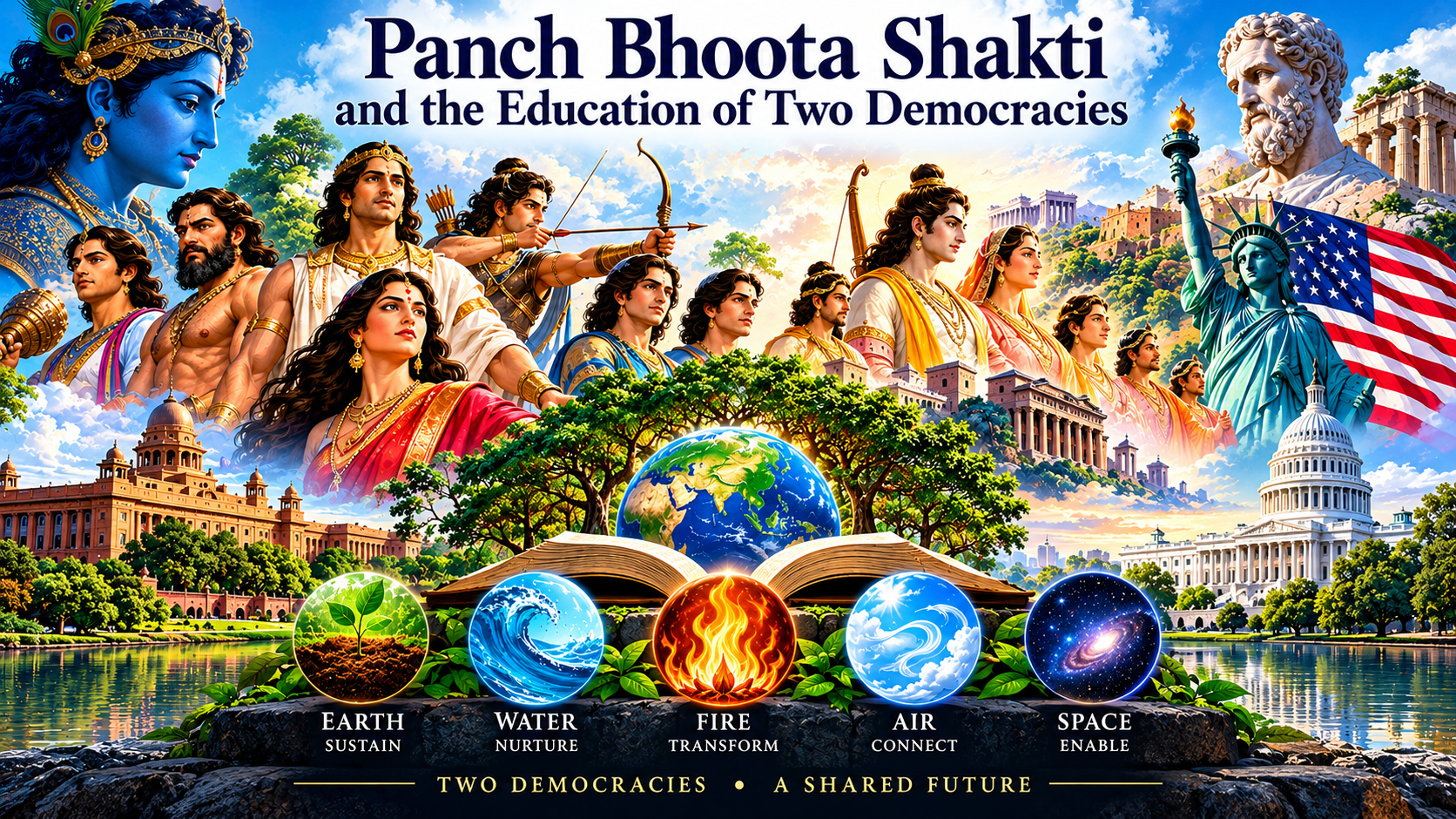
The Panch Bhoota framework uses earth, water, fire, air, and space as metaphors for civic life. These elements are paired pedagogically with the five Pandavas: Yudhishthira with space and legitimacy, Bhima with earth and strength, Arjuna with fire and disciplined action, Nakula with water and care, and Sahadeva with air and foresight. This is a DDDI™ educational construction, not a fixed scriptural interpretation. Its lesson is that no single civic capacity can govern effectively in isolation.
Draupadi represents Shakti as dignity, intelligence, memory, and constitutional conscience. Her questioning during the dice-hall episode illustrates how formal procedure can become unjust when institutions lose the courage to confront humiliation and manipulation. The paper also warns against reducing Shakti to female sacrifice, while examining how gender and caste affect voice, safety, and power.
The Ramayana provides another metaphor for moral sovereignty. Rama, Sita, Lakshmana, Bharata, and Shatrughna represent different forms of leadership, loyalty, restraint, stewardship, and administration. Bharata’s refusal to treat accidental access to power as personal entitlement illustrates custodial legitimacy. Ravana represents capability separated from restraint, while Golden Lanka symbolizes prosperity whose legitimacy is undermined when power becomes appropriation and domination.
The paper compares these traditions with Greek epic and American constitutional development while rejecting simplistic claims of direct historical descent. Greek literature and the Peloponnesian War illustrate tensions between democratic participation, exclusion, empire, and power. American founding traditions combined Enlightenment ideas, classical republicanism, English constitutional conflict, colonial self-government, and political conflict. The Declaration’s principles of equality and consent existed alongside slavery, Indigenous dispossession, restricted suffrage, and other exclusions.
India’s constitutional development reflects its own historical circumstances. The Constitution established a parliamentary, federal, rights-based republic with universal adult franchise and social transformation. The paper emphasizes that India did not simply copy America but drew from multiple traditions and the deliberations of its Constituent Assembly.
The DDDI™ framework organizes civic analysis around four dimensions: Dominion, Dharma, Destiny, and Identity. Dominion asks who possesses the capacity to decide and act; Dharma asks what duties and limits govern that capacity; Destiny examines long-term consequences; and Identity asks who belongs within the political “we.”
The proposed education system combines textual study, power and dignity audits, comparative constitutional analysis, ecological laboratories, scenario planning, identity dialogue, and yoga. Yoga is presented not as state-imposed theology but as disciplined attention that can strengthen civic listening, self-restraint, and the ability to disagree without dehumanization.
Finally, MAGA plus MIGA is reframed as reciprocal renewal rather than supremacy or imitation. America and India are encouraged to improve their constitutional performance while cooperating on challenges such as climate, health, artificial intelligence, and peace.
The concluding principle is that greatness should not mean domination, conformity, wealth, or victory. It should mean the ability to govern power responsibly, protect dignity, sustain pluralism, and build a future in which different civilizations can learn together without erasing their differences.
READ MORE HERE – Panch Bhoota Shakti and the Education of Two Democracies