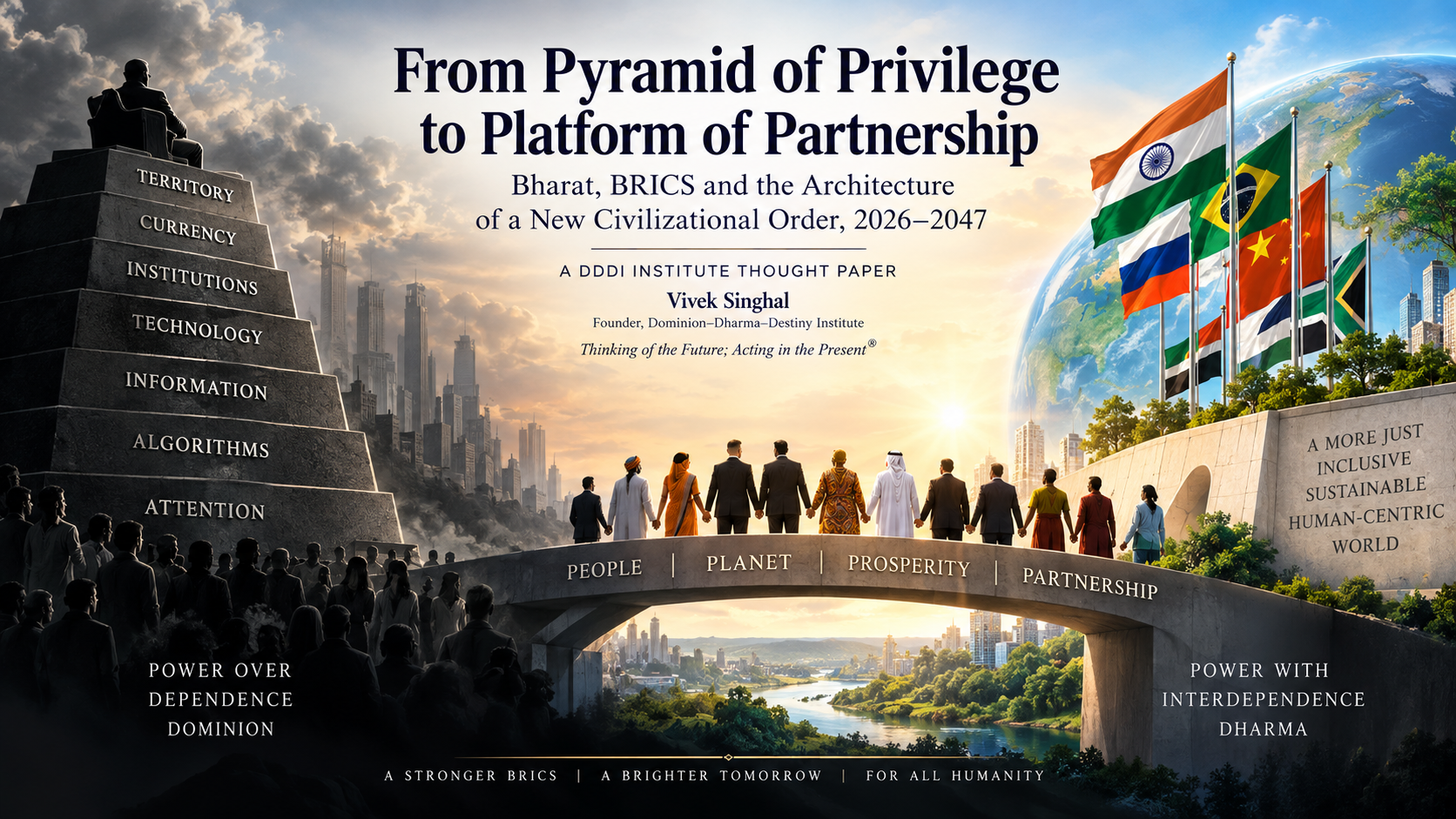
Bharat, BRICS and the Architecture of a New Civilizational Order, 2026–2047
Thinking of the Future; Acting in the Present®
Prologue: 2026 Is More Than Another Year
There are moments when history changes dramatically.
There are other moments when the institutions of one age quietly cease to correspond to the realities of the next.
2026 may prove to be such a year.
Two hundred and fifty years ago, in 1776, the American Declaration of Independence proclaimed perhaps the most consequential political proposition of modernity:
all human beings are created equal and possess inherent rights to Life, Liberty and the pursuit of Happiness.
In that same year, Adam Smith published The Wealth of Nations, articulating another revolutionary proposition: that distributed human initiative, specialization, exchange and enterprise could generate prosperity on a scale centralized authority could not.
These two ideas transformed the world.
One concerned human dignity.
The other concerned human productivity.
For 250 years, modern civilization has struggled to reconcile them.
Capitalism created extraordinary wealth.
Democracy expanded political participation.
Science multiplied knowledge.
Industrialization multiplied energy.
Technology multiplied capability.
Globalization multiplied exchange.
And yet the world of 2026 confronts an uncomfortable paradox:
Humanity possesses more power than at any previous moment while remaining deeply uncertain about what that power is for.
Prime Minister Narendra Modi’s 2026 BRICS interventions must be understood against this larger background.
India’s proposition is increasingly that institutions created by yesterday’s concentration of power must adjust to today’s distribution of capability.
At the BRICS Business Forum, Modi noted that BRICS members now represent approximately half of humanity, around 40 percent of global GDP and more than one-quarter of world trade. He called upon the group to convert “ambition into action” and collective strength into solutions for the world. (PM India)
This is not simply an economic statistic.
It is evidence of a deeper redistribution of civilizational agency.
The central question for the next twenty years is therefore not simply:
Who will dominate the world?
It is:
What kind of world shall increasingly distributed power create?
I. FROM THE AGE OF DOMINION
For several centuries, world order developed around concentrations of power.
Territory mattered.
Navies mattered.
Factories mattered.
Currency mattered.
Oil mattered.
Nuclear weapons mattered.
Institutions mattered.
And whoever controlled these structures could shape the choices available to everyone else.
This is what DDDI describes as Dominion.
Dominion is not inherently evil.
Every civilization requires some capacity to organize energy, resources, territory, institutions and knowledge.
But Dominion becomes dangerous when capacity becomes control and control becomes an end in itself.
The colonial system represented territorial Dominion.
Industrial monopolies represented economic Dominion.
Nuclear deterrence represented military Dominion.
Reserve currencies can become monetary Dominion.
Platforms can become informational Dominion.
Algorithms can become attentional Dominion.
Artificial intelligence may become cognitive Dominion.
We have therefore reached an extraordinary historical transition.
The instruments of Dominion are becoming increasingly intangible.
Yesterday, power occupied land.
Today, power increasingly occupies attention, data, networks, standards, algorithms and perception.
The battlefield has moved from geography toward consciousness.
And this produces one of the central propositions of the DDDI framework:
Dominion captures human energy. Dharma must restore human dignity and moral agency.
II. THE “PYRAMID OF PRIVILEGE”
Modi’s emerging critique of global governance can be summarized as a challenge to what he has described as structures in which too much decision-making remains concentrated among institutions and powers formed under previous historical conditions.
India has consistently argued that institutions such as the United Nations Security Council, World Bank, IMF and WTO require substantive reform to reflect the distribution of population and economic power in the twenty-first century. In his earlier BRICS interventions, Modi explicitly cautioned that BRICS should not merely seek to replace existing global institutions but should help reform them. (PM India)
That distinction is critically important.
Because merely replacing one hierarchy with another accomplishes little.
Replacing:
American Dominion
with
Chinese Dominion
or
BRICS Dominion
would not constitute civilizational progress.
It would simply change the identity of those sitting at the top of the pyramid.
The real transformation must therefore be:
Pyramid of Privilege
↓
Platform of Partnership
This is a transformation from:
Power over
toward
Power with.
From:
Rule taking
toward
Rule shaping.
From:
Dependence
toward
interdependence.
And ultimately from:
Dominion
toward
Dharma.
III. BRICS AT TWENTY: FROM ACRONYM TO ARCHITECTURE
BRICS itself represents a fascinating historical evolution.
What began as an economic acronym evolved into an intergovernmental grouping.
What began with four countries has become a much larger BRICS and partner ecosystem. Modi described the broader BRICS family in 2026 as encompassing 21 member and partner countries. (PM India)
The strategic question now is whether BRICS can evolve again:
Phase One
2006–2015: Recognition
Emerging economies recognize their growing collective weight.
Phase Two
2015–2025: Institution Building
The New Development Bank and expanding political coordination provide embryonic alternatives within global governance.
Phase Three
2026–2035: Infrastructure
Payments, trade corridors, digital systems, financing, technological cooperation and supply-chain resilience begin creating practical connectivity.
Phase Four
2035–2047: Architecture
BRICS may begin participating in the design of rules governing AI, currencies, digital identity, trade, climate technologies, space, biotechnology and other systems of planetary importance.
But that progression is not inevitable.
BRICS faces substantial internal differences: India and China have unresolved strategic tensions; Iran and Gulf states possess competing interests; members vary dramatically in political systems, security relationships and economic priorities.
The 2026 summit itself is unfolding amid geopolitical tensions serious enough to test whether BRICS can maintain consensus. (Reuters)
Therefore BRICS’ greatest strength may paradoxically be its greatest weakness:
diversity.
If BRICS requires ideological uniformity, it may fail.
If it learns how radically different civilizations can cooperate without demanding conformity, it could become a prototype for the world humanity actually inhabits.
IV. FROM INDEPENDENCE TO INTERDEPENDENCE
The United States emerged from a Declaration of Independence.
That declaration was necessary.
A human being who cannot stand independently cannot enter a relationship freely.
The same is true of nations.
But independence cannot be humanity’s final destination.
The twenty-first century has already revealed the limits of absolute sovereignty.
Viruses do not recognize borders.
Carbon does not recognize borders.
Artificial intelligence does not recognize borders.
Capital does not recognize borders.
Information does not recognize borders.
Cyberattacks do not recognize borders.
Oceans do not recognize borders.
Space does not recognize borders.
Supply chains do not recognize borders.
Humanity therefore faces a paradox:
Sovereignty remains necessary.
But sovereignty alone has become insufficient.
What comes next?
Not dependence.
Not homogenization.
Not world government.
But conscious interdependence.
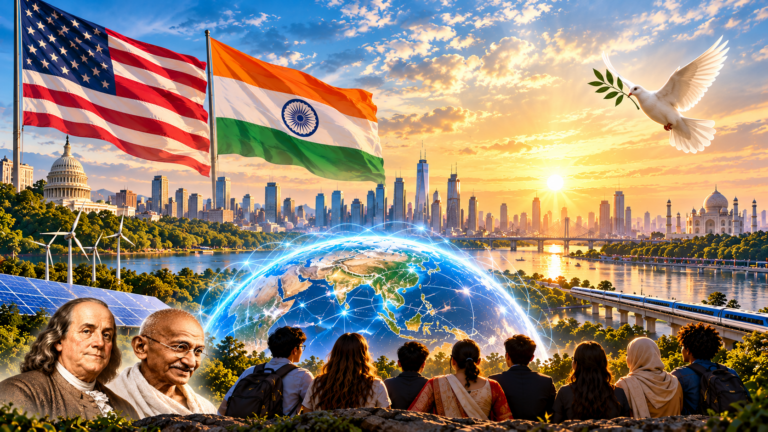
That is why the journey from America’s Declaration of Independence in 1776 toward what might eventually become a global Declaration of Interdependence is one of the great unfinished projects of the twenty-first century.
The objective is not to abolish identity.
It is to make multiple identities compatible.
I may be:
Indian.
American.
Chinese.
African.
European.
Hindu.
Muslim.
Christian.
Jewish.
Buddhist.
Secular.
Local.
National.
Civilizational.
And simultaneously:
human.
Identity need not be either/or.
It can become both/and—and also.
This may ultimately be one of Bharat’s deepest contributions.
V. WHY BHARAT OCCUPIES AN UNUSUAL POSITION
India’s importance cannot be reduced to population or GDP.
Its strategic significance arises from its unusual location at several intersections.
East and West
India engages deeply with the United States and Europe while maintaining relationships with Russia and participating simultaneously in BRICS, the Quad, G20 and SCO-related diplomacy.
North and South
India possesses world-class technological capabilities yet continues to understand development challenges shared by much of the Global South.
Ancient and Modern
Bharat simultaneously carries civilizational memories extending thousands of years and one of the world’s youngest large populations.
Physical and Digital
India is developing highways, manufacturing, energy and logistics while also constructing digital public infrastructure.
Capitalism and Dharma
India participates enthusiastically in markets while retaining philosophical traditions that ask whether material accumulation without inner balance constitutes genuine prosperity.
That makes Bharat potentially more than another rising power.
It could become a bridge civilization.
But only if it resists the temptation simply to imitate yesterday’s great powers.
The objective cannot merely be:
America became powerful. China became powerful. Now India must become powerful.
That remains Dominion thinking.
The larger possibility is:
What can Bharat contribute to the operating system of a plural human civilization?
VI. MAKE IN INDIA → INNOVATE WITH INDIA → SCALE FOR THE WORLD
One of the most consequential formulations in Modi’s 2026 BRICS Business Forum speech was:
Make in India.
Innovate with India.
Scale for the world.
The formulation contains an important progression. (PM India)
Make in India
Build productive capacity.
Innovate with India
Move from labor arbitrage toward intellectual and technological value creation.
Scale for the World
Use India’s demographic and digital scale to develop systems transferable across societies.
This progression describes India’s desired movement from:
market
to
factory
to
laboratory
to
platform
to
civilizational architect.
The decisive question is whether India can complete this progression.
Manufacturing alone will not define the next great power.
Nor will software alone.
The countries that shape the next twenty years will integrate:
AI,
semiconductors,
energy,
robotics,
biotechnology,
quantum technologies,
digital payments,
space,
advanced manufacturing,
and human capital.
Technology increasingly becomes sovereignty.
VII. FROM DOLLAR DOMINION TO MONETARY DHARMA
The discussion surrounding BRICS frequently becomes distorted into one dramatic question:
Will BRICS destroy the dollar?
That may be the wrong question.
The dollar is supported by deep capital markets, institutional networks, geopolitical relationships, liquidity and decades of accumulated trust.
A sudden replacement is unlikely.
A gradual diversification is much more plausible.
BRICS finance officials are pursuing greater interoperability among payment systems and exploring mechanisms that could reduce friction in cross-border settlements. (Reuters)
Therefore the more interesting transition may be:
Dollar Monopoly
↓
Dollar Primacy
↓
Monetary Plurality
↓
Interoperable Financial Networks
The long-term contest may not be:
Dollar versus Yuan versus Rupee.
It may be:
Which financial operating system best combines trust, liquidity, sovereignty, transparency, inclusion and interoperability?
This is where India’s experience with digital public infrastructure could become significant.
Money itself is becoming Phygital.
And once money becomes programmable, instantaneous and interoperable, the architecture of finance changes dramatically.
The challenge becomes ensuring that efficiency does not destroy freedom.
A perfectly efficient payment system combined with unlimited surveillance could produce financial Dominion.
A trusted, transparent, interoperable and human-centered system could represent something closer to Monetary Dharma.
VIII. CHINDUS: THE THREE-CIVILIZATION TRIANGLE
The geopolitical conversation of the last century frequently revolved around Atlantic civilization.
The twenty-first century increasingly revolves around what DDDI calls:
ChIndUS
China + India + United States
These three societies embody very different civilizational experiences.
The United States represents perhaps history’s boldest experiment in individual liberty, entrepreneurial capitalism and technological innovation.
China represents extraordinary state capacity, civilizational continuity, manufacturing scale and coordinated development.
India represents democratic pluralism, enormous diversity, civilizational continuity, spiritual inquiry and increasingly powerful technological capability.
The great danger is to imagine their relationship entirely through a Cold War framework:
Who defeats whom?
The far more consequential question is:
What does each possess that humanity needs?
America possesses tremendous innovative energy.
China possesses tremendous implementation capacity.
India possesses tremendous pluralistic and civilizational complexity.
Very crudely:
America asks:
What can the individual create?
China asks:
What can organized society accomplish?
Bharat historically asks:
What is the nature of the human being who is doing the creating and accomplishing?
None is sufficient alone.
The twenty-first century requires a new synthesis.
This does not mean eliminating competition.
Competition drives discovery.
But competition without cooperation eventually destroys the field upon which everyone competes.
Hence:
MAGA + MIGA = MEGA
Make America Great Again
plus
Make India Great Again
need not become rival nationalist projects.
Properly understood, both can contribute to:
Make Earth Great Again
provided greatness means not domination but expanded human capability, dignity and responsibility.
IX. AI: THE CIVILIZATIONAL CHOKEPOINT
Nothing illustrates the Dominion–Dharma transition more clearly than artificial intelligence.
For thousands of years, technology amplified physical capability.
The wheel amplified movement.
The lever amplified force.
The steam engine amplified energy.
Electricity amplified productivity.
Computers amplified calculation.
Networks amplified communication.
AI amplifies something different:
cognition itself.
Human civilization has never previously created technology capable of participating directly in language, reasoning, perception, creativity and decision-making at planetary scale.
This changes everything.
Modi’s own 2026 AI Impact Summit formulation is important here. He argued that AI governance should be human-centered, that Global South participation matters, and that profit must be aligned with purpose. He also framed AI around the M.A.N.A.V. principles and spoke of humans and intelligent systems increasingly co-creating and co-evolving. (PM India)
That brings us directly to Dharma.
The question is no longer:
Can AI become more intelligent?
It will.
The question is:
Can humans become sufficiently wise to govern increasing intelligence?
AI can liberate.
AI can surveil.
AI can educate.
AI can manipulate.
AI can democratize expertise.
AI can centralize power.
AI can expand individual agency.
AI can destroy individual agency.
Therefore the fundamental AI question is not technological.
It is civilizational.
X. FROM ZORBA THE BUDDHA TO EINSTEIN THE BUDDHA
Humanity’s technological development has dramatically outpaced its psychological evolution.
We carry Stone Age instincts inside nuclear civilizations.
We possess tribal nervous systems operating global networks.
We possess ancient fears amplified by modern algorithms.
That cannot continue indefinitely.
Osho’s metaphor of Zorba the Buddha attempted to reconcile two dimensions historically separated:
Zorba — matter, celebration, embodiment, prosperity, sensuality and worldly engagement.
Buddha — awareness, meditation, consciousness, inner freedom and transcendence.
The next stage might be called:
Einstein the Buddha
Not science instead of spirituality.
Not spirituality instead of science.
But:
knowledge + awareness.
technology + wisdom.
intelligence + consciousness.
wealth + meaning.
power + responsibility.
Human evolution in the Phygital Era therefore cannot merely mean biological change.
It must increasingly mean the conscious evolution of:
attention,
awareness,
identity,
judgment,
compassion,
creativity,
and moral agency.
The New Human is not merely technologically augmented.
The New Human must become consciously self-directed.
XI. THIRUKKURAL AS CIVILIZATIONAL DIPLOMACY
One seemingly small gesture surrounding the BRICS summit may carry extraordinary symbolic significance.
Modi presented President Vladimir Putin with a Russian translation of the Thirukkural, describing Thiruvalluvar’s wisdom as transcending languages and borders. (PM India)
This deserves much deeper interpretation.
Why gift an ancient ethical text at a summit dominated by trade, geopolitics, war, finance and technology?
Because perhaps the essential challenge of the new era is precisely this:
Power has globalized faster than wisdom.
The Thirukkural speaks of virtue, wealth and love.
It does not reject wealth.
It attempts to place wealth inside an ethical architecture.
That is precisely the DDDI challenge.
Capital is necessary.
Technology is necessary.
Markets are necessary.
Power is necessary.
But each must answer a larger question:
For what purpose?
The twenty-first century does not need less intelligence.
It needs intelligence governed by wisdom.
It does not need less wealth.
It needs wealth connected to human flourishing.
It does not need less power.
It needs power bounded by Dharma.
XII. DHARMA CAPITALISM
Adam Smith’s capitalism liberated enormous productive energy because it decentralized economic decision-making.
But the capitalism of the twenty-first century has evolved far beyond Smith’s eighteenth-century marketplace.
Capital now moves at machine speed.
Corporations may possess resources exceeding those of states.
Algorithms shape behavior.
Platforms mediate speech.
Private firms participate in space, intelligence, communications and infrastructure.
Human attention itself has become a commodity.
Therefore capitalism must evolve.
DDDI proposes moving from a narrow model of:
Value Creation → Value Capture
toward:
VALUE
Value Creation
What genuine benefit has been produced?
Value Capture
Who receives the economic return?
Value Diffusion
How widely does prosperity, capability and knowledge spread?
Value Regeneration
Does the activity replenish—or deplete—the human, social, natural and consciousness capital upon which civilization depends?
This is the foundation of what may be called:
Dharma Capitalism
Not socialism.
Not communism.
Not state capitalism.
Not laissez-faire capitalism.
But markets embedded within responsibility.
Prosperity without Dharma eventually produces concentration.
Dharma without productive capability produces noble poverty.
Human civilization needs both.
XIII. FROM GDP TO CIVILIZATIONAL VALUE
This leads directly to another necessary transition.
GDP measures economic activity.
It does not measure civilization.
A society can increase GDP while degrading:
mental health,
trust,
families,
soil,
water,
attention,
community,
education,
and democratic legitimacy.
Therefore by 2047 Bharat should aspire not merely to become a large economy.
It should become a high-value civilization.
DDDI proposes expanding national accounting beyond financial capital toward at least six forms of capital:
- Financial Capital
- Human Capital
- Intellectual Capital
- Social Capital
- Natural Capital
- Consciousness Capital
This could form the foundation of a future:
Consciousness Dividend Index
GDP would remain.
But GDP would become one instrument within a wider dashboard.
The question would evolve from:
How much did we produce?
to:
What kind of humans and civilization did our production create?
That is a far more profound measure of development.
XIV. THE NEXT TWENTY YEARS: 2026–2047
The coming two decades can be interpreted through four DDDI horizons.
2026–2030 — The Years of Design
Humanity will increasingly establish the basic architecture for:
AI governance,
digital identity,
payments,
energy transition,
supply-chain restructuring,
semiconductor ecosystems,
robotics,
autonomous systems,
space infrastructure,
and biotechnology.
Standards adopted in this period could shape decades.
These are therefore Design years.
2030–2035 — The Years of Diffusion
Technologies currently considered advanced will become ordinary infrastructure.
AI agents will become embedded across organizations.
Robotics will spread.
Real-time translation will reduce language barriers.
Personalized education and medicine may scale.
Digital financial systems will become increasingly interoperable.
The central challenge becomes:
Who gets access?
Technology concentrated among elites creates Dominion.
Technology diffused through humanity can expand Dharma.
2035–2040 — The Years of Identity
As machines assume increasingly sophisticated cognitive functions, societies will confront a profound question:
What is distinctively human?
If machines can calculate,
write,
diagnose,
design,
translate,
program,
and perhaps reason better than many humans in many domains,
then employment can no longer serve as the sole foundation of identity.
Civilization will be forced to rediscover:
purpose,
creativity,
relationships,
service,
awareness,
meaning,
and consciousness.
The technology question therefore becomes an identity question.
2040–2047 — The Years of Destiny
By the time Bharat reaches the centenary of Independence, the technologies now emerging will have matured.
The question by then will no longer be whether AI works.
It will be:
What kind of civilization did we build with it?
That is Destiny.
And Destiny is not fate.
Destiny is the accumulated consequence of decisions made today.
Hence DDDI’s operating principle:
Thinking of the Future; Acting in the Present®
XV. DOMINION → DHARMA → DESTINY → IDENTITY
The four DDDI concepts can now be understood as a civilizational sequence.
DOMINION
What power can we command?
Capital.
Technology.
Military capability.
Energy.
Institutions.
Data.
Knowledge.
DHARMA
How should power be exercised?
Responsibility.
Balance.
Reciprocity.
Justice.
Human dignity.
Stewardship.
DESTINY
What future are our choices creating?
Not prediction.
Direction.
IDENTITY
Who are we becoming?
This may ultimately be the deepest question.
Not:
What does India become?
Not:
What does America become?
Not:
What does China become?
But:
What does the human being become?
XVI. THE REAL MEANING OF A MULTIPOLAR WORLD
Multipolarity is often discussed as if adding more powerful countries automatically produces justice.
It does not.
Five empires are not morally superior to one empire merely because there are five.
Ten surveillance states are not better than one.
A hundred exploitative corporations do not produce dignity merely through competition.
Therefore:
Multipolarity is a condition.
Dharma must be the objective.
The real civilizational transformation would be:
From a unipolar hierarchy
to multipolar power,
then
from multipolar power
to interoperable partnership,
then
from partnership
to conscious interdependence.
That is a far larger project than BRICS.
BRICS may become one laboratory within it.
XVII. A NEW SOCIAL CONTRACT FOR THE PHYGITAL ERA
The industrial social contract roughly said:
Work → Income → Consumption → Security.
The emerging Phygital Era may require a new one:
Identity → Capability → Contribution → Meaning → Belonging.
Citizens will increasingly require rights concerning:
data,
algorithms,
AI agents,
digital identity,
attention,
biometric information,
and cognitive autonomy.
The great human-rights struggle of the nineteenth century concerned slavery.
The twentieth century concerned political and civil equality.
The twenty-first century may increasingly concern:
Cognitive sovereignty.
Who controls my attention?
Who controls my data?
Who constructs my digital identity?
Who determines what information I see?
Who can simulate my voice?
Who owns the intelligence trained on collective human knowledge?
Can an algorithm manipulate my perception without my informed consent?
These questions represent the frontier of the Declaration of Independence itself.
Because liberty in the Phygital Era requires not merely freedom of movement and speech.
It requires freedom of mind.
XVIII. THE GREATEST SENTENCE EVER WRITTEN — VERSION 2.0
The great promise of 1776 was revolutionary because it located legitimacy not in kings but in human beings.
But its implementation remained incomplete.
Slavery remained.
Women lacked political equality.
Indigenous peoples were displaced.
Colonialism expanded globally.
Economic inequality persisted.
The sentence was greater than the civilization that initially proclaimed it.
That is why it endured.
The challenge of 2026 is not to reject that sentence.
It is to universalize it.
Imagine its twenty-first-century implication:
Every human being is born with inherent dignity.
Every human deserves agency.
Every human should possess meaningful access to knowledge and capability.
Every human should remain sovereign over consciousness.
Technology should serve humanity rather than colonize it.
Capital should enlarge opportunity rather than monopolize destiny.
And civilization should organize itself so that Life, Liberty and the pursuit of Happiness become not merely political declarations but lived human possibilities.
That would be the unfinished journey from:
Declaration of Independence
toward
Declaration of Interdependence.
XIX. THE CHOICE BEFORE BRICS
BRICS now faces a historic fork.
It can become:
BRICS as Counter-Dominion
A coalition organized principally to oppose Western power.
Or:
BRICS as Civilizational Platform
A laboratory for plural civilizations learning to cooperate without becoming identical.
The first path reproduces history.
The second could help transcend it.
India should therefore insist that BRICS remain:
plural,
open,
development-oriented,
reformist,
human-centered,
and non-hegemonic.
Modi has previously emphasized precisely that BRICS should be seen as reforming global institutions rather than merely replacing them. (PM India)
This may prove one of India’s most important strategic principles.
XX. THE CHOICE BEFORE BHARAT
India faces the same choice internally.
Will Bharat become merely:
a richer India?
a more powerful India?
a more technologically sophisticated India?
Or can it become:
a consciously developed civilization?
Viksit Bharat 2047 should therefore represent more than per-capita income.
It should mean:
educated humans,
healthy humans,
creative humans,
financially secure humans,
ecologically responsible humans,
technologically empowered humans,
and increasingly conscious humans.
The ultimate objective cannot merely be a $20-trillion economy or any particular GDP number.
It must be the flourishing of 1.5 billion human beings.
Numbers are means.
Human beings are ends.
XXI. THE CIVILIZATIONAL EQUATION
DDDI can therefore express the coming transition through a simple progression:
Dominion
creates capability.
Dharma
gives capability direction.
Destiny
emerges from repeated direction.
Identity
becomes the human outcome.
Or more simply:
POWER + PURPOSE + PARTICIPATION = CIVILIZATIONAL PROGRESS
And another DDDI equation follows:
1 + 1 = 11
Civilizations need not diminish each other to become greater.
America does not have to become less American for Bharat to rise.
Bharat does not have to become less Bharatiya to cooperate with China.
China need not become Western to participate in a global civilization.
Unity need not require uniformity.
This is Aikyam:
oneness that preserves plurality.
Conclusion: From Rule-Takers to Rule-Shapers—and Beyond
Prime Minister Modi’s 2026 BRICS message can easily be reduced to geopolitical language:
Global South.
Multipolarity.
Institutional reform.
Trade.
Payments.
Technology.
Supply chains.
But beneath these subjects lies a much larger civilizational question.
Humanity is moving from an age in which relatively few institutions could organize much of the world’s economic and political power toward an era in which capability is becoming more distributed.
The danger is obvious.
Distributed power can create distributed conflict.
More technology can produce more surveillance.
More capital can produce more concentration.
More nationalism can produce more confrontation.
More intelligence can produce more manipulation.
Multipolarity alone does not guarantee progress.
Therefore the next twenty years require something beyond new power centers.
They require a new relationship between:
Power and Purpose.
Capital and Consciousness.
Technology and Humanity.
Independence and Interdependence.
Dominion and Dharma.
This is why the deepest interpretation of the BRICS moment is not:
West versus Rest.
Nor:
America versus China.
Nor:
Dollar versus BRICS currency.
It is:
Dominion versus Dharma.
Will emerging powers inherit yesterday’s machinery of domination?
Or will they help design institutions in which human dignity becomes the organizing principle of technological and economic progress?
That is the choice before Bharat.
That is the choice before BRICS.
That is the choice before America.
And increasingly, that is the choice before humanity itself.
The task of the next twenty years is therefore not simply to move the Global South from rule-taker to rule-shaper.
It is to ask a more difficult question:
What rules should a conscious human civilization shape?
Perhaps that is the true meaning of 2026.
Two hundred and fifty years after humanity proclaimed the revolutionary dignity of the individual, we stand at the threshold of another revolution:
from Independence to Interdependence,
from Dominion to Dharma,
from technological progress to conscious human evolution,
and from inherited history toward consciously designed Destiny.
The journey has only begun.
Shoonya se Anant ki Aur.
From Zero toward Infinity.
DDDI Institute
Dominion → Dharma → Destiny → Identity
Thinking of the Future; Acting in the Present®