Renewing the American Experiment through truth dignity justice and peace from 2026 to 2036
Vivek Singhal | Buddhi Jova Saarthi
Dominion Dharma and Destiny Institute™
Working paper for public discussion | October 12, 2026
Purpose and central proposition
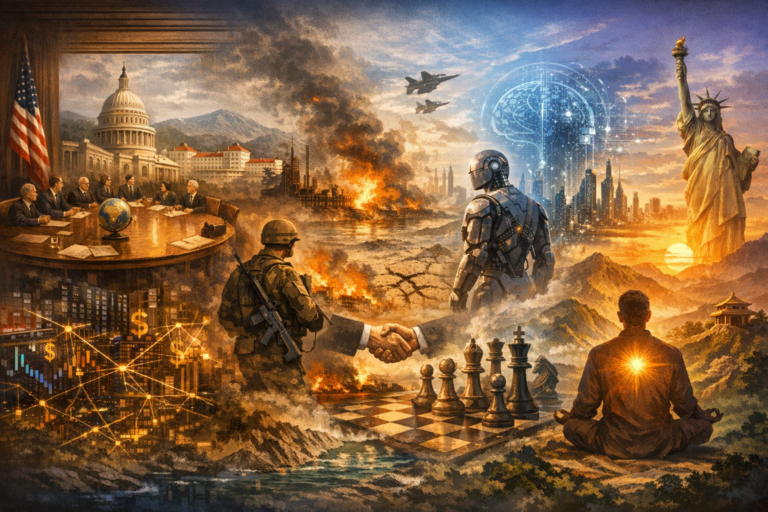
The world needs a renewal of the habits and institutions that make freedom possible. Political rivalry, economic insecurity, armed conflict, ecological vulnerability, concentrated business power, and digital manipulation increasingly intersect in ordinary life. A response worthy of the coming decade must connect personal responsibility with institutional reform. DDDI Institute™ proposes New Awakening 2.0 as a voluntary, pluralistic program of inquiry, service, experimentation, and public accountability beginning in the Diwali and Christmas season of 2026.
Its purpose is justice, dignity, and peace in service of life, liberty, the pursuit of truth, and fulfillment for every human being. This formulation extends the moral conversation opened by the American Declaration of Independence. It does not replace the Declaration’s actual language, “Life, Liberty and the pursuit of Happiness,” or claim that a single nation owns these aspirations. The continuation of the American Experiment requires making its universal promise more credible in practice, at home and in its relations with the world. [1]
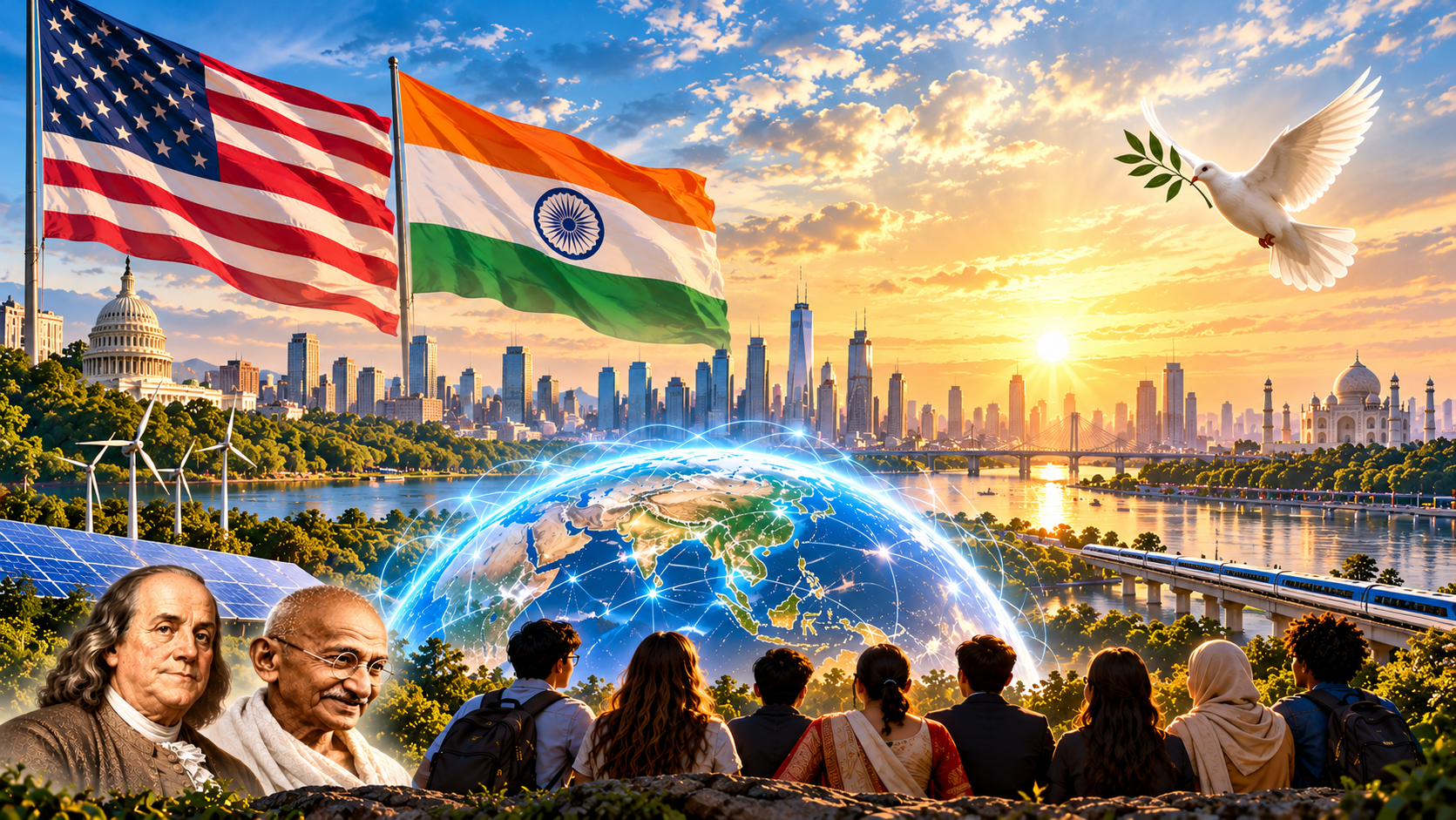
Benjamin Franklin’s civic experiments and M. K. Gandhi’s practice of satyagraha offer complementary resources: organize people to solve shared problems, and subject both ends and means to moral scrutiny. Their histories are distinct. Their relevance here is a constructive comparison, not a claim that Gandhi directly inherited Franklin’s program.
“Einstein the Buddha consciousness” names this paper’s proposed integration of disciplined inquiry, imaginative problem solving, compassion, and self-examination. “Human 2.0” describes learned capacities and fairer institutions, not a superior biological class. The 2036 horizon is a programmatic ambition; no evidence establishes that humanity will undergo a synchronized transformation of consciousness within ten years.
The recommendations are proposals for review, not announcements of funded programs or confirmed partnerships. Contemporary examples draw on reporting associated with the October 12 news cycle; they illustrate governance problems without treating disputed accusations as established facts.
The global condition and the crisis of trust
The political, economic, social, climatic, business, and institutional dimensions of the present crisis cannot be managed in isolation. A damaged airport disrupts families and commerce. An energy bargain affects household prices and the credibility of diplomacy. A disputed election process strains the authority of institutions. A communications licence can influence rural opportunity, commercial competition, and security. A flood exposes the vulnerability of homes, infrastructure, and public decision making.
The analytical claim of this paper is that these pressures become especially dangerous when people lose confidence in the fairness and intelligibility of decisions. Institutions need not promise perfect outcomes. They must explain what they know, which interests they considered, why they acted, and how an error can be corrected. Trust should be earned through reliable conduct and justified scrutiny, rather than demanded as loyalty.
Political authority and civilian life
IGR’s contemporary coverage describes repeated attacks on Riyadh’s airport and disruption to civilian aviation. Whatever the strategic claims advanced by belligerents, the public-interest question is how to protect the connections on which civilian life depends. A DDDI™ peace agenda would prioritize verifiable protection of essential infrastructure, humanitarian access, channels for negotiation, and accountability for harm. This is a proposed direction, not a claim that the parties have accepted such arrangements. [7]
The Indian election controversy and the emergency reported in Pakistan’s Khyber Pakhtunkhwa raise a related question: how can political authority remain answerable under pressure? Allegations against election administrators require evidence and credible review. Protest must be assessed by actual conduct. Emergency measures require clear purposes, independent scrutiny, and conditions for termination. Neither official reassurance nor opposition accusation should substitute for examination. The two countries’ situations are distinct and should not be treated as equivalent. [7]
Political economy and reciprocal standards
The reported American agreement concerning Russian diesel illustrates the tension between immediate price relief and longer-term credibility. Reuters describes the administration’s defense of the deal and bipartisan criticism. A DDDI™ assessment asks whether comparable needs receive comparable consideration across nations, and who bears the costs of changing rules. Affordable energy, responsibility for conflict consequences, and policy consistency must be considered together. [8]
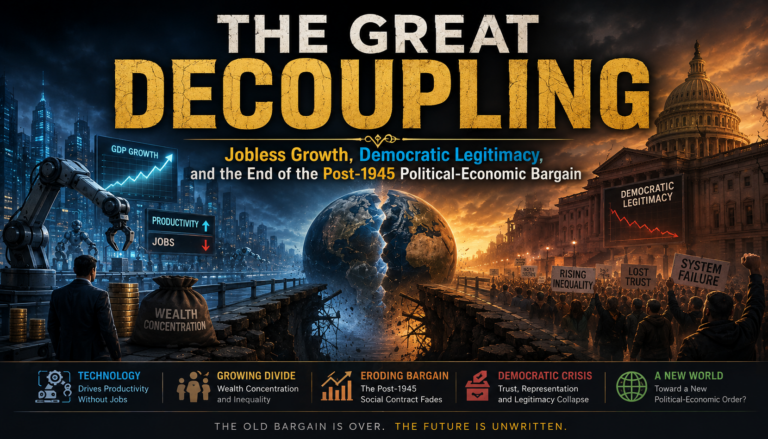
Peace consequently has an economic dimension. Households need reliable services and livelihoods; businesses need predictable rules; international agreements need credible implementation. A system that rewards short-term coercion while transferring costs to people without bargaining power undermines the conditions for durable cooperation.
Business technology and ecological responsibility
Connectivity and the test of impartial regulation
The Musk–Ambani dispute is a useful test of evidentiary discipline. Reuters reports that Starlink already has an Indian licence, while commercial launch still depends on security compliance and spectrum assignment. Musk alleged obstruction without providing evidence against Ambani; the government rejected discrimination claims. These facts do not establish regulatory capture or prove perfect neutrality. A fair assessment requires comparable timelines, requirements, reasons for decisions, and opportunities for review. [9]
The public purpose extends beyond the rivalry between wealthy individuals. Citizens need affordable access, reliable coverage, privacy, resilience, and remedies when services fail. Security scrutiny and competition can both serve that purpose. DDDI™ should evaluate foreign and domestic providers by the same public-interest questions rather than assume either origin guarantees ethical conduct.
Trade as a field of negotiated interdependence
The reported China–EU understanding over hybrid vehicle trade demonstrates the possibility of negotiated accommodation amid industrial rivalry. It should not be mistaken for the end of wider disputes. Britain’s renewed discussion of closer European ties similarly raises the distinction between national identity and practical cooperation. The relevant question is what arrangements improve people’s capacity to prosper and govern themselves. [10, 11]
For business, justice requires attention to how value is created and distributed. Productivity gains should be assessed alongside working conditions, access, environmental costs, and market concentration. A profitable firm may make an important contribution; profit alone cannot answer whether burdens have been imposed on workers, communities, or future generations without meaningful consent or remedy.
Water climate and the limits of infrastructure planning
Reporting on Nepal’s October flooding describes a landslide-related river blockage and damage to homes, bridges, and hydropower infrastructure. This particular event should not be attributed to climate change without event-specific evidence. Separately, the IPCC establishes human-caused warming and the importance of mitigation and adaptation. The practical response combines hazard monitoring, watershed knowledge, sound siting, maintenance, evacuation planning, and social protection. [12, 13]
DDDI™ proposes that ecological responsibility become part of ordinary accounting. A water project should track withdrawals, reuse, ecosystem effects, resilience, and access for surrounding communities. A digital project should assess energy and material demands. Development succeeds when infrastructure continues to serve people under stress, not merely when construction is completed.
Research on lower rewards for female-presenting AI agents adds a social warning: people can carry prejudices into interactions with new technology. These experimental rewards are not literal robot salaries. The implication is to test how design and human judgment affect fairness, without claiming one study explains all workplace inequality. [14]
Franklin and the unfinished American Experiment
The American Experiment did not originate with one inventor, one religious movement, or one document. Its formation involved colonial institutions, Enlightenment ideas, religious disputes, commerce, imperial conflict, collective organizing, and many contributors. Benjamin Franklin matters because he made improvement practical: conversation could produce shared resources, and shared resources could increase a community’s capacity to act.
Franklin formed the Junto with fellow Philadelphians in 1727. Its deliberations helped lead to the Library Company of Philadelphia in 1731. Pooling resources made knowledge more accessible to participants than isolated purchasing could have done. This offers DDDI™ a durable method: identify a common constraint, bring people into disciplined discussion, create a useful institution, and improve it through experience. [2]
The First Great Awakening was a religious revival associated especially with figures such as Jonathan Edwards and George Whitefield during the eighteenth century. Franklin was not its founder. It is more accurate to locate his civic and intellectual work within a wider period of religious, social, and political change. The movement itself also generated conflict and exclusion; awakening should never be assumed to produce tolerance automatically. [3]
The historical insight for this paper is that public imagination changes through institutions as well as ideas. A library, discussion circle, school, or voluntary association gives people repeated opportunities to practice cooperation. A modern awakening therefore needs places and procedures through which citizens learn to inquire, disagree, and undertake useful work.
The Declaration’s statement of human equality exceeded the society that proclaimed it. Slavery and exclusion from political participation exposed a profound gap between principle and practice. The continuation of the American Experiment requires acknowledging that gap and extending effective protection and opportunity, rather than treating the founding as completed moral perfection. Its universal language provides a standard by which the republic can be questioned. [1]
DDDI™ proposes the pursuit of truth and dignity as explicit contemporary commitments within this continuing work. Truth-seeking requires access to evidence, freedom to question, and willingness to revise. Dignity requires that people remain entitled to fair treatment even when they lack wealth, status, citizenship in a powerful state, or majority approval. Neither commitment authorizes an institution to impose a compulsory doctrine.
America’s 250th anniversary in 2026 is therefore an occasion for a public audit. Do people have meaningful avenues to challenge power? Can institutions correct mistakes? Are opportunities to learn and participate broadly available? Can national achievement coexist with responsibility toward those outside the nation? The experiment continues through credible answers and sustained practice.
Gandhi and the discipline of experiments with truth
Gandhi’s South African experience provides another model of learning through organized action. Tolstoy Farm, established in 1910 with Hermann Kallenbach’s support, supplied a communal setting for satyagrahis and their families. Gandhi’s own account describes Kallenbach making the land available without rent. The settlement supported a struggle already underway; satyagraha did not begin only with the farm. [4, 5]
The significance for DDDI™ is the relation between personal discipline, mutual support, and public resistance. A movement cannot sustain ethical conduct solely by denouncing injustice elsewhere. Its internal practices must also be examined: how people work together, allocate burdens, educate children, resolve disagreement, and treat those who disagree.
Satyagraha can inform a contemporary commitment to truthful claims, nonviolent action, and refusal to deny an opponent’s humanity. Such a commitment does not require accepting exploitation or abandoning accountability. It asks that the means of pursuing justice remain consistent with the dignity sought. This paper draws a modern application; it does not suggest that Gandhi supplied a complete answer to every contemporary conflict.
The connection to Franklin is an interpretive bridge. Franklin’s civic association and Gandhi’s communal experimentation both show how small groups can become sites of practical learning. They operated in different political settings, held different views, and pursued different projects. A responsible synthesis compares useful methods without inventing an unbroken chain of influence.
DDDI™ should also resist hero worship. Historical figures can be studied critically, including their limitations and exclusions, while their useful contributions remain available. Truth-seeking cannot stop when evidence challenges an admired person. An awakening built on selective memory would reproduce the institutional weaknesses it hopes to overcome.
From historical example to present practice
A contemporary community laboratory might join a library reading circle to a local water-resilience project, a digital-literacy workshop, or a mentoring program. Participants would define the problem together, make assumptions explicit, record results, and invite disagreement. Public learning would be as valuable as the immediate service delivered.
This distinguishes a pilot from routine production. A pilot tests an uncertain proposition: whether a process works, for whom, under what conditions, and at what cost. It needs a learning question, baseline, feedback, and a decision about continuation. Repeating a familiar job under a new name is insufficient. Franklinian institution building and Gandhian self-scrutiny become meaningful today when they help people learn honestly from action.
What Einstein the Buddha consciousness means
“Einstein the Buddha consciousness” is a DDDI™ philosophical metaphor, not a quotation from Einstein, a claim that physics proves Buddhism, or a scientifically established neurological state. Einstein represents disciplined curiosity, imaginative models, and empirical testing. The Buddha represents, within this proposed synthesis, attention to suffering, compassion, and examination of attachment. Neither figure can be reduced to these brief descriptions.
The metaphor asks how powerful intelligence can become more responsible. Scientific inquiry helps determine what happens and why. Ethical reflection asks which outcomes deserve pursuit and whose suffering has been overlooked. Contemplative practice may help individuals notice impulses and assumptions, but it cannot replace evidence, public deliberation, or institutional safeguards.
Human 2.0 therefore means a person better able to question a persuasive claim, recognize uncertainty, cooperate across differences, restrain the impulse to humiliate, and accept responsibility for consequences. It does not divide people into awakened superiors and inferior others. Every person’s dignity precedes participation in this program, including the right to reject its terminology.
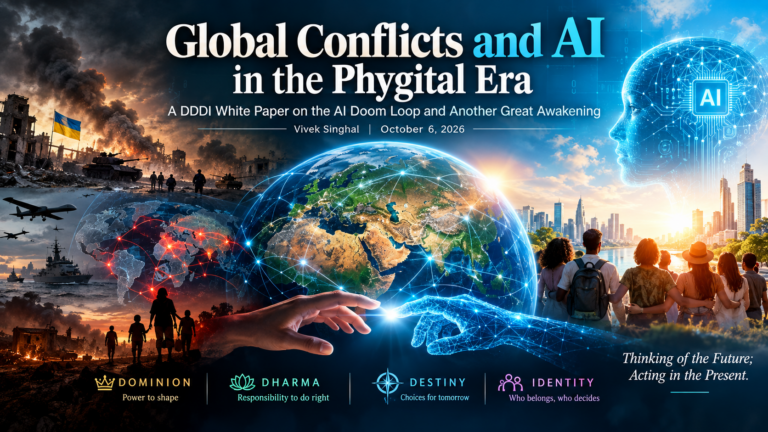
The Phygital Era™ describes the growing interweaving of physical life and digital systems. In that setting, judgment must extend to the design of interfaces, algorithms, infrastructure, and organizational incentives. A compassionate employee inside an institution that rewards manipulation may have limited influence. Personal growth and institutional change must reinforce each other.
Four questions for every consequential decision
Dominion asks who controls resources, decisions, information, and remedies. Dharma asks what responsibilities accompany that control. Destiny asks what near-term choices make more or less likely over a generation. Identity asks who is included, who is excluded, and how belonging shapes judgment. Together these lenses connect power to human consequences.
Data–Decision–Design–Impact provides the action sequence. Establish the evidence and uncertainty; identify the decision and responsible parties; design a reversible intervention where possible; measure its effects and revise. The 4C framework adds Content, Commerce, Community, and Context so that a persuasive narrative cannot conceal incentives or overlook affected people.
The Chokepoint Map™ identifies concentrated dependencies. The Time Horizon Map™ distinguishes immediate relief from accumulated risk. The Trust Curve™ is used here as a qualitative reminder that credibility develops through conduct; it is not presented as a validated numerical law. DharmaOS™ and Trust AI™ name proposed approaches to responsibility and assurance, not already deployed systems whose effectiveness has been demonstrated.
Diwali and Christmas as a beginning in 2026
Diwali and Christmas provide an opportunity for renewal because they already gather families and communities around reflection, generosity, and meaning. Diwali has varied meanings across Hindu, Jain, Sikh, and other communities; its imagery of light offers an invitation to examine ignorance and responsibility. Christmas has its own Christian theological meaning centered on the birth of Jesus, alongside traditions of giving and care. Their differences should be honored rather than dissolved into a single doctrine.
A New Awakening 2.0 can invite these communities, other religious traditions, and secular participants to undertake common work without requiring common theology. In this paper, “2.0” names a proposed renewal; it is not a claim to replace the historical Second Great Awakening or to declare a new authorized stage of religion.
The case for beginning in 2026 is practical. The American anniversary creates a moment of civic reflection; the holiday season supplies existing networks of gathering and service; the next decade offers time for repeated experiments and correction. No festival automatically changes consciousness. A beginning becomes consequential when people adopt durable commitments and return to them after the celebration.
“Everywhere All at Once” should describe an open invitation to concurrent local beginnings. It cannot reasonably promise simultaneous psychological transformation across the world. Communities would choose their own language, priorities, and pace while sharing evidence about what they learn. A distributed movement should protect pluralism rather than seek uniform obedience.
A proposed seasonal covenant
During the 2026 season, participating groups could adopt five commitments: verify consequential claims before circulating them; refuse dehumanizing speech; disclose interests that may influence decisions; undertake one practical act of service with affected people; and publish an honest account of what was learned. Participation would remain voluntary.
An Oak Brook group, for example, could begin with a modest circle of residents and invite people from different generations and perspectives. A library meeting room could be requested as a venue, without implying library sponsorship or requiring staff to administer the initiative. A community in Bharat or elsewhere could run a parallel experiment shaped by its own needs.
Each circle would choose a question answerable in ninety days. Can mentoring improve digital confidence? Can a water audit identify an affordable conservation measure? Can a structured discussion help participants distinguish evidence from inference? The purpose is to turn shared ideals into visible practices and discover where the proposal itself needs correction.
A decade of accountable experimentation
The following is a proposed roadmap, not a forecast or an existing institutional commitment. DDDI Institute™ would need named owners, resources, consent from partners, and independent scrutiny before implementation. Expansion should follow evidence of benefit rather than the appeal of a slogan.
2026 and 2027 establish the learning communities
Begin with a small number of voluntary circles. Publish a plain-language charter covering evidence, nonviolence, inclusion, privacy, conflicts of interest, and complaints. Each circle selects one pilot, identifies its learning question, records a baseline, and reports results within ninety days. Participation and spending should be visible without disclosing private personal information.
2028 through 2030 test what can be repeated
Invite additional communities to replicate promising practices and document failures. Develop learning materials for civic inquiry, AI literacy, mediation, and environmental resilience. Compare results across contexts before claiming general effectiveness. A practice that works for affluent volunteers may need substantial redesign to serve people with less time, money, connectivity, or institutional access.
2031 through 2033 connect institutions and incentives
Seek voluntary partnerships with schools, civic bodies, businesses, and research organizations. Tie proposals to concrete decisions: procurement standards, transparent service timelines, accessible complaints systems, fair AI evaluation, or infrastructure resilience. Sponsors should disclose funding and conflicts. Independent reviewers should be able to publish unfavorable findings without losing access or support.
2034 through 2036 assess the transition
Conduct an external review of demonstrated benefits, costs, distributional effects, and unintended harm. Continue effective programs, redesign weak ones, and close those that fail. The central assessment should concern observable capabilities and institutional behavior, not a declaration that humanity has achieved a higher level of consciousness.
Measures that make the vision reviewable
Truth can be assessed through source-checking performance, correction practices, and participants’ ability to distinguish fact from inference. Dignity can be examined through accessibility, reported respectful treatment, and whether complaints receive fair resolution. Justice requires attention to who receives benefits and who bears costs. Peace can be assessed through successful mediation and reduced harmful conduct within the scope of a project. Environmental measures should track actual resource use and resilience outcomes.
Every measure needs a denominator, a baseline, a defined collection method, and a review interval. Participant feedback should include people who leave. Trust surveys alone are insufficient: increased trust without improved reliability could indicate persuasion rather than progress. Measurement must avoid intrusive surveillance and must not score people’s moral worth.
A charter for trust transparency and peace
Transparency should make consequential decisions understandable and challengeable. It does not require publishing personal records, exposing vulnerable people, or releasing security-sensitive details indiscriminately. Institutions should explain what cannot be disclosed and provide an accountable route for independent examination. The purpose is justified confidence with effective remedies.
Justice should remain accessible to those who cannot afford influence. In a DDDI™ pilot, this means clear eligibility, fair access, reasons for adverse decisions, a reachable complaints process, and correction when harm occurs. In a larger institution, the same principles require stronger governance and external checks. The scale changes; the obligation to treat people as persons remains.
A proposed Great Power Dharma Protocol™ would apply reciprocal standards to powerful states: protection of civilian necessities, credible communication during crises, transparent commitments where feasible, and negotiation that includes the interests of affected populations. It would not erase legitimate disagreements or guarantee peace. It would make restraint and accountability explicit subjects of diplomacy.
The same standard must apply inwardly to DDDI Institute™. Its frameworks should be open to criticism. Public benefit should not be inferred from branding. Finances, decision responsibilities, affiliations, and claims of impact should be described accurately. An institute seeking to renew trust must make its own performance reviewable.
An invitation to continue the experiment
The continuation of the American Experiment can contribute to a wider human endeavor when freedom is joined to responsibility and national achievement to universal dignity. Franklin offers a lesson in building useful civic institutions. Gandhi offers a demanding practice of examining means alongside ends. The proposed Einstein the Buddha consciousness joins inquiry and compassion without pretending that their union has already been achieved.
Diwali and Christmas 2026 can mark a new beginning if the light celebrated in public becomes a discipline of examination, and generosity becomes sustained service. Over the decade to 2036, the credible goal is a growing number of people and institutions able to use power with greater honesty, restraint, and care. That is substantial work even without a promise of universal transformation.
Life and liberty require protection. Truth requires inquiry and correction. Dignity requires equal regard. Justice requires remedies. Peace requires practices that survive disagreement. New Awakening 2.0 becomes real through these commitments, tested in ordinary decisions and renewed when they fail.
Thinking of the Future; Acting in the Present.
© 2026 Vivek Singhal. All rights reserved in original text. DDDI Institute™, DDDI™, Phygital Era™, DharmaOS™, Trust AI™, and named DDDI frameworks are presented as claimed marks; ™ does not assert registration. Third-party names and sources remain the property of their respective owners. Working paper for review and discussion; no endorsement by cited institutions or historical figures is implied.
Sources and scope notes
Historical sources support the chronology; reporting supports the bounded news descriptions; recommendations and conceptual connections are the paper’s own proposals. The full IGR transcript was unavailable. Its supplied chapter list and accessible related coverage informed the initial themes. Current-event claims are dated and may require updating before external publication.
[1] National Archives. Declaration of Independence transcription.
https://www.archives.gov/founding-docs/declaration-transcript
[2] Library Company of Philadelphia. History of Share 3 and the Library Company’s first shareholders.
https://librarycompany.org/librarycompanypapersproject/2025/08/25/history-of-share-3/
[3] National Park Service. The Joseph Bellamy House and the Great Awakening in Puritan New England.
https://home.nps.gov/articles/the-joseph-bellamy-house-the-great-awakening-in-puritan-new-england-teaching-with-historic-places.htm
[4] M. K. Gandhi. Satyagraha in South Africa, Tolstoy Farm I.
https://www.mkgandhi.org/satyagraha_safrica/33tolstoy_farm.php
[5] High Commission of India in Pretoria. Mahatma Gandhi Remembrance Garden Tolstoy Farm.
https://www.hcipretoria.gov.in/page/mahatma-gandhi-remembrance-garden-tolstoy-farm/
[6] India Global Review. The Palki Sharma Show, October 12, 2026. Chapter list supplied by the reader.
https://www.youtube.com/watch?v=zoqLBJQmiVg
[7] IGR. Related reporting on Riyadh airport, India’s election controversy, and the Pakistan emergency; accessible listings, not full transcripts.
https://www.facebook.com/igr.media/
[8] Reuters. Trump defends Russia diesel deal as lawmakers from both parties complain. October 12, 2026.
https://www.reuters.com/business/energy/trump-defends-russia-diesel-deal-lawmakers-both-parties-complain-2026-10-12/
[9] Reuters. India rejects monopoly claim after Musk accuses Ambani of blocking Starlink launch. October 9, 2026.
https://www.reuters.com/business/media-telecom/india-rejects-monopoly-claim-after-musk-accuses-ambani-blocking-starlink-launch-2026-10-09/
[10] Reuters. China details outcome of EU trade talks on hybrid electric vehicles. October 12, 2026.
https://www.reuters.com/world/china/china-holds-intensive-talks-hybrid-ev-trade-with-eu-2026-10-12/
[11] IGR. Britain is reopening the Brexit debate. Related segment listing.
https://www.facebook.com/igr.media/posts/122136132446845831/
[12] Reuters. More than 100 foreign trekkers stranded in flood-hit region of Nepal. October 12, 2026.
https://www.reuters.com/business/environment/more-than-100-foreign-trekkers-stranded-flood-hit-region-nepal-official-says-2026-10-12/
[13] IPCC. Climate Change 2023 Synthesis Report, headline statements.
https://report.ipcc.ch/ar6syr/headline.html
[14] University of Limerick research announcement via EurekAlert. Does the gender pay gap extend to AI. October 5, 2026.
https://sciencesources.eurekalert.org/news-releases/1146341