By Vivek Singhal
“Empires built on Dominion seek to absorb. Civilizations guided by Dharma seek to connect. The Intelligence Era will not be won by tariffs, but by trust.”
1. The Dominion Gambit: The 51st State
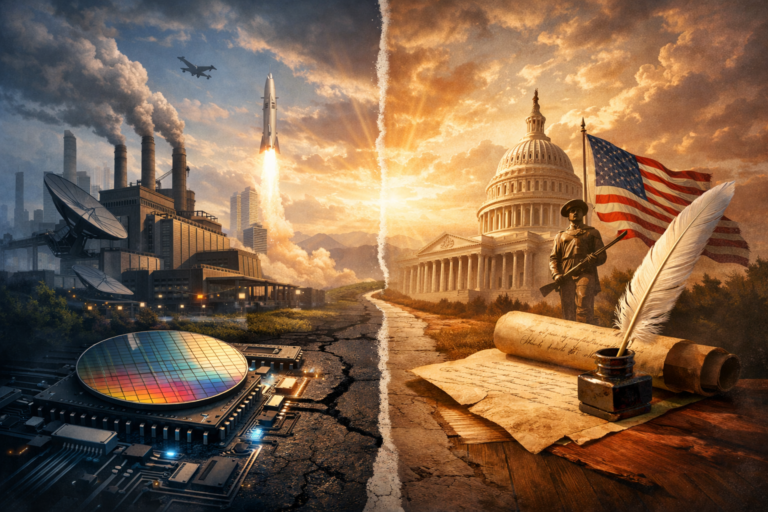
When President Trump 2.0 hinted that Canada could become the “51st state of the United States,” it wasn’t satire. It was Dominion logic revealed in plain speech: absorb your neighbor, dominate your ally, and punish your competitor.
Canada has always been America’s closest partner. Yet when tariffs are wielded on steel, lumber, dairy, and now electric batteries, sovereignty is challenged. The implicit threat: integrate more deeply under Washington’s rules—or watch your industries strangled.
Canada’s quiet reply has been defiance through diversification: shifting trade to 11 new partners—Japan, Germany, South Korea, and others. This isn’t betrayal; it is balance. No nation has the right to monopolize another’s future.
2. Tariffs, Sanctions, and the Dollar: Dominion’s Arsenal
Since 1945, America has fused its military-industrial edge with financial supremacy. The U.S. dollar as reserve currency and the SWIFT system became not just tools of trade, but tools of discipline.
• Tariffs now function as extraterritorial taxes.
• Dollar dominance ensures every Canadian, Indian, or Brazilian trade clears through U.S. institutions.
• Sanctions extend beyond enemies; they are used to discipline allies.
To Canada, the tariff threat is not about dairy—it is about whether it will bow to an empire of Dominion or chart its own Dharmic path.
3. Dharma’s Countermove: Networks Over Empires
Here Metcalfe’s Law matters: the value of a network grows as the square of its nodes. By building new ties, Canada multiplies its resilience.
This is Dharma in practice:
• A mesh of trust replaces a single hub.
• Each new partner strengthens autonomy.
• Networks create stability where empires create fragility.
India’s path mirrors Canada’s: investing in Digital Public Infrastructure (UPI, ONDC), trading in local currencies, and resisting tariff pressures with diversified alliances.
4. The Trinity Śakti of the Intelligence Era
The real contest is not tariffs but the three exponential forces shaping our age:
1. Moore’s Law (compute): Exponential power. Dominion hoards it; Dharma shares it.
2. Metcalfe’s Law (networks): Exponential value. Dominion centralizes it; Dharma distributes it.
3. Turchin’s Law (elite overproduction): Surplus talent. Dominion pits elites into zero-sum games; Dharma absorbs them into plural paths of service and innovation.
When these three forces align, they form a Trinity Śakti—a regenerative spiral that can lift all eight billion humans into the Intelligence Era.
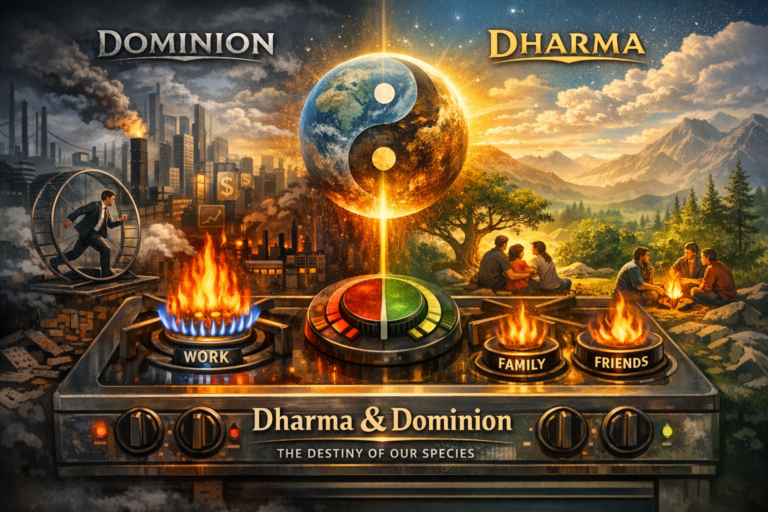
5. Dominion vs Dharma: The Fork Ahead
Dominion Path:
• Canada as “51st state.”
• India as tariff target.
• Dollar and SWIFT as weapons.
• Short-term supremacy, long-term collapse.
Dharma Path:
• Canada as sovereign network hub.
• India as bridge civilization.
• Dollar re-anchored in openness and trust.
• Shared prosperity, long-term resilience.
“Tariffs can bend a partner’s spine, but they cannot bend its soul. Canada, India, and the BRICS world are discovering that trust—not tariffs—creates true resilience.”
6. Conclusion: Dominion Is Dying, Dharma Is Rising
Trump 2.0’s threats to Canada and India are not just bilateral skirmishes—they are symptoms of a collapsing Dominion operating system. As tariffs, sanctions, and dollar weaponization tighten, nations will not submit. They will connect elsewhere.
The Intelligence Era offers a civilizational choice:
• Dominion turns exponential power into monopolies and fragility.
• Dharma turns exponential power into abundance and flourishing.
The future will belong to those who choose networks of trust over empires of control.
Author Bio
Vivek Singhal is the author of Dominion and Dharma: Reframing Capitalism Through Conquest, Consciousness, and Civilizational Memory (2025). An alumnus of IIT Delhi, the University of Michigan (MS, MBA), and the University of Chicago (Basic Program in Liberal Arts), he is a corporate executive who, after creating value for three Fortune 100 corporations, founded his own strategy formulation and implementation services to create value for client organizations before shifting his focus to mentoring and impact investing. Today he is a civilizational thought leader writing on the convergence of technology, geopolitics, and dharmic renewal in the Intelligence Era.