
Part 10 blog series about From Education to Credentialed Obedience: How the Post-WWII World Manufactured the “Stupid Generation” — An OSHO-Inspired Reflection
Traditional education systems were designed for an industrial and information-based civilization. Schools and universities primarily focused on transmitting knowledge, improving memory, encouraging specialization, and preparing individuals to function within existing institutions. For decades, educational success was closely tied to the ability to absorb information, follow structured systems, and develop technical expertise. In earlier eras, access to knowledge itself provided significant advantage because information was relatively scarce and difficult to obtain.
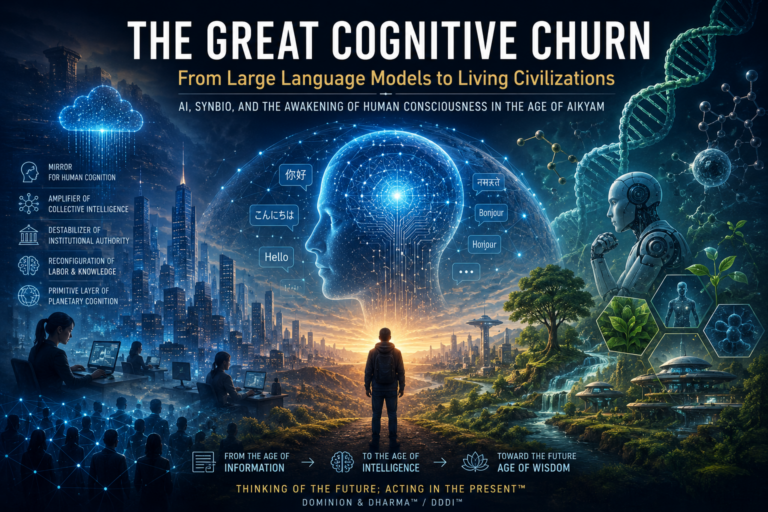
The AI era is rapidly transforming this reality. Information is now abundant, instantly accessible, and increasingly processed by intelligent systems. Artificial intelligence can already organize, summarize, analyze, and generate information at speeds beyond human capability. As machines become more efficient at handling data and technical tasks, humanity faces a deeper question: what forms of intelligence remain uniquely essential for human civilization?
The Limits of Information-Based Education
Modern education succeeded in producing technically skilled societies, but it often neglected emotional integration, ethical development, and self-awareness. Many educational systems prioritized performance, competition, and institutional adaptation while giving far less attention to psychological resilience or conscious thinking. As a result, highly educated societies still struggle with polarization, anxiety, manipulation, and social fragmentation.
The AI age exposes the limitations of purely information-based education because knowledge alone no longer guarantees wisdom. Machines can increasingly memorize, retrieve, and process information more effectively than humans. What remains scarce is discernment — the ability to evaluate complexity thoughtfully, recognize deeper patterns, and make ethically grounded decisions in uncertain situations.
Humanity now requires more than populations trained to repeat information or perform specialized functions. It requires individuals capable of critical thinking, emotional stability, and conscious awareness. In a world saturated with data, misinformation, and algorithmic influence, the ability to think independently and remain psychologically grounded becomes increasingly valuable.
Without these capacities, societies may become technologically advanced yet emotionally unstable. Education that develops technical intelligence without cultivating self-awareness risks producing populations that are highly skilled but easily manipulated, reactive, and disconnected from deeper meaning.
The Future of Conscious Education
The future of education may therefore need to evolve beyond its traditional industrial framework. Technical skills will remain important, but they may no longer be sufficient on their own. Educational systems may increasingly need to integrate systems thinking, emotional intelligence, ethical reflection, contemplation, and psychological awareness alongside scientific and technological training.
Systems thinking helps individuals understand how social, technological, ecological, and economic forces interact with one another rather than viewing problems in isolation. Emotional intelligence strengthens empathy, communication, and resilience in a rapidly changing world. Contemplative practices and self-awareness can help individuals develop clarity and stability amid constant digital stimulation and uncertainty.
This shift reflects a broader civilizational need. Machines can process information at extraordinary scale, but wisdom requires qualities that remain deeply human. Wisdom involves judgment, ethical awareness, emotional balance, and the ability to navigate complexity without becoming consumed by fear or ideology. These capacities cannot simply be automated or outsourced to algorithms.
As AI transforms the structure of work and society, education may increasingly focus not only on preparing individuals for employment, but also on preparing them for conscious participation in an interconnected and psychologically complex world.
Conclusion
The AI era is revealing that education based solely on information and technical specialization is no longer enough. While traditional systems successfully expanded access to knowledge, they often neglected the development of wisdom, emotional maturity, and psychological resilience. As artificial intelligence increasingly automates information processing, humanity must rediscover the importance of discernment, ethical thinking, and conscious awareness. The future of education may depend on integrating technical capability with deeper human capacities such as emotional intelligence, systems thinking, contemplation, and self-awareness. In a world where machines can process vast amounts of information, the uniquely human challenge may be learning how to cultivate wisdom.