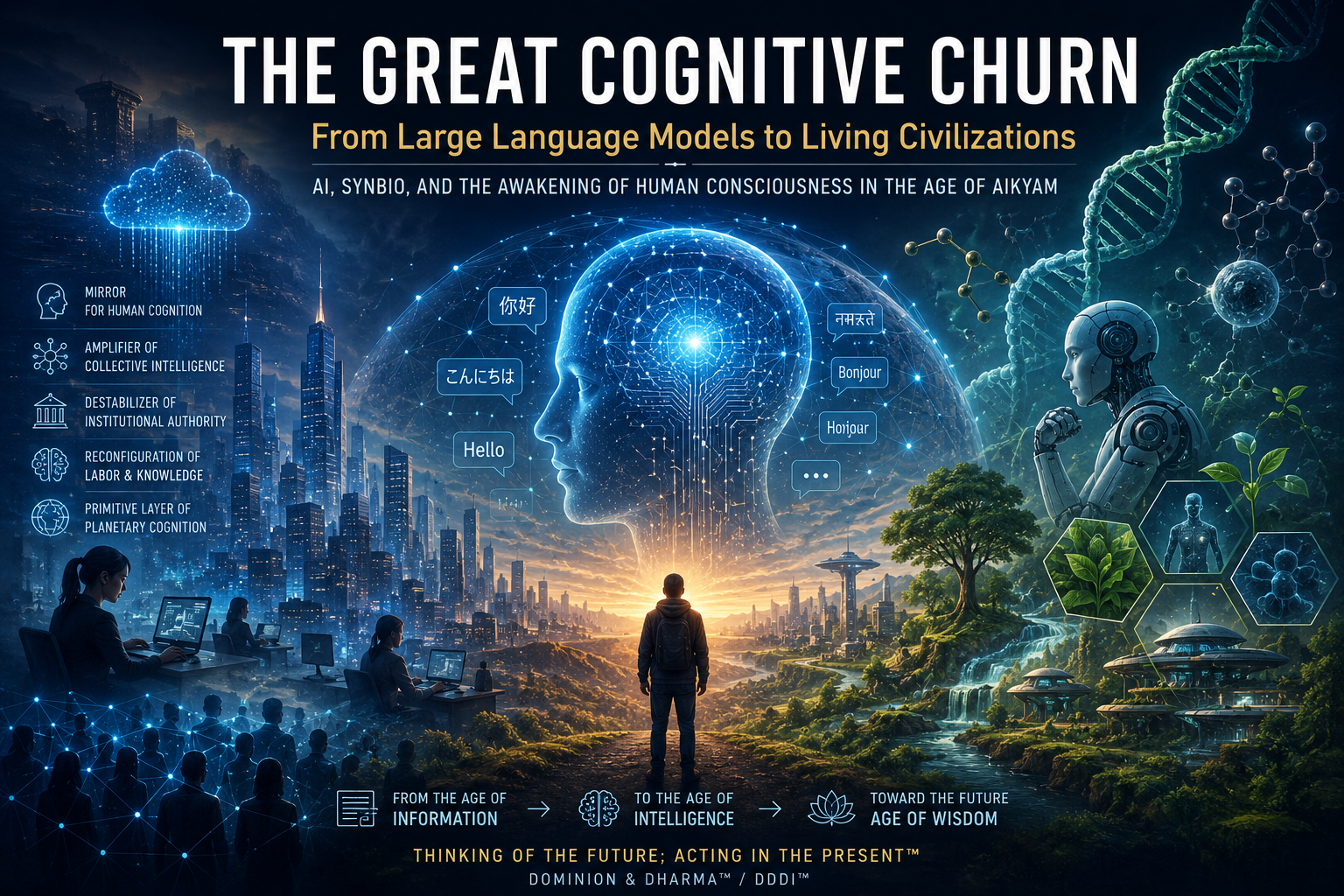
AI, SynBio, and the Awakening of Human Consciousness in the Age of Aikyam
By Vivek Singhal
Dominion & Dharma™ / DDDI™
Thinking of the Future; Acting in the Present™
Introduction: A Civilizational Turning Point
The Great Cognitive Churn explores the transformative impact of artificial intelligence, particularly Large Language Models (LLMs), on humanity, civilization, and consciousness. The paper argues that AI is not merely another technological advancement but a historic shift comparable to the Agricultural, Industrial, and Digital Revolutions. As AI converges with synthetic biology, robotics, quantum computing, and neurotechnology, humanity is entering a new era that could fundamentally redefine what it means to be human.
COVID-19: The Catalyst for Acceleration
While COVID-19 did not create the AI revolution, it significantly accelerated it. During the pandemic, billions of people moved online, remote work became the norm, and digital dependence intensified. At the same time, institutional trust weakened, and human attention became one of the world’s most valuable resources.
It was during this period that LLMs entered public awareness. Humanity found itself physically isolated but digitally connected, creating conditions for a new form of collective cognition mediated by intelligent machines.
The Rise of Large Language Models
The paper identifies LLMs as a breakthrough unlike previous technological innovations because they operate through language—the foundation of human civilization. Language shapes memory, law, culture, religion, economics, governance, and identity.
When machines became capable of generating human-like language, they crossed a threshold that had long been considered uniquely human. Although these systems may not possess consciousness, they exhibit forms of synthetic cognition, creating both excitement and uncertainty about humanity’s future relationship with intelligent machines.
Understanding the Difference Between Knowledge, Intelligence, and Wisdom
One of the paper’s most important insights is the distinction between data, information, knowledge, intelligence, and wisdom.
- Data consists of raw signals.
- Information organizes data.
- Knowledge identifies patterns.
- Intelligence enables adaptive decision-making.
- Wisdom aligns actions with ethics, truth, and long-term harmony.
While AI can greatly amplify information processing, knowledge generation, and intelligence, it cannot automatically create wisdom. Wisdom requires lived experience, self-awareness, ethical grounding, compassion, and reflection. The author warns that a civilization may become highly intelligent while remaining dangerously unwise.
The Emergence of Synthetic Civilization
According to the paper, humanity is gradually building a synthetic civilization. The internet connected people, but AI is beginning to connect cognition itself.
Every prompt, search, and interaction contributes to the training and evolution of future AI systems. Humans are simultaneously users, creators, trainers, and data generators within this ecosystem. As biological and digital intelligence become increasingly intertwined, civilization may evolve into a planetary-scale cognitive network.
Synthetic Biology and the Next Evolutionary Leap
Alongside AI, synthetic biology is transforming humanity’s relationship with life itself. AI is accelerating breakthroughs in drug discovery, genetic engineering, protein folding, longevity research, and neural mapping.
The convergence of AI, synthetic biology, robotics, nanotechnology, quantum computing, and neurotechnology may allow humanity to redesign both cognition and biology. The author argues that this development represents not only a technological singularity but also a civilizational singularity.
Digital Dominion versus Aikyam
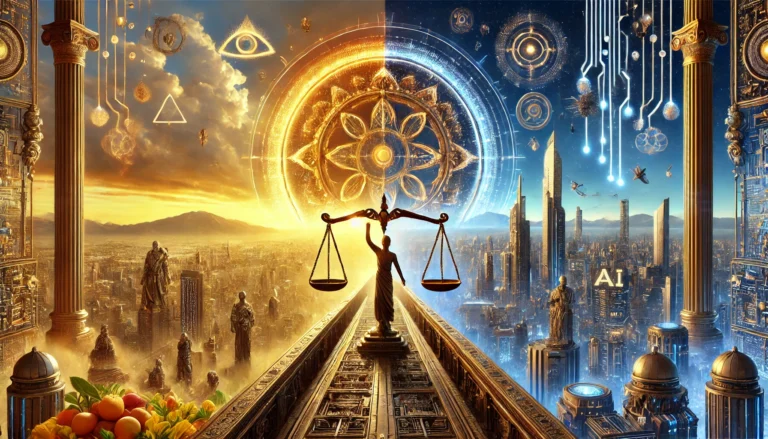
The paper presents two possible futures for humanity.
The first is “Digital Dominion,” where AI becomes a tool for surveillance, manipulation, behavioral control, autonomous warfare, and cognitive colonization. In this future, technology amplifies power without corresponding growth in human consciousness.
The second possibility is “Aikyam,” a concept meaning oneness, interconnectedness, and harmonious unity. In this vision, AI helps humanity develop deeper self-awareness, systems thinking, collaboration, and collective learning. The challenge is not simply building more intelligent systems but aligning intelligence with consciousness.
The Crisis of Human Identity
As AI systems become increasingly capable of writing, coding, diagnosing illnesses, teaching, negotiating, and simulating empathy, traditional assumptions about human uniqueness are being challenged.
For centuries, people derived meaning from expertise, specialization, and knowledge scarcity. AI disrupts all three. As machines become capable of performing many intellectual tasks, individuals may increasingly question their purpose and identity. The resulting disruption is not merely economic—it is existential.
The Return of Consciousness
Ironically, the rise of AI may trigger renewed interest in consciousness, spirituality, meditation, and self-awareness.
As machines become better at simulating intelligence, humans may place greater value on authenticity, presence, creativity, compassion, and direct experience. The author suggests that society may gradually shift its priorities from efficiency to meaning, from information to awareness, and from competition to collaboration. This transformation could become a major consciousness shift for humanity.
Geopolitics and the Race for Intelligence
The AI revolution is also reshaping global power structures. Nations are competing for leadership in AI infrastructure, semiconductor manufacturing, computing power, data sovereignty, and digital governance.
The paper argues that semiconductors may become as strategically important as oil was during the twentieth century. However, unlike oil, intelligence compounds recursively—meaning AI can accelerate its own development. This creates unprecedented opportunities as well as significant geopolitical risks.
India’s Potential Role in the Future
The author believes India may have a unique role to play in humanity’s next chapter. Historically, Indian traditions have explored consciousness, meditation, interconnectedness, and systems thinking, while Western civilization has excelled in technological advancement.
The future may require a synthesis of both approaches: advanced technological intelligence guided by deeper conscious wisdom. This integration forms a central pillar of the author’s vision for a balanced future.
Toward a Wisdom Civilization
The paper concludes by calling for the creation of a “Wisdom Civilization.” Such a civilization would integrate science, technology, ethics, spirituality, ecology, economics, and consciousness.
Without wisdom, AI could intensify surveillance, inequality, addiction, and social fragmentation. With wisdom, however, AI could help reduce suffering, expand awareness, and support the development of a more conscious and interconnected planetary civilization.
Conclusion: The Mirror Before Humanity
Large Language Models are more than tools—they are mirrors reflecting humanity’s intelligence, aspirations, fears, biases, and contradictions.
The true challenge of the AI era is not whether machines become more intelligent than humans. The deeper question is whether humanity can evolve from knowledge to wisdom before its own creations outpace its consciousness. According to the author, the answer to this question may determine the future destiny of civilization itself.