Engineering Human Flourishing
From Technical Acceleration to Civilizational Responsibility
The world is entering a period in which engineering, artificial intelligence, water systems, Earth observation, and physical infrastructure are becoming increasingly interconnected. The challenge is no longer simply whether humanity can build more powerful technologies. It is whether our institutions, ethics, and collective imagination can keep pace with that accelerating capability.
That was the central theme of an IIT alumni and community gathering that brought together engineers, scientists, policymakers, entrepreneurs, educators, and community members. The discussion moved from technological innovation to a broader question: How can engineering serve human flourishing while protecting the natural systems on which civilization depends?
From Engineering Achievement to Civilizational Responsibility
The gathering emerged from a nearly two-decade tradition of IIT alumni fellowship, networking, and intellectual exchange. What began as community building has increasingly become a forum for discussing AI, robotics, entrepreneurship, science, and public responsibility.
The acceleration of technology has changed the nature of that conversation. Innovation cycles that once took years can now unfold in months or even weeks. Artificial intelligence is moving beyond software into robotics, infrastructure, transportation, energy, healthcare, and other physical systems.
This creates a new responsibility for engineers.
The important question is no longer only “Can we build it?” It is also: Who will it serve? What resources will it consume? Who will bear the risks? And what kind of future will it create?
Agni and Apah: Power and Life
Vivek Singhal framed the discussion through two ancient symbols: Agni, representing fire, energy, transformation and technological power, and Apah, representing water, life, nourishment, adaptation and flow.
Together, they provide a framework for thinking about technology.
Humanity has become extraordinarily capable of harnessing “fire.” We can generate energy, transform materials, build machines, process enormous amounts of information, and increasingly direct physical systems through AI.
But water reminds us that life depends upon relationships, circulation, renewal and balance.
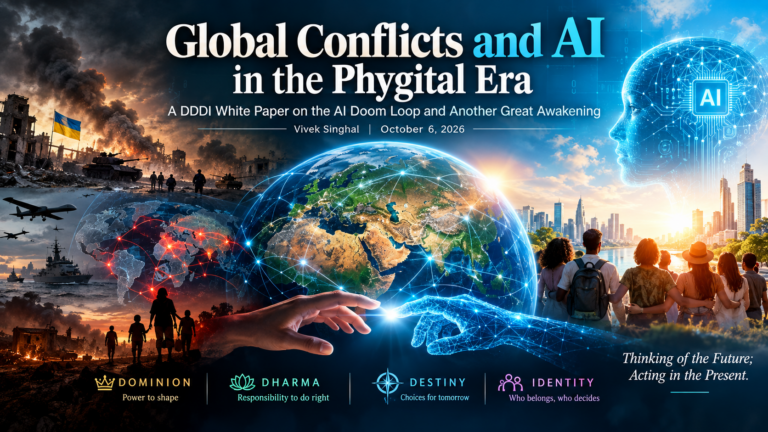
The DDDI™ interpretation is that Dominion must be balanced by Dharma. Dominion represents the organized capacity to know, build, finance and act. Dharma introduces responsibility to people, communities, ecosystems and future generations.
The objective is not to slow innovation. It is to make innovation worthy of the civilization it is helping to create.
From the Laboratory to Society
Dr. Najma Heptulla brought another dimension to the discussion: the relationship between scientific knowledge and public policy.
Her own story illustrated the importance of moving ideas from the laboratory into society. Scientific discovery alone does not change communities. Knowledge must be translated into education, legislation, budgets, institutions and practical implementation.
Her experience also emphasized the importance of persistence in institution building. Scientists and engineers can contribute to public life without abandoning their technical foundations. They can bring evidence into governance and help policymakers understand the consequences of their decisions.
But successful implementation requires more than experts. It requires political leadership, public administration, industry, civil society and affected communities.
The lesson is simple: science creates possibilities, but institutions determine whether those possibilities become public value.
Seeing Water from Space
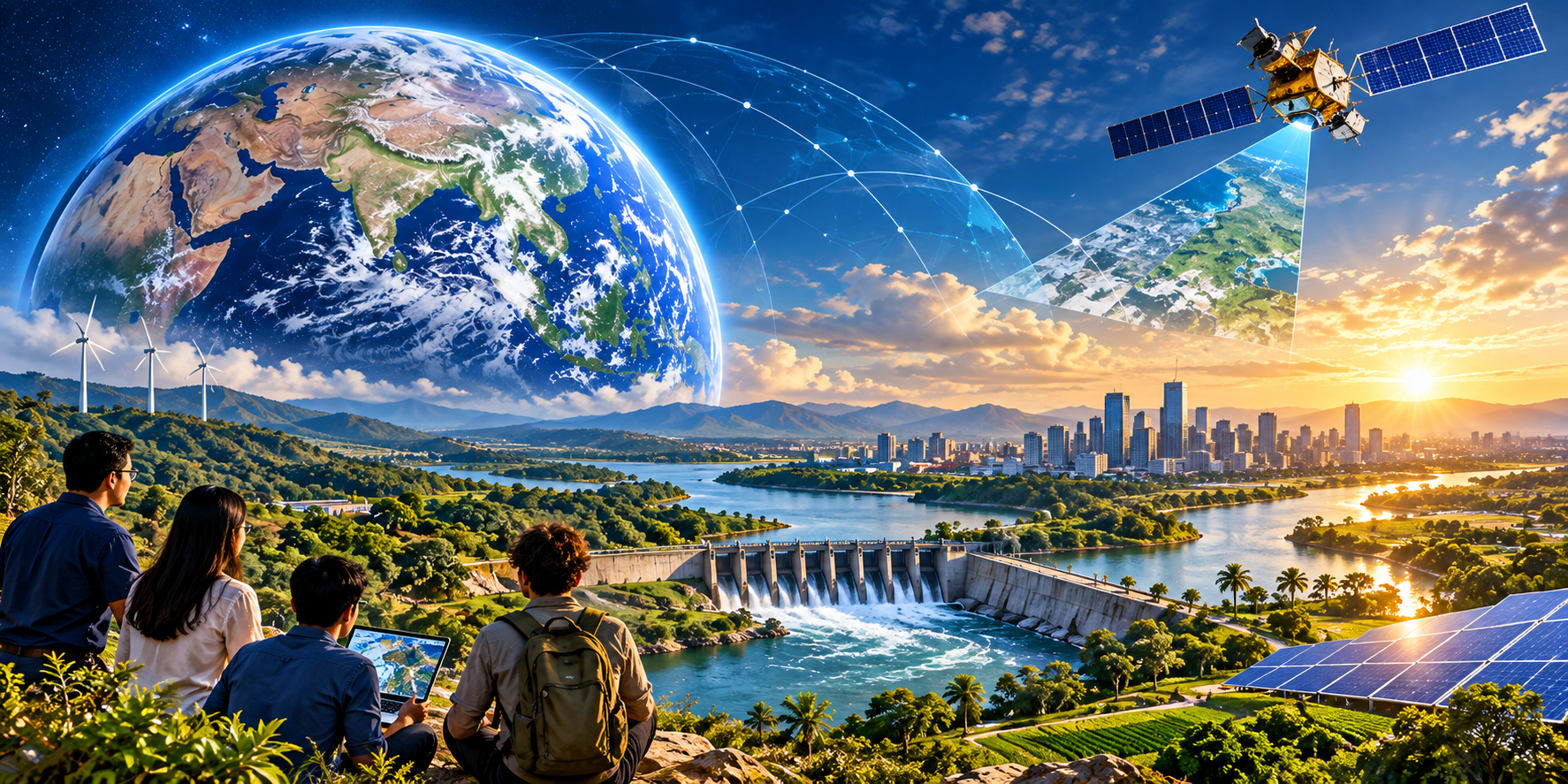
Dr. Sujay V. Kumar brought the conversation to the planetary scale through his work in hydrology and Earth observation at NASA Goddard.
Earth appears to be a water-rich planet, yet only about 2.5 percent of its water is fresh. Much of that freshwater is locked in glaciers and ice or stored underground. The amount readily available in rivers and lakes is only a small fraction.
This makes water security fundamentally a question of location, timing, accessibility and replenishment.
Satellites and sophisticated models can help reveal drought, flooding, soil moisture, groundwater changes and precipitation patterns across regions that cannot be understood through local observation alone.
The report highlights NASA’s GRACE and GRACE Follow-On missions as examples of how changes in Earth’s gravity field can reveal otherwise difficult-to-observe changes in stored water.
But observation is only the beginning.
Science can show us what is happening. Institutions and communities must decide what to do about it.
Water Requires a Portfolio, Not a Single Solution
The later panel discussion examined proposals including river interlinking, conservation, groundwater management, recycling, desalination and emerging water technologies.
The discussion did not present any one intervention as a universal answer. Instead, it emphasized a portfolio approach.
Different regions have different hydrological, economic, ecological and social conditions. Solutions therefore need to be evaluated according to their water benefits, energy requirements, environmental consequences, resilience, cost, operating requirements and effects on communities.
The discussion also highlighted a major challenge facing technological innovation: the gap between invention and implementation.
A promising water technology may require millions of dollars to move from laboratory development to engineering design, field demonstration and reliable operation. It also needs permits, infrastructure, operating partners, investors and customers.
This is very different from the economics of developing a software application.
Physical infrastructure requires patient capital and institutional commitment.
The Phygital Era
The report describes the emerging Phygital Era as a period in which digital intelligence and physical reality increasingly operate as one system.
AI can influence irrigation, energy systems, transportation, financial decisions, healthcare, water management and public administration.
This convergence creates enormous opportunities, but also new risks. A digital system can affect physical resources and human lives at unprecedented scale.
That means ethical questions must move upstream into the design process.
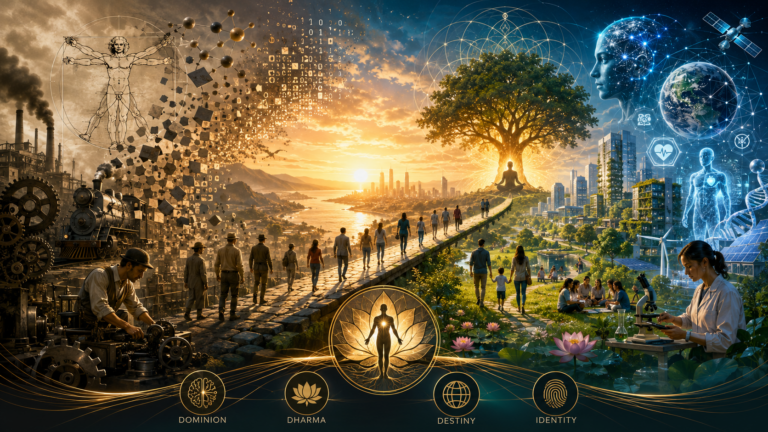
The DDDI framework proposes four interconnected dimensions:
Dominion asks what humanity has the capability to build and control.
Dharma asks what responsibility accompanies that capability.
Destiny asks what future today’s systems are creating through accumulated decisions and infrastructure.
Identity asks who is included in the “we” for whom these systems are being designed.
Together, these questions turn engineering from a technical exercise into a civilizational practice.
From Lab to Land
One of the report’s strongest ideas is the transformation of the traditional “lab to land” model.
In the Phygital Era, knowledge should not move only from laboratories to communities. It should move in both directions.
Scientists contribute measurements, models and controlled experiments. Communities contribute local knowledge, lived experience and historical memory. Policymakers provide authority and continuity. Businesses provide operational capability and scale. Civil society provides scrutiny and inclusion.
This creates a learning system rather than a one-way delivery pipeline.
For AI in particular, this matters. A model developed far from the field may optimize the wrong objective with extraordinary precision. Local knowledge can identify problems that formal datasets overlook.
Building an Engineering Dharma
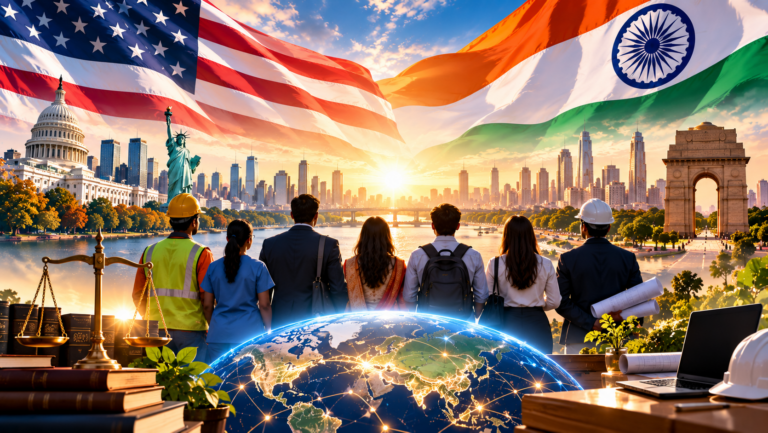
The white paper proposes several practical initiatives, including a Phygital Water Commons, regional living laboratories, a Dharma-by-Design Protocol, a Youth Engineering Dharma Fellowship, and an India–United States challenge network.
The proposed Water Commons would bring together Earth-observation data, hydrological information, infrastructure data, community observations and AI models.
The Dharma-by-Design approach would require projects to consider questions of ecological dependence, data ownership, human agency, failure, fairness and long-term local capacity.
The proposed youth fellowship would bring together engineering, policy, design, law, ecology and humanities students to work on real-world problems.
These initiatives share one principle: technology should be evaluated not only by whether it works, but by what it does to people, communities, institutions and ecosystems.
A Different Question for Engineering
The report concludes with a fundamental shift in the engineering question.
The traditional question is:
“Can we build it?”
The emerging question should be:
“What relationships will this system create, and are we willing to be responsible for them?”
The Blue Marble image of Earth provides the report’s closing symbol: one interconnected planet without visible political borders. Earth observation gives us the ability to see changes occurring across that planet. AI gives us new tools to understand and respond to those changes.
But technology alone cannot determine the future.
Human judgment, institutions, trust and responsibility remain essential.
Engineering human Flourishing therefore means bringing capability and responsibility together: Agni with Apah, Dominion with Dharma, intelligence with wisdom, and innovation with stewardship.
The future will not be defined only by what humanity is capable of building.
It will also be defined by what humanity chooses to build, whom it serves, and whether it can remain responsible for the world it creates.