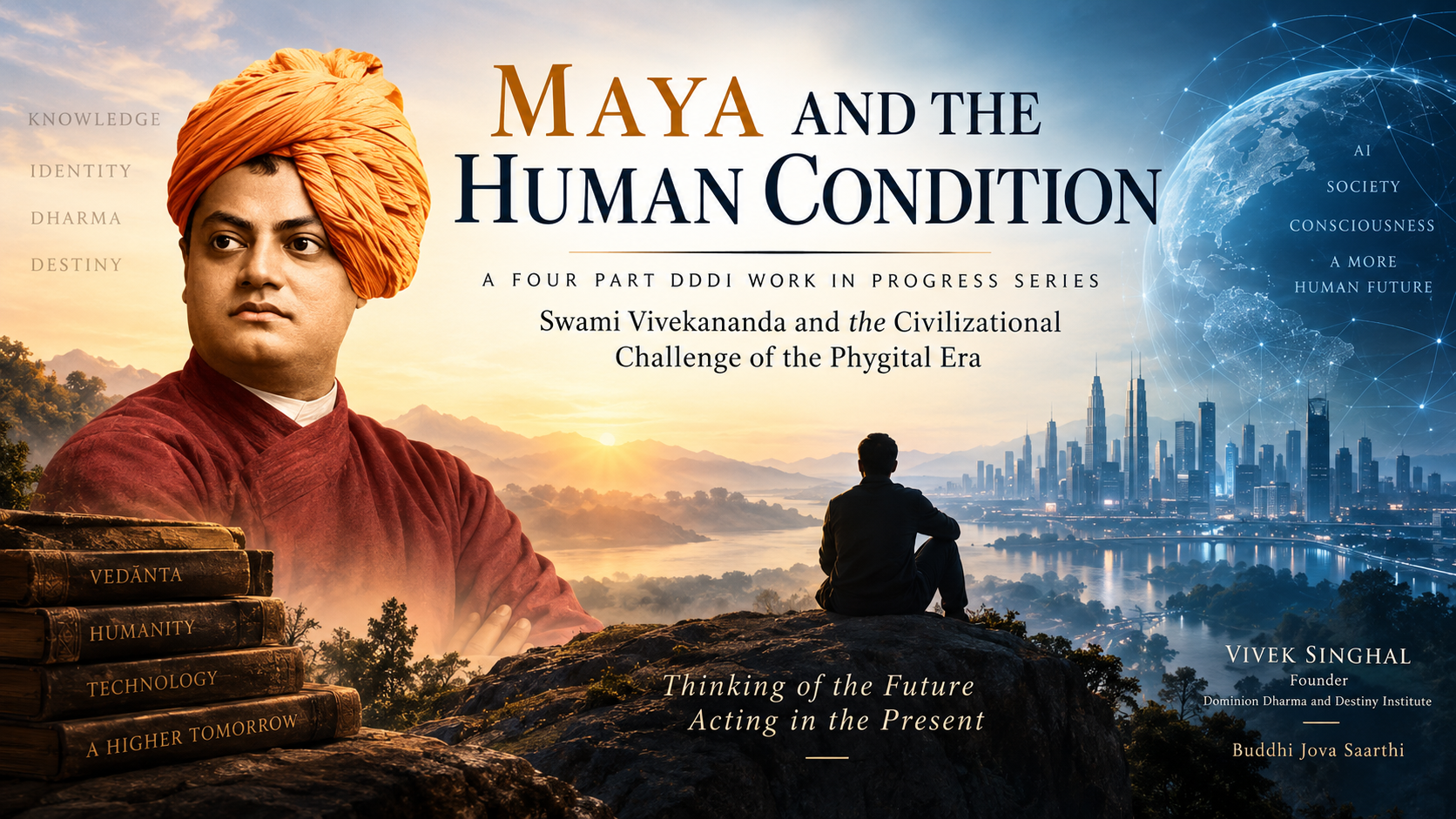
A Four Part DDDI Work in Progress Series
Swami Vivekananda and the Civilizational Challenge of the Phygital Era
Buddhi Jova Saarthi
WORK IN PROGRESS VERSION 0 1 SEPTEMBER 2026
Thinking of the Future Acting in the Present
Series Purpose
This four paper series examines Māyā through Swami Vivekananda and applies his account of conditioned reality to human identity, political economy, technological power and artificial intelligence. Each paper is written to stand on its own. A reader may begin with any paper and still find the central terms, argument and practical implications stated within it. Read together, the papers develop a single proposition: human beings suffer not because the world is meaningless, but because they repeatedly treat partial representations as complete reality and temporary arrangements as final truth.
The series uses Maya in its familiar English form and Māyā when referring specifically to the Sanskrit philosophical term. The word is often translated as illusion. Vivekananda gave it a more exact and more demanding meaning. Māyā names the mixed, conditioned and contradictory character of experience under space, time and causation. It also names our tendency to absolutize what is relative. The world matters, suffering matters and moral action matters. What Vedānta denies is that the changing world possesses independent, permanent and self sufficient reality.
DDDI™ approaches this teaching as civilizational diagnosis. Dominion begins when a fragment claims the authority of the whole. Dharma restores proportion, relationship and responsibility. Destiny concerns the direction in which power is used. Identity concerns whether the human person remains enclosed within inherited labels and engineered desires or discovers the deeper freedom of the Self. In the Phygital Era™, these questions become operational because algorithms now shape attention, judgment and social reality at planetary scale.
The Four Papers
| Paper | Central question | DDDI focus |
| One Maya and the Structure of Human Experience | What did Vivekananda mean by Māyā and why is it more than illusion | Knowledge reality freedom |
| Two Maya and the Construction of Identity | How do perception desire and ego turn useful identities into bondage | Identity moral agency education |
| Three Maya and the Civilizational Machinery of Dominion | How do markets states media and institutions manufacture collective realities | Dominion Dharma political economy |
| Four Maya in the Age of Artificial Intelligence | Can AI deepen engineered appearance or help humanity recover conscious agency | Trust AI DharmaOS Phygital Era |
Editorial Status
This manuscript is a work in progress intended for discussion, teaching and further development. It advances an interpretive synthesis rather than claiming to settle every dispute within Advaita Vedānta. Direct quotations have been kept brief. References identify primary texts and major interpretive sources; a later scholarly edition can add page specific citations keyed to the chosen edition of The Complete Works of Swami Vivekananda.
Contents
Paper One Maya and the Structure of Human Experience
Paper Two Maya and the Construction of Identity
Paper Three Maya and the Civilizational Machinery of Dominion
Paper Four Maya in the Age of Artificial Intelligence
Series Synthesis
Selected References
About the Author
Paper One Maya and the Structure of Human Experience
Swami Vivekananda on Reality Contradiction and Freedom
Abstract
Swami Vivekananda did not reduce Māyā to the claim that the world is a hallucination. He presented it as a statement of the conditions under which human knowledge and action occur. We experience a world structured by space, time, causation, change and opposing values. We seek permanence while living amid decay; pursue happiness through objects that cannot remain; and discover that progress solves one problem while generating another. Māyā names this mixed and relational field. Advaita does not erase the world. It denies that any finite appearance can be the final measure of reality. Liberation begins when the human being learns to act fully within experience without being imprisoned by its claims to absoluteness.
The Question Vivekananda Reframed
The popular sentence that the world is an illusion creates more confusion than understanding. It seems to deny the evidence of the senses and can invite fatalism. A person in pain does not experience pain as imaginary. A hungry child cannot be fed with metaphysical dismissal. A political prisoner is not liberated by being told that chains are unreal. Vivekananda therefore treated Māyā neither as casual skepticism nor as permission to withdraw from responsibility.
His lectures on Jnana Yoga describe Māyā as the form in which the universe presents itself to finite consciousness. Human beings know through distinctions. We separate subject from object, cause from effect, self from other and desirable from undesirable. These distinctions are indispensable for practical life. They become bondage when the mind assumes that they reveal reality exhaustively. Māyā is the gap between the conditioned form of our knowledge and the unconditioned reality that knowledge cannot turn into another object.
Maya as a Statement of Fact
Vivekananda repeatedly presents Māyā as a statement of fact rather than a speculative theory about how a perfect universe went wrong. Experience itself is mixed. Life carries death within it. Attachment to pleasure carries fear of loss. Social order protects some forms of freedom while restricting others. New wealth can relieve deprivation and intensify inequality. Education can liberate judgment and manufacture conformity. Technology can extend human capacity and deepen dependence.
This is not a complaint that reality should have been designed differently. It is recognition that every finite arrangement contains limits and consequences. Whatever arises through conditions passes when those conditions change. Whatever is defined through relationship cannot possess an isolated essence. Whatever the mind knows as an object is already framed by the mind and therefore cannot be the limitless ground of mind itself.
The significance of this argument is practical. If human beings expect permanent satisfaction from impermanent objects, disappointment is built into the project. If societies present temporary institutions as sacred and final, they turn history into dogma. If experts mistake a useful model for reality itself, their success within a narrow range becomes a source of blindness outside it.
Three Orders of Reality
Later Advaita teaching often distinguishes apparent, practical and ultimate orders of reality. The distinction helps prevent two opposite errors. One error treats every appearance as final. The other dismisses practical life as worthless.
| Order | Meaning | Illustration | Ethical implication |
| Apparent | An error corrected by better knowledge | A rope mistaken for a snake | Fear can be real as experience even when its object is misperceived |
| Practical | The shared world of bodies duties institutions and consequences | Law medicine money and social relationships | Action remains necessary and produces consequences |
| Ultimate | The nondual ground that does not depend on another condition | Brahman and the identity of Atman with Brahman | Every being possesses an intrinsic dignity deeper than social rank |
The practical world is therefore neither absolute nor negligible. It is real enough to demand responsibility and relative enough to require humility. This double recognition is essential to Vivekananda. He could proclaim the divinity of the soul while organizing relief, education and service. He did not treat spiritual insight as an excuse to abandon the field in which suffering occurs.
The One and the Many
Advaita holds that Brahman is the unconditioned reality and that Ātman, the deepest Self, is not separate from Brahman. Māyā is associated with the appearance of multiplicity within this unity. The One appears as many centers, objects and forces. Yet the relation should not be pictured as a material curtain covering a separate divine object. Any picture of a curtain, a place behind it and an observer looking through it already belongs to spatial imagination.
Vivekananda approaches the matter through consciousness. Every object changes, including the body, feelings and thoughts. Change can be recognized only against some continuity. Vedānta directs inquiry toward the witness of change. The witness is not another passing thought because thoughts themselves are observed. This inquiry does not provide an object that the ego can possess. It loosens the assumption that the ego is the final subject.
Knowledge and Its Boundary
Science has enlarged the observable universe by extending the senses through instruments and converting events into measurements. Vivekananda welcomed this disciplined search for unity. Physics looks for common forces beneath diverse phenomena. Biology traces apparent variety through common processes. Vedānta presses the movement toward unity into the field of consciousness and asks what makes any experience or knowledge possible.
The two inquiries operate at different levels. Science studies relations among observable and inferable phenomena. Vedānta examines the status of the observer and the conditions under which phenomena appear. Māyā does not invalidate science. It prevents scientific description from quietly becoming a total metaphysics. A complete map of neural activity, even if achieved, would still raise the question of lived awareness and the knower to whom the map appears.
Freedom within Maya
Vivekananda does not promise freedom through rearranging every external condition until contradiction disappears. No finite arrangement can remove finitude. Freedom begins with disidentification. The person recognizes that body, role, memory, success and failure are contents of experience rather than the whole Self.
This recognition need not diminish action. It can release action from compulsive self defense. A person less dependent on praise can tell the truth more readily. A leader less attached to office can surrender power when duty requires it. A society less captivated by accumulation can evaluate wealth by the human capabilities it supports. Detachment in this sense is not indifference. It is freedom from possession by the object of action.
The DDDI Reading
For DDDI, Māyā identifies a recurring error of scale. A partial institution, metric or identity expands until it claims authority over the whole person. Gross domestic product becomes national wellbeing. Price becomes value. visibility becomes truth. Legal citizenship becomes the measure of human worth. Algorithmic prediction becomes destiny. Each construct may contain practical knowledge. Dominion begins when the construct denies its own boundary.
Dharma restores the relationship between part and whole. It asks what responsibility follows from interdependence. Destiny concerns whether greater power produces deeper bondage or wider freedom. Identity concerns whether persons can use names and roles without becoming reducible to them. In this framework, Māyā is not an exotic doctrine. It is the central problem of civilization whenever representation becomes reality and means become ends.
Conclusion
Vivekananda’s Māyā is a disciplined realism about the limits and contradictions of finite experience. It neither denies the world nor permits worship of the world. It allows us to respect practical reality while refusing to confuse it with ultimate reality. The appropriate response is neither escape nor submission. It is lucid participation: knowledge without arrogance, action without bondage and service grounded in the recognition that the same consciousness appears through all.
Questions for Further Development
- How can institutions acknowledge the limits of their models without losing the capacity to decide
- What forms of education teach students to distinguish practical truth from ultimate claims
- Can public policy incorporate multiple forms of value without turning them into one reductive index
- How does Vivekananda’s account of freedom compare with liberal autonomy and Buddhist dependent origination
Primary Texts for Paper One
Swami Vivekananda Jnana Yoga lectures including Maya and Illusion Maya and the Evolution of the Conception of God Maya and Freedom and The Absolute and Manifestation in The Complete Works of Swami Vivekananda. Relevant scriptural foundations include the Isha Upanishad Katha Upanishad Mundaka Upanishad Shvetashvatara Upanishad and Bhagavad Gita.
Paper Two Maya and the Construction of Identity
Mind Desire Education and the Recovery of Moral Agency
Abstract
Māyā becomes personally binding through identification. The human mind converts changing experiences into a seemingly fixed owner called the ego and then defends the identities assembled around that owner. Family, nation, profession, religion, race, class and reputation have practical meaning, but none contains the whole person. Vivekananda’s account of the Ātman offers a foundation for dignity that precedes achievement and social recognition. This paper examines perception, desire, fear, education and service as forces that either harden conditioned identity or open it toward freedom. It argues that moral agency requires the capacity to observe conditioning without denying responsibility for action.
From Experience to Identity
Human beings do more than receive sensations. The mind selects, organizes, remembers and interprets. It builds continuity from discontinuous events and assigns ownership to thoughts and actions. This capacity makes biography, responsibility and social coordination possible. It also creates the impression that the constructed personality is an independent and permanent self.
Vivekananda distinguishes the changing instruments of experience from the witnessing Self. Body, mind and ego belong to nature. They operate through causes and habits. The Ātman is the ground of awareness and freedom. This distinction is easily misunderstood as hostility toward personality. Its real purpose is to prevent personality from becoming a prison. A role can be honored without being absolutized. A wound can be healed without being made the final definition of the wounded person.
Desire and the Manufacture of Lack
Desire begins with the perception that fulfillment lies in acquiring or avoiding something. Some desires serve life and relationship. Bondage arises when desire promises completion through an object that cannot provide permanence. The object may be wealth, prestige, ideological victory, romantic possession or public visibility. Achievement delivers a temporary state, after which comparison generates a new deficit.
Modern commercial systems have become highly effective at manufacturing this cycle. Advertising first identifies or creates insecurity, then links relief to purchase. Social media makes the comparison continuous. The user no longer compares a life with a small community but with a curated field of exceptional images. Attention becomes occupied by what one lacks, how one appears and how quickly others respond.
Māyā here is not the existence of goods or communication platforms. It is the false transfer of ultimate expectation to limited objects. The ethical question is therefore not whether desire can be eliminated by command. It is whether a person can see desire clearly enough to choose which desires serve flourishing and which have been installed by systems designed to capture attention.
Fear and the Defense of the Constructed Self
Every constructed identity is vulnerable because its conditions can change. Status can fall. Borders can move. institutions can withdraw credentials. The body ages. Memory weakens. Public opinion reverses. When the person equates the Self with these conditions, fear becomes rational within the mistaken frame. The ego must defend what it believes itself to be.
Collective politics often mobilizes this insecurity. Leaders define a threatened group, narrate a lost purity and promise restoration through exclusion or obedience. The story may contain genuine grievances. Māyā enters when the narrative becomes total, when no evidence can revise it and when the humanity of outsiders disappears behind a category.
Vivekananda’s insistence on fearlessness follows from his metaphysics. If the deepest Self is not born and does not die with changing forms, moral courage becomes possible. This is not permission for physical recklessness. It is freedom from the inward servitude that makes conscience dependent on approval and safety.
Education as Liberation or Conditioning
Vivekananda understood education as the manifestation of capacities already present within the human being. The phrase does not imply that knowledge and skill emerge without disciplined learning. It means that education should awaken strength, judgment and character rather than treat the learner as an empty container or an obedient instrument.
An education system deepens Māyā when it equates intelligence with scores, merit with credentials and worth with employability. These measures can provide useful information, but their authority must remain limited. Once they become total judgments, learners organize identity around external validation. Curiosity narrows into performance and failure becomes an ontological verdict.
Liberating education teaches students to examine the frames through which knowledge is presented. It joins scientific method with self observation, historical evidence with civilizational memory and technical ability with responsibility for consequences. It develops the power to participate in institutions without surrendering judgment to them.
Service and the Expansion of Identity
Vivekananda’s practical Vedānta joins realization to service. If the same Self appears through every being, service is not benevolence bestowed by a superior upon an inferior. It is recognition expressed through action. This changes the moral psychology of giving. The recipient is not an object through which the giver displays virtue. Both participate in a relationship that can reveal shared dignity.
Service also tests metaphysical claims. A person who speaks of oneness while exploiting workers or humiliating dependents has converted Advaita into verbal identity. Practical Vedānta demands that insight alter conduct. The measure is not the grandeur of belief but the quality of relationship, especially where power is unequal.
Identity within the DDDI Framework
| Conditioned identity | Dominion risk | Dharmic reorientation | Practice |
| Profession | Productivity becomes personal worth | Work becomes one expression of capacity | Maintain vocations beyond employment |
| Nation | Loyalty becomes denial of shared humanity | Patriotism accepts global responsibility | Test national claims against universal dignity |
| Religion | Belonging hardens into exclusive possession of truth | Tradition becomes a path toward realization | Compare conduct with professed principle |
| Digital profile | Visibility and engagement replace presence | Technology serves conscious relationship | Create protected spaces beyond measurement |
| Wealth and status | Accumulation becomes proof of merit | Resources become means of stewardship | Measure creation diffusion and regeneration of value |
DDDI treats Identity as a fourth civilizational pillar because power works through the answer to the question who am I. Dominion supplies identities useful to extraction and control. Dharma does not erase difference; it situates difference within relationship. Destiny depends on whether human beings can inhabit multiple identities without allowing any one of them to monopolize consciousness.
A Practice of Discernment
The recovery of agency requires repeated discernment rather than one dramatic revelation. Before acting, a person can ask what perception is present, what desire or fear organizes it, what identity feels threatened and what wider field has been excluded. This pause creates distance between stimulus and action. Vedānta calls for discrimination between the changing and the unchanging. Modern psychology might describe part of the same movement as metacognition. The vocabularies differ, but both value the capacity to observe mental content without immediate obedience.
Meditation strengthens this capacity by making the movements of mind visible. Ethical discipline reduces the turbulence generated by deception and harm. Work performed without exclusive attachment to reward weakens compulsive self reference. Devotion redirects desire toward a reality larger than ego. Vivekananda’s four yogas can therefore be read as complementary methods for loosening the different bonds through which Māyā operates.
Conclusion
The problem of identity is not that human beings possess names, histories and affiliations. The problem arises when a useful identity claims to be the whole Self. Vivekananda’s teaching restores depth to the person. It grounds dignity before achievement, moral courage beyond approval and service beyond paternalism. In DDDI terms, the movement from Dominion to Dharma begins inside the structure of identity. A civilization cannot respect human agency if its members know themselves only through the labels that institutions assign and markets monetize.
Questions for Further Development
- How should education assess performance without converting assessment into identity
- What institutional protections are needed when platforms profit from insecurity and comparison
- How can civilizational identity remain rooted without becoming exclusionary
- What would a DDDI curriculum of self knowledge moral agency and service contain
Primary Texts for Paper Two
Swami Vivekananda Practical Vedanta Karma Yoga Raja Yoga and Jnana Yoga in The Complete Works of Swami Vivekananda. Relevant scriptural foundations include the Katha Upanishad on the chariot of the person the Bhagavad Gita on action without attachment and the great Upanishadic declarations concerning the identity of Ātman and Brahman.
Paper Three Maya and the Civilizational Machinery of Dominion
Markets States Media and the Moral Limits of Institutional Power
Abstract
Māyā is not confined to private misperception. Societies construct shared realities through law, money, hierarchy, media, ritual and technology. These constructions enable large scale cooperation, yet they can conceal their historical origins and present themselves as natural or inevitable. This paper uses Vivekananda’s account of conditioned reality to examine the civilizational machinery of Dominion. It argues that institutions become oppressive when their partial measures claim total authority over persons and nature. Dharma supplies a discipline of purpose, proportion and accountability. It does not abolish power or markets; it judges them by whether they protect dignity, distribute capability and regenerate the conditions on which life depends.
Collective Maya
A currency note has little physical value, but shared confidence makes it economically powerful. A border is an agreed line enforced by institutions, yet it determines movement, security and belonging. A corporation is a legal person without a biological body, yet it owns assets and shapes the lives of thousands. These are not mere fantasies. They are collectively sustained realities with material consequences.
The Vedantic insight becomes relevant when society forgets that such arrangements are constructed, conditional and revisable. A system created to serve life begins to demand that life serve the system. The abstraction becomes sovereign. People then experience historically contingent rules as if they were laws of nature.
Dominion as the Absolutization of the Partial
Dominion is power organized around separation, possession and control. It does not refer only to empire or coercive government. It appears wherever one part of reality claims the right to define and use the whole. Capital claims labor as a cost. The state claims citizens as instruments of security. A majority claims the nation as exclusive property. Technology companies claim attention as inventory. Humanity claims Earth as inert material.
Each system depends upon abstraction. Abstraction is necessary because no institution can process the total uniqueness of every person and situation. The danger begins when the administrative category replaces the living subject. The patient becomes a billing code. The student becomes a score. The citizen becomes a demographic segment. The worker becomes a productivity unit. Māyā becomes institutional when representation no longer remembers what it leaves out.
Money Price and Value
Markets coordinate complex activity by translating diverse goods and preferences into prices. This is a major civilizational achievement. Price, however, measures an exchange under particular rules and distributions of power. It does not automatically measure intrinsic worth, ecological consequence, unpaid care, social trust or spiritual meaning.
A society under monetary Māyā treats whatever carries a price as real and whatever lacks a price as negligible. Forests become valuable when converted into timber, while their contribution to water, climate, biodiversity and community may remain invisible. Care work becomes economically marginal because much of it is unpaid. Attention becomes valuable when it can be sold, while silence and contemplation appear unproductive.
The DDDI concept of VALUE asks institutions to examine creation, capture, diffusion and regeneration. Who creates the benefit. Who captures the return. How widely do capabilities spread. Does the activity regenerate or exhaust the human and natural conditions on which future value depends. This framework does not reject markets. It prevents price from masquerading as a complete account of value.
Nation Empire and Civilizational Memory
Nations sustain solidarity through stories. Such stories can preserve sacrifice and give citizens a language of obligation. They can also convert selective memory into innocence. Empire often describes conquest as discovery, extraction as development and obedience as order. The story filters what can be seen.
Vivekananda addressed India under colonial rule without reducing freedom to imitation of the colonizer. He demanded strength, education and social regeneration while drawing upon Vedantic universality. His response suggests that civilizational self recovery requires memory without imprisonment by grievance. A people must name domination clearly, yet it must not allow the identity of victimhood to become its permanent self definition.
The same discipline applies to dominant societies. Honest memory is not self hatred. It is liberation from a flattering illusion that blocks responsibility. Dharma requires the capacity to hold achievement and injury within one account and to redesign institutions accordingly.
Media and Manufactured Reality
Public judgment depends on selection. Editors, broadcasters, platforms and political actors decide which events receive attention and which categories organize interpretation. No account can include everything. The ethical issue is whether selection remains open to correction or is hidden behind claims of neutrality and inevitability.
Modern platforms add personalization and behavioral prediction. Two citizens may inhabit different informational worlds while believing each is seeing reality directly. Outrage receives priority because it sustains attention. Repetition generates familiarity, and familiarity is mistaken for truth. The machinery does not need a single conspirator. Incentives can produce systematic distortion without centralized intention.
Trust therefore cannot rest on authority alone. It requires transparency about selection, correction when evidence changes and plural channels through which excluded experience can enter public judgment. Trust AI™ extends this principle to computational mediation. A trustworthy system must expose relevant limits and incentives rather than merely produce fluent confidence.
Dharma as Institutional Discipline
Dharma is sometimes reduced to personal virtue or religious duty. For civilizational analysis it also asks whether a system sustains the relationships on which its legitimacy depends. Power must have a purpose beyond perpetuating itself. Authority must answer to those who bear its consequences. Wealth must support the capabilities that make its creation possible. Knowledge must remain corrigible.
| Institutional field | Maya when | Dharmic test | Possible measure |
| Economy | Price is treated as complete value | Does activity sustain human and natural capability | Value creation diffusion and regeneration |
| Government | Legal authority is treated as moral infallibility | Can affected persons contest and correct decisions | Participation reasons review and remedy |
| Education | Credentials are treated as wisdom | Does learning expand judgment character and agency | Capability and contribution beyond scores |
| Media | Attention is treated as truth | Are selection incentives and corrections visible | Source diversity correction speed public trust |
| Technology | Prediction is treated as destiny | Can persons understand appeal and refuse automated power | Agency explainability recourse and human override |
Beyond Ideological Escape
Capitalism, socialism, nationalism and globalism each illuminate some relations and obscure others. Māyā warns against converting any one system into a final explanation of human nature and history. Ideology becomes a substitute for perception when every new fact is forced into an inherited script.
A Dharmic political economy should therefore be judged by consequences and relationships rather than doctrinal purity. It must preserve initiative without allowing accumulated power to purchase the rules. It must secure basic capabilities without converting citizens into passive clients. It must support innovation while charging present actors for costs transferred to future generations. These tensions cannot be abolished by naming a perfect system. They require continuing judgment.
Conclusion
Collective Māyā arises because human cooperation requires representations that can later conceal their constructed and limited character. Dominion turns these representations into instruments of capture. Dharma keeps power answerable to the life it organizes. The civilizational task is not to live without institutions, money, borders or technology. It is to prevent any of them from becoming an idol that consumes the persons and relationships it was created to serve.
Questions for Further Development
- Which current metrics most seriously distort public decisions by excluding human or ecological value
- How can institutions disclose the limits of models without paralyzing action
- What forms of ownership best align value creation capture diffusion and regeneration
- How can civilizational memory support responsibility without hardening inherited antagonisms
Primary Texts for Paper Three
Swami Vivekananda Practical Vedanta Karma Yoga Modern India The Future of India and the Jnana Yoga lectures on Māyā in The Complete Works of Swami Vivekananda. Supporting sources for later development include the Upanishads the Bhagavad Gita Adam Smith on moral sentiments and political economy and modern work on institutions media and ecological economics.
Paper Four Maya in the Age of Artificial Intelligence
Trust AI DharmaOS and Human Freedom in the Phygital Era
Abstract
Artificial intelligence changes the scale and speed at which representations influence reality. Models infer patterns from recorded data, generate persuasive language and images, rank human possibilities and increasingly mediate access to work, credit, education and public attention. These systems can improve knowledge and capability. They can also convert historical data into self fulfilling destiny and make synthetic appearances more influential than lived experience. Vivekananda’s account of Māyā provides a framework for understanding this danger without demonizing technology. The central question is whether AI remains an instrument open to human judgment or becomes an authority that colonizes attention, identity and moral agency.
Artificial Intelligence as a Machine of Representation
An AI model does not encounter the whole world. It processes data selected, formatted and made available through human institutions and technical pipelines. Its output is therefore a representation built from representations. Even highly accurate prediction remains conditional on the data, objective and environment in which the model operates.
Māyā becomes relevant at the moment a useful output is mistaken for comprehensive knowledge. Fluency can be mistaken for understanding. Statistical regularity can be mistaken for necessity. A score can become a verdict on a person. A synthetic image can acquire the emotional force of witnessed fact. The model does not need consciousness or intention for these effects to occur. Authority can arise from scale, opacity and institutional dependence.
Digital Maya
Digital Māyā differs from ordinary perceptual limitation because it is designed, optimized and distributed through infrastructure. Platforms observe behavior, estimate preference and select what will keep attention. Generative systems can produce individualized narratives, companions and environments. The user’s field of appearance increasingly responds to the user, creating a world that seems intimate while being commercially and computationally constructed.
This personalization can aid learning and access. It can also close the loop between desire and stimulation. The system predicts what will hold the person and then uses the resulting behavior as evidence that its prediction was correct. Human possibility narrows to behavioral probability. The past becomes a template for the future.
A Vivekanandan response does not consist in declaring the digital world unreal and retreating from it. The response is to recognize layers of mediation and protect the capacity of the person to stand apart from them. The human being must be able to know when a representation is synthetic, understand why an important decision was made, challenge it and choose spaces not governed by optimization.
Attention as the New Field of Dominion
Industrial capitalism organized labor and material production. Platform capitalism also organizes perception. Attention is measured, auctioned and redirected. The product is often the prediction and modification of behavior. This creates a form of Dominion that enters before deliberation, shaping which possibilities reach consciousness at all.
The moral issue extends beyond privacy. A person may consent formally to data collection while lacking any practical understanding of cumulative influence. Continuous interruption weakens reflection. Personalized persuasion makes collective scrutiny difficult because each person receives a different message. The capacity to form an intention independent of the system can erode without an obvious moment of coercion.
Vivekananda linked freedom to mastery of mind. In the Phygital Era, mastery of mind requires an ecology that does not subject every pause, desire and relationship to extraction. Attention should be treated as a condition of agency, not merely as a commercial asset.
Trust AI
Trust AI™ should not mean branding a system as safe or asking users to have faith in technical experts. Trust must be earned through verifiable relationships among capability, limits, incentives and accountability. A trustworthy system states what it knows, what it infers and where uncertainty remains. It allows correction and provides recourse when decisions materially affect a person.
From the perspective of Māyā, the first duty of trustworthy AI is epistemic humility. The system and its operators must not present a partial model as the person, a prediction as destiny or a generated account as witnessed fact. The second duty is protection of agency. People need meaningful alternatives, not a ceremonial consent screen. The third duty is responsibility across the value chain. Designers, deployers and institutions cannot transfer all consequences to users while retaining all power to shape the environment.
| Trust principle | Maya risk | Design requirement |
| Provenance | Synthetic content appears as direct evidence | Disclose origin transformation and confidence where material |
| Bounded claims | Model fluency appears as complete knowledge | State domain limits uncertainty and missing context |
| Agency | Prediction becomes an irreversible verdict | Provide explanation contest and human review |
| Plurality | One optimization objective defines human value | Use multiple measures and affected community input |
| Regeneration | Efficiency hides social and ecological cost | Account for labor energy attention and long term capability |
DharmaOS
DharmaOS™ can be understood as a civilizational operating logic rather than a single software product. Conventional systems begin with what can be measured and optimized. DharmaOS begins with the relationships and responsibilities that must be sustained. It asks who is affected, which values cannot be collapsed into one metric, what power asymmetry exists and how decisions remain open to correction.
This approach does not reject computation. It assigns computation a proper place. Data informs judgment but does not replace it. Prediction supports preparation but does not define the human future. Automation removes drudgery where possible while preserving meaningful participation. Efficiency remains a value, but not the sovereign value.
The DDDI sequence of Data Decision Design and Impact provides an operational path. Data must be examined for provenance and exclusion. Decision must identify the accountable human or institution. Design must incorporate agency, recourse and plural value. Impact must be assessed across creation, capture, diffusion and regeneration rather than by adoption or profit alone.
The New Human Question
The debate about artificial intelligence often asks whether machines will become more like human beings. Vivekananda invites the prior question of what a human being is. If the person is defined mainly as a producer of calculations, text and economic output, advanced machines will appear to diminish human value. If consciousness, moral agency, relationship and self transcendence belong to the human horizon, automation can expose the poverty of the earlier definition.
The New Human is not a biologically superior species or a technologically augmented elite. It is the human being who can use multiple intelligences without surrendering identity to any of them. Such a person combines technical knowledge with self knowledge, participates in networks without dissolving into them and treats intelligence as a capacity for relationship and responsibility rather than domination.
A Civilizational Choice
AI systems are being embedded in institutions already shaped by concentrated capital, geopolitical rivalry and unequal access to knowledge. Technology will therefore inherit the moral structure of its deployment unless that structure is consciously redesigned. An optimization system serving Dominion will make capture more efficient. The same capability under Dharmic governance can widen education, strengthen health, reveal ecological interdependence and return time to human development.
The choice cannot be settled through technical alignment alone because societies disagree about the purposes to which systems should align. Governance must therefore include philosophical and civilizational inquiry. What is a person. Which capabilities should never be traded away. What duties accompany intelligence. What forms of interdependence deserve protection. Vivekananda’s Māyā helps keep these questions open by warning that every formal answer remains a conditioned representation rather than the whole of reality.
Conclusion
Artificial intelligence can intensify Māyā by generating persuasive appearances, hardening historical patterns and making invisible systems decisive in human life. It can also help humanity recognize patterns of interdependence and release people from mechanical activity. The decisive issue is governance by consciousness and Dharma. Trust AI must keep representation answerable to reality. DharmaOS must keep optimization answerable to dignity and relationship. Human destiny must remain open to moral agency rather than being enclosed by prediction.
Questions for Further Development
- Which AI decisions should always preserve a right to human review
- How can provenance be made visible without overwhelming ordinary users
- What indicators can measure the regeneration or depletion of human attention
- How should Trust AI incorporate civilizational plurality while protecting universal dignity
- What practices help individuals maintain interior freedom within personalized digital environments
Primary Texts for Paper Four
Swami Vivekananda Raja Yoga Jnana Yoga Practical Vedanta and the lectures on Māyā in The Complete Works of Swami Vivekananda. Supporting sources for later development should include current primary technical standards and governance documents on artificial intelligence research on attention and platform incentives and comparative work on human dignity agency and technological mediation.
Series Synthesis
From Conditioned Perception to Conscious Civilization
The Integrated Argument
The four papers trace one movement across different scales. At the metaphysical level, Māyā describes reality as experienced through space, time, causation and distinction. At the psychological level, it explains how the mind identifies the Self with changing roles, desires and fears. At the institutional level, it reveals how shared representations become structures of power. At the technological level, it shows how artificial intelligence can automate and personalize the production of appearances.
The movement does not imply that metaphysics mechanically causes politics or that one Sanskrit concept explains every modern problem. It provides a disciplined analogy and a set of questions. What is being represented. What has the representation omitted. Who benefits when the representation is treated as complete. What form of freedom becomes possible when its limits are recognized.
The DDDI Arc
| Dimension | Condition under Maya | Civilizational danger | Dharmic movement |
| Dominion | The part presents itself as the whole | Power hides behind apparently natural categories | Expose construction limits and consequences |
| Dharma | Relationship is obscured by separation | Duty is reduced to compliance or private virtue | Restore responsibility reciprocity and proportion |
| Destiny | Historical pattern is mistaken for necessity | Prediction closes the future | Preserve agency learning and alternative possibility |
| Identity | The changing role is mistaken for the Self | Dignity depends on status recognition and utility | Ground difference within deeper unity |
A Research Agenda
The next stage of this work should place Vivekananda in sustained conversation with Shankara, Ramakrishna, Buddhist accounts of dependent origination, Western phenomenology, cognitive science, political economy and AI governance. It should distinguish points of genuine convergence from superficial similarity. It should also test the DDDI concepts through concrete cases in education, health, media, finance and algorithmic administration.
A later edition can develop a Māyā Audit for institutions. Such an audit would identify the representation on which a decision depends, the realities excluded by that representation, the groups able to contest it, the incentives that sustain it and the consequences of treating it as complete. This would translate philosophical discernment into institutional practice without pretending that philosophy can be reduced to a compliance checklist.
Closing Proposition
Human freedom does not require the disappearance of the conditioned world. It requires a consciousness that can participate in conditions without mistaking them for the whole of reality. Vivekananda called humanity toward strength because weakness clings to appearances and fears their loss. He called humanity toward service because realization of unity must enter conduct. He called humanity toward freedom because no social label, inherited hierarchy or mental habit exhausts the Self.
For DDDI, this yields a working civilizational proposition. Dominion captures human energy by making constructed realities appear final. Dharma restores dignity by revealing relationship, responsibility and the limits of every representation. Destiny remains open when knowledge serves conscious agency. Identity matures when the person can say both I belong to a history and I am more than every history assigned to me.
Selected References
Primary sources
- Swami Vivekananda The Complete Works of Swami Vivekananda Advaita Ashrama especially the Jnana Yoga lectures Maya and Illusion Maya and the Evolution of the Conception of God Maya and Freedom and The Absolute and Manifestation
- Swami Vivekananda Karma Yoga Raja Yoga and Practical Vedanta in The Complete Works of Swami Vivekananda
- The Principal Upanishads especially Isha Katha Mundaka and Shvetashvatara
- Bhagavad Gita especially teachings on action attachment knowledge and divine Māyā
Sources for the next research edition
- Classical Advaita commentaries on Brahman Ātman avidyā and orders of reality
- The Gospel of Sri Ramakrishna and biographical sources on the formation of Vivekananda’s practical Vedānta
- Primary standards and official governance frameworks for artificial intelligence risk accountability and human rights
- Empirical research on attention platforms behavioral prediction automation bias and human computer interaction
- Comparative work in phenomenology cognitive science Buddhist philosophy ecological economics and institutional theory
About the Author
Vivek Singhal is the founder of the Dominion Dharma and Destiny Institute and Strategic Business Management Company. He is a civilizational thought leader global strategist mentor and impact investor. Born in Bharat and a first generation American immigrant he earned a B Tech in Electrical Engineering from IIT Delhi an MS in Electrical and Computer Engineering and an MBA from the University of Michigan and completed the four year Basic Program at the University of Chicago Graham School. He created value as a corporate executive in three Fortune 100 corporations before founding his strategy formulation and implementation practice in 1985 and later shifting toward mentoring and impact investing. His work examines the movement from Dominion to Dharma and the conscious design of human institutions in the Phygital Era.
Vivek writes as Buddhi Jova Saarthi and develops the DDDI frameworks of Dominion Dharma Destiny and Identity Data Decision Design and Impact and VALUE through creation capture diffusion and regeneration.