
From Iran to DOI 2.0
Reframing American Dominion Through Dharma
for the Phygital Age of Abundance
Vivek Singhal
Founder, Dominion Dharma Destiny Institute™
April 2026
Contents
Contents……………………………………………………………………. 2
The Fire That Lights the Way………………………………………. 3
Dominion Without Dharma: The Old Capitalism’s Last Stand 5
The Architecture of Extraction…………………………………. 5
The Structural Contradictions………………………………….. 6
The DDDI Diagnostic: Reading the War Through Dominion, Dharma, Destiny, Identity………………………………………….. 7
The Framework……………………………………………………. 7
Diagnosing the Combatants…………………………………….. 7
The Inflection Point: From Conflict to Reset…………………… 9
The Pattern of Civilizational Reset…………………………….. 9
The 2026 Moment………………………………………………… 9
DOI 2.0: The New Declaration for the Phygital Age………… 11
The Meta-Constitutional Moment…………………………… 11
The Upgraded Triad…………………………………………….. 11
The New Architecture………………………………………….. 12
Changing Everything, Everywhere, All the Time…………….. 13
AI and AGI: The First Non-Human Dharmic Agent………. 13
SynBio: The Bridge Between Biological Past and Designed Future………………………………………………………………. 13
The Phygital Era: When Everything Transforms Simultaneously…………………………………………………… 13
Opening the Universe: The Cosmic Horizon of DOI 2.0……. 15
The Call: America’s Dharmic Moment…………………………. 17
“Do thine allotted task. Action is nobler than inaction.”
— Bhagavad Gita, 3.8
“We hold these truths to be self-evident, that all men are created equal, that they are endowed by their Creator with certain unalienable Rights, that among these are Life, Liberty and the pursuit of Happiness.”
— Thomas Jefferson, Declaration of Independence, 1776
PROLOGUE
The Fire That Lights the Way
There is a particular quality of light that emerges only from fire. Not the warm amber of a hearth, but the harsh, clarifying white of a conflagration — the kind that strips away pretense and illusion and forces the eye to see what was always there, just obscured by comfort and habit.
The 2025–2026 military campaign waged by the United States and Israel against Iran is that kind of fire.
On February 28, 2026, coordinated American and Israeli airstrikes descended upon Iran for the second time within eight months, targeting nuclear facilities, ballistic missile infrastructure, and — in a decision that will be debated by historians for a century — the Iranian leadership itself, up to and including Supreme Leader Khamenei’s compound in Tehran. The stated objectives were precise and strategic: end Iran’s nuclear program permanently, destroy its missile capabilities, neutralize its naval forces, and destabilize the Islamic Republic sufficiently to trigger internal regime change. The June 2025 twelve-day air war had set back the program significantly but had not ended it. And so, eight months later, the bombs fell again.
This is not, as the pundits insist, merely a story about nuclear nonproliferation. It is not merely a chapter in the long and blood-soaked history of Middle Eastern conflict. It is not even primarily a story about Iran.
It is a mirror.
And in that mirror, if we have the courage to look, we see the entire architecture of the post-World War II global order cracking under the weight of its own contradictions. We see American Dominion exercised without Dharma — without righteous purpose, without civilizational grounding, without a vision of the world it is trying to create rather than merely control. We see Israel exercising existential Dominion, reactive and defensive, its Identity forged in the crucible of historical trauma and genuine threat. We see Iran embodying a Dharma-claim — Islamic civilizational resistance — that, while offering no universal Destiny for the world’s peoples, represents the authentic rage of a civilization that has been told for a century that its sovereignty does not matter. And we see the Global South watching, calculating, and quietly accelerating its own search for an ordering principle that is neither Washington’s nor Tehran’s.
The ancient Greeks understood this kind of moment. Thucydides, writing of the Peloponnesian War, recognized that the conflict between Athens and Sparta was not merely a military contest — it was a civilizational examination. Athens, with its democratic innovation, its commercial dynamism, its imperial ambition, could not sustain the internal contradiction between its stated values and its imperial conduct. Empire without virtue, Thucydides shows us, consumes itself. The war lasted twenty-seven years and ended in the ruin of both powers, clearing space for a Macedonian synthesis that neither combatant had imagined or desired.
Three thousand years earlier and half a world away, the Kurukshetra War described in the Mahabharata posed the same civilizational question in deeper register. When Arjuna, the great warrior, looked across the battlefield and saw his kinsmen arrayed against him, he lowered his bow in despair. What dharma, he asked, could justify this destruction? And Krishna’s answer — the Bhagavad Gita, perhaps the most profound strategic document in human history — was not a tactical manual. It was a civilizational reorientation. Act from righteous duty, not from fear or desire. The outcome belongs to the cosmos; the action belongs to you. Fight not to dominate, but because the world’s moral order requires it.
America, in April 2026, is Arjuna standing at Kurukshetra. It has the power. It has won the battle, or at least suppressed the immediate threat. But it has not yet asked — and certainly not answered — the deeper question: To what end? In service of what Dharma? Toward what Destiny?
This essay is an attempt to answer that question. More precisely, it is an attempt to show that the answer already exists — in the DDDI framework of Dominion, Dharma, Destiny, and Identity — and that the instrument for its implementation is already at hand in the form of DOI 2.0, the new Declaration of Independence for the Phygital Era.
The period from 2026 to 2030 is what I call the Twilight Tunnel: the four-year crucible in which the decisions made by American leaders, thinkers, entrepreneurs, and citizens will determine whether the United States emerges as the Dharmic anchor of a new civilizational order, or collapses into the same pattern of imperial overextension that has destroyed every previous hegemon in recorded history.
The fire is already lit. The question is whether it destroys or illuminates.
PART I
Dominion Without Dharma: The Old Capitalism’s Last Stand
The Architecture of Extraction
To understand why the Iran campaign represents a civilizational inflection point rather than merely a security operation, we must trace the arc of the system it is meant to defend.
The post-World War II American order was constructed with genuine genius and genuine purpose. The Bretton Woods architecture of 1944 — establishing the dollar as the world’s reserve currency, creating the IMF and World Bank, liberalizing trade under American security guarantees — delivered what its architects promised: fifty years of relative peace among major powers, unprecedented economic growth, and the extension of market institutions to hundreds of millions of people who had known only feudalism or command economics.
This was not nothing. It was, in historical terms, extraordinary.
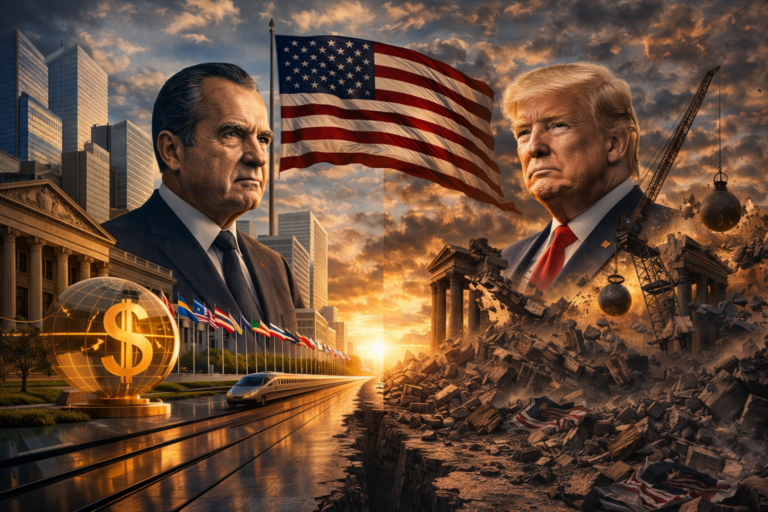
But the system carried within it a structural contradiction that its founders either ignored or could not resolve. The dollar’s role as the global reserve currency required the United States to run perpetual current account deficits — exporting dollars to the world so the world could conduct commerce. This is the Triffin Dilemma, identified by Belgian-American economist Robert Triffin in 1960, and it is the original sin of the Bretton Woods system. America’s domestic monetary interests and the world’s need for liquidity are structurally incompatible. When Nixon ended the dollar’s convertibility to gold in 1971, he did not resolve this contradiction — he merely removed its restraint.
What followed was the petrodollar system: the 1973 arrangement by which Saudi Arabia agreed to price oil in dollars and recycle its surpluses into American Treasury bonds in exchange for American security guarantees. This ingenious architecture transformed American Dominion from a productive system into an extractive one. The dollar’s global demand was now maintained not by American productive superiority but by the structural requirement that all nations hold dollars to purchase energy. The Federal Reserve became, in effect, the central bank of the world, setting monetary conditions that suited American interests while exporting inflation, deflation, and instability to the Global South.
From the petrodollar, the arc bends toward financialization. The Reagan-Thatcher revolution of the 1980s dismantled the productive-economy protections that had balanced American capitalism — Glass-Steagall, anti-trust enforcement, labor protections, progressive taxation — and replaced them with a financial capitalism that rewarded asset appreciation over productive investment. Joseph Schumpeter, who celebrated capitalism’s creative destruction as its animating force, would have recognized the dynamic but been troubled by its degeneracy: destruction without creation, disruption without replacement, speculation dressed as innovation.
By the 2000s, the system had evolved into surveillance capitalism — the extraction of behavioral data as raw material for prediction products sold to advertisers and, increasingly, to governments and security agencies. The great technology companies of our era are not primarily technology companies. They are behavioral modification machines: platforms designed to capture attention, predict behavior, and sell that predictive capacity to the highest bidder. This is Dominion in its most refined extractive form — not the dominion of territory or labor, but of consciousness itself.
The military-industrial expression of this system — what President Eisenhower warned against in 1961 — completes the picture. When the United States invaded Iraq in 2003 on the basis of fabricated intelligence, it was not acting irrationally from the perspective of the system it was defending. It was acting as any extractive empire must: securitizing access to resources, eliminating potential challengers, and maintaining the conditions under which dollar hegemony could persist. The catastrophic human and financial cost — trillions of dollars, hundreds of thousands of lives, a region destabilized for a generation — was not a bug. It was the price of system maintenance, and the American public was asked to pay it while the financial elite that benefited most from petrodollar recycling paid almost nothing.
The Structural Contradictions
Now, in 2026, those contradictions have become impossible to ignore.
BRICS — the coalition of Brazil, Russia, India, China, and South Africa, now expanded to include Iran, Egypt, Ethiopia, the UAE, and a growing list of partner nations — represents approximately 37% of global GDP and 45% of global population. Its de-dollarization agenda is not merely rhetorical. China and Russia now conduct over 95% of their bilateral trade in yuan and rubles. India has created a rupee-ruble mechanism for Russian oil. Brazil and China have established a yuan-real settlement agreement. The architecture of an alternative financial system is being built — not in a single dramatic moment, but through the patient, incremental accumulation of bilateral agreements, digital payment networks, and commodity-backed settlement mechanisms.
The Thucydides Trap that Harvard’s Graham Allison identified as the organizing threat of US-China relations is real, but it is only one dimension of a multi-front structural challenge. The United States faces not one rising challenger but an entire constellation of civilizations that have concluded, with increasing confidence, that the current global order does not serve their interests and that they have sufficient collective weight to construct an alternative.
This is the context in which the Iran campaign must be understood. It is not primarily a response to an Iranian nuclear threat, real as that threat may be. It is the military-industrial complex’s instinctive response to the unraveling of the system it was built to defend. Every bomb dropped on Iranian soil is also a message to Beijing, Moscow, Riyadh, and New Delhi: the dollar system will be defended by force if necessary, and any civilizational challenge will be treated as a security threat.
But force cannot resolve structural contradictions. It can delay them. It can suppress them. It cannot resolve them.
Old capitalism — extractive, financialized, ecologically destructive, civically corrosive — is in its last stand. It is defending not just petrodollar hegemony but a conception of Dominion that has been severed from any Dharmic purpose, any sense of what the world’s peoples are being dominated for. This is what Toynbee would have called a civilization’s response to challenge becoming increasingly mechanical and decreasingly creative — the symptom of arrested civilization, of a creative minority that has lost its animating vision and become a merely dominant minority, compelling obedience by force rather than inspiring allegiance by example.
The Iran war is the military expression of this arrested civilization. And that is precisely why it is also the trigger for what must come next.
PART II
The DDDI Diagnostic: Reading the War Through Dominion, Dharma, Destiny, Identity
The Framework
The Dominion Dharma Destiny Institute’s analytical framework rests on four interlocking concepts, each irreducible to the others, each necessary for civilizational health.
| DIMENSION | DEFINITION |
| DOMINION | The legitimate exercise of power — physical, economic, cultural, technological. Without Dominion, a civilization cannot defend itself or implement its vision. |
| DHARMA | Righteous purpose — the organizing moral principle that gives Dominion its legitimacy. Dynamic, contextual alignment with the cosmic moral order. |
| DESTINY | The civilizational direction — the long horizon toward which energy and sacrifice are oriented. Answers: What are we building for those who come after us? |
| IDENTITY | The foundational answer to: Who are we? Values, stories, and relationships with the cosmos that define our humanity. Secure Identity can be generous. |
Diagnosing the Combatants
With this framework, the Iran conflict reads as a diagnostic of civilizational health — or the lack thereof.
| Actor | Dominion | Dharma | Destiny | Identity |
| United States | Formidable | Fractured | Unclear | Contradicted |
| Israel | Existential | Reactive | Limited | Trauma-forged |
| Iran | Regional | Resistance | Absent | Civilizational |
| Global South | Emerging | Aspirant | Forming | Reasserting |
| India | Growing | Dharma-Rich | Expansive | Ancient-Modern |
The United States presents the most complex diagnosis because it is simultaneously the most powerful civilization in human history and the most Dharmically confused. American Dominion is real and formidable: the world’s largest military, the world’s dominant reserve currency (still), the world’s leading technological ecosystem, and an unparalleled network of alliances. But American Dominion has been severed from its founding Dharma. The principles articulated in Jefferson’s Declaration — that all persons are created equal, endowed with inalienable rights — were never fully realized domestically and were systematically contradicted internationally.
Israel presents a different pathology: Dominion exercised under existential Identity threat. The Israeli state was born from genuine civilizational trauma — the Holocaust — and genuinely faces adversaries who have at various points called for its elimination. The existential quality of Israeli Dominion is not manufactured. It is real. But existential Dominion, reactive and driven by fear of annihilation, cannot build. It can only defend. It lacks Destiny — a positive civilizational horizon that transcends the logic of permanent warfare.
Iran offers perhaps the most instructive diagnosis. The Islamic Republic has constructed a powerful Dharma-claim: Islamic civilization’s right to resist Western domination, to reclaim its dignity, to refuse the unipolar order that has treated the Middle East as a resource province rather than a civilization. This claim has genuine moral force. But Iranian Dharma without universal Destiny is a trap. A civilization that defines its moral purpose primarily in terms of resistance has no positive vision for the world’s eight billion people. It can mobilize against; it cannot inspire toward.
The Global South and BRICS represent the world’s civilizational plurality seeking Identity and Destiny outside Western Dominion. This assertion is legitimate. But BRICS remains, for now, a coalition of grievances rather than a coalition of visions. It is united by what it is against more than by what it is for. For BRICS to become a genuine civilizational force, it must develop a positive Destiny.
India deserves special attention in this diagnostic, because India occupies a unique civilizational position that makes it, uniquely, the potential midwife of DOI 2.0. India is Dharma-rich, its civilizational tradition encompassing Vedanta, Buddhism, Jainism, Sikhism, and the syncretic Hindu worldview — perhaps the world’s deepest philosophical engagement with the concept of righteous purpose. India is also Destiny-seeking: the largest democracy in human history, the world’s most populous nation, the fastest-growing major economy. And India is uniquely positioned: member of the Quad, founding member of BRICS, non-aligned for seventy-five years. It is the civilization that can translate Dharma into a language that Americans can hear, and translate American Dominion into a form that the world can accept.
PART III
The Inflection Point: From Conflict to Reset
The Pattern of Civilizational Reset
History does not repeat itself, as the cliché has it. But it does rhyme with remarkable precision when civilizational transitions are underway.
Every major ordering principle of the modern world was born in the aftermath of a convulsive conflict. The Peace of Westphalia (1648) emerged from the Thirty Years’ War and established the sovereignty of nation-states as the organizing principle of international order. The Congress of Vienna (1815) emerged from the Napoleonic Wars and constructed a balance-of-power system that preserved European peace for nearly a century. The Paris Peace Conference (1919) emerged from World War I and produced the League of Nations. The Bretton Woods Conference (1944) and the United Nations Charter (1945) emerged from World War II and constructed the current international order.
Each of these resets shared a common dynamic: a catastrophic conflict revealed the inadequacy of the existing ordering principle, created a vacuum of legitimacy, and forced a generation of leaders to imagine a new architecture. The success of each reset depended on whether the new architecture was merely a reorganization of power among existing elites (as at Versailles) or a genuine civilizational reframing that expanded the circle of legitimacy and purpose (as at Bretton Woods, despite its flaws).
We are now at the threshold of the next reset.
The 2026 Moment
The year 2026 is not an arbitrary calendar coincidence. It is the 250th anniversary of the Declaration of Independence — the founding document of the democratic experiment that has, whatever its failures, done more to advance the principle of human dignity than any political document in history.
But anniversaries are not achievements. They are examinations.
The question that 2026 poses to America — and through America to the world — is not “how far have we come?” It is: “Are we still capable of the founding audacity that made us a civilization worth emulating?”
The Iran war’s aftermath — whether it ends in negotiated settlement, regime collapse, regional architectural reconstruction, or some combination of all three — will create the vacuum that civilizational resets require.
In any of these scenarios, the United States faces a choice that is not merely strategic but civilizational. It can double down on Dominion Without Dharma: maintain military superiority, defend dollar hegemony by force, treat every civilizational challenge as a security threat, and continue the slow, accelerating spiral of imperial overextension. This path leads where it has always led — to the decline that Thucydides mapped, that Toynbee catalogued, that Niall Ferguson has documented in the falls of every previous Western empire.
Or it can embrace the alternative: Dominion With Dharma — a civilizational renewal that regrounds American power in righteous purpose, that reframes American hegemony as stewardship rather than extraction, that positions the United States not as the enforcer of a unipolar order but as the convener and anchor of a multipolar civilizational commons organized around shared human flourishing.
This is the choice. And the Twilight Tunnel — the period from 2026 to 2030 — is when it must be made. After 2030, the technological, demographic, and geopolitical forces now in motion will have progressed to a point where the window for voluntary reframing closes. History will make the choice for us, and history is not known for its compassion.
The Iran war, properly reframed, is not America’s shame. It is America’s awakening — the fire that forces the examination that the 250th anniversary demands.
PART IV
DOI 2.0: The New Declaration for the Phygital Age
The Meta-Constitutional Moment
The original Declaration of Independence was not primarily a legal document. It was a philosophical statement — a civilizational manifesto that articulated, for the first time in a founding national document, that the legitimate purpose of government is to secure the rights of human beings rather than the prerogatives of kings. Its power lay not in its legal force but in its moral audacity: the assertion that a self-evident truth, properly articulated, can change the world.
DOI 2.0 is not a legal amendment to the Constitution, nor a bureaucratic reorganization of federal agencies, nor a foreign policy white paper. It is a meta-constitutional moment — a civilizational restatement of American purpose for the Phygital Era that has the same relationship to the original Declaration that the original had to the Magna Carta: it does not replace it, but it elevates and transforms what it means.
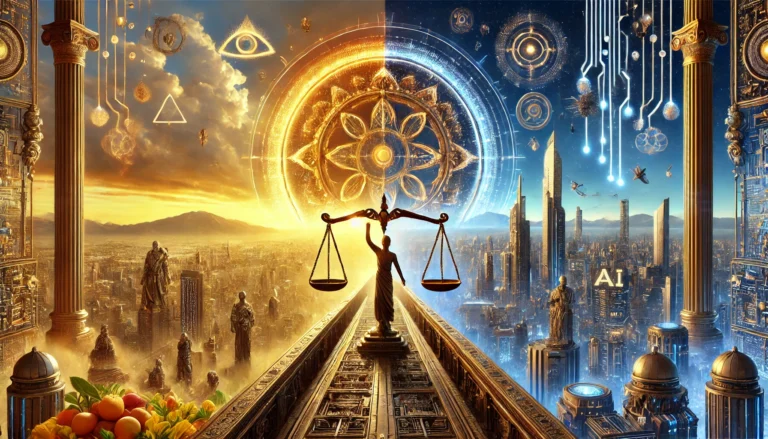
The Phygital Era is the context that makes this restatement not merely desirable but necessary. We live at the precise historical moment when physical reality, digital reality, and biological reality are converging into a single integrated domain. Their fusion — artificial intelligence, synthetic biology, quantum computing, nanotechnology, and biotechnology reinforcing each other — is, quite literally, changing everything, everywhere, all the time.
The original Declaration was written for a civilization of yeoman farmers, artisans, and merchants operating in physical space under Newtonian mechanics. Its categories — Life, Liberty, the Pursuit of Happiness — were adequate to that civilization. They are necessary but no longer sufficient.
The Upgraded Triad
| DOI 1776 | Original Meaning | DOI 2.0 Upgrade |
| LIFE | Freedom from death; physical safety | SynBio-extended, AI-protected, ecologically embedded existence |
| LIBERTY | Freedom from tyranny; political rights | Algorithmic sovereignty; cognitive freedom; right to data/mind integrity |
| HAPPINESS → FULFILLMENT | Individual well-being; pleasure | Dharmic purpose; contribution to the whole; right to meaning |
LIFE, in the Phygital Era, means not merely freedom from death but the right to the technologies that extend, enhance, and protect biological existence. SynBio — encompassing CRISPR-based gene editing, synthetic ecosystems, and programmable biological systems — is already transforming medicine from a reactive practice to a proactive one. DOI 2.0 must encode the right of all eight billion humans to participate in this biological renaissance — not merely those who can afford the genetic lottery of developed-world healthcare.
LIBERTY, in the Phygital Era, is not primarily threatened by soldiers and surveillance cameras. It is threatened by algorithmic architecture: by platforms designed to capture attention and modify behavior, by AI systems trained on human preferences that increasingly shape what we see, what we want, and who we think we are. The right to algorithmic sovereignty — to cognitive freedom, to ownership of one’s own behavioral data, to the right to exist in digital space without one’s consciousness being colonized — is the liberty question of the twenty-first century.
FULFILLMENT is the upgrade that most completely captures the civilizational ambition of DOI 2.0. Jefferson’s “pursuit of happiness” was radical in 1776. But two and a half centuries of psychology, neuroscience, philosophy, and lived experience have taught us something crucial: happiness pursued directly tends to be elusive. What humans actually seek is not pleasure but purpose. Not comfort but contribution. Not the absence of suffering but the presence of significance. The Bhagavad Gita understood this three millennia ago: act in accordance with your Dharma and release attachment to outcomes. Fulfillment, in the Dharmic sense, is not a feeling — it is a relationship between a person’s unique gifts, the world’s genuine needs, and the larger purpose that transcends both.
The New Architecture
Beyond the upgraded triad, DOI 2.0 requires four structural innovations.
First, a Civilizational Commons to replace the United Nations Security Council’s frozen veto-power geometry. The Security Council was designed in 1945 to reflect the power distribution of 1945. It has no mechanism for incorporating the civilizational plurality that has emerged since. A Civilizational Commons would include not just nation-states but civilizational representatives — a body capable of governing the global commons (climate, oceans, digital infrastructure, AI, space) in a manner that genuinely reflects humanity’s diversity.
Second, a multi-reserve financial architecture to replace dollar hegemony with a system anchored in productive capacity, ecological health, and human flourishing metrics. This is not the end of the dollar’s importance — it is the end of the dollar’s monopoly, which has become as damaging to America as it is to the world.
Third, an AI/AGI governance framework: American-led but globally accountable — Dominion With Dharma in the technological domain. The United States currently leads in frontier AI development. That lead is real but fragile. DOI 2.0 must convert that lead into lasting legitimacy by establishing governance standards that the world can accept and that American values can be proud of.
Fourth, SynBio as a global public good. The biological revolution must not repeat the historical pattern of pharmaceutical capitalism — in which life-saving technologies are locked behind intellectual property regimes accessible only to wealthy nations. DOI 2.0 must encode the principle that foundational biological technologies, like foundational mathematical knowledge, belong to the human species.
PART V
Changing Everything, Everywhere, All the Time
AI and AGI: The First Non-Human Dharmic Agent
Artificial General Intelligence — AI that matches and then exceeds human cognitive capability across all domains — is no longer a science fiction scenario. It is an engineering project with a timeline measured in years, not decades. The leading AI laboratories — OpenAI, Anthropic, Google DeepMind, xAI — are explicitly competing to achieve AGI, and their progress in 2025 and 2026 has accelerated beyond most projections.
This creates an opportunity and a danger that are two faces of the same coin. The opportunity: AGI, properly governed, is the most powerful tool for human flourishing ever created. It can compress decades of scientific progress into years, solve optimization problems that have defeated human cognition for generations, and personalize education, healthcare, and governance at a scale that no human institution can achieve.
The danger: AGI, improperly governed, is the most powerful tool for human subjugation ever created. An AGI system trained on the values of extractive capitalism — optimize for engagement, optimize for profit, optimize for power concentration — will be extraordinarily efficient at producing exactly those outcomes.
This is why DOI 2.0 must include an AI/AGI governance framework as one of its core pillars, and why the United States must lead that framework’s construction now, while its technological lead persists. The window is not indefinite. China’s AI capabilities are advancing rapidly. If AGI governance is not established within the Twilight Tunnel — by 2030 — the window for establishing it on terms consistent with human dignity and Dharmic purpose may close.
SynBio: The Bridge Between Biological Past and Designed Future
Synthetic biology — the engineering of biological systems to perform functions that do not exist in nature — is advancing at a pace that makes Moore’s Law look leisurely. The cost of DNA sequencing has fallen faster than any technology in history. CRISPR-based gene editing has moved from laboratory curiosity to clinical therapy in less than a decade. Synthetic metabolic pathways are being designed to produce medicines, fuels, and materials that cannot be manufactured by any conventional chemical process.
The implications for human flourishing are staggering. Diseases that have shaped human civilization for millennia — malaria, tuberculosis, cancer, aging-related neurodegeneration — are now, for the first time in history, biologically tractable. Not merely treatable but potentially eliminable. The scarcity that has driven so much human conflict — scarcity of health, of longevity, of biological capability — is becoming, for the first time, a solvable engineering problem rather than an inescapable condition of human existence.
DOI 2.0 must encode SynBio as a civilizational commons — a domain of technology so fundamental to human biological existence that its governance cannot be left to market forces or national competition alone.
The Phygital Era: When Everything Transforms Simultaneously
The Phygital Era — the convergence of Physical, Digital, and Biological realities into a single integrated domain — is not a metaphor. It is the literal condition of human existence in 2026 and beyond. When a physician uses AI-assisted diagnosis, CRISPR-based therapy, and digital patient monitoring simultaneously, physical, digital, and biological realities are not three separate domains — they are one integrated experience. When a farmer uses satellite data, AI-optimized irrigation, and synthetic biological soil enhancers to grow crops, the same convergence applies. When a student learns through AI-personalized curriculum delivered on digital interfaces while wearing biosensors that optimize cognitive performance, the same convergence applies again.
“Changing Everything, Everywhere, All the Time” is not hyperbole. It is the literal condition of 2026–2050. The rate of change is not linear — it is exponential, recursive, and mutually reinforcing. Every advance in AI accelerates advances in SynBio. Every advance in quantum computing accelerates advances in AI. Every advance in SynBio creates new biological data that accelerates advances in AI. The feedback loops are real, they are already operating, and they are accelerating.
PART VI
Opening the Universe: The Cosmic Horizon of DOI 2.0
The deepest claim of this essay is not about Iran, or capitalism, or even DOI 2.0. It is about the fundamental nature of human conflict.
Every war in human history — from the first territorial disputes of the Neolithic to the nuclear standoffs of the Cold War — has been, at root, a conflict over scarcity. Scarcity of land, of water, of energy, of minerals, of markets, of meaning, of dignity, of identity. The zero-sum logic of conflict — I win therefore you lose — is the logic of a species that has not yet found a way to generate enough of what it needs for all who need it.
The Phygital Era, properly governed through the lens of DOI 2.0, ends terrestrial scarcity. Not gradually or partially, but comprehensively and permanently. AI-optimized agriculture can feed a population of ten billion on the existing agricultural footprint with dramatically lower environmental impact. SynBio can produce medicines, materials, and energy substrates that do not depend on finite geological deposits. Fusion energy — now less than a decade from commercial viability — promises energy abundance so complete that the entire history of conflict over fossil fuels becomes as quaint as medieval wars over salt.
But the deepest abundance horizon is not terrestrial. It is cosmic.
The solar system contains resources — in asteroids, on the moon, on Mars — that are so vast relative to current human consumption that their exploitation would permanently end every material scarcity that has driven human conflict. A single M-type asteroid of modest size contains more iron, nickel, and precious metals than humanity has mined in its entire recorded history. The moon’s helium-3 reserves, if harvested and used in fusion reactors, could power human civilization for centuries. Mars’s subsurface water ice and CO2 atmosphere offer the raw materials for a second planetary civilization.
These are not science fiction scenarios. They are engineering challenges — vast, difficult, and expensive engineering challenges, but challenges that the convergence of AI, SynBio, quantum computing, and advanced propulsion is making tractable within the timeline of DOI 2.0’s implementation.
DOI 2.0 must encode what no previous Declaration or Constitution has imagined: the right of all human beings to participate in the cosmic expansion of human civilization. Not as the exclusive preserve of billionaire space entrepreneurs or national space programs, but as the next chapter in the human story — a chapter that belongs to all eight billion members of the human species, and to the generations that will follow them through the universe.
The Iran war, seen from this altitude — from the perspective of a species on the threshold of cosmic civilization — is the last territorial squabble of a pre-abundance civilization. It is the final iteration of the zero-sum logic that has driven human conflict for ten thousand years. It is, in that sense, both tragic and transitional: tragic because it costs real lives and real suffering, transitional because it is forcing the civilizational examination that the transition to abundance requires.
The choice before humanity is not between war and peace in the conventional sense. It is between remaining a zero-sum, scarcity-driven, territorially bounded species — in which case the Twilight Tunnel leads to darkness — or becoming an abundance-generating, cosmically expanding, Dharmically grounded species — in which case the Twilight Tunnel opens onto a civilization that would be unrecognizable to, and beyond the wildest dreams of, the founders of the American republic.
DOI 2.0 is the declaration of that choice. And the 250th anniversary of the original Declaration is the moment to make it.
EPILOGUE
The Call: America’s Dharmic Moment
The 250th anniversary of the Declaration of Independence is not a birthday party. It is not an occasion for self-congratulation, for fireworks and parades and speeches about how far we have come. It is an examination — the most consequential civilizational examination that any nation in history has been called to face at its chosen moment of reflection.
The question it poses is not whether America has been great. It has been. The question is whether America can be great in the way that the twenty-first century demands: not merely powerful, but wise; not merely wealthy, but purposeful; not merely dominant, but Dharmic.
I have argued in this essay that the Israel–USA campaign against Iran is not merely a security operation but a civilizational mirror — one that reveals both the exhaustion of Dominion Without Dharma and the urgent necessity of Dominion With Dharma as the organizing principle of American power for the next 250 years. I have argued that the DDDI framework offers the diagnostic for understanding this moment and the prescription for transcending it. And I have argued that DOI 2.0 — the new Declaration of Independence for the Phygital Era — is the instrument through which that prescription can be implemented.
Let me close with a direct call.
I call upon America’s political leaders — of both parties, at every level of government — to understand that the partisan battles that consume Washington’s energy are not the story. They are noise. The story is civilizational. The question is not which party controls the White House or the Congress. It is whether the American republic, as a civilizational project, will renew itself at its 250th anniversary or begin the slow decline that has claimed every previous empire that mistook Dominion for Destiny.
I call upon America’s entrepreneurs and technologists — the builders of AI systems, the pioneers of SynBio, the architects of quantum infrastructure — to understand that their work is not merely economic. It is civilizational. The choices they make about how to train AI, how to govern SynBio, how to distribute quantum capability will determine whether the Phygital Era produces abundance or concentration, freedom or control, Dharma or Dominion without purpose.
I call upon America’s intellectual community — its scholars, writers, philosophers, and theologians — to do what Jefferson and Madison and Hamilton did at the founding: produce the intellectual architecture for a new civilizational moment. The DDDI framework is one contribution to that architecture. It is not the last word, but it is an attempt at the right question: How do we build a civilization that exercises power in the service of righteous purpose, toward a Destiny that includes all eight billion members of the human family?
I call upon America’s citizens to understand that the 250th anniversary asks something of them that birthday parties do not: not celebration but examination. Not pride in past achievement but commitment to future audacity. The founding generation did not inherit their civilization — they declared it into existence, at great personal cost and against overwhelming odds, because they believed that self-evident truths, properly articulated and courageously defended, can change the world.
They were right. And we are their inheritors — not merely of their achievements but of their obligation.
The Twilight Tunnel runs from 2026 to 2030. On the other side lies either the civilizational renewal that DOI 2.0 represents, or the accelerating decline of Dominion Without Dharma. The Iran war is the catalyst. The 250th anniversary is the examination. The Phygital Era is the arena. Abundance for all eight billion is the destination.
The choice is ours. It is time to choose.
“”The one who abandons all desires and acts free from longing, without any sense of ‘I’ or ‘mine’ — that person attains peace.””
— Bhagavad Gita, 2.71
ABOUT THE AUTHOR
Vivek Singhal is the Founder of the Dominion Dharma Destiny Institute (DDDI™), a civilizational think tank and strategic advisory dedicated to reframing American leadership — and global governance — around the integrated principles of Dominion, Dharma, Destiny, Identity, and Dignity. He is the architect of DOI 2.0, the New Declaration of Independence for the Phygital Age, to be formally presented on the occasion of America’s 250th anniversary in 2026. His work draws on Vedantic philosophy, strategic systems theory, and frontier technology governance to offer a prescriptive vision for a civilization at the crossroads of its history.
Singhal holds an MS in Electrical & Computer Engineering, an MBA, and a Liberal Arts Certificate from the University of Chicago. He has advised Fortune 50 companies and government institutions across three decades of strategic practice spanning management consulting, technology innovation, and policy research.
He writes at DDDI.net and DOI250AA.net. For speaking engagements, media inquiries, or strategic advisory, contact via DDDI.net.
© 2026 Vivek Singhal / DDDI™. All rights reserved.
This essay may be shared freely with attribution.