
By Vivek Singhal
Founder, Dominion & Dharma Destiny Institute (DDDI™)
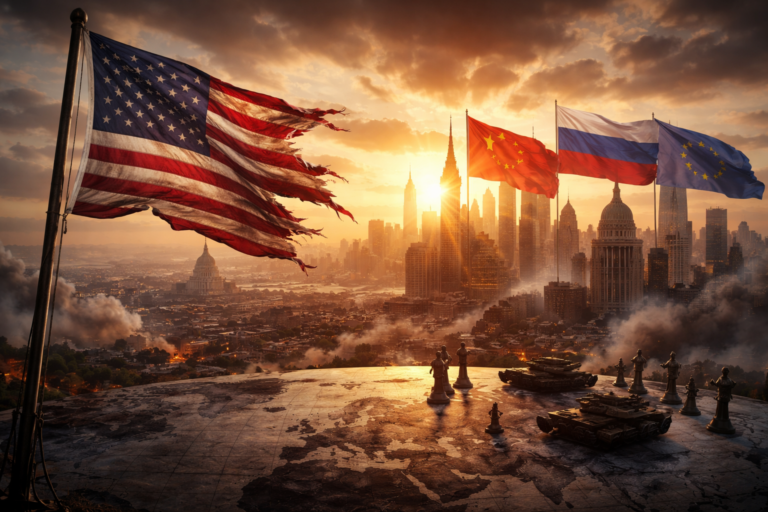
In the high-stakes arena of global power, ceasefires are rarely acts of wisdom—they are pauses in the game. Yesterday’s NDTV interview with Ian Bremmer laid bare the fragile truce that now holds between the United States, Israel, and Iran after a 40-day war that killed Supreme Leader Ayatollah Ali Khamenei and reshaped the region. His son Mojtaba Khamenei has assumed power, driven, as Bremmer starkly noted, by a personal thirst for revenge. The Strait of Hormuz remains a chokepoint of tension, senior officials are heading to Islamabad for talks, and the first 24-hour lull in strikes feels more like a breath held than a foundation laid.
This is the Game of Truce: a temporary suspension of Dominion logic, not its transcendence.
Dominion at Play
For centuries, Dominion has operated as humanity’s default operating system—conquest, control, extraction, and the perpetual cycle of dominance and retaliation. The recent war and its uneasy aftermath fit this pattern with almost mechanical precision.
The United States demanded the removal of highly enriched uranium, the complete end of uranium enrichment, severe limits on ballistic missiles, and the severance of Iran’s support for regional proxies. Iran, now led by a figure “incensed” by the killing of his father and family, sees every concession through the lens of humiliation and vengeance. Decentralized military commands, hardened IRGC factions, and a closed strait where only seven vessels passed in a day—all signal a system wired for survival through strength, not harmony.
Even President Trump’s decision to de-escalate and declare victory, while tactically shrewd, remains framed within the old paradigm. It reframes American dominion as a win rather than inviting a deeper civilizational reckoning. As Bremmer observed, the truce hangs by a thread because both sides are still playing the same game: one seeking total strategic disarmament, the other nursing wounds that demand retribution.
This is not new. It is the predictable outcome of a dominion-based world order—where power is zero-sum, resources are to be locked down, and leadership is measured by the ability to inflict or withstand pain. The result is what DDDI has long described as “the empire that forgot how to learn.” Wars end not because wisdom prevails, but because exhaustion or tactical advantage forces a temporary reset.
The Dharma Alternative
At the Dominion & Dharma Destiny Institute, we propose a different operating system for humanity: one rooted in Dharma—conscious action, ethical responsibility, sacred abundance, and the recognition that true power flows from harmony, not control.
What would a Dharma-guided truce look like? It would begin by refusing the revenge imperative. Mojtaba Khamenei’s personal drive, while human and understandable under dominion logic, becomes a civilizational trap if left unexamined. Dharma teaches that duty without attachment to outcome—nishkama karma, as the Bhagavad Gita reminds us—breaks the cycle. A leader operating from consciousness would see the killing of his father not merely as a wound to avenge, but as a moment to choose a higher destiny for his people and the region.
Similarly, American demands, while framed as security necessities, could be reframed through abundance rather than scarcity. The Strait of Hormuz does not need to be a theater of domination; it could become a shared artery of prosperity in a phygital age where energy transitions and conscious technology render old choke points obsolete. Ballistic missiles and proxies are symptoms of a world built on fear. Dharma asks: what structures of mutual respect and collective responsibility could replace them?
The upcoming talks in Islamabad offer more than diplomatic theater. They are a civilizational inflection point. Will the participants arrive as players in the Game of Truce—calculating leverage, preparing fallback strikes, guarding enrichment sites—or as architects of a new operating system?
A Destiny Beyond the Game
The world is not broken; it is built this way—by centuries of dominion thinking that taught us control equals safety and victory equals peace. Yet every major conflict now carries the same lesson: the old system is exhausting itself. Younger generations, even within traditional power centers, are beginning to question “Israel-first” or “America-first” framing when it collides with a deeper “humanity-first” consciousness.
This is the invitation of the current moment. The fragile truce is not the end of the story but the opening chapter of a possible shift—from Dominion to Dominion & Dharma.
Let the talks in Islamabad be more than bargaining over uranium and missiles. Let them be the first conscious negotiation in which leaders ask not only “What can we extract?” but “What can we build together that preserves life?”
The Game of Truce will end, as all such games do. The real question DDDI poses to policymakers, citizens, and civilizations alike is this: When the next round begins, will we still be playing by the old rules—or will we finally choose the operating system our collective future demands?
The destiny of the 21st century will not be written by whoever controls the strait or the centrifuge. It will be written by whoever dares to lead from consciousness.
Vivek Singhal is the founder of the Dominion & Dharma Destiny Institute (DDDI™) and author of Dominion and Dharma: Reframing Capitalism through Conquest, Consciousness, and Civilizational Memory. He writes on reframing global challenges through the lens of harmony, ethical abundance, and conscious leadership.
For more on the DDDI framework and upcoming workshops, visit dddi.net.